Complete Beginner’s Guide for Traders To Start Forex Trading

Currency exchange can seem complex at first, but the core idea is straightforward: the foreign exchange market is where participants buy one currency and simultaneously sell another, with the goal of profiting from changes in exchange rates. The forex market is the largest and most liquid financial market in the world, with a daily volume exceeding $7.5 trillion (Bank for International Settlements, 2022). For anyone new to currency markets, understanding how this market works is the essential first step.
Key Takeaways
- The forex market is the largest financial market in the world, with a daily volume exceeding $7.5 trillion, and operates 24 hours a day, five days a week across major global financial centres.
- FX trading involves buying one currency and simultaneously selling another, with all transactions expressed through currency pairs such as EUR/USD or GBP/USD.
- The foreign exchange market operates entirely over-the-counter (OTC) — retail participants access the market through a regulated forex broker rather than a centralised exchange.
- Core terminology every beginner must understand includes: pip, spread, leverage, margin, lot size, stop-loss, and take-profit.
- Leverage allows traders to control positions larger than their deposited capital, amplifying both potential gains and potential losses equally.
- According to the European Securities and Markets Authority (ESMA), a significant proportion of retail investor accounts lose money when dealing in CFDs and leveraged products — past performance does not guarantee future results.
- The four main styles in currency markets are day trading, swing trading, position trading, and scalping — each differs in holding period, time commitment, and risk profile.
- The three primary analytical approaches used by currency traders are fundamental analysis, technical analysis, and sentiment analysis.
- A structured plan defining goals, risk parameters, market selection, and entry/exit criteria is widely regarded as essential for long-term consistency.
- Risk management practices — including position sizing, stop-loss orders, and a positive risk-reward ratio — are central to protecting account equity from disproportionate losses.
- A demo account allows beginners to practise in live market conditions without financial risk, and is widely considered the most practical starting point before committing real capital.
- Choosing a regulated broker — one overseen by authorities such as the FCA, ASIC, or FSCA — provides an important layer of client protection for retail participants.
What Is Forex Trading?
What is forex trading is one of the first questions beginners encounter. FX trading, also known as foreign exchange trading or currency trading, is the process of exchanging one national currency for another at an agreed price. The foreign exchange market runs continuously — 24 hours a day, five days a week — across major global financial centres including Sydney, Tokyo, London, and New York.
Unlike stock markets, the currency market has no centralised exchange. Transactions occur directly between participants via electronic networks, making it an over-the-counter (OTC) market. Retail participants access this environment through a regulated forex broker, who connects client orders with the broader liquidity pool.
A simple real-world example: a traveller converting US dollars into euros at an airport is participating in foreign exchange, though the purpose is travel rather than speculation. When retail currency traders operate in this market, the objective is to anticipate which currency in a pair will strengthen or weaken relative to the other.
How the Foreign Exchange Market Operates
The foreign exchange market runs across four major sessions: Sydney, Tokyo, London, and New York. Each session reflects the business hours of the corresponding financial region. Volume and price activity tend to increase during session overlaps — particularly the London–New York overlap — when the majority of daily volume in major pairs is generated (Bank for International Settlements, 2022).
Currency prices can become extremely volatile around major economic announcements, such as central bank interest rate decisions, employment data releases, and inflation figures. Volatility creates both opportunities and significant risk, and beginners should understand that rapid price movements can result in losses exceeding initial expectations.
FX activity takes place across all forex market hours in India and globally. Because the market runs around the clock, retail participants in different time zones can access the instruments they want to engage with at times that suit their schedules.
Understanding Currency Pairs
What are currency pairs?
Currency pairs are the foundational instruments in the foreign exchange market. Every position involves buying one currency and selling another simultaneously.
A pair is quoted as two currencies separated by a slash — for example, EUR/USD. The first currency listed is called the base currency; the second is the quote currency.
How a currency pair quote works
If EUR/USD is quoted at 1.1200, this means one euro is worth 1.1200 US dollars. A trader who expects the euro to strengthen against the dollar may consider a long position; a trader who expects the euro to weaken may consider a short position.
Types of currency pairs
| Category | Description | Examples |
| Major pairs | Pairs involving the US dollar and a major currency | EUR/USD, GBP/USD, USD/JPY |
| Minor pairs | Pairs between major currencies, without USD | EUR/GBP, GBP/JPY |
| Exotic pairs | A major currency paired with an emerging market currency | USD/INR, EUR/TRY |
The majority of daily volume is concentrated in a handful of pairs — primarily the majors — which typically offer tighter spreads and greater liquidity. Beginners may find it useful to explore major currency pairs and the best currency pairs to trade for beginners before expanding to less liquid instruments. Those interested in the Indian market may also explore forex trading USD/INR.
Core Forex Terminology Every Beginner Should Know
Learning to operate in currency markets requires familiarity with specific terminology.
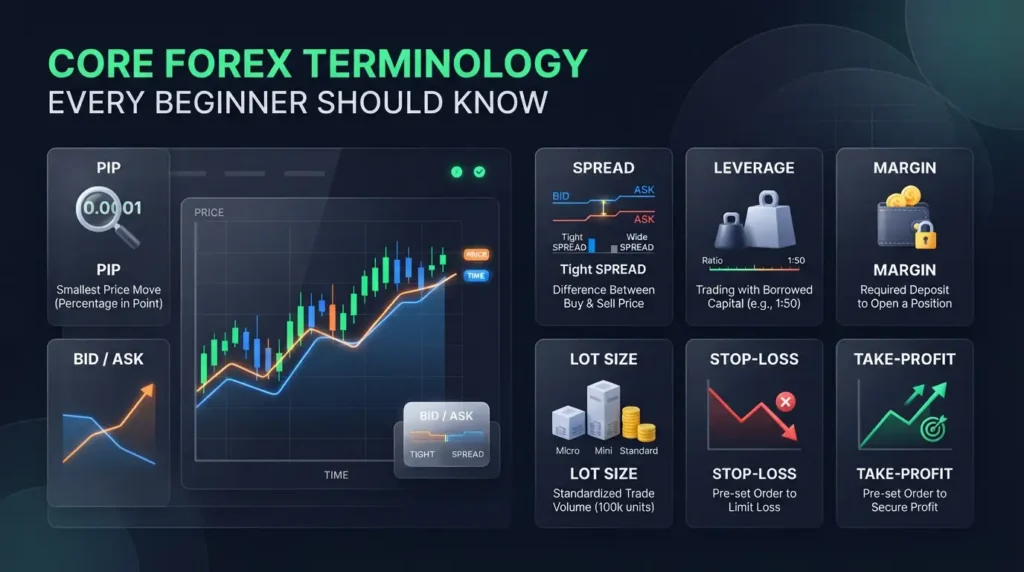
The table below defines the essential terms that appear throughout any FX education resource.
| Term | Definition |
| Pip | The smallest standard price movement in a currency pair, typically 0.0001 for four-decimal pairs |
| Spread | The difference between the bid (sell) price and the ask (buy) price |
| Leverage | A mechanism that allows participants to control a larger position with a smaller deposit |
| Margin | The deposit required to open and maintain a leveraged position |
| Lot size | A standardised unit measuring the volume of a single position |
| Stop-loss | An order that closes a position at a predefined adverse price level |
| Take-profit | An order that closes a position at a predefined favourable price level |
Pips explained with an example:
If EUR/USD moves from 1.1200 to 1.1215, the price has moved 15 pips in forex. Each pip carries a monetary value that depends on the lot size and the currency pair in question.
Lot sizes explained:
A forex trading lot size determines the volume of a single position. A standard lot equals 100,000 units of the base currency. A mini lot equals 10,000 units, and a micro lot equals 1,000 units. Beginners often start with micro lots to limit exposure while developing their knowledge.
Spread explained with an example:
If GBP/AUD has an ask price of 1.8873 and a bid price of 1.8866, the spread in forex trading is 0.0007 — or seven pips. The spread represents an immediate cost paid upon entering a position.
Leverage and Margin in Forex Trading
Leverage in forex trading allows participants to control a position whose notional value is larger than the capital deposited. For example, with 1:100 leverage, a 0.1 lot EUR/USD position with a notional value of approximately $12,322 may require only around $123 as margin (Bank for International Settlements, 2022).
The margin formula is: Margin = Position Size / Leverage
Leverage does not reduce the economic size of a position. A 1% adverse move on a $12,322 position represents a $123.22 loss — approximately equal to the entire margin committed. This is why leverage amplifies both potential gains and potential losses, making risk controls a central part of any structured plan.
ESMA notes that a significant proportion of retail investor accounts lose money when dealing in CFDs and leveraged products (European Securities and Markets Authority, 2023). Past performance does not guarantee future results, and losses may exceed initial expectations when leverage is applied without adequate safeguards.
Types of Trading Styles in the Forex Market
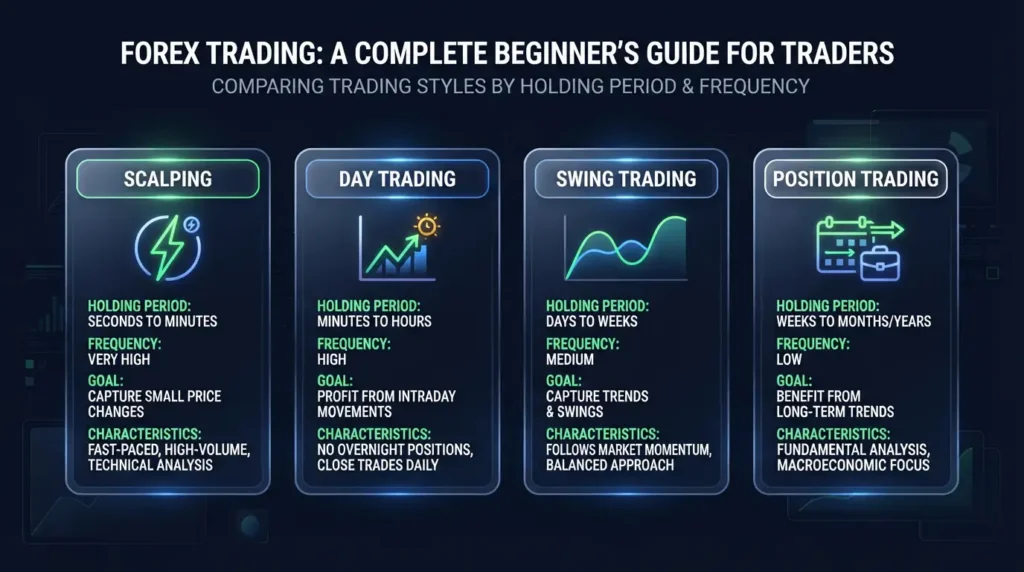
Different styles suit different schedules, personalities, and risk tolerances.
The four most widely recognised approaches in the foreign exchange market are outlined below.
| Style | Holding Period | Key Characteristic |
| Day trading | Positions closed within a single session | Multiple entries per session; no overnight exposure |
| Swing trading | Days to weeks | Captures medium-term price movements |
| Position trading | Weeks to months | Longer-term view based on fundamental analysis |
| Scalping | Seconds to minutes | Very short-term; high frequency of entries |
Day trading involves opening and closing positions within a single session. Participants who follow this approach avoid overnight exposure but require consistent attention during active market hours.
Swing trading involves holding a position for several days or weeks, aiming to benefit from price swings between support and resistance levels. This style aligns with goals suited to those who cannot monitor charts continuously.
Position trading is a longer-term approach where participants hold a position for weeks or months, basing decisions primarily on fundamental economic analysis. This style suits a plan focused on macroeconomic trends rather than short-term fluctuations.
The approach that aligns with your schedule, risk tolerance, and overall goals will vary between individuals. There is no universally superior method, and each carries distinct costs and risk exposure.
How to Analyse the Currency Market
Participants in the foreign exchange market commonly use three types of analysis to form decisions. Each approach examines price and value from a different angle.
Fundamental analysis evaluates economic data, central bank policy, geopolitical events, and macroeconomic conditions that may influence currency valuations. An interest rate increase by a central bank, for example, may attract foreign capital and potentially strengthen the associated currency. Beginners can explore forex fundamental analysis to build this knowledge base.
Technical analysis studies historical price data and chart patterns to identify potential opportunities. The approach assumes that all available market information is reflected in the price. Participants using forex technical analysis may identify trends, support and resistance levels, and forex trading chart patterns as inputs for their decisions.
Sentiment analysis attempts to gauge the overall mood of market participants — whether the majority are bullish or bearish on a given pair. Sentiment analysis is generally used as a supplementary tool alongside technical or fundamental methods, rather than as a standalone approach.
Basic Forex Trading Strategies
Forex trading strategies provide a structured framework for making decisions in currency markets. A defined method helps beginners approach the market with consistency rather than relying on guesswork or emotion.
Trend-following: Some participants may use trend-following as a basic strategy, identifying the direction of a prevailing price movement and seeking entries that align with it. A pair consistently making higher highs and higher lows may be considered to be in an uptrend.
Range trading: In certain conditions, pairs may move sideways between defined support and resistance levels. Some participants may evaluate these boundaries and consider entries near support or resistance, with predefined exit levels at the opposing boundary.
Breakout approach: A breakout occurs when price moves beyond a defined level with increased momentum. Some currency market participants evaluate breakouts as potential entry opportunities, though false breakouts remain a recognised and common risk.
Stop-Loss and Take-Profit Orders
Stop-loss in forex trading is an order type that automatically closes a position when price reaches a predefined adverse level. The stop-loss order is designed to limit the maximum loss on a single position without requiring manual intervention.
Example: A participant opens a long EUR/USD position at 1.1000. A stop-loss placed at 1.0975 defines a maximum planned loss of 25 pips. If the price falls to 1.0975, the position closes automatically, subject to execution conditions.
Take-profit in forex trading is an order that closes a position when price reaches a predefined favourable level, locking in a planned gain. Using both order types as part of a structured plan is widely considered a foundational element of responsible risk management.
Stop-loss execution may not be guaranteed during periods of extreme volatility or market gaps. Participants should factor this possibility into their overall approach.
Understanding Forex Order Types
Forex order types define how and when a position is executed. The most common types in the foreign exchange market are:
- Market order: Executes immediately at the current available price.
- Limit order: Executes only at a specified price or better.
- Stop order: Triggers when price reaches a specified level — commonly used to enter on a breakout or to exit via a stop-loss.
- Stop-limit order: Combines features of stop and limit orders, triggering at a stop price but executing only at the limit price or better.
Understanding order types is part of the mechanics of execution and affects how decisions are implemented on a forex trading platform.
Creating a Forex Trading Plan
A forex trading plan is a written framework that defines how a participant will approach the currency market. The plan covers goals, risk tolerance, preferred style, instrument selection, position sizing rules, and criteria for entering and exiting each position.
The key components of a well-structured plan include:
- Goals: Define realistic, measurable objectives for overall performance.
- Style: Specify whether the approach is day trading, swing trading, or position trading.
- Instrument selection: Identify which currency pairs to focus on.
- Risk parameters: Define the maximum acceptable loss on a single position and across a session.
- Entry and exit criteria: Establish clear conditions based on analysis before entering any position.
- Review process: Plan regular evaluation of past decisions to develop knowledge over time.
The ability to stick to a structured plan — particularly during periods of market stress — is widely regarded as one of the most important disciplines for long-term consistency. Emotional decisions that deviate from the plan are among the most common errors beginners make. A full breakdown of avoidable errors is available in the guide on common forex trading mistakes.
Risk Management in Forex Trading
Risk management in forex trading is the set of practices used to protect account equity from disproportionate losses. Effective risk management does not eliminate losses but aims to ensure that no single position or sequence of positions causes unrecoverable damage to the account.
Position sizing determines how much capital is allocated to each entry. A common approach is to risk only a small, fixed percentage of total account capital per position — for example, 1% to 2%. This means that even a sequence of losing positions does not immediately deplete the account.
The risk-reward ratio describes the relationship between the potential loss and the potential gain on a position. A ratio of 1:2 means the participant risks one unit to potentially gain two units. Maintaining a positive average ratio across multiple positions is a core principle of sustainable participation.
According to ESMA data, a large proportion of retail investor accounts lose money when dealing in CFDs (European Securities and Markets Authority, 2023). This underlines the importance of understanding and applying risk controls before committing capital. Losses may exceed initial expectations, particularly when leverage is applied without adequate safeguards.
Choosing a FX Platform and Regulated Broker
A forex trading platform is the software through which participants access the currency market, execute orders, analyse charts, and manage their account. Platforms such as MetaTrader 4 and MetaTrader 5 provide charting tools, technical indicators, automated execution capabilities, and order management features used widely by retail participants globally.
When selecting a forex broker, key considerations include regulatory status, the range of forex trading platforms offered, available instruments, spreads and commissions, and the quality of educational resources. A regulated broker operates under oversight from authorities such as the Financial Conduct Authority (FCA) in the UK, ASIC in Australia, or the FSCA in South Africa, providing a defined level of client protection.
Before committing real capital, many beginners open a forex trading demo account, which allows practice in live market conditions without financial risk. A demo account is one of the most practical tools for learning and testing a structured plan before going live.
Participants based in India can explore guidance on how to open a forex trading account in India, review the top forex brokers in India, and find the best forex trading app in India for mobile access.
Understanding the Risks of Forex Trading
The risks of participating in currency markets are real and should be understood clearly before any capital is committed. Exchange rates can move sharply in response to economic data, geopolitical events, or sudden shifts in sentiment.
Key risks to understand include:
- Leverage risk: Leverage amplifies both gains and losses. A small adverse price movement can result in a loss that exceeds the initial margin deposit.
- Market risk: Currency prices fluctuate continuously, and no analytical method can predict movements with certainty.
- Liquidity risk: In certain conditions — particularly around major news events — spreads may widen significantly and order execution may be delayed.
- Counterparty risk: Participating through an unregulated or poorly regulated broker increases the risk of fraud or fund mismanagement.
Past performance does not guarantee future results. The information in this guide is educational in nature and does not constitute financial advice or a recommendation to engage with any specific instrument.
About Forex Trading Signals
Forex trading signals are trade ideas or alerts generated by analytical tools or experienced market participants, indicating a potential entry or exit point for a specific currency pair. Signals may be based on technical analysis, fundamental analysis, or a combination of both. Beginners should understand that signals do not guarantee profitable outcomes and should be evaluated critically within the context of a broader structured plan.
Getting Started: A Summary of Key Steps
For anyone looking to start participating in currency markets, the following framework is often understood as a logical progression:
- Study the basics through structured educational resources.
- Understand core terminology, execution mechanics, and risk principles.
- Select a regulated broker and explore available platforms.
- Open a demo account and practise in real market conditions without risk.
- Develop a structured plan reflecting personal goals and risk tolerance.
- Begin with small position sizes and focus on applying risk controls consistently.
- Review past decisions regularly and continue developing knowledge over time.
Participants interested in the Indian market can explore how to start forex trading in India, review the regulatory framework through the guide on is forex trading legal in India, and find further context under forex trading in India.
Frequently Asked Questions
What is forex trading in simple terms?
FX trading, in simple terms, is the buying of one currency and the selling of another at the same time, with the aim of profiting from changes in the exchange rate between the two. The foreign exchange market is the global venue where this activity takes place, operating 24 hours a day across major financial centres worldwide.
Can anyone trade forex?
Anyone can participate in the foreign exchange market provided they meet the eligibility requirements of a regulated broker and have access to a funded account. The market is accessible to retail participants globally, though the specific regulations vary by country. Participants in India should review the local regulatory framework before starting, as certain restrictions may apply.
How much money do I need to start trading forex?
The amount required varies by broker and account type. Some regulated brokers allow participants to open an account with a relatively small initial deposit, particularly for micro lot activity. However, the capital available directly affects position sizing and overall risk capacity. Starting with a demo account before committing real funds is widely considered sound practice for beginners.
What is the difference between day trading and swing trading?
Day trading involves opening and closing all positions within a single session, avoiding overnight exposure. Swing trading involves holding a position for several days or weeks, aiming to capture larger price movements. The main differences are the time commitment required, the number of entries placed, and the nature of the opportunities each approach targets.
What are the risks of forex trading?
The risks include leverage risk, market volatility risk, liquidity risk, and counterparty risk. Leverage amplifies both gains and losses, and accounts may lose money when conditions move adversely. Prices can be extremely volatile at times, and losses may exceed initial expectations. Effective risk management — including stop-loss orders and appropriate position sizing — is a central part of any responsible structured plan.
How do I learn how to trade forex?
Learning to operate in currency markets typically involves studying core concepts: how the foreign exchange market operates, how pairs are quoted, and how leverage and margin function. Practical experience through a demo account is widely recognised as one of the most effective ways to develop knowledge without financial risk. Reviewing past decisions regularly and studying the linked guides throughout this article will help beginners build their understanding progressively.