What Is Forex Trading – Complete Beginner’s Guide to the Foreign Exchange Market

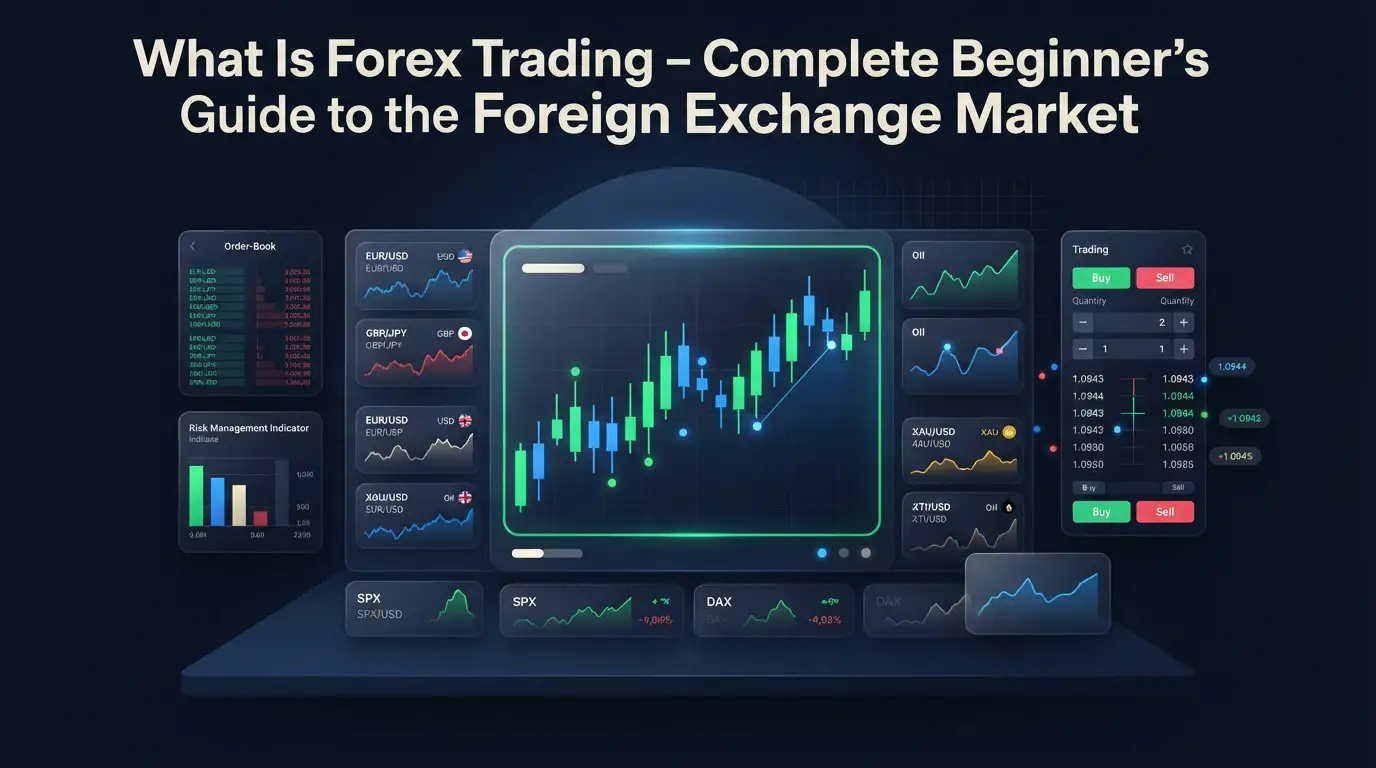
Foreign exchange trading — commonly abbreviated to forex — is the process of buying and selling currencies on a global, decentralised market where exchange rates are determined by supply and demand. The FX market is where individuals, commercial banks, central banks, corporations, and institutional investors exchange one currency for another. For beginner traders, understanding what a currency trade involves, how the foreign exchange market operates, and what risks are present is the essential first step before committing any capital.
Key Takeaways
- The FX market is the largest financial market in the world, with an estimated $6–7.5 trillion in daily trading volume
- Currency trading always takes place in pairs — for example, EUR/USD or USD/JPY — where one currency is bought and another is simultaneously sold.
- The foreign exchange market operates 24 hours a day, five days a week, across four major sessions: Sydney, Tokyo, London, and New York.
- There are three types of forex markets: the spot market, the forward market, and the futures contract market.
- Key concepts every beginner must understand include pip, spread, leverage, margin, and lot size.
- Leverage magnifies both potential profits and potential losses — making risk management a critical skill.
- According to the European Securities and Markets Authority (ESMA), approximately 70–89% of retail investor accounts lose money when trading CFDs with leverage (ESMA, 2023).
- Past performance does not guarantee future results. Losses may exceed initial expectations.
What Is a Forex Trade?
A currency trade in the foreign exchange market is the simultaneous purchase of one currency and the sale of another, executed through a regulated broker or electronic platform. The goal for most retail participants is to profit from shifts in the exchange rate between two currencies over time.
Currency speculation differs from stock ownership in one fundamental way: rather than buying a share in a company, FX trading involves speculating on the relative value of one currency against another. A trader who believes the euro will strengthen against the United States dollar might buy the EUR/USD pair, profiting if the exchange rate moves in the expected direction.
The foreign exchange market does not operate through a single central exchange. Instead, transactions take place directly between participants in an over-the-counter (OTC) network — meaning currency deals are conducted daily across a global system of banks, brokers, and electronic platforms.
How Does the Foreign Exchange Market Work?
The FX market runs 24 hours a day, five days a week, because currency transactions occur across financial centres in different time zones. When the New York session closes, the Sydney session opens, ensuring continuous price activity from Monday morning to Friday evening. This uninterrupted schedule is one reason why so many participants prefer currency trading over instruments tied to exchange-specific hours.
Understanding how FX markets work begins with recognising that the foreign exchange market is decentralised. There is no single location or governing exchange where all orders are processed. Instead, transactions flow directly between counterparties — banks, brokers, and individual traders — connected electronically. This structure affects how prices are quoted, how spreads are set, and how liquidity varies throughout the day.
Exchange rates are influenced by macroeconomic variables. Interest rate decisions by central banks such as the US Federal Reserve or the Bank of England, economic data releases, inflation figures, geopolitical events, and policy changes — including measures like quantitative easing — all affect supply and demand for currencies, which in turn drives price movement (Study.com, What Is Forex Trading).
What Is Being Traded?
In the foreign exchange market, currencies are always exchanged in pairs. A currency pair consists of a base currency and a quote currency. The base currency is listed first; the quote currency is listed second. The exchange rate tells a participant how much of the quote currency is needed to purchase one unit of the base currency.
Example: If EUR/USD = 1.10, then one euro costs 1.10 United States dollars. Buying this pair means purchasing euros while selling dollars simultaneously. Selling the pair means the opposite (IG, What Is Forex and How Does It Work).
For a deeper understanding of how pairs are structured and priced, the currency pairs guide provides a detailed explanation of base currency, quote currency, and pricing mechanics.
Types of Forex Markets
The foreign exchange market is not a single unified venue. There are three distinct types of FX markets, each serving different participants and purposes.
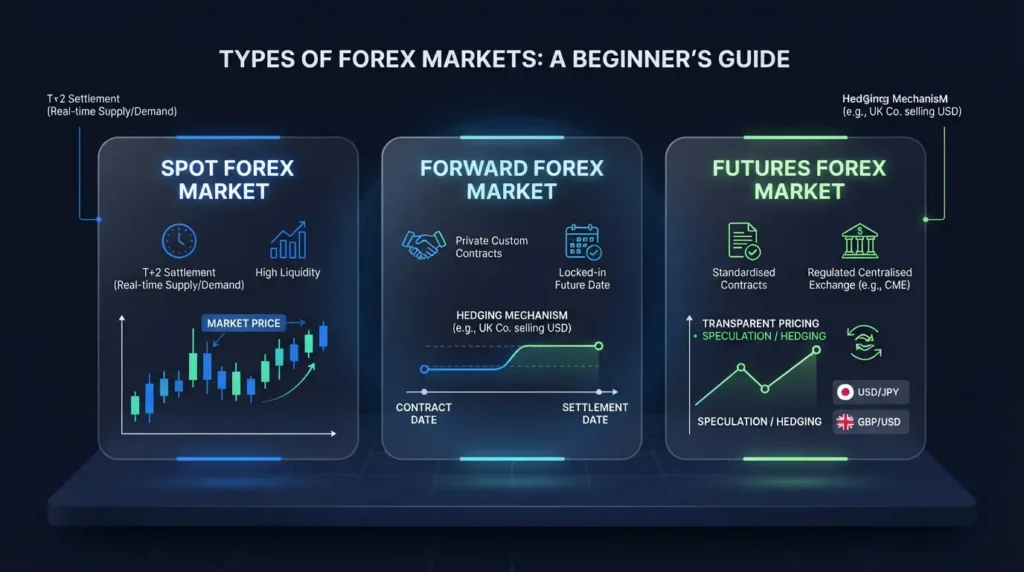
Understanding the differences between them helps beginners recognise where and how currency transactions occur in practice.
Spot Forex Market
The spot market is where currencies are bought and sold at the current exchange rate, with settlement typically occurring within two business days. The spot market is where the vast majority of retail currency activity takes place, and it is what most people are referring to when they discuss opening a position through a broker or platform.
Prices in the spot market reflect real-time supply and demand, making it highly sensitive to economic data releases, central bank announcements, and geopolitical developments. Market liquidity in the spot segment is among the highest of any financial market globally, which means large orders can generally be filled quickly and at competitive prices.
Forward Forex Market
The forward market involves private contracts that lock in an exchange rate for a currency transaction at a specified future date. A forward contract is a customisable agreement between two parties — typically a corporation and a commercial bank — and is not traded on a centralised exchange. Forward contracts are used primarily by businesses engaged in international trade to hedge against unfavourable currency movements.
For example, a United Kingdom company expecting to receive payment in United States dollars in three months may enter a forward contract to sell USD at a fixed rate, protecting the value of that future income regardless of how the exchange rate moves between now and settlement. The forward segment does not carry the same degree of market liquidity as the spot market, and these contracts are generally not accessible to retail participants in the same way.
Futures Forex Market
The futures market involves standardised contracts that obligate the buyer and seller to exchange a specific amount of currency at a set price on a predetermined future date. Unlike forward contracts, currency futures are traded on regulated, centralised exchanges — such as the Chicago Mercantile Exchange (CME) — which provides greater transparency and reduced counterparty risk.
Currency futures are used by both institutional investors seeking to hedge currency exposure and by speculative participants aiming to profit from anticipated exchange rate movements. Because futures contracts are standardised in terms of size, expiry date, and settlement terms, the futures segment is more structured than either the spot or forward markets. Contracts on pairs such as USD/JPY and GBP/USD are among the most actively traded derivative instruments in global financial markets.
Key FX Concepts Explained
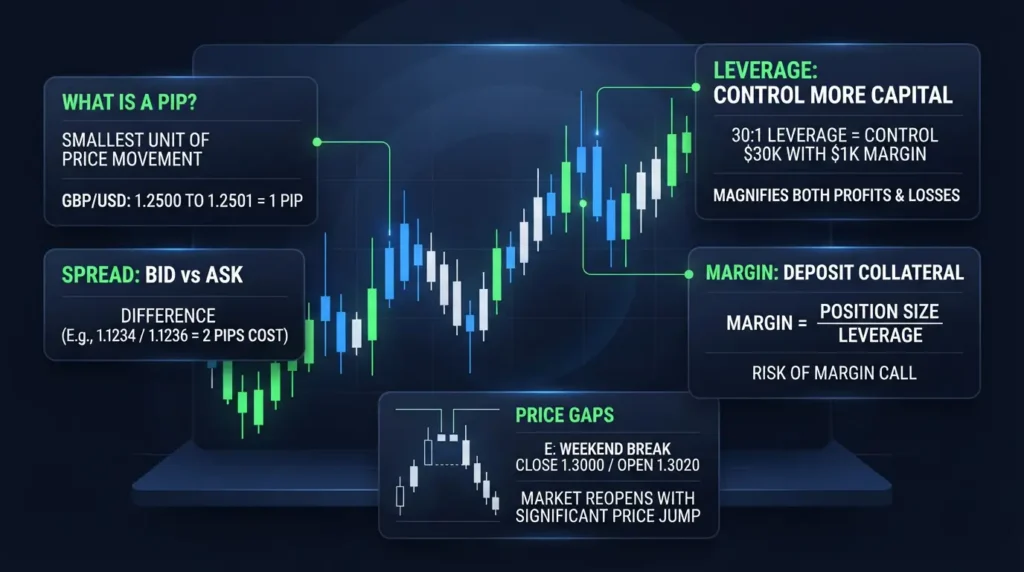
If you are new to currency trading, the following terms appear in almost every aspect of the market. Understanding each one individually is essential before entering any position.
What Is a Pip in Forex?
A pip is the smallest standard unit of price movement for a currency pair. For most major pairs, one pip equals 0.0001 — or one ten-thousandth of the quote currency. For example, if GBP/USD moves from 1.2500 to 1.2501, the pair has moved one pip (Charles Schwab, What Is Forex Trading). Pips are used to measure profit and loss on an open position.
What Is the Spread in Forex Trading?
The spread is the difference between the bid price (the price at which a participant can sell) and the ask price (the price at which a participant can buy). The spread represents a primary transaction cost for retail participants when they enter a position. A tighter spread generally means lower costs per trade, while a wider spread increases the expense of each transaction
What Is Leverage in Forex?
Leverage allows a trader to control a larger position using a smaller amount of capital. A regulated broker may offer leverage of 30:1 for retail clients, meaning a participant can control a position worth 30 times the required margin deposit. Leverage magnifies both potential profits and potential losses in equal measure. A small adverse price movement on a leveraged position can result in losses that exceed the initial deposit — which is why leverage is considered the primary risk factor in retail currency trading
What Is Margin in Forex?
Margin is the deposit required to open and maintain a leveraged position. Margin is not a fee — it is a portion of the trader’s funds set aside as collateral by the broker. The formula is:
Margin = Position Size / Leverage
If a participant opens a position worth $10,000 with leverage of 10:1, the required margin is $1,000. If the position moves adversely, the broker may issue a margin call, requiring additional funds to keep the trade open.
What Are Gaps in Forex Trading?
Gaps occur when the price of a currency pair opens significantly higher or lower than the previous close, with no transactions in between. These price jumps are most common at the start of the week, when the market reopens after the weekend and reacts to news or events that occurred during the break. Gaps can affect stop-loss orders and expected entry prices, making them an important consideration for risk management.
Who Uses the Foreign Exchange Market?
Many different participants use the FX market for different purposes. Understanding who is active in the market provides useful context for beginners.
- Retail traders — individuals speculating on currency price movements using a personal account with a regulated broker.
- Commercial banks — the largest participants, facilitating international trade and client currency transactions while also conducting proprietary activity.
- Central banks — institutions such as the European Central Bank or the Bank of England that intervene to influence exchange rates or manage national reserves.
- Corporations — businesses engaged in international commerce that use the FX market to hedge against currency risk. A UK company receiving revenue in United States dollars may sell USD/GBP to protect the value of those earnings.
- Institutional investors — hedge funds, asset managers, and pension funds that use foreign exchange as part of broader investment and risk management strategies.
Basic Currency Trading Strategies
Currency trading strategies describe the approaches participants use to make decisions based on price analysis, market conditions, or economic data. The following are widely discussed frameworks — they are not recommendations, and different approaches suit different risk tolerances and time commitments.
Day Trading
Day trading involves opening and closing all positions within a single session, avoiding overnight exposure. This approach requires active monitoring throughout the day and is typically associated with short-term price movements rather than fundamental macroeconomic views.
Swing Trading
Swing trading involves holding a position for several days or weeks, aiming to capture medium-term price movements. Swing trading and position trading both require more tolerance for holding through periods of market volatility compared to intraday approaches, but demand less time at the screen during each session.
Position Trading
Position trading is a longer-term approach where a participant holds a currency position for weeks, months, or longer. Position trading is typically informed by fundamental analysis — examining macroeconomic factors such as interest rates, economic growth, and central bank policy to form a view on a currency’s directional trend.
Disciplined Trading Strategies
Successful currency trading, regardless of the approach, is generally associated with disciplined strategies that include defined entry and exit criteria, risk management rules, and consistent position sizing. Navigating the market successfully over time requires structure — not unplanned speculation.
For a broader overview of approaches and mechanics, the forex trading guide covers strategies in greater depth.
Risks of Forex Trading
The risks involved in currency trading are significant, and beginners should understand them clearly before opening an account. While the foreign exchange market offers exciting opportunities, participation also involves substantial risk of loss.
Key risks include:
- Leverage risk — Leverage amplifies losses just as it amplifies gains. A position moving 1% adversely on 30:1 leverage represents a 30% loss on the margin deposited.
- Market volatility — Currency prices can shift rapidly in response to economic data, central bank announcements, or geopolitical events. Volatility is inherent to the FX market and can work against open positions quickly.
- Liquidity risk — While the foreign exchange market is generally highly liquid, market liquidity can thin during off-peak hours or around major news releases, affecting order execution at expected prices.
- Counterparty risk — Because the FX market is decentralised and OTC, execution quality and reliability depend heavily on the broker and the regulatory framework governing that broker.
- Psychological risk — Decisions made under emotional pressure frequently deviate from disciplined strategies and may lead to avoidable losses.
According to the European Securities and Markets Authority (ESMA), approximately 70–89% of retail investor accounts lose money when trading CFDs with leverage (ESMA, 2023). This outcome is driven primarily by the combined effect of leverage, volatility, and insufficient risk management.
How Currency Trading Differs from Stock Trading
Foreign exchange trading differs from stock trading in several important ways. Understanding these distinctions helps beginners assess which financial market best suits their goals.
| Feature | Foreign Exchange Market | Stock Market |
| What is exchanged | Currency pairs | Shares of companies |
| Market structure | OTC, decentralised | Centralised exchange |
| Operating hours | 24 hours a day, 5 days a week | Exchange-specific hours |
| Leverage available | High (e.g., up to 30:1 for retail in EU) | Lower, varies by broker |
| Daily volume | ~$6–7.5 trillion | ~$200–300 billion |
| Primary price drivers | Interest rates, economic data, policy | Company earnings, sector trends |
The FX market is decentralised, meaning no single exchange monitors every transaction. Stock trading occurs on regulated venues such as the London Stock Exchange or the New York Stock Exchange, where all activity is centralised and recorded. Currency transactions, by contrast, flow across a network of commercial banks, regulated brokers, and electronic systems operating simultaneously across time zones.
Currency Trading on Forex in India
Participation in the foreign exchange market in India is permitted under specific conditions set by the Reserve Bank of India (RBI) and the Securities and Exchange Board of India (SEBI). In India, currency activity is legally restricted to pairs that include the Indian rupee (INR) — such as USD/INR, EUR/INR, GBP/INR, and JPY/INR — and must be conducted through SEBI-registered brokers on recognised exchanges such as the NSE or BSE.
Retail participants interested in how to start forex trading in India should be aware that engaging with currency pairs that exclude INR through offshore brokers may not comply with Indian foreign exchange law. The linked guide covers the regulatory framework and practical steps in full detail.
How to Open a Currency Trading Account
Opening a regulated account is the standard starting point for retail participants who want to access the foreign exchange market. A currency trading account is opened through a regulated broker and allows participants to place orders on pairs using an electronic platform.
The general process involves selecting a regulated broker, completing identity verification, choosing an account type, and depositing funds. Before using real capital, many brokers offer a practice environment — a forex trading demo account — where beginners can place positions using virtual funds to understand platform mechanics and price behaviour without financial risk.
When evaluating a broker, regulation is a critical factor. Brokers overseen by the Financial Conduct Authority (FCA) in the United Kingdom, ESMA-compliant bodies in Europe, or equivalent regulators in other jurisdictions offer a higher degree of client protection, including segregated client funds and negative balance protection in many cases.
Frequently Asked Questions
What does forex trade mean?
A forex trade is the act of buying one currency while simultaneously selling another through the foreign exchange market. The term describes speculating on whether one currency will rise or fall in value relative to another, with the aim of generating a profit from changes in the exchange rate. Every transaction is expressed as a currency pair — for example, USD/JPY or GBP/USD — where the rate reflects the price of one currency in terms of the other.
How does the foreign exchange market work for beginners?
The foreign exchange market works by allowing a participant to open a position on a currency pair through a broker’s electronic platform. If a participant believes the euro will rise against the United States dollar, the participant may buy EUR/USD. If the exchange rate rises, the position may be closed at a profit. If the rate falls, a loss is incurred. The outcome is calculated based on the number of pips the price has moved and the size of the position. Leverage means both outcomes are magnified relative to the initial margin deposited.
Is currency trading risky for beginners?
Yes, currency trading involves significant risk, particularly for beginners who may not yet have experience managing leverage, interpreting economic data, or applying disciplined strategies. Risks include leverage-amplified losses, rapid price movements driven by volatility, and the psychological challenge of making rational decisions under pressure. According to ESMA, the majority of retail investor accounts lose money when trading leveraged products such as CFDs. Beginners are generally advised to use a demo account, understand the mechanics thoroughly, and start with small position sizes.
What is a pip in currency trading?
A pip is the standard smallest unit of price movement for a currency pair, equal to 0.0001 for most major pairs. For example, if EUR/USD moves from 1.1000 to 1.1001, the price has moved one pip. Pips are used to calculate the profit or loss on an open position — the more pips a position moves in the participant’s favour, and the larger the position size, the greater the potential gain. The same relationship applies to losses, making pip awareness an important part of risk management.
Can you access the foreign exchange market 24 hours a day?
Yes, the foreign exchange market runs 24 hours a day, five days a week. Continuous operation is possible because the market spans multiple time zones, with four major sessions — Sydney, Tokyo, London, and New York — overlapping at different points throughout the day. The most active period is typically when the London and New York sessions overlap, as this is when volume is highest and spreads are often tightest. The market is not open on weekends, though some brokers may offer limited access to certain instruments on Saturdays and Sundays.
What is leverage in currency trading?
Leverage is a mechanism provided by a regulated broker that allows a participant to control a position larger than the actual deposit. For example, with 30:1 leverage, a participant with $1,000 in margin can control a position worth $30,000. Leverage magnifies both gains and losses proportionally. If a leveraged position moves 2% adversely under 30:1 leverage, the loss relative to the margin deposit is 60%, not 2%. Regulated brokers in the European Union are required by ESMA rules to cap retail leverage at 30:1 for major currency pairs.