Forex Trading Signals: How to Evaluate Alerts and Avoid Scams

Forex trading signals are market alerts that typically reference a currency pair, a suggested market direction, a price level, a timeframe, and sometimes a short explanation of the reasoning behind the alert. Some signal providers add supporting analysis, while others offer only a bare notification. Because forex trading signals vary so widely in depth and quality, understanding forex trading fundamentals is often considered a useful starting point before relying on any alert to inform trading decisions.
This article takes an educational approach to forex trading signals, covering their types, evaluation criteria, performance evidence, provider transparency, common scam patterns, and general regulatory considerations. It is intended as background information rather than a recommendation of any particular signal, provider, or trading approach.
Key Takeaways
- A forex signal is a market alert, not a complete trading system; it may or may not include a documented rationale.
- Transparency around methodology, costs, and provider identity is commonly associated with more credible signal services.
- Verifiable, independently monitored performance records provide more context than isolated screenshots or testimonials.
- Historical signal performance does not guarantee future outcomes, and past performance does not guarantee future results.
- Exceptionally high or guaranteed-return claims are often treated by regulators as a warning sign rather than evidence of quality.
- Regulatory status and provider identity can offer useful context, though requirements vary by jurisdiction and service type.
- No single metric — such as win rate alone — is generally considered sufficient to assess a signal provider or the risks involved in following its alerts.
What Are Forex Trading Signals?
A forex signal is generally understood as a market alert suggesting a potential trading opportunity in a specific currency pair, such as USD/JPY or GBP/USD. A forex signal is typically distinct from a complete trading methodology, since it usually communicates a single data point rather than a full framework for managing a position or applying risk management over time.
Forex signals may be generated by human analysts, automated systems built on trading algorithms, technical-analysis tools, or a combination of these approaches, and services describing themselves as a forex signal provider may use any of these methods.
What Information Can a Forex Signal Contain?
A forex signal can include the currency pair involved, a directional bias, a suggested price level, a timeframe, a brief rationale, the current status of the alert, and sometimes a summary of past performance. Providers differ significantly in how much of this information they disclose; some publish detailed market analysis alongside each alert, while others limit the notification to a currency pair and a direction with little further context.
- Currency pair (for example, EUR/USD, GBP/USD, or other actively traded forex pairs)
- Directional bias or market sentiment
- Suggested price level or price range
- Timeframe associated with the alert (day trading versus swing trading horizons)
- Rationale referencing technical indicators, support and resistance levels, or fundamental analysis
- Status updates (active, expired, or cancelled)
- Historical performance summary, where disclosed
Manual, Automated and Broker-Integrated Signals
Analyst-generated alerts are produced by an individual or team applying forex technical analysis, fundamental analysis, or a combination of both to identify potential trading opportunities. Automated systems rely on trading algorithms and technical indicators to generate signals without direct human input at the moment of publication. Broker-integrated technologies are built into a trading platform and may combine automated pattern recognition with data feeds already available to that platform’s users.
| Signal Type | Typical Source | Transparency Considerations |
| Manual/analyst-generated | Human analyst or research team | Rationale can be explained but is subject to individual judgement |
| Automated | Trading algorithms and technical indicators | Rules-based and consistent, but limited by the underlying data and model design |
| Broker-integrated | Built into a trading platform | Delivery is streamlined, but methodology disclosure varies by broker |
Free and Paid Forex Signals
Free forex signals, subscription-based trade signals, premium channels, and broker-provided alerts differ mainly in their commercial structure rather than in any guaranteed relationship to quality. A signal service offered at no cost may still apply a documented methodology, while a paid service may offer little supporting evidence.
Because price alone does not establish quality, readers researching how to get free forex signals or compare paid options are generally encouraged to examine the same transparency criteria regardless of cost.
How to Evaluate Forex Trading Signals
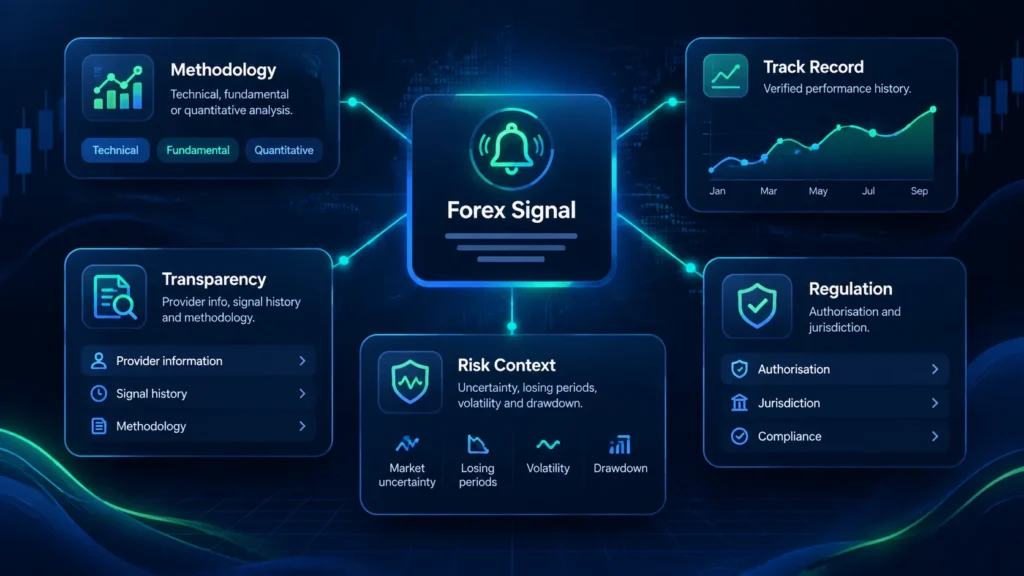
Assessing the credibility of forex trading signals generally involves looking beyond the headline claim and considering several criteria together, including methodology, historical evidence, consistency, and how the information is documented. The sections below outline commonly referenced evaluation dimensions rather than a fixed checklist.
Signal Methodology and Market Rationale
A credible signal provider can generally describe the analytical basis behind its alerts, whether that basis is technical analysis, fundamental analysis, a quantitative model, or a hybrid approach combining several methods.
Some methodologies reference recognisable forex chart formations or support and resistance levels, while others lean on macroeconomic data. Vague references to “proprietary technology,” without any further explanation of the underlying logic, are often considered to provide limited evidence on their own about the quality of a trading system.
Verified Track Record and Historical Results
Independently verifiable performance records — for example, results monitored by a third-party platform such as Signal Start or a similarly structured tracking service — are generally treated differently from screenshots or a curated selection of winning trades. Examining a complete historical record, including losing periods and stretches of weaker performance, is often described as a more informative approach than reviewing isolated highlights.
Accuracy, Drawdown and Performance Context
A headline win rate can be misleading when it is presented without accompanying information about losses, drawdown, trade frequency, or the overall distribution of outcomes. A service reporting a high percentage of winning alerts may still show a negative net result if losing trades are proportionally larger. For this reason, one performance metric alone is generally not considered sufficient to describe a provider’s overall track record.
Signal Consistency and Record Keeping
Timestamped alerts, archived historical results, and unchanged records are commonly cited as features that support easier evaluation of a provider’s claims. Clear treatment of cancelled or expired signals — rather than quietly removing them from a record — is often associated with more consistent documentation practices among established signal service operators.
What Makes a Forex Signal Provider Transparent?
Provider-level characteristics can help distinguish a documented service from a vague promotional channel. These characteristics generally relate to business identity, pricing terms, and how signals are delivered, rather than to the accuracy of any individual alert.
Clear Provider Identity and Business Information
Publicly available information about the company or individual operating a signal service — including a registered business name, contact details, published terms, and commercial disclosures — is often treated as a baseline transparency indicator. Services that omit this information, or that only provide contact through anonymous social-media accounts, generally offer less context for evaluation.
Transparent Pricing and Subscription Terms
Subscription-based trade signals typically involve recurring fees, and readers can generally examine trial periods, renewal conditions, cancellation policies, and refund terms before committing. A pricing structure described clearly in advance is commonly viewed as more transparent than terms that only become apparent after payment.
Clear Explanation of Signal Delivery
Delivery mechanisms vary between email alerts, mobile applications such as a dedicated FXLeaders App, messaging platforms, broker-platform notifications, and automated integrations offering real-time updates. The delivery mechanism can affect how signals are recorded and later evaluated — for example, a signal delivered through a messaging channel that allows message deletion may be harder to verify retrospectively than one archived on a fixed platform.
Forex Signal Scam Warning Signs
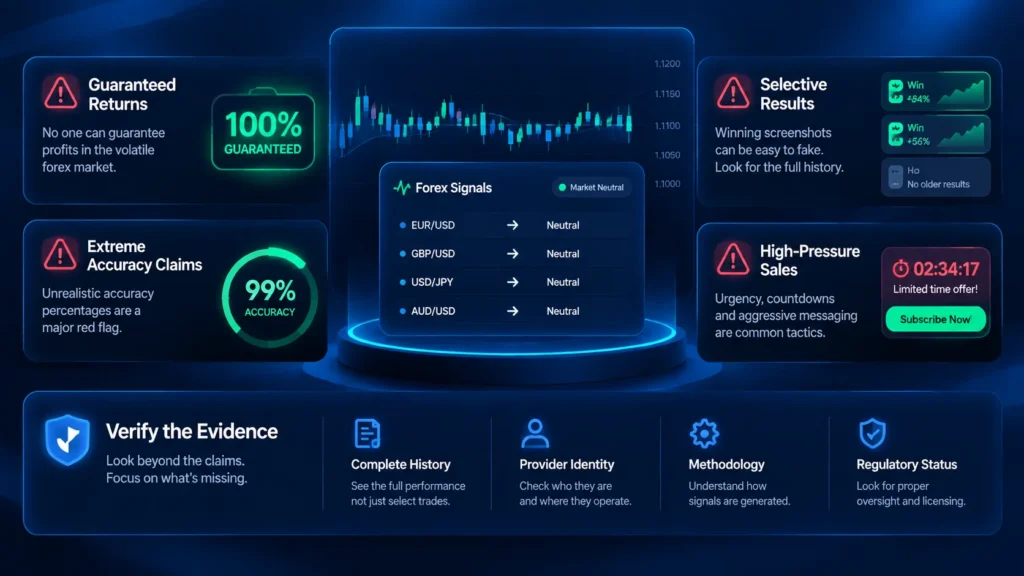
Regulators have described several patterns commonly associated with fraudulent or misleading promotions. According to the UK Financial Conduct Authority’s warning list, unauthorised firms promoting forex signals may use unsolicited social-media approaches, incorrect or changing contact details, and marketing that targets consumers without the necessary authorisation to provide financial services in the relevant jurisdiction.
- Unsolicited direct messages from accounts presenting as successful traders or “trading experts”
- Guaranteed or unusually consistent monthly returns
- Firms that are not listed, or are listed with a warning, on a national regulator’s public register
- Pressure to move conversations quickly to private messaging channels
- Requests to send payment directly to an individual rather than a registered business
Guaranteed Profits and Unrealistic Accuracy Claims
Claims of guaranteed returns, near-perfect accuracy, or exceptional and unusually consistent monthly performance are generally treated with particular scrutiny by regulators and experienced analysts alike. Financial markets involve inherent uncertainty and unpredictable market movement, and marketing language promising certainty is often considered inconsistent with how currency markets actually behave.
Fake Testimonials and Selective Winning Trades
Testimonials, cropped screenshots, edited trade histories, and isolated successful alerts can together create an incomplete impression of a service’s overall performance. A complete, unedited record generally provides stronger context than a curated highlight reel, since it allows losing trades to be weighed alongside winning ones.
Pressure, Urgency and Private Messaging
Promotional tactics such as limited-time subscription offers, aggressive sales language, unsolicited direct messages, and requests to continue discussions in private channels are patterns that regulators have flagged in relation to unauthorised investment promotions, including forex signal offers circulated through social media.
Unclear Payment and Account Arrangements
Unusual payment requirements, unclear company ownership, or requests to transfer money directly to an individual rather than a registered entity are generally considered warning signs. It is also worth distinguishing between paying a fee for an information service, such as a subscription to live forex signals, and depositing trading capital with a separate broker or investment firm — these are different arrangements with different implications.
How Regulation and Authorisation Relate to Signal Services
Regulatory status becomes relevant when a signal provider offers financial services beyond simply publishing educational market commentary. Requirements vary by jurisdiction and by the specific structure of the service being offered, so no single rule applies uniformly worldwide.
Checking Provider Registration
National financial regulators generally maintain public registers that can be used to check whether a firm is authorised to provide particular financial services. The FCA’s Warning List is one example of a public resource used to flag unauthorised firms operating in or targeting the UK market.
Signal Service vs Regulated Financial Service
Not every publisher of market commentary holds the same regulatory status as a broker, investment firm, or other regulated financial business. A channel that simply shares informational commentary may be structured differently, from a legal and regulatory standpoint, than a firm that provides personalised investment advice or executes trades on a client’s behalf. This distinction is often relevant when considering what a given provider actually offers and what legal liability, if any, may attach to that offering.
Geographic Differences in Investor Protection
Regulatory frameworks, compensation arrangements, complaints procedures, and authorisation requirements differ between countries. A firm’s authorisation in one jurisdiction does not automatically extend to another, and legislation governing signal services, trading platforms, and related financial products can vary considerably depending on where a provider and its clients are located.
Common Mistakes When Evaluating Forex Signals
Superficially attractive evidence can sometimes lead to an inaccurate assessment of a provider’s overall reliability, and these patterns often overlap with more general common forex trading mistakes that beginner forex traders are encouraged to become familiar with.
Focusing Only on Win Rate
A high percentage of successful alerts does not, on its own, establish the overall quality or long-term sustainability of a signal service, particularly if losing trades are disproportionately larger than winning ones.
Treating Backtests as Live Performance
Historical simulations and backtests differ from live or independently monitored results, since assumptions about execution conditions, spreads, and data selection can meaningfully affect backtest outcomes in ways that may not carry over to live market conditions.
Ignoring Losing Periods
A complete assessment of the provider generally includes periods when signals performed poorly, rather than focusing exclusively on successful alerts or favourable stretches of performance.
Confusing Popularity With Reliability
Subscriber counts, social-media engagement, reviews, and community size can indicate a service’s popularity, but these metrics do not independently verify financial performance, methodology, or legitimacy.
Forex Signals and Risk
Forex trading signals operate within markets that are inherently uncertain, and this section addresses risk conceptually rather than through specific risk-management instructions.
Why Signals Cannot Predict Markets With Certainty
Currency markets are affected by a wide range of factors, including economic data, interest-rate decisions, geopolitical developments, and shifting market sentiment. Neither human analysts nor automated systems relying on trading algorithms can consistently know future price movements with certainty, which is a structural characteristic of the forex market generally rather than a limitation specific to any one provider.
Market Conditions Can Affect Performance
Volatility, liquidity, macroeconomic announcements, changing correlations between assets such as forex pairs and commodities, and different market regimes may all affect how a given signal methodology has historically performed and how market trends unfold. A methodology that appeared effective in one market environment may behave differently under changed market conditions, which is part of why risk appetite is described as a personal consideration rather than something a signal alone can determine.
Execution Can Differ From Published Alerts
There is a conceptual difference between a published signal and the price or conditions actually available when an alert is received. Timing, spreads, liquidity, and broader execution conditions can all contribute to a gap between the price referenced in an alert — including any referenced stop-loss level — and the price available on a given trading platform at the moment it is read.
Evaluating Forex Signals Without Relying on Marketing Claims
Bringing these considerations together, some forms of evidence are generally considered stronger than others when assessing a provider, while other claims tend to remain incomplete without further context.
Evidence That Can Be Independently Verified
Audited or independently monitored performance records, complete historical archives rather than curated highlights, documented methodology, and consistent timestamps are commonly cited as examples of evidence that provide greater transparency than unverified marketing claims.
Questions Left Unanswered by Promotional Material
Claims about accuracy, profitability, underlying technology, or community size often remain incomplete without clear definitions, full historical context, an explained methodology, and some form of independent verification. A provider that answers these questions in detail is generally considered more transparent than one that does not.
Why No Single Metric Is Enough
Methodology, performance history, documented losses, subscription costs, transparency practices, provider identity, and regulatory context are generally considered together rather than reduced to a single headline figure such as an advertised win rate. This combined view is more consistent with how analysts and experienced forex traders are generally described as approaching the evaluation of any forex signal provider and the broader risks involved in following third-party alerts.
FAQ About Forex Trading Signals
What Are Forex Trading Signals?
Forex trading signals are market alerts that typically reference a currency pair, a suggested direction, and sometimes a price level or supporting rationale. They can be generated by human analysts, automated systems, or a combination of both, and they generally represent a single piece of market information rather than a complete trading methodology.
Are Forex Trading Signals Reliable?
Reliability varies considerably by provider, underlying methodology, prevailing market conditions, and the quality of supporting evidence a service discloses. No signal, regardless of its source, can guarantee future results, and past performance does not guarantee future outcomes.
How Can a Forex Signal Provider Be Evaluated?
Evaluation generally considers several dimensions together: the methodology behind the alerts, the completeness of historical records, whether performance has been independently verified, the transparency of pricing and provider identity, and applicable regulatory status.
Are Free Forex Signals Legitimate?
Free access does not, on its own, indicate either legitimacy or poor quality. The same transparency and evidence considerations — methodology, verifiable history, and clear provider identity — generally apply whether a service is free or paid.
What Are Common Forex Signal Scam Signs?
Commonly cited warning signs include guaranteed returns, unrealistic accuracy claims, selectively presented performance evidence, anonymous or unverifiable providers, high-pressure sales tactics, and unclear payment arrangements, several of which regulators such as the FCA have specifically flagged in relation to unauthorised promotions.
Can Forex Signals Guarantee Profit?
No forex signal can guarantee profit. Advertised or historical performance, however favourable, does not establish that similar results will occur in future market conditions, and losses may exceed initial expectations in leveraged trading.
Are Paid Forex Signals Better Than Free Signals?
Subscription price alone does not determine the quality of a signal service. The underlying methodology, the completeness of available evidence, provider transparency, and how the service is structured are generally considered more informative than cost.
Why Is Regulatory Status Important for Forex Signal Providers?
Regulatory authorisation can provide information about a firm’s legal status and any protections that may apply to a particular financial service, such as complaints procedures or compensation arrangements. Requirements differ across jurisdictions, so authorisation in one country does not necessarily apply elsewhere.
Can Automated Forex Signals Be Trusted?
Automated systems can generate alerts systematically using trading algorithms and technical indicators, but they remain subject to the limitations of their underlying methodology, the data they rely on, prevailing market conditions, and how the system has been implemented.