Risk Management in Forex Trading: Essential Rules for Beginners


Risk management in forex trading refers to the process of controlling potential losses that can arise from individual trades, from multiple open positions, from losing streaks, and from broader account drawdown. For anyone new to the forex trading overview, understanding risk in forex trading is often considered just as important as understanding market direction, since even a well-reasoned trade idea does not remove the possibility of loss.
This article is educational rather than instructional. It explores concepts such as position sizing, stop-loss orders, leverage, margin, risk-to-reward, correlation, and drawdown, explaining how these concepts are generally discussed in FX risk management without providing specific trading signals, a personal trading plan, or personalized financial advice.
Key Takeaways
- Forex risk management is generally understood as controlling potential exposure, not eliminating the possibility of loss on every trade.
- Position sizing and risk per trade are commonly discussed in relation to overall account equity rather than in isolation.
- Stop-loss orders are widely used to define a predetermined exit point, though they cannot guarantee an exact execution price.
- Leverage and margin can increase both potential gains and potential losses relative to deposited capital.
- Drawdown reflects the decline from an account’s peak value and is often considered alongside individual trade outcomes.
- Correlated currency pairs can create combined exposure that may be larger than it appears from position count alone.
- Commonly cited percentage-based risk rules are widely used conventions, not universal guarantees of safety.
- Emotional responses to losses are frequently discussed as a behavioral factor that can influence outcomes and trading strategies over time.
What Is Risk Management in Forex Trading?
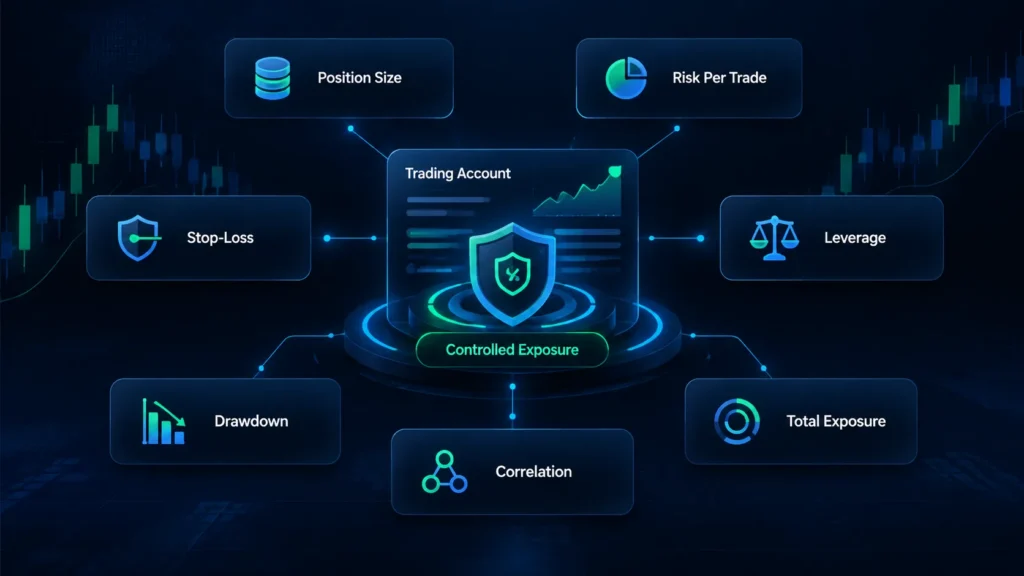
Risk management in forex trading is generally described as the framework traders use to think about potential financial exposure before, during, and after a position is open. It sits alongside market analysis as one of the core pillars commonly referenced in discussions of the foreign exchange market.
Core Purpose of Risk Management
Risk management is often explained as the process of controlling potential financial exposure arising from individual trades and from broader account activity. In simple terms, it separates the risk that is planned in advance from the outcome that actually occurs once the forex market moves, which can differ from what was anticipated.
Trade and Account Risk
Trade risk refers to the potential loss tied to a single open position, while account risk refers to the combined exposure across all positions in a trading account. Several individually small positions, when added together, can sometimes create meaningful combined exposure, particularly if those positions share related currency exposure within the fx market.
Why Risk Management Matters for Beginners
Beginner forex traders are often described as more vulnerable to oversized positions, excessive leverage, and emotional reactions to market movement, largely due to limited prior exposure to how drawdown accumulates. According to the Financial Conduct Authority, retail traders are commonly encouraged to understand the risks of leveraged products before opening an account, since losses may exceed initial expectations in volatile market conditions.
Risk Per Trade and Position Sizing
Position sizing is one of the most frequently discussed elements of forex risk management, since it links directly to how much capital a single trade can affect. The following sections describe how this concept is generally framed rather than prescribing a specific approach.
Percentage-Based Risk
A commonly discussed convention involves expressing potential trade loss as a percentage of account equity, such as one or two percent. This percentage-based approach is widely used as a general reference point rather than a fixed rule, and different traders, account sizes, and market conditions can lead to very different applications of the same concept across every trade.
Position Size and Potential Loss
Position size affects how much a given movement, often measured in pips, translates into monetary gain or loss for a trading account. In conceptual terms, larger exposure relative to account size generally means that a comparable price movement produces a proportionally larger effect, which is why position size and account value are often discussed together rather than in isolation.
| Concept | What It Describes | Why It Matters |
| Account equity | Total value of the trading account | Serves as the base figure for percentage-based risk discussions |
| Position size | The exposure taken on a given trade | Determines how much a price move affects account value |
| Pip movement | A standardized unit of price change in a currency pair | Helps traders quantify how far price has moved |
| Price distance | Movement between entry and a defined exit level | Combines with position size to produce potential loss |
Why Position Size Matters More Than Trade Confidence
Confidence in a particular market view is not generally described as reducing financial risk on its own. Two traders holding an identical market opinion about whether to buy or sell a currency pair can experience very different financial outcomes depending on the size of the position each has taken, which illustrates why position size is often treated as a distinct consideration from the strength of a market view.
Stop-Loss Orders and Loss Control
Stop-loss orders are one of the most commonly referenced tools in discussions of forex risk management, and they are generally described in terms of defining a boundary rather than guaranteeing an outcome. For further detail, see this explanation of stop loss in forex trading.
Role of Stop-Loss Orders
A stop-loss order is commonly used to define a price level at which a trading thesis is considered invalid, prompting the position to be closed. It is important to note that a stop-loss order is generally understood as a trigger rather than a guarantee, since it does not necessarily execute at the exact price specified, regardless of whether the original position was set up to buy or sell.
Stop Distance and Position Size
Stop distance refers to how far a predefined exit level sits from the entry price, often measured in pips, and this distance is often discussed in relation to position size. A wider stop distance generally changes the amount of exposure associated with reaching a particular monetary risk level, compared with a narrower stop distance on the same account.
Slippage, Gaps, and Execution Risk
Actual losses can differ from planned losses because of market gaps, rapid price movement, wider spreads, and reduced market liquidity, particularly around major news events that move the exchange rate sharply. Execution risk is often cited as a reason why stop-loss orders, while widely used, cannot be considered a complete substitute for broader risk awareness or effective management more generally.
Leverage and Margin Risk
Leverage and margin are central to how forex trading capital is structured, and both concepts are frequently linked to potential risk. A detailed breakdown is available in this resource on forex leverage explained.
Leverage and Market Exposure
Leverage allows a trader to control a larger market exposure relative to deposited capital, which can magnify both potential gains and potential losses on an FX trade. It is commonly noted that higher available leverage does not automatically translate into lower trading risk, since the underlying exposure is what ultimately determines the financial effect of a price movement.
Margin and Free Margin
Margin, sometimes called used or initial margin, is the portion of account equity set aside to open and maintain a leveraged position. Free margin refers to the remaining equity available for further trading activity, and this distinction is often discussed separately from actual trade risk, since margin requirements and potential loss are related but not identical concepts.
- Equity – the current value of the trading account, including open position performance.
- Used margin – the amount set aside to maintain currently open positions.
- Free margin – equity remaining available for additional exposure.
- Margin level – commonly expressed as a ratio of equity to used margin.
Margin Calls and Forced Liquidation
Adverse price movement can reduce account equity and available margin, which may bring broker-specific margin-call or stop-out mechanisms into effect. These mechanisms are generally described as automated processes that can close positions once margin falls below a defined threshold, independent of a trader’s own decision-making at that moment.
Risk-to-Reward and Expected Outcomes
Risk-to-reward is frequently discussed alongside win rate as a way of framing potential trading outcomes in conceptual terms, without implying a specific numerical target is universally appropriate.
Risk-to-Reward Ratio
Risk-to-reward is commonly described as a comparison between the potential loss and the potential gain associated with a given trade idea. There is no single ratio that is described as universally optimal, since this comparison is often discussed in the context of trading style, various trading strategies, and individual account circumstances.
Win Rate and Risk-to-Reward
Win rate on its own is generally considered insufficient for evaluating a trading approach, since it must be viewed alongside the average size of gains and losses. Different combinations of win rate and risk-to-reward can theoretically produce very different overall account outcomes over time, even when the underlying trading plan remains unchanged.
Costs and Realistic Risk Assessment
Spreads, commissions, financing costs, and slippage are commonly cited as factors that can affect the relationship between a theoretical outcome and a realized one. These costs are often discussed as part of a more complete risk assessment, since they can accumulate across many trades even when each individual cost, sometimes just a few pips, appears small.
Drawdown and Losing Streaks
Drawdown is frequently discussed as a way of measuring risk beyond the result of any single trade, capturing how an account behaves across a series of outcomes.
What Is Drawdown?
Drawdown refers to the decline from an account or portfolio’s peak value to a subsequent lower value. It is commonly used as a risk measure because it reflects cumulative performance rather than the result of an isolated position.
Impact of Consecutive Losses
Repeated losses can compound over a series of trades, and a sequence of individually manageable losses may, in combination, produce a materially larger decline in account value. This compounding effect is one reason drawdown is often discussed separately from single-trade risk, and why some traders build it into a broader trading plan.
Recovery and Drawdown Mathematics
There is a widely noted asymmetry between the size of a loss and the gain required to recover it. For example, a twenty percent decline conceptually requires a twenty-five percent gain to return to the original account value, and this asymmetry becomes progressively more pronounced as drawdown size increases.
| Drawdown | Gain Required to Recover |
| 10% | approximately 11% |
| 25% | approximately 33% |
| 50% | approximately 100% |
Correlation and Total Forex Exposure
Correlation between currency pairs is a concept commonly referenced when discussing total account exposure, since it extends risk considerations beyond any individual position.
Currency Correlation
Different currency pairs can share a common underlying currency, such as the United States dollar or the euro, and may therefore respond to similar economic or market drivers. This shared exposure is often discussed as currency correlation, which can affect how independent a series of positions actually is, particularly when the exchange rate of one pair moves in tandem with another.
Hidden Concentration Risk
Several apparently separate trades can, in some cases, effectively represent a single concentrated market view once shared currency exposure is taken into account. Counting the number of open positions alone is generally considered an incomplete way of estimating overall account risk in the forex market.
Account-Level Exposure
Risk management discussions often extend beyond individual trades to include total open exposure, overlapping positions, and common sources of market risk across a portfolio. This broader view is generally considered a component of account-level risk awareness rather than a trade-specific calculation.
Common Forex Risk Management Mistakes
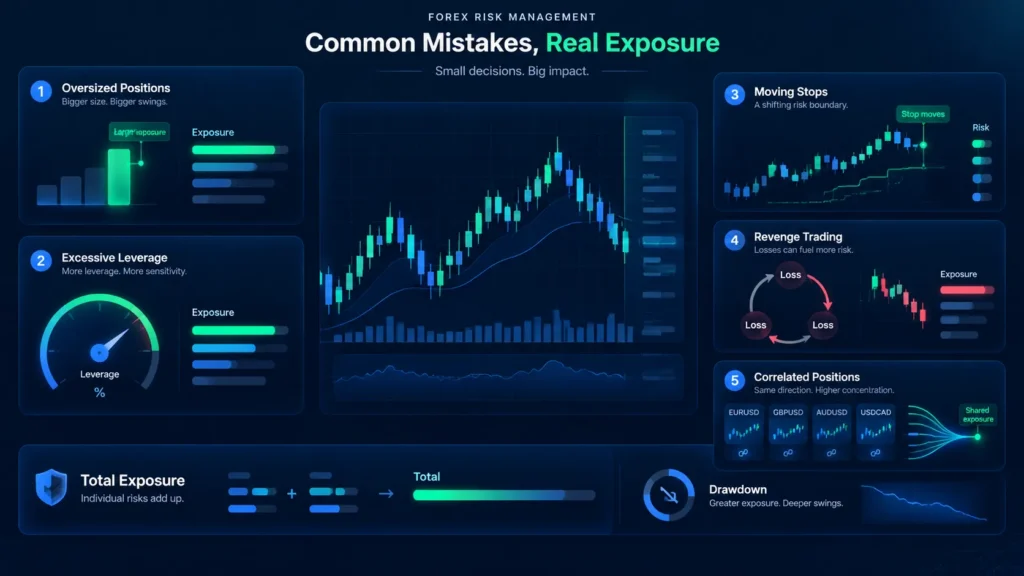
A number of recurring patterns are frequently discussed in relation to forex risk management, and further detail is available in this overview of beginner forex errors to avoid.
- Oversized positions – exposure that is large relative to account size can make ordinary market fluctuations disproportionately significant.
- Excessive leverage – higher leverage can magnify both gains and losses, and available leverage is not the same as appropriate exposure.
- Moving stops after losses – adjusting a predefined loss boundary after a position moves adversely is often discussed as a behavioral factor.
- Averaging down and revenge trading – adding exposure to a losing position or attempting to recover previous losses quickly can increase cumulative risk.
- Ignoring correlated positions – multiple positions sharing similar currency exposure can create combined risk greater than their individual sizes suggest.
- Trading without a plan – entering positions without a defined trading plan is sometimes discussed as a factor that can make risk harder to track consistently.
Psychological Side of Forex Risk Management
The psychological aspects of forex risk management are commonly discussed alongside the more technical elements, since behavior can influence how a defined risk framework is actually applied.
Emotional Impact of Losses
Losses can influence confidence, decision-making, and the perception of subsequent market opportunities. This emotional response is often described as a factor that can affect how consistently a trader applies a predefined approach over time.
Fear and Greed
Fear is commonly associated with premature decision-making, such as closing a position earlier than originally planned, while greed is often linked to excessive exposure or disregard for previously defined risk boundaries. Both are frequently discussed as behavioral tendencies rather than fixed traits.
Discipline and Consistency
Consistent application of a predefined framework is often discussed as an important behavioral component of forex risk management. This is generally framed as a conceptual discussion of trading psychology rather than a prescriptive set of trading instructions, and it is one reason a written trading plan is sometimes referenced in broader discussions of risk management strategies.
Building a Risk-Aware Trading Framework
A risk-aware framework is commonly discussed as combining several layers of consideration, from an individual trade up to overall account and market conditions.
Trade-Level Risk
Elements commonly considered before a position is opened include potential loss, position size, stop distance, entry and exit points, transaction costs, and prevailing market conditions. These factors are often discussed together as part of trade-level risk awareness for any fx trade.
Account-Level Risk
Total exposure, margin capacity, drawdown, correlated positions, and cumulative losses are frequently described as broader measures of account health that extend beyond any single trade.
Market and Event Risk
Economic releases, unexpected news, changes in volatility, liquidity conditions, spreads, and price gaps are commonly cited as factors that can alter expected risk levels, particularly around scheduled announcements from central banks or unexpected geopolitical developments that shift the exchange rate quickly.
Reviewing Risk Over Time
Historical trade records, sometimes maintained in a trading journal, are commonly used to evaluate whether actual risk outcomes have remained consistent with an originally intended trading plan. This review process is often discussed as an ongoing part of effective risk management rather than a one-time exercise.
FAQ
What Is Risk Management in Forex Trading?
Risk management in forex trading is generally described as the process of controlling potential financial exposure from individual trades and overall account activity. Its purpose is commonly understood as limiting the impact of adverse price movements rather than eliminating the possibility of loss entirely.
How Much Risk Is Commonly Associated With One Forex Trade?
Percentage-based approaches, such as risking a small percentage of account equity per trade, are commonly cited conventions in forex risk management discussions. There is no single percentage described as universally appropriate, since this can vary by trader, account size, and market conditions.
Why Is Position Sizing Important in Forex?
Position sizing is often discussed as a key factor because it determines how much a given price movement translates into financial gain or loss for an account. Larger position sizes generally amplify the effect of the same price movement compared with smaller ones.
Does Stop-Loss Placement Eliminate Forex Risk?
Stop-loss orders can help define a planned exit point, but they are generally understood as unable to eliminate risks associated with slippage, price gaps, or reduced market liquidity. Execution at the exact specified price is not guaranteed in fast-moving market conditions.
How Does Leverage Affect Forex Risk?
Leverage increases the amount of market exposure that can be controlled relative to available capital, which can magnify both potential gains and potential losses. Higher leverage does not automatically reduce risk and is often discussed as a factor that requires additional awareness.
What Is Drawdown in Forex Trading?
Drawdown is defined as a decline from an account or portfolio’s peak value to a subsequent lower point. It is commonly used to assess the severity of losses over a period of time, rather than focusing solely on the outcome of a single trade.
Why Can Correlated Currency Pairs Increase Risk?
Multiple currency pairs can be influenced by the same underlying currency or macroeconomic factor, which is commonly referred to as currency correlation. This shared exposure can create a more concentrated risk profile than the number of open positions might otherwise suggest.
What Are Common Risk Management Mistakes for Beginners?
Commonly discussed mistakes include oversized positions, excessive leverage, underestimating transaction costs, concentrating correlated positions, reacting emotionally to losses, and underestimating potential drawdown across a series of trades.
Can Forex Risk Management Prevent Losses?
Forex risk management cannot prevent losing trades or guarantee a particular outcome. It is generally described as a framework intended to control exposure and reduce the potential impact of adverse market movements, rather than as a method for avoiding losses altogether.