Stop Loss in Forex Trading: How Beginners Can Control Risk

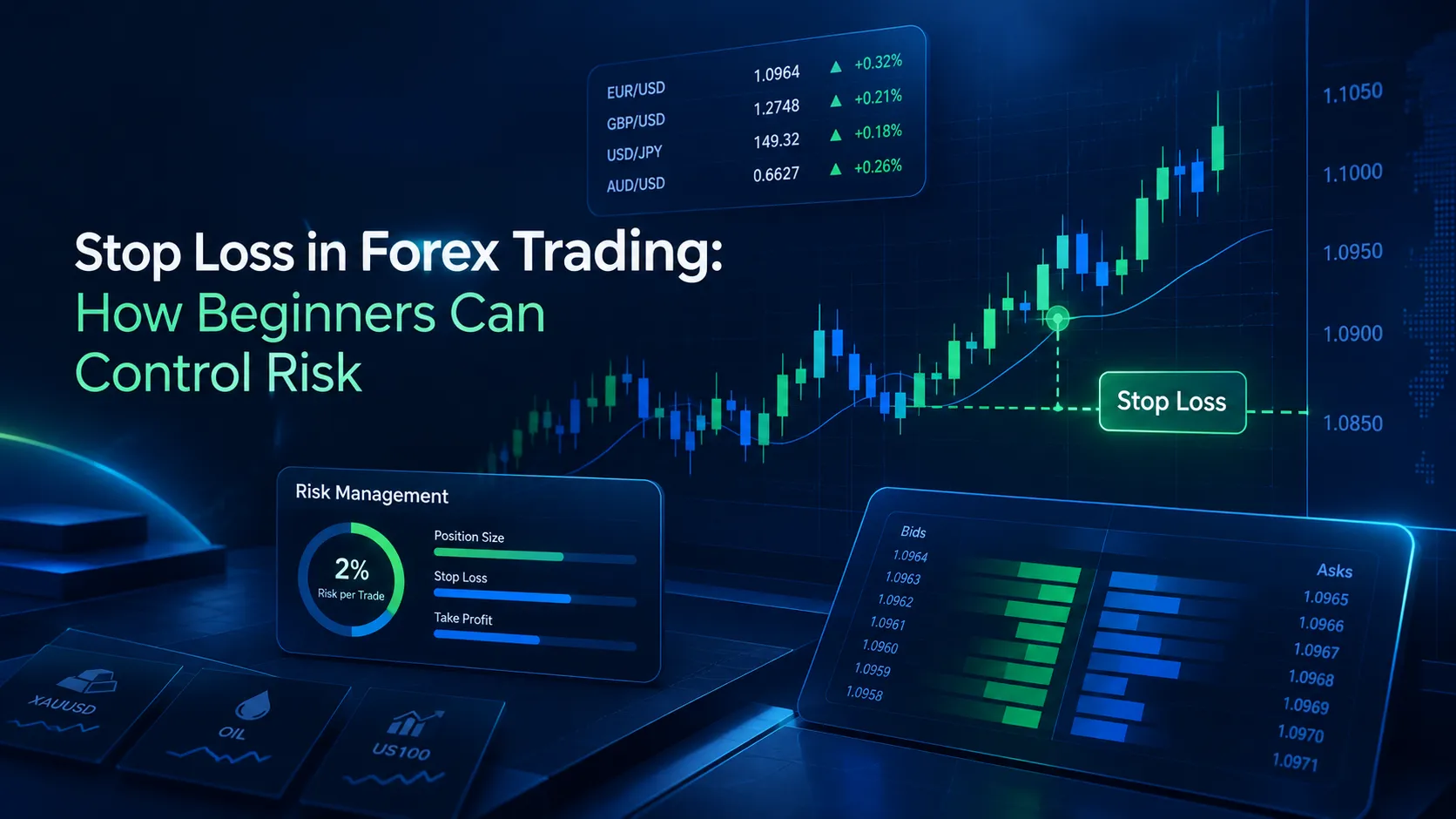
A stop-loss order is a widely used risk management tool in forex trading that can automatically close a trade when price reaches a predefined level. For a trader entering the forex market for the first time, understanding this order type alongside take profit orders is often considered a foundational step before engaging in leveraged trading or trading CFDs.
This article explains what a stop-loss order is, how it works, and why it is commonly referenced as part of disciplined trading. For readers exploring these concepts for the first time, a broader forex trading guide can offer additional background on how currency markets and leveraged trading generally function before deciding to start trading.
Why Stop Loss Matters in Forex
Currency pairs can move quickly, and leverage in forex trading can magnify both gains and losses on a relatively small amount of trading capital. Because of this, many traders reference a predefined exit level as a way of defining, in advance, the point at which an open position may be closed if the market moves unfavorably. This approach is generally described as a core part of risk management rather than a guarantee of limited loss, and it applies similarly when trading CFDs on other instruments.
What Stop Loss Can and Cannot Do
A stop loss order can define a trigger level tied to a specific price, and it can be attached to a position on most trading platforms. However, it cannot guarantee that the position will close at that exact level, since factors such as slippage, market gaps, and low liquidity can affect the eventual execution price. Recognizing this distinction is often described as important for beginners exploring the forex market before they start trading with real capital.
Key Takeaways
- A stop-loss order is a conditional instruction that may close a trade automatically once a specified price level is reached.
- Stop losses are commonly viewed as a risk management tool, not a guarantee against loss.
- Placement can vary depending on volatility, timeframe, currency pair, and trading style.
- Execution price can differ from the predefined level due to slippage, spreads, or gaps.
- A stop loss and a take profit order are often used together as part of a broader approach to managing open trades.
- Trailing stops, fixed-pip levels, and volatility-based levels represent different ways market participants may structure an exit.
- Past performance does not guarantee future results, and losses may exceed initial expectations in leveraged trading or CFD trading.
What Is Stop Loss in Forex Trading?
Before exploring placement and strategy, it helps to define what a stop-loss order actually is within the structure of an order in trading. The sections below outline the mechanics at a conceptual level, without presenting execution instructions.
Stop Loss Definition
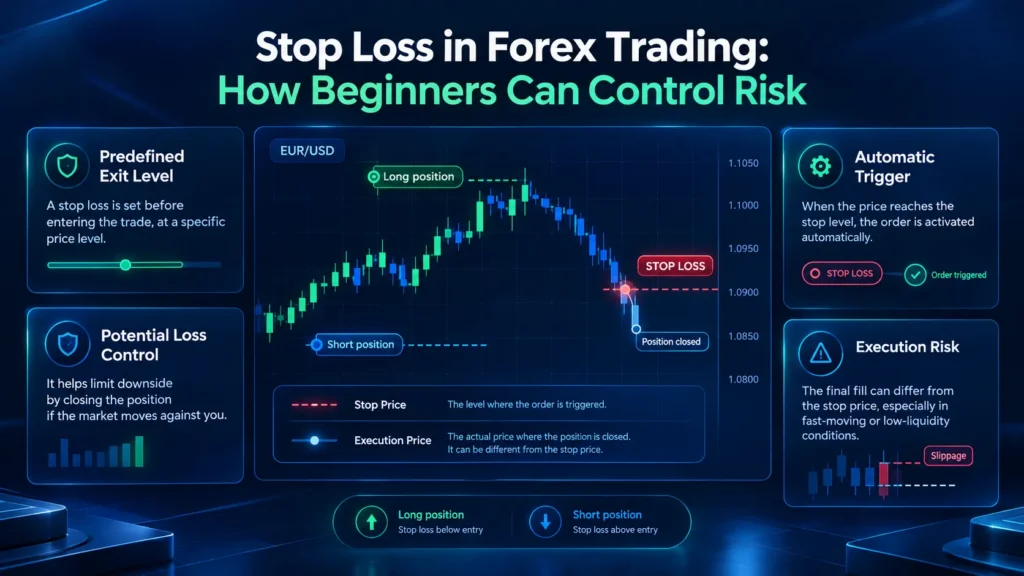
A stop-loss order is a type of order associated with an open forex position that may be triggered when the market price reaches a specified level. It is generally distinguished from a market order or limit order because its purpose is tied to closing an existing position rather than opening one. Brokers and trading platforms typically allow this order type to be attached at the same time a trade is opened, whether trading forex or trading CFDs.
How Stop Loss Works
In simple terms, this order type references the relationship between the current market price and a predefined level. When price reaches that level, a trigger event occurs, which may result in the position being closed at the next available price. Using stop mechanisms like this is largely automated on most trading platforms, reducing the need for constant manual monitoring.
Stop Loss for Long and Short Positions
The direction of a predefined exit level depends on whether a position is long or short. For a long position, it is typically placed below the current market price, while for a short position it is typically placed above it. This distinction reflects the fact that a long position loses value as price falls, while a short position loses value as price rises.
Stop Loss vs Manual Position Closure
Manually closing a position depends on a trader being present, attentive, and able to act during volatile price movements, which can be influenced by emotional decision-making. Setting a stop loss order, by contrast, can operate independently of the trader’s attention once it has been established. This difference is often cited as one reason automated exit levels are discussed as part of disciplined trading.
Why Stop Loss Is Important for Risk Control
Risk control in forex trading is often described as a combination of position sizing, trade planning, and predefined exit conditions. This order type is one component frequently referenced within that broader framework, and the same logic applies when trading CFDs more generally.
Limiting Potential Losses
Setting a stop loss can establish a predefined point at which a position may be closed if the market moves unfavorably, which allows a trader to define potential downside exposure before the outcome of a trade is known. This does not eliminate the possibility of loss but may help define its boundaries. Many educational resources describe this as one of the primary functions of using stop-loss protection.
Reducing Emotional Decision-Making
Predefined exit conditions can reduce reliance on decisions made during periods of fear, uncertainty, or rapidly changing prices. Because the level is set in advance, using stop-loss orders may reduce the need to make reactive choices while a trade is already open. This is sometimes discussed in the context of disciplined trading and consistent trading skills.
Managing Risk in Leveraged Forex Trading
Leverage allows a trader to control a larger position with a comparatively small amount of trading capital, which increases both potential gains and potential losses. Because leveraged trading can amplify the impact of price movement, predefined exit levels are frequently discussed alongside broader forex risk controls. Understanding this relationship is often considered part of basic risk awareness for a forex trader, and it is one reason such tools help traders approach leveraged positions with more structure.
Protecting Against Prolonged Adverse Moves
An unattended position can remain exposed to continued adverse price movement if no exit condition has been defined. Setting stop parameters in advance can provide an automated conditional exit, which may limit the duration of that exposure. This characteristic is sometimes referenced in discussions of position management across different trading strategies.
Types of Stop Loss in Forex
Not every exit approach is structured the same way. Market participants may reference several distinct methods, each with different characteristics and limitations.
| Order Approach | Basis for Placement | General Characteristic |
| Fixed-Pip Exit Level | A set number of pips from entry | Simple to apply, but static across volatility conditions |
| Percentage-Based Level | A proportion of account equity or position value | Tied to account size rather than price structure |
| Structure-Based Level | Support, resistance, swing highs/lows | Reflects technical price structure |
| Volatility-Based Level | Indicators such as Average True Range (ATR) | Adjusts with changing market conditions |
| Trailing Mechanism | Moves with favorable price movement | Depends on platform-specific order rules |
Fixed-Pip Stop Loss
A fixed-pip approach uses a set number of pips as the distance between the current market price and the predefined level. This approach is often described as straightforward and easy to apply consistently when using stop-loss orders for the first time. A noted limitation is that it does not automatically adjust for changing volatility, meaning the same distance may behave differently across market conditions.
Percentage-Based Stop Loss
Some traders reference an exit level expressed relative to account equity or position value rather than a fixed number of pips. This is generally described as a way of tying the level to the size of a trading account rather than to price structure alone. Specific percentage figures are not universal and can vary by individual circumstances and market conditions.
Structure-Based Stop Loss
A structure-based approach may reference support, resistance, swing highs, swing lows, or similar price levels drawn from technical analysis. This method is often associated with aligning an exit level with observable market structure rather than an arbitrary distance. Analysts sometimes note that structure-based placement can shift with each new price pattern.
Volatility-Based Stop Loss
Volatility measures such as the Average True Range (ATR) are sometimes referenced when evaluating how far an exit level might reasonably be placed from current price. Because ATR reflects recent price movement, it can offer a way of relating distance to prevailing market volatility. Resources such as Investopedia describe ATR as one of several volatility-based indicators used in technical analysis, alongside tools like Parabolic SAR and Fibonacci retracement levels.
Trailing Stop Loss
A trailing mechanism differs from a conventional fixed level in that it may move as market price changes favorably, while generally remaining fixed if price moves unfavorably. Its exact behavior depends on the trading platform and the specific order parameters selected. Trailing stops are sometimes discussed as one of several order types associated with dynamic position management.
Stop Loss Placement Factors
Where an exit level is conceptually placed can be influenced by several market-related factors, rather than a single fixed rule.
- Market structure, including recent highs, lows, support, and resistance
- Prevailing market volatility
- The timeframe being analyzed
- Characteristics specific to the currency pair being traded
- The trading session and surrounding market conditions
Market Structure
Recent highs, lows, support levels, and resistance levels can influence how market participants conceptualize a potential invalidation point for a trading idea. A level positioned beyond a relevant structural point is sometimes discussed in relation to that structure rather than an arbitrary distance. This connects to broader discussions of price levels and market trend analysis.
Market Volatility
A distance that appears relatively close during quiet market conditions may behave very differently once volatility increases. Elevated volatility can result in price swings that reach a predefined level without necessarily reflecting a broader directional shift. This is one reason volatility is often discussed alongside placement decisions.
Timeframe Differences
Distances and general market noise can differ significantly between short-term charts and longer-term charts. A distance considered relatively wide on a short-term chart might be considered narrow on a longer-term chart. This distinction is often relevant when comparing approaches such as day trading and swing trading.
Currency Pair Characteristics
Currency pairs can differ in volatility, liquidity, and typical price movement, meaning a uniform distance may not carry the same meaning across different pairs. A pair such as EUR/USD, which reflects the exchange rate between the Euro and the United States dollar, may behave differently from a less liquid cross pair. This is a commonly cited reason for avoiding identical distances across all forex pairs.
Trading Session and Market Conditions
Liquidity can change around major market sessions, scheduled economic announcements, and market openings, which can affect price behavior and how an order is executed. Reduced liquidity during certain sessions is sometimes associated with wider spreads and less predictable execution. This factor is often mentioned in relation to broader forex order execution considerations.
Stop Loss and Forex Risk Management
Placement decisions do not exist in isolation; they are typically discussed alongside broader concepts of position size, risk per trade, and overall account management.
Stop Distance and Position Size
The distance between entry price and a predefined level relates to the potential monetary impact of a position, since a wider distance generally corresponds to greater potential exposure at a given position size. This relationship is often described conceptually rather than through a specific formula or execution framework. Understanding this relationship is generally considered relevant to basic risk management.
Risk Per Trade
Risk per trade refers to the amount or proportion of trading capital exposed to a potential loss on a single position. It is commonly considered alongside exit-level placement when evaluating overall exposure. Some traders reference a consistent approach to risk per trade as part of a broader trading strategy.
Drawdown and Losing Streaks
Repeated losing trades can accumulate into what is generally referred to as an account drawdown. Risk management discussions often consider the cumulative effect of multiple trades rather than evaluating each position in isolation. This perspective is sometimes associated with investment management principles applied to a trading account.
Stop Loss and Risk-Reward Concepts
The relationship between potential downside, as defined by an exit level, and potential upside, as defined by a take-profit level, is a general analytical concept referenced in trading education. This is typically discussed without presenting specific target ratios or prescriptive recommendations. It is often mentioned in connection with forex take-profit orders as a related concept.
Stop Loss Execution and Market Conditions
Even when a predefined level is clearly defined, actual execution depends on prevailing market conditions at the moment the order is triggered.
Stop Price vs Execution Price
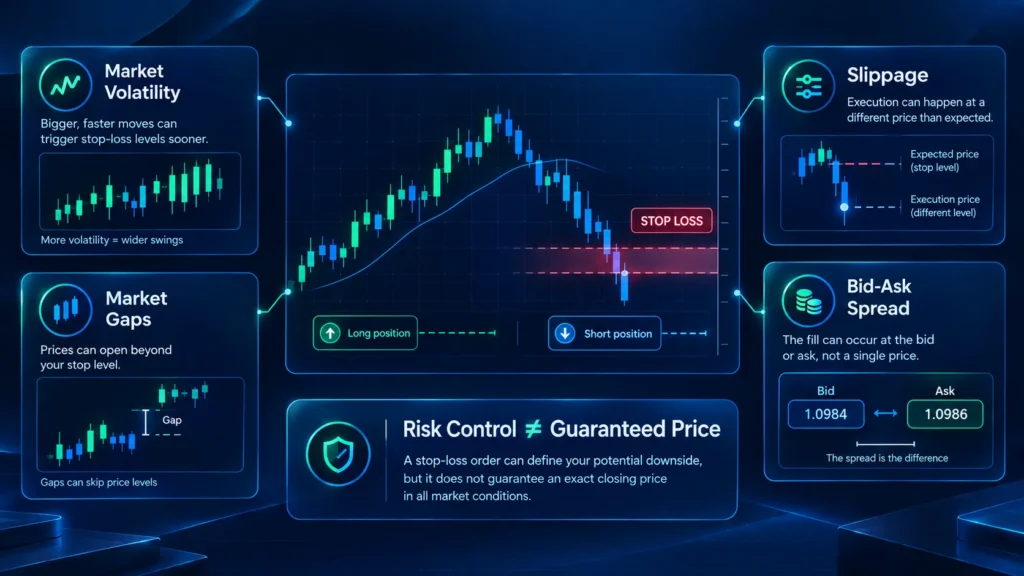
The trigger price refers to the level that activates a stop loss order, while the execution price refers to the price at which the position is eventually closed. In fast-moving or thin markets, these two figures are not always identical. This distinction is a key reason such orders are generally described as risk management tools rather than guarantees.
Slippage
Slippage occurs when an order is executed at a price different from the predefined level, typically during periods of rapid price movement or reduced liquidity. It can result in a larger realized loss than initially anticipated based on the distance alone. Slippage is one of the more commonly cited limitations associated with using stop-loss protection in leveraged trading.
Market Gaps
A market gap describes a situation in which available prices move beyond a predefined level without trading continuously through the intermediate prices, often around market openings or major news events. When this occurs, the eventual execution price may be considerably different from the level originally set. This is one reason an exit mechanism guarantees a trigger condition but not a guaranteed execution price.
Spread and Bid-Ask Prices
Bid and ask prices can affect when an exit condition is triggered, since long and short positions are generally exposed to different sides of the spread. A wider spread during certain conditions can mean a predefined level is reached sooner in relation to one side of the market than the other. This factor is often relevant when comparing outcomes across different brokers and trading platforms.
News and High-Volatility Events
Economic announcements, central-bank decisions, and geopolitical developments can create rapid price movement and execution uncertainty. During these periods, spreads may widen and liquidity may temporarily decrease, which can affect how an order behaves. This is frequently mentioned as a reason for additional caution around scheduled high-volatility events.
Common Stop Loss Mistakes Among Beginners
Several patterns are frequently discussed in educational content as common areas of difficulty for newer traders.
- Placing levels too close to current price
- Placing levels too far from current price
- Moving a predefined level after a losing move
- Treating an exit order as guaranteed protection
- Ignoring changes in market volatility
- Using identical distances across different currency pairs
Placing Stops Too Close
A distance that is very narrow may be reached by ordinary short-term price fluctuations before any broader directional move has the opportunity to develop. This is sometimes described as a mismatch between the exact level and normal market noise. Some educational resources note that this pattern can result in a trade closing earlier than intended.
Placing Stops Too Far Away
Excessive distance between entry price and a predefined level can increase potential exposure and may reduce how meaningfully the order functions as a risk boundary. A level placed far beyond what was initially considered can also affect how position size decisions are approached. This is one reason volatility and structure are often weighed together.
Moving Stop Loss After a Losing Move
Repeatedly adjusting a predefined level after a trade has moved unfavorably can alter the original risk characteristics associated with the position. Some educators describe this pattern as increasing exposure beyond what was initially planned. It is frequently referenced in discussions distinguishing disciplined trading from reactive decision-making.
Treating Stop Loss as Guaranteed Protection
An exit order does not guarantee an exact price in every market condition, and it cannot fully eliminate slippage or gap risk. This distinction is emphasized across most beginner-focused forex education. Recognizing this limitation is often described as an important step toward a more realistic understanding of risk.
Ignoring Volatility
Applying the same distance across different volatility environments can produce materially different outcomes, since a level that appears reasonable during quiet conditions may be reached quickly during elevated volatility. This is one reason volatility measures such as ATR are sometimes referenced when set stop decisions are being made. Ignoring this factor is commonly cited as a contributor to inconsistent outcomes.
Using Identical Stop Distances Across Currency Pairs
Currency pairs can differ meaningfully in volatility and liquidity, which means a fixed distance that seems reasonable for one pair may carry a different meaning for another. This is often discussed in relation to broader differences across forex pairs and market conditions. Some traders account for this by considering pair-specific characteristics rather than a single uniform distance.
Stop Loss vs Other Forex Exit and Order Types
A stop-loss order is one of several order types used in forex trading, each associated with a different purpose.
| Order Type | General Purpose | Typical Association |
| Stop-Loss Order | Closing a position if price moves unfavorably | Downside risk management |
| Take-Profit Order | Closing a position after a favorable price movement | Locking in potential gains |
| Stop Entry Order | Opening a new position after a specified condition | Trade initiation |
| Limit Order | Execution at a specified price or better | Price-sensitive entry or exit |
| Trailing Mechanism | Adjusting a level as price moves favorably | Dynamic exposure management |
Stop Loss vs Take Profit
An exit order like this is generally associated with limiting potential downside on an open position, while a take-profit order is associated with closing a position after price has moved in a favorable direction. Some traders reference using both together when structuring a trade. Neither order type guarantees a specific outcome, and both depend on prevailing market conditions.
Stop Loss vs Stop Entry Order
A stop loss order is used to close an existing position, while a stop entry order is used to open a new position once price reaches a specified condition. Although both share similar terminology, their function within the sequence of an order in trading differs considerably. This distinction is sometimes a source of confusion among newer traders.
Stop Loss vs Limit Order
A conditional trigger order is generally activated once price reaches a specified condition, while a limit order is associated with execution at a specified price or better. A stop-limit order combines a trigger condition with a limit-style execution condition, which can affect whether the order is filled once activated. Recognizing the difference between these order types is often described as useful for understanding available choices in trading.
Stop Loss vs Trailing Stop
A fixed level generally remains unchanged once set, while a trailing mechanism may adjust as market price moves favorably, subject to platform-specific rules. This difference affects how each order type responds to ongoing price movement after a trade has been opened. Some traders view a trailing approach as offering more flexibility, while others note it can also behave less predictably in choppy conditions.
Stop Loss Example in Forex Trading
The following hypothetical examples are provided to illustrate mechanics only and should not be interpreted as trading recommendations.
Basic Long Position Example
In a hypothetical long position on a currency pair, a trader might reference an entry price with an associated exit level placed below that price. If the market price were to fall to that level, the position could be closed, subject to prevailing execution conditions. This example illustrates the general mechanics rather than a suggested distance or level.
Basic Short Position Example
For a hypothetical short position, the corresponding level would generally be placed above the entry price rather than below it. If the market price were to rise to reach that level, the position could be closed under normal execution conditions. This mirrors the long position example but reflects the opposite price direction.
Example of Slippage
Consider a hypothetical scenario in which an exit level is set at a particular price, but a sudden price movement causes the market to trade through that level quickly. In such a case, the actual closing price could differ from the originally defined level. This illustrates how slippage may occur during fast-moving market conditions.
Example of Volatility Impact
The same distance applied during a low-volatility period might rarely be approached by normal price movement, while during a high-volatility period that same distance could be reached far more frequently. This conceptual example illustrates why volatility is often considered when set a stop-loss level is being evaluated. It does not suggest a specific distance appropriate for any particular market condition.
How Beginners Can Evaluate Stop Loss Risk
Evaluating this type of risk generally involves looking beyond a single trade to consider broader patterns and market context, which resources like this aim to help traders understand before they begin.
Define Potential Exposure
Traders may assess the amount of trading capital exposed if a predefined level were to be triggered on a given position. This is often discussed as a way of understanding potential impact before a trade is opened. Reviewing potential exposure is commonly associated with broader risk awareness.
Consider Market Conditions
Volatility, liquidity, spreads, the relevant trading session, and scheduled economic events can all influence how a predefined level might behave in practice. Considering these factors together is often described as more informative than evaluating a single level in isolation. This reflects the broader theme that this type of risk is context-dependent.
Review Stop Loss Performance
Historical trade records can be examined to identify patterns such as frequent early exits, unusually large exposure on individual trades, or consistent differences between intended and realized execution prices. This type of review is sometimes associated with refining an overall trading strategy over time. Reviewing past outcomes is generally described as an ongoing process rather than a one-time exercise.
Distinguish Risk Control From Loss Prevention
An exit order like this is generally designed to manage exposure rather than prevent losses entirely, and this distinction is emphasized throughout beginner-focused forex education. Even with one in place, a loss may still occur, and in some conditions that loss may exceed initial expectations. This is one of the core concepts distinguishing risk management from a guarantee of protection.
FAQ About Stop Loss in Forex Trading
What Is Stop Loss in Forex?
A stop-loss order is a conditional instruction associated with an open forex position that may close the position automatically once price reaches a specified level. Its primary role is generally described as limiting potential downside exposure on a trade. It does not eliminate risk but is commonly discussed as part of basic risk management.
Does Stop Loss Guarantee the Exact Exit Price?
No, this order type does not guarantee execution at the exact predefined level. Factors such as slippage, market gaps, and reduced liquidity can cause the actual execution price to differ from the original trigger price. This is one of the more commonly cited limitations of using stop-loss orders in leveraged trading.
Can Stop Loss Protect Against All Forex Losses?
A stop loss order can help manage exposure on an individual position, but it cannot eliminate broader market risk, leverage risk, or execution risk entirely. Under certain conditions, such as significant gaps, realized losses may exceed the distance originally associated with the level. It is generally described as a risk management tool rather than a complete safeguard.
What Is the Difference Between Stop Loss and Take Profit?
An exit order like this is generally associated with limiting potential downside, while a take-profit order is associated with closing a position after favorable price movement. Both are commonly used together as part of a broader approach to managing an open trade. Neither order type guarantees a specific financial outcome.
What Happens When Forex Price Reaches Stop Loss?
When price reaches the specified level, the order is generally triggered, and the position may then be closed at the next available market price. This next available price is not always identical to the original level, particularly during fast-moving conditions. The overall process is largely automated on most trading platforms.
Can Stop Loss Be Moved?
In most cases, a predefined level can be adjusted depending on the trading platform and the specific order conditions in place. However, changing it after a position has been opened can alter the original risk characteristics associated with that position. This is a consideration frequently discussed in relation to disciplined trading practices.
Why Does Stop Loss Sometimes Close a Trade Earlier Than Expected?
A trade may close earlier than expected due to factors such as spread, bid-ask pricing, or short-term volatility that reaches the predefined level without reflecting a broader directional move. Differences between the price shown on a chart and the executable market price can also contribute to this outcome. These factors are commonly cited when discussing execution behavior in practice.
What Is a Trailing Stop Loss?
A trailing mechanism is one that can adjust the level as market price moves in a favorable direction, subject to the rules of the specific trading platform. It generally remains fixed if price moves unfavorably after being set at a given point. Its exact behavior can vary depending on platform-specific order settings.
Is Stop Loss Suitable for Beginner Forex Traders?
This order type is widely discussed as part of basic risk-management education for newer traders exploring the forex market. However, having one in place does not make forex trading a low-risk activity, and losses remain possible even when it is used. It is generally presented as one component among several within a broader approach to risk awareness, and platforms often highlight it to help traders build good habits early.
Can Stop Loss Be Used During High-Volatility Markets?
This type of order remains relevant during high-volatility conditions, though it may face greater execution uncertainty, wider spreads, and an increased likelihood of slippage during such periods. This is one reason volatility is frequently referenced alongside placement decisions. Understanding this relationship is often described as relevant background before engaging in volatile market conditions.