
Take Profit in Forex Trading: How to Plan an Exit


Take profit in forex trading refers to a predefined exit mechanism that can automatically close an open position once price reaches a specified favourable level. It is often discussed alongside stop-loss orders, since both represent predetermined conditions attached to a trade rather than decisions made in the moment. Understanding the difference between an unrealised gain (a paper profit on an open position) and a realised gain (profit that is locked in once a position closes) is a useful starting point for anyone building a beginner forex trading guide foundation.
This article explains take-profit mechanics, stop loss and take profit together, and the factors traders commonly consider when thinking about trade exits — without presenting any of it as investment advice. No take-profit level can guarantee a particular outcome, and past performance does not guarantee future results.
Key Takeaways
- A take-profit order is a mechanism for defining a potential profit-taking point in advance, before a market move actually happens.
- Take profit and stop loss serve different purposes: one is associated with a favourable price level, the other with an unfavourable one.
- Exit planning commonly involves market structure (support and resistance), volatility, trading costs, and time horizon.
- Predefined exits may reduce reliance on decisions made during volatile conditions, though they can also limit participation if a market move continues beyond the chosen level.
- Take-profit methods have both advantages and limitations and are not a guarantee of profitable results; losses may exceed initial expectations.
What Is Take Profit in Forex?
A take-profit order (often abbreviated as TP) is an instruction attached to an open forex position. In simple terms, it tells a trading platform to close that position automatically once the market price reaches a level the trader has specified in advance, rather than requiring a manual decision at that moment.
Take-Profit Order Definition
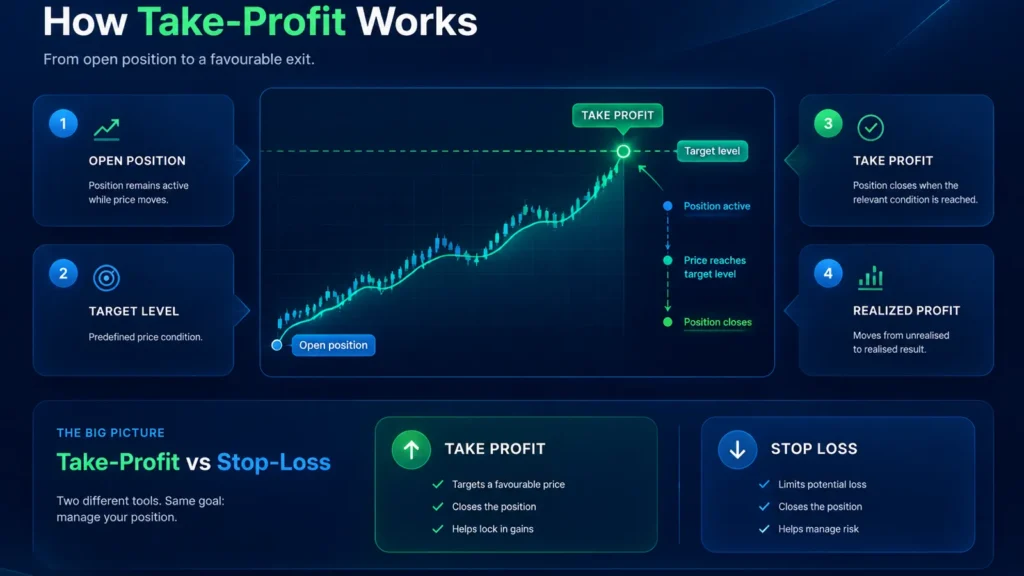
A take-profit order is commonly described as an instruction linked to an open position that can automatically close that position once price reaches a chosen favourable level. Before that level is reached, any gain on the position is described as unrealised — it exists only on paper and can still change as the market moves. Once the take-profit order executes, the gain becomes realised, meaning it is locked in and no longer affected by subsequent price movement.
How Take Profit Works
The mechanics differ slightly depending on the direction of the position. On a long position (a trade opened by buying), the take-profit level is typically set above the entry price, so the order closes the position by selling once that higher level is reached. On a short position (a trade opened by selling), the take-profit level is typically set below the entry price, closing the position through a buy order. In both cases, execution depends on several factors beyond the price level itself, including available liquidity, broker infrastructure, and the specific mechanics of the trading platform being used.
Take Profit vs Stop Loss
| Feature | Take-Profit Order | Stop-Loss Order |
| Associated with | A predefined favourable price movement | A predefined unfavourable price movement |
| General purpose | May help lock in gains at a chosen level | May help limit the size of a potential loss |
| Position outcome | Realises a gain if reached | Realises a loss if reached |
| Execution style | Often linked to limit-order mechanics | Often linked to stop-order mechanics |
Take profit is associated with a predefined favourable exit, while stop loss is associated with an unfavourable price movement. Some traders combine both within a broader trade-management approach — sometimes referred to as using stop loss and take profit together, or “SL and TP” — though neither order is a mandatory component of every trade, and their use varies by individual approach and by broker.
Why Exit Planning Matters in Forex Trading
Exit planning is sometimes treated as being just as significant as entry considerations when a trading position is being analysed, since the difference between an open position and a closed one is what ultimately determines a realised result.
- Predefined exit conditions can be set before a trade is opened, rather than decided during live market movement.
- Exit planning is commonly discussed alongside entry analysis, since both affect the overall shape of a trade.
- Time horizon (short-term, medium-term, or longer-term) can influence how an exit is conceptualised.
Educational discussions of forex order types commonly treat take-profit and stop-loss instructions as distinct mechanisms, each associated with a different market condition, rather than as a single combined tool.
Role of Predefined Exit Levels
Predetermined exit conditions can reduce the need for real-time discretionary decisions, which some traders describe as a potential psychological benefit — it removes the need to make a fast decision while a market is actively moving. However, a predefined level does not eliminate market risk; price can still move in unexpected ways, and execution is never guaranteed.
Balance Between Profit Target and Market Movement
There is a natural tension between closing a position at a predefined level and remaining exposed to a potentially longer market movement. If price continues favourably after a take-profit level has already closed the position, the additional movement is not captured — a situation often described in terms of opportunity cost.
Time Horizon and Exit Planning
Short-term approaches may involve positions held for minutes or hours, medium-term approaches may span days, and longer-term approaches may extend across weeks or months. Each time horizon can involve different expectations about how long a position might remain open and how an exit level is conceptualised relative to typical price movement over that period.
Factors That Influence Take-Profit Levels
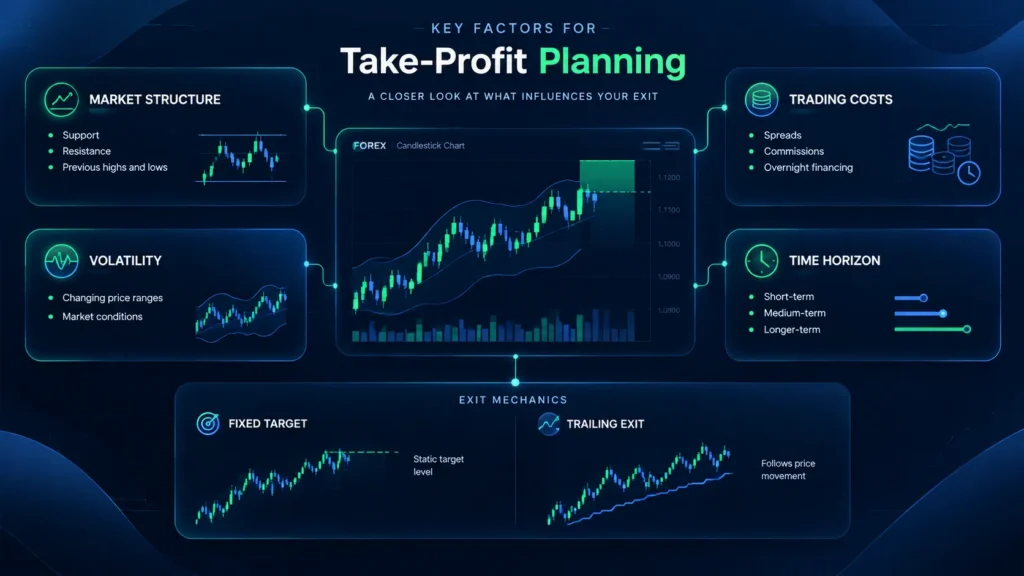
Several analytical factors are commonly associated with how traders think about take-profit placement, though none of them function as a formula or guaranteed method.
- Market structure, including prior highs and lows.
- Volatility and prevailing market conditions.
- Trading costs, including spread and commissions.
- Overall time horizon of the position.
Support and Resistance
Previous highs, lows, and other visible price zones — commonly referred to as support and resistance — are often referenced when traders conceptualise potential exit areas. A resistance zone, for example, is a price level where selling interest has previously appeared, which some market participants associate with a potential area where upward movement could slow.
Volatility and Market Conditions
Market volatility can affect both the distance and reliability of a potential price target. During periods of elevated volatility, price fluctuations tend to be larger, spreads can widen, and execution can become less predictable compared with calmer market conditions.
Trading Costs and Spread
Spread (the difference between the buy and sell price), commissions, and overnight financing charges are all transaction-related costs that can affect the gap between a theoretical price target and the actual financial result once a position is closed. These costs apply across instruments, including CFDs and other leveraged products.
Take-Profit Methods in Forex Trading
Several approaches to profit-taking are commonly discussed in educational material. None is presented here as superior to another — each carries a different balance of simplicity and flexibility.
| Method | General Description | Common Trade-Off |
| Fixed price target | One predefined level closes the full position | Simple, but price may continue moving afterward |
| Multiple take-profit levels | Position divided into portions with separate levels | More complex, changes exposure gradually |
| Trailing exit approach | Exit condition adjusts as price moves favourably | Can stay exposed longer, but may exit early on reversals |
Fixed Price Target
A fixed price target involves selecting one predefined level at which a position may be closed. This approach is often described as straightforward, though it carries the possibility that price continues moving in the same direction after the position has already been closed.
Multiple Take-Profit Levels
Some traders divide a position into several portions, each associated with a different potential exit level. Partial exits of this kind can change a trader’s overall exposure over time and introduce a more layered position-management structure compared with a single fixed target.
Trailing Exit Approach
A trailing mechanism differs from a fixed take-profit level by allowing the exit condition to adjust as price moves favourably, rather than remaining static. This is sometimes associated with the potential to stay exposed to a longer price movement, though it also carries the possibility of a premature exit if price reverses temporarily before resuming its original direction.
Take Profit and Risk-Reward Relationship
The relationship between potential profit and potential loss is a concept frequently discussed in relation to take-profit and stop-loss placement, though it is presented here descriptively rather than as a formula or rule.
Potential Reward and Potential Risk
Potential reward generally refers to the distance between an entry price and a take-profit level, while potential risk generally refers to the distance between an entry price and a stop-loss level. Traders and analysts sometimes compare these two dimensions when evaluating a trading idea conceptually.
Risk-Reward Ratio as Analytical Concept
A risk-reward ratio is a descriptive way of expressing the relationship between potential gain and potential loss on a given position, rather than a recommended target. Adjusting an exit level changes this theoretical ratio, illustrating how take-profit and stop-loss placement are conceptually linked.
Limitations of Risk-Reward Analysis
A favourable theoretical risk-reward ratio does not guarantee a profitable outcome. The probability of price actually reaching a chosen target, changing volatility, execution conditions, spread, and slippage can all affect whether a theoretical relationship translates into an actual result.
Common Take-Profit Mistakes and Limitations
A predefined exit does not remove uncertainty from forex trading, and several conceptual issues are commonly discussed in relation to profit-taking.
- Setting a target without reference to visible market structure or volatility.
- Adjusting a target after a position is already open.
- Closing exposure too early relative to a larger move.
- Maintaining exposure too long while a target is not reached.
Setting Targets Without Market Context
Arbitrary or purely psychological targets — for example, a round number chosen without reference to market structure — may fail to account for prevailing volatility, support and resistance, or transaction costs, which some educational sources associate with less consistent outcomes.
Moving Targets During Open Positions
Changing an initially defined target while a position remains open can alter the original exit concept entirely. This is sometimes discussed in relation to emotions such as greed, fear, or hesitation, though no single response to this situation is being prescribed here.
Exiting Too Early or Too Late
Two opposing limitations are often discussed together: closing exposure before a larger movement develops, and maintaining exposure while expecting a target that the market ultimately does not reach. Both outcomes can occur, since future price movements remain inherently uncertain.
Take-Profit Execution and Market Conditions
A theoretical take-profit level and the actual executed price are not always identical, and the difference is generally explained by market mechanics rather than platform-specific instructions.
Limit Orders and Take Profit
Take-profit orders are commonly associated with limit-order mechanics, meaning the order is designed to execute at a specified price or better. A desired price level does not automatically guarantee that an order will be filled under all market conditions, particularly during fast-moving markets.
Slippage and Fast Markets
Slippage refers to a difference between an expected execution price and the price at which an order actually fills. Rapid price movement, reduced liquidity, and major economic-data releases can all contribute to slippage, meaning quoted prices and executed prices can diverge, especially during a volatile market.
Platform and Broker Differences
Available order types, execution models, and specific order conditions can differ between trading providers. Technical characteristics of a take-profit order — such as how it interacts with a stop-loss order on the same position — may therefore vary across different trading environments, which is one reason traders are often encouraged to review a provider’s own order documentation directly.
Take profit in forex trading is a mechanism for defining a potential exit point in advance, distinct from — but often discussed alongside — stop-loss orders. Exit planning commonly involves market structure, volatility, trading costs, and time horizon, and predefined levels do not remove execution risk such as slippage. Take-profit methods, including fixed targets, multiple levels, and trailing approaches, each carry different trade-offs.
None of these concepts should be interpreted as a guarantee of profitable results, and trading forex and CFDs carries a meaningful risk of loss. Readers who want to go further may find it useful to review forex stop-loss orders and general forex trading strategies as related educational topics.
FAQ
What Is Take Profit in Forex?
A take-profit order is an instruction attached to an open forex position that can automatically close the position once price reaches a specified favourable level, converting an unrealised gain into a realised one.
How Does Take Profit Differ From Stop Loss?
Take profit is associated with closing a position after a favourable price movement, while stop loss is associated with closing a position after an unfavourable price movement. They serve different, complementary functions within an overall trade structure.
Is Take Profit Guaranteed to Execute at Exact Price?
Execution can depend on liquidity, the speed of price movement, broker-specific conditions, and order mechanics, so a specified take-profit level should not automatically be interpreted as a guaranteed fill price, particularly during fast or thin markets.
Can Take Profit Be Used With Long and Short Positions?
Yes. On a long position, the take-profit level is generally set above the entry price and closes the trade via a sell. On a short position, it is generally set below the entry price and closes the trade via a buy.
What Factors Affect Take-Profit Levels?
Market structure such as support and resistance, prevailing volatility, trading costs including spread, overall time horizon, and broader market conditions are commonly considered when analysing potential exit levels.
Can Take Profit Limit Further Gains?
Yes, conceptually. Once a position closes at a predefined target, any subsequent favourable price movement is no longer captured by that position — an outcome often discussed in terms of opportunity cost.