Common Forex Trading Mistakes: 10 Errors Beginners Should Avoid

Every trader who starts trading in the forex market eventually encounters a familiar set of pitfalls. Common forex trading mistakes rarely come down to a single bad trade — they usually stem from a combination of risk, planning, psychology, and limited market knowledge.
Before exploring these patterns, it helps to understand how the market itself works; a broader overview of forex trading explained provides useful background on the mechanics involved. This article examines ten recurring errors that beginner traders may encounter, describing why they happen and what their potential consequences can look like, in neutral and educational terms rather than as a prescriptive guide.
Key Takeaways
- Recurring themes across these mistakes include excessive leverage, oversized exposure, emotional decision-making, insufficient planning, overtrading, and limited market knowledge.
- Recognizing behavioral and planning patterns can offer useful context when reviewing past activity.
- Forex trading, and CFD trading more broadly, involves significant financial risk, and past market behavior does not guarantee future outcomes.
- None of the points below should be read as trading instructions — they describe concepts and tendencies rather than specific actions.
10 Common Forex Trading Mistakes Beginners Should Avoid
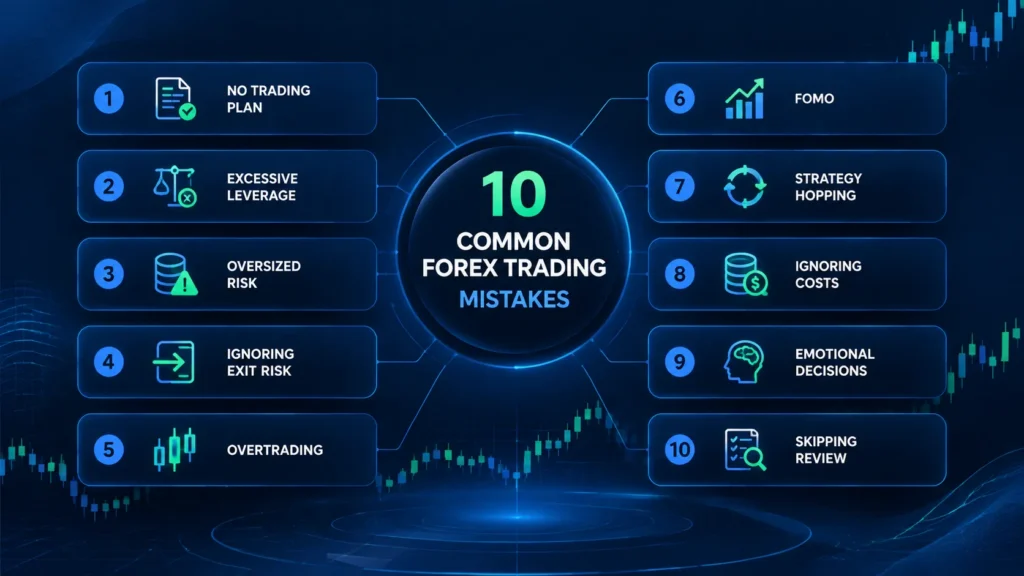
Beginner traders entering the forex market often encounter the same recurring errors, regardless of the currency pair, broker, or trading platform involved. The sections below describe each pattern conceptually.
1. Trading Without a Clear Plan
Trading without a plan means making decisions without predefined criteria for entries, exits, or risk exposure. When choices are driven mainly by short-term price movement rather than a consistent framework, trading activity can become inconsistent from one trading day to the next. A trading plan is generally understood as a conceptual structure for organizing market observations, risk considerations, and decision-making criteria, rather than a rigid checklist.
- A trading plan may outline the markets or currency pairs a trader is generally interested in.
- It may describe the type of market conditions a trader considers relevant.
- It can include general risk considerations rather than specific formulas.
2. Using Excessive Leverage
Leverage (finance) allows a trader to control a larger market exposure relative to the capital deposited in a trading account. This mechanism can amplify both potential gains and potential losses, which is why leveraged forex exposure is often associated with higher volatility in account value. Because leverage magnifies the effect of price movement, relatively small shifts in a currency pair can have a disproportionately large impact on an account balance.
In simple terms, a margin calculation might be expressed as:
Margin = Position Size / Leverage
This relationship illustrates why higher leverage ratios reduce the margin required to open a position, while simultaneously increasing the sensitivity of the account to price fluctuations.
3. Taking Excessive Position Risk
Position size refers to the volume of a trade relative to an account’s overall capital. Oversized positions can magnify the impact of ordinary market fluctuations, meaning that even typical volatility may produce outsized effects on an account. Position size, overall account exposure, and total risk are related but distinct concepts — a single large position can affect an account differently than several smaller ones spread across multiple currency pairs.
| Concept | Description |
| Position Size | The volume or quantity of an asset involved in a single trade |
| Account Exposure | The proportion of total capital affected by open positions |
| Overall Risk | The combined effect of leverage, position size, and market volatility |
4. Ignoring Stop-Loss and Exit Risk
A stop-loss order is generally described as a risk-control mechanism used to define a predetermined exit point for a position. When predefined exit conditions are removed, widened, or ignored, potential losses on a position are no longer bound by the original parameters considered when the trade was opened. Reviewing forex risk controls can provide additional conceptual context on how exit-related tools function within a broader risk management framework.
5. Overtrading After Losses or Wins
Overtrading describes an increase in trading activity that is not necessarily connected to market opportunity. Revenge trading, a related concept, refers to the tendency to open new trades shortly after a loss in an attempt to recover it quickly. Emotion — including frustration, excitement, or boredom — can influence how often a trader opens new positions, regardless of whether market conditions actually support increased activity.
- Frustration following a losing trade may lead to rapid re-entry into the market.
- Excitement after a winning trade can encourage larger or more frequent positions.
- Boredom during quiet market periods may contribute to trading without a specific rationale.
6. Chasing Market Moves and FOMO
Fear of missing out, often abbreviated as FOMO, describes a reactive response to a currency pair that has already made a significant move. Momentum chasing, social-media influence, and headline-driven decisions are commonly associated with this pattern. Rapidly changing markets can create psychological pressure that contributes to decisions made after a price move has largely already occurred rather than before it.
7. Constantly Switching Strategies
A trading strategy typically refers to a defined methodology for analyzing markets and identifying potential opportunities. Beginners sometimes abandon one methodology after a small number of unsuccessful outcomes, moving between indicators, timeframes, currency pairs, or approaches. Frequent strategy switching can make it difficult to distinguish between unfavorable market conditions and genuine weaknesses within the methodology itself, since neither is given sufficient time to be evaluated.
8. Ignoring Trading Costs and Market Conditions
Trading costs include spreads, commissions, swaps, and slippage (finance), all of which can influence overall trading outcomes over time. Market liquidity and volatility (finance) can also change how a given strategy behaves — an approach that appears consistent during quiet conditions may behave differently during highly volatile or news-driven periods.
| Cost Type | Description |
| Spread | Difference between the buy and sell price of a currency pair |
| Commission | A fee charged by a broker per trade, depending on account type |
| Swap | An overnight financing charge or credit for holding a position |
| Slippage | The difference between an expected and an actual execution price |
9. Letting Emotions Drive Trading Decisions
Trading psychology is a field that examines how fear, greed, overconfidence, loss aversion, and confirmation bias can influence trading behavior. The concept of greed and fear is often used descriptively to explain shifts in market sentiment as well as individual decision-making. Emotional reactions may contribute to premature exits, extended holding of losing positions, increased trading activity, or deviation from a previously considered approach.
10. Skipping Education and Trade Review
Insufficient understanding of forex mechanics, economic events, currency correlations, margin, and order types can contribute to avoidable errors. Many beginners use a forex trading demo account as a way to become familiar with a trading platform, such as MetaTrader 4 or charting tools like TradingView, before engaging in live trading. Trade journaling and performance review are commonly described as analytical methods for identifying recurring behavioral patterns, rather than mandatory procedures.
Why Forex Trading Mistakes Often Become Repeated Patterns
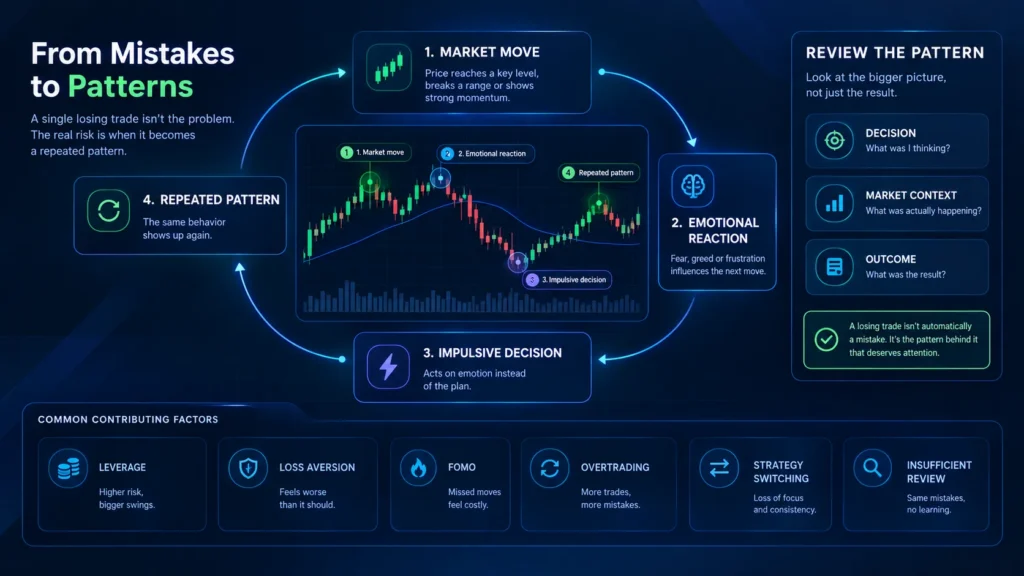
Individual mistakes rarely occur in isolation. The interaction between risk, psychology, and planning often explains why certain errors tend to repeat themselves over time.
Risk Management, Psychology, and Planning Are Connected
One mistake can trigger another. Excessive exposure, for example, may increase emotional pressure on a trader, which can then contribute to overtrading or impulsive decisions. Because these factors are interconnected, a single planning gap can influence behavior across multiple trades rather than remaining contained to one.
Short-Term Results Can Reinforce Bad Habits
An unusually profitable trade may create overconfidence, while a temporary loss may encourage revenge trading or sudden strategy switching. Isolated outcomes — whether profit or loss — do not necessarily demonstrate the overall quality of a trading approach, since a single result can be influenced by chance as much as by process.
Market Conditions Can Change the Impact of Mistakes
Volatility, liquidity, and economic announcements can all influence how the same trading behavior plays out in different circumstances. A position that appears manageable during a quiet trading period may behave very differently during a high-impact news event, even if the underlying decision-making process was identical.
How Beginners Can Recognize Recurring Forex Trading Errors
Identifying patterns in past trading activity is generally considered more informative than evaluating individual trades in isolation.
Reviewing Decision Patterns Instead of Single Outcomes
Evaluating the reasoning and circumstances behind a trade can offer more insight than focusing solely on whether that trade produced a profit or a loss. A profitable trade made without a clear rationale and a losing trade made with sound reasoning may reflect very different underlying processes.
Using a Trading Journal for Behavioral Analysis
A trading journal is often described as a record of factors such as market conditions, emotional state, rationale, execution issues, and outcome for each trade. Over time, this type of record can help reveal recurring patterns that might not be obvious when individual trades are viewed separately.
- Market conditions present at the time of the trade
- The reasoning or setup that prompted the decision
- Emotional state before and during the trade
- Any execution issues, such as slippage or delayed order fills
- The eventual outcome and any post-trade observations
Distinguishing Market Losses From Avoidable Errors
A losing trade does not automatically represent a mistake. Financial markets, including the foreign exchange market, involve inherent uncertainty, meaning that a reasonable, well-considered decision can still result in a loss. The distinction between an expected negative outcome and an error caused by impulsive behavior, excessive exposure, or insufficient preparation is a central theme across many of the patterns discussed above.
Trading forex and other leveraged instruments, including CFDs, carries a high level of risk and may not be suitable for all investors. Losses can exceed initial deposits, and past performance does not guarantee future results.
FAQ
What are the most common forex trading mistakes beginners make?
Beginner traders frequently encounter a recurring set of errors, particularly excessive leverage, oversized positions, lack of planning, overtrading, emotional decision-making, and insufficient education. These patterns tend to reinforce one another rather than occurring independently, which is why they are often discussed together in educational contexts.
Why do beginners make so many forex trading mistakes?
A combination of unfamiliar market mechanics, the effects of leverage, psychological pressure, limited experience, and unrealistic expectations can all contribute to repeated errors. Because forex markets operate continuously and react to a wide range of economic factors, new traders often face a steep learning curve when adjusting to real market conditions.
Is overtrading a common forex trading mistake?
Overtrading refers to an increase in trading activity that is not necessarily driven by genuine market opportunity. It can develop after emotionally significant outcomes, such as a loss or a win, or during periods of boredom. Excessive trading activity may also increase exposure to trading costs and the influence of short-term emotional decision-making.
Why is leverage considered risky in forex trading?
Leverage allows traders to control a larger market exposure relative to their deposited capital, which amplifies both potential gains and potential losses. Because leverage increases the sensitivity of an account to price movement, relatively small fluctuations in a currency pair can have a larger effect on account value than would occur without leverage.
Can emotional decisions affect forex trading results?
Emotion — including fear, greed, FOMO, frustration, and overconfidence — can influence trading behavior in various ways. These reactions may contribute to deviations from a previously considered approach, such as exiting a position early, holding a losing trade longer than planned, or increasing trading activity without a clear rationale.
Does every losing forex trade mean a mistake was made?
Not necessarily. Losses are an inherent possibility in financial markets, and an unfavorable outcome alone does not establish that the underlying decision was flawed. A well-reasoned trade can still result in a loss due to market uncertainty, while a poorly reasoned trade could occasionally result in a profit by chance.
Why do beginners switch forex strategies frequently?
Strategy switching is often described as a response to short-term losses, conflicting information encountered online, indicator overload, or unrealistic expectations about how quickly results should appear. Frequent switching can make it difficult to evaluate whether a given trading strategy is genuinely ineffective or simply had insufficient time to be assessed.
How can trading costs affect forex performance?
Spreads, commissions, swaps, and slippage can all influence trading outcomes, particularly when trading activity is frequent or when market liquidity changes. These costs are generally considered a structural part of trading rather than something that can be avoided entirely, which is why they are often factored into broader discussions of market conditions.
Why is a trading journal useful for identifying forex mistakes?
A trading journal creates a historical record of trades that can help reveal repeated behavioral, planning, and execution patterns that might not be obvious when individual trades are considered separately. Reviewing this type of record over time is commonly described as a way to better understand tendencies in decision-making.