Forex Fundamental Analysis: Economic Factors That Move Currency Prices


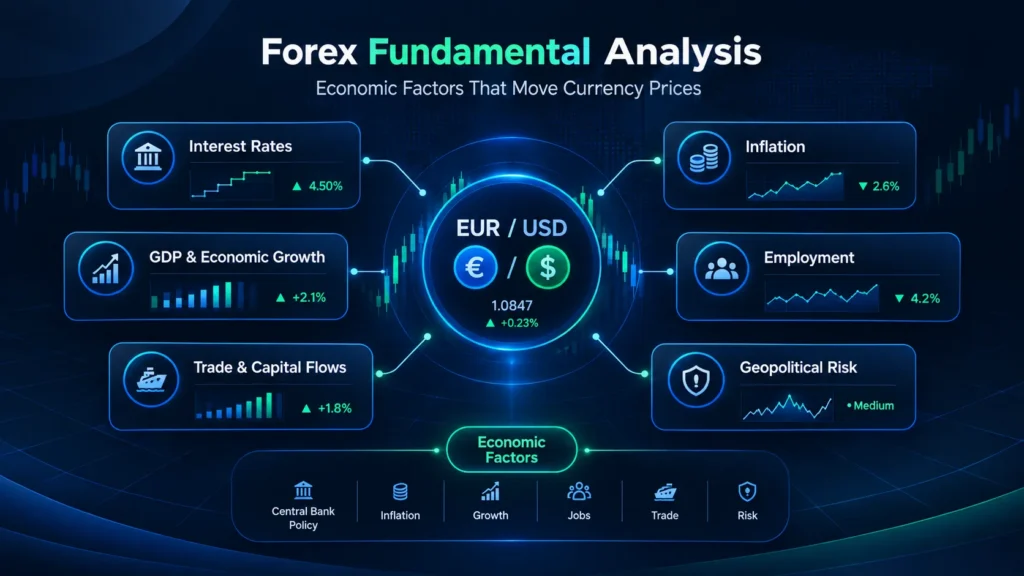
Forex fundamental analysis is the study of economic, monetary, financial, and political conditions that can influence the relative value of one currency against another. In the foreign exchange market, prices rarely move in isolation — they respond to shifting expectations about growth, inflation, interest rates, and capital flows.
For traders exploring this topic, a complete forex trading guide can offer broader context on how the market operates day to day. This article introduces the main economic drivers behind currency valuation and explains, in simple terms, why currencies are always assessed relative to one another rather than in isolation. It also briefly distinguishes fundamental analysis from technical analysis, which is covered in more depth later in the article.
Key Takeaways
- Currency prices are often influenced by interest rates, central bank policy, and monetary policy decisions.
- Inflation, measured through indicators like the consumer price index, can shape expectations about future policy.
- Gross domestic product and other growth indicators may affect perceptions of economic strength.
- Employment data, trade balances, and capital flows can contribute to longer-term currency trends.
- Fiscal policy, political stability, and geopolitical developments are also commonly cited as fundamental drivers.
- Commodity prices, including oil, can be particularly relevant for certain economies and currencies.
- Market expectations often matter as much as the economic data itself, according to the CFA Institute’s research on macroeconomic analysis.
- Fundamental analysis has recognized limitations, particularly around short-term price movements and unexpected events.
What Is Forex Fundamental Analysis?
Fundamental analysis, in the context of the foreign exchange market, refers to the examination of economic, monetary, financial, and political conditions that can influence the relative value of a currency. This approach differs from technical analysis, which focuses primarily on historical price behavior and chart-based data rather than underlying economic conditions.
Currency Value and Economic Conditions
The value of a currency is often connected to expectations about economic strength, monetary stability, and potential investment returns. Stronger economic data does not automatically translate into currency appreciation, however, because the market may have already anticipated the information. In simple terms, currency value reflects expectations as much as current conditions.
Relative Strength Between Two Economies
Currency pairs such as EUR/USD, GBP/USD, and USD/JPY require a comparison between two separate economies rather than an assessment of a single country. Differences in growth, inflation, and interest rates between the United States and the eurozone, for example, can shift the relative attractiveness of the euro against the U.S. dollar over time.
Fundamental Analysis and Technical Analysis
Fundamental analysis is generally understood as focused on economic and financial drivers, while technical analysis is often associated with historical price trends and market patterns. Neither approach is presented here as superior; each may serve a different purpose depending on the trader’s objectives, time horizon, and the type of asset being examined.
Interest Rates and Central Bank Policy
Interest rates are frequently described as one of the most significant fundamental influences on currency markets. Central bank decisions on policy rates can affect bond yields, cross-border capital flows, and the relative appeal of assets denominated in a given currency, which is why market participants often monitor central bank communication closely.
Interest Rate Differentials
The difference between interest rates in two economies — known as the interest rate differential — can influence currency demand more than the absolute level of either rate. A currency offering a comparatively higher yield may, in some market conditions, attract additional capital, though this relationship is not guaranteed to hold at all times.
Central Bank Decisions
Central bank announcements covering rate increases, rate cuts, or policy pauses can influence currency markets. Reaction is often driven not only by the decision itself but also by the accompanying statement, since the tone of the communication can reveal how policymakers view future economic conditions and risks to their outlook.
Forward Guidance and Policy Expectations
Forward guidance is a tool central banks use to communicate the likely future course of monetary policy, allowing individuals and businesses to factor this information into decisions before any actual rate change occurs, according to the Federal Reserve. Expectations about future inflation and growth can shape this guidance considerably.
Inflation and Purchasing Power
Inflation can affect currencies both directly, through changes in purchasing power, and indirectly, through its influence on monetary policy decisions. Persistent inflation may alter expectations about future interest rates, which in turn can shape how a currency is valued relative to others in the market.
Consumer Price Index and Inflation Data
The consumer price index measures the average change over time in prices paid by urban consumers for a representative basket of goods and services, according to the U.S. Bureau of Labor Statistics. Monthly CPI releases are widely followed because they can attract significant attention in currency markets.
Core and Headline Inflation
Headline inflation includes all items in the basket of goods and services, while core measures typically exclude more volatile components such as food and energy. Market participants may interpret the two figures differently depending on prevailing conditions, since a temporary spike in one component does not always reflect broader price trends.
Inflation Expectations
Expected future inflation can matter as much as current inflation readings. Changing expectations may affect bond yields, shift monetary-policy expectations, and influence currency demand well before an official data release confirms whether inflation has actually accelerated or slowed.
| Inflation Concept | What It Measures | Common Relevance |
| Headline CPI | All items in the consumer basket | Broad inflation trend |
| Core CPI | Basket excluding food and energy | Underlying price pressure |
| PPI | Prices received by producers | Early cost-pressure signal |
Economic Growth and GDP
Gross domestic product is a broad measure of economic activity, and changes in growth expectations can affect currencies by shaping views on monetary policy, investment conditions, and overall economic resilience. A slowdown or acceleration in growth can influence how a currency is perceived relative to its peers.
GDP Growth Rates
GDP growth indicates whether an economy is expanding or contracting over a given period. Comparisons between the growth rates of two economies can matter for a currency pair, since relative economic performance is often considered alongside interest rate and inflation differentials.
Economic Activity Indicators
- Retail sales figures
- Industrial production data
- Business and consumer confidence surveys
- Consumer spending trends
- Purchasing managers’ indexes
These indicators can provide information about economic momentum between quarterly GDP releases, offering a more frequent, though narrower, view of conditions.
Growth Expectations and Currency Valuation
Markets often respond to changes in expected growth rather than solely to the latest GDP figure. Revised forecasts, whether from government agencies or private economists, can affect expectations for monetary policy and capital flows well before the next official growth release is published.
Employment and Labor Market Data
Employment conditions are commonly considered an important part of fundamental analysis, largely because labor market strength can influence household spending, wage growth, and inflation — all of which can, in turn, factor into central bank policy decisions.
Employment Reports
Employment reports, unemployment rates, and payroll figures are indicators of labor market conditions. These releases can have a notable market impact when the reported figures differ significantly from consensus expectations, particularly in major economies such as the United States.
Wage Growth
Wage growth can offer information about consumer demand and potential inflationary pressure. It is generally considered relevant to central bank policy discussions rather than treated as a standalone currency signal, since wages interact with employment, productivity, and broader price trends.
Labor Market Expectations
Changes in employment forecasts can influence expectations for economic growth and monetary policy before official data is released. Analysts often revise their labor market projections in response to related indicators, such as jobless claims or business hiring surveys.
Trade Balance and Capital Flows
International trade and cross-border capital movements affect currency supply and demand. Trade-related flows and financial flows are typically distinguished from one another, and both can contribute to longer-term currency trends depending on how persistent the underlying imbalances are.
Imports and Exports
The trade balance reflects the difference between a country’s exports and imports. Export and import activity can affect currency demand through the volume of cross-border payments required to settle international transactions involving goods and services.
Foreign Investment
Foreign direct investment and portfolio investment represent sources of cross-border capital flow. Changes in a country’s investment attractiveness — driven by growth prospects, interest rates, or political stability — can influence demand for its currency over time.
Balance of Payments
The balance-of-payments framework combines the current account and the financial account to provide a broader view of international money flows. This wider perspective can help explain currency trends that are not fully captured by trade data alone.
Fiscal Policy, Politics, and Geopolitical Conditions
Government policy, political stability, fiscal deficits, public debt, and geopolitical developments can all influence currency valuations. These factors often work through expectations about future economic policy, perceived risk, capital flows, and overall investor confidence.
Government Spending and Fiscal Policy
Changes in taxation, government spending, and borrowing can affect economic growth, interest rates, and perceptions of fiscal sustainability. A widening fiscal deficit, for instance, may raise questions about long-term debt servicing that can factor into currency assessments.
Political Stability and Policy Uncertainty
Political uncertainty can influence capital flows and risk perceptions, though the effect can differ depending on the country, the specific event, and prevailing market conditions. Elections and policy transitions are commonly cited examples of periods with elevated uncertainty.
Geopolitical Risk
Wars, sanctions, trade disputes, and diplomatic tensions are often discussed as potential currency drivers. The concept of safe-haven demand is frequently referenced in this context, though it should not be assumed that any single currency will always benefit from geopolitical stress.
Commodity Prices and Currency Markets
Commodity prices can be particularly relevant for economies that depend heavily on commodity exports or imports. Changes in energy and raw-material prices may influence inflation, trade balances, economic growth, and monetary-policy expectations across different regions.
Oil and Energy Prices
The price of oil is connected to inflation, import costs, and trade balances. Energy-price shocks can affect commodity-exporting and commodity-importing economies differently, since a rising oil price may benefit exporters while raising costs for net importers.
Commodity-Linked Currencies
Currencies such as the Australian, Canadian, or New Zealand dollar are sometimes described as sensitive to commodity-market developments. Multiple economic factors typically influence these currencies simultaneously, so commodity prices are usually considered alongside, not instead of, other indicators.
Terms of Trade
Terms of trade refers to the ratio of export prices to import prices. Changes in this ratio can affect national income and, by extension, currency demand, particularly for smaller open economies with concentrated export sectors.
Market Expectations and Economic Data Surprises
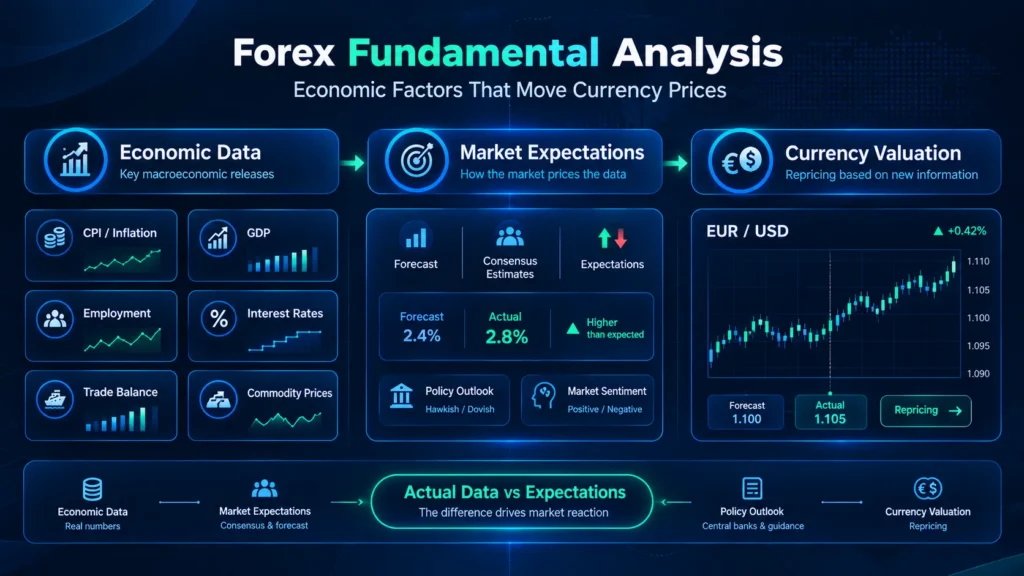
One widely discussed principle in fundamental analysis is that markets tend to respond not only to economic data itself but also to how that data compares with prior expectations. A stronger-than-expected figure can have a different market effect than the same figure released when expectations were already elevated.
Forecasts and Consensus Estimates
Economists’ forecasts and market consensus estimates create expectations ahead of an economic release. These expectations can already be reflected in currency prices before the data is published, which is one reason markets sometimes react in unexpected directions.
Actual Data Versus Expectations
The gap between released data and expected data can shape market interpretation. This pattern applies across inflation, employment, GDP, and central bank decisions, where the surprise element is often described as more influential than the absolute figure.
Market Reaction and Repricing
Currencies can reprice when new information changes expectations about interest rates, economic growth, or future policy direction. The initial market reaction can differ from the longer-term interpretation, as participants continue to assess the broader implications of new data.
How Economic Factors Interact
Fundamental drivers rarely operate independently. A single economic development can influence several variables at once, creating effects that may reinforce or, at times, conflict with one another across different parts of the economy.
Inflation and Interest Rates
Higher inflation can raise expectations for tighter monetary policy while also raising concerns about broader economic conditions. The eventual currency response often depends on which of these dynamics the market weighs more heavily at a given time.
Growth and Employment
Economic growth, labor market conditions, household spending, and inflation are closely related. Collectively, these indicators can shape expectations about monetary policy, since central banks typically consider a range of data rather than any single measure in isolation.
Trade, Commodities, and Capital Flows
Commodity prices can affect trade balances and inflation, while shifting investment conditions can alter capital flows. These interconnected factors illustrate why macroeconomic analysis is generally approached holistically rather than through any one indicator alone.
Economic Calendars and Key Forex Indicators
Economic calendars organize major scheduled data releases and central bank events. Understanding what each indicator measures — and why it matters — is often considered more useful than focusing solely on the timing of individual releases.
High-Impact Economic Releases
- Central bank interest rate decisions
- Inflation reports, including CPI and PPI
- Employment and payroll data
- GDP growth figures
- Retail sales and business activity surveys
Some releases tend to attract more attention than others, often depending on the size of the economy involved and how far the figures deviate from consensus estimates.
Leading, Lagging, and Coincident Indicators
Leading indicators may provide early signals of economic change, lagging indicators tend to confirm conditions that have already developed, and coincident indicators generally reflect the economy as it currently stands. Distinguishing between these categories can help clarify what a given data point is actually communicating.
Revisions and Historical Data
Economic releases are commonly revised after initial publication. Later revisions can change the interpretation of earlier conditions, which is one reason analysts often review a series of data points rather than relying on a single release.
Limitations of Forex Fundamental Analysis
Fundamental analysis cannot fully account for every short-term currency movement. Uncertainty, conflicting indicators, unexpected events, and shifting expectations all contribute to the difficulty of isolating individual causes within a highly interconnected global market.
Conflicting Economic Signals
Inflation, employment, growth, and trade data can sometimes point in different directions. When this happens, interpreting the overall economic picture becomes more complex, and market participants may reasonably reach different conclusions from the same set of releases.
Expectations Already Priced In
Widely anticipated economic developments may have limited additional market impact once they are already reflected in currency valuations. This is one reason a well-anticipated event does not always produce a large price reaction when it occurs.
Unpredictable Events
Political shocks, natural disasters, financial stress, and unexpected policy decisions can alter currency conditions rapidly. These events are, by nature, difficult to forecast, which represents an inherent limitation of any fundamentals-based framework. Readers exploring forex trading strategies may find it useful to consider how such unpredictable developments are generally addressed within a broader risk framework.
For traders based in different time zones, understanding forex sessions in IST can also help place the timing of major data releases in context, since overlapping trading sessions may coincide with periods of heightened data-driven activity — for example around trading the USD/INR pair, where local and U.S. economic releases can both be relevant.
Trading foreign exchange and other leveraged instruments carries a high level of risk and may not be suitable for all investors. Past performance does not guarantee future results, and losses may exceed initial expectations. According to the European Securities and Markets Authority, between 74% and 89% of retail investor accounts typically lose money when trading CFDs, which underscores the importance of understanding these instruments before committing capital.
FAQ
What is fundamental analysis in forex?
Forex fundamental analysis refers to the study of economic, monetary, financial, and political factors that can influence the relative value of a currency. It differs from technical analysis, which focuses on historical price data rather than the underlying economic conditions driving currency movements.
What economic factors move currency prices?
Currency prices can be influenced by interest rates, inflation, GDP growth, employment data, trade balances, capital flows, fiscal policy, commodity prices, and geopolitical conditions. The relative importance of each factor can vary depending on the currency pair and the prevailing market environment.
Why do interest rates affect currency prices?
Interest rate differentials between two economies can influence relative asset yields and cross-border capital flows. A currency offering comparatively higher yields may, in some conditions, attract additional capital, though this relationship depends on broader market sentiment and risk appetite.
Does inflation strengthen or weaken a currency?
The relationship is not automatic. Inflation can affect currencies through purchasing power and, importantly, through its influence on expectations about future monetary policy, meaning the same inflation reading can produce different currency effects depending on context.
Why does GDP affect forex markets?
Economic growth, as measured by GDP, can influence expectations about interest rates, investment conditions, employment, and overall economic strength. Stronger or weaker growth relative to other economies may shift how a currency is valued against its peers.
Why can good economic news sometimes weaken a currency?
Markets often price in expectations ahead of a data release. If positive information has already been reflected in currency valuations, the actual announcement may have a limited or even inverse effect compared with what the headline figure alone might suggest.
What economic reports are most important for forex?
Major categories include central bank decisions, inflation reports, employment data, GDP figures, retail sales, and business activity indicators. Their relative importance can vary by country, economic cycle, and prevailing market conditions at the time of release.
How do geopolitical events affect currencies?
Geopolitical developments can influence risk perception, capital flows, commodity prices, inflation, and monetary-policy expectations. These channels mean that political events can have both direct and indirect effects on currency markets, depending on their scale and duration.