What Is Leverage in Forex Trading – Benefits and Risks for Beginners

For anyone stepping into currency markets for the first time, understanding leverage in forex trading is one of the most essential steps before opening a live account. In simple terms, this mechanism allows traders to control a position whose total market value is far larger than the funds they actually deposit. This guide covers how forex leverage works, what common ratios mean in practice, how margin connects to position sizing, and why controlling risk is more important than chasing maximum exposure.
Key Takeaways
- Leverage in forex trading allows traders to control positions much larger than their deposited capital, using a smaller amount known as margin.
- Forex leverage is expressed as a ratio — such as 10:1, 30:1, or 100:1 — and determines how much market exposure a trader can hold relative to their margin requirement.
- Higher ratios amplify both potential gains and potential losses equally.
- The margin requirement is the capital a broker reserves as collateral to keep an open trade running.
- A margin call is triggered when account equity falls too low to support open positions, potentially leading to forced liquidation.
- Effective leverage — actual exposure relative to account equity — matters far more than the maximum ratio a broker advertises.
- Sound risk management strategies, including defining a maximum loss per trade and maintaining a margin buffer, are essential in leveraged forex trading.
- Past performance does not guarantee future results. Losses in leveraged trading may exceed initial expectations.
What Is Leverage in Forex Trading?
Leverage in forex trading is a facility that allows a trader to control a position whose total market value significantly exceeds the funds held in their trading account. Forex leverage is expressed as a ratio — for example, 10:1, 30:1, 50:1, or 100:1 — where the first number represents the total position value the trader controls and the second represents the portion of that value required as a deposit.
This concept does not involve borrowing cash in the traditional sense. A forex broker does not transfer money to the trader. Instead, the trading platform grants access to a larger position in the market, while reserving a portion of the account equity as collateral. That reserved portion is called the margin requirement. The market risk, however, applies to the full position value — not just the collateral held.
For anyone beginning with a forex trading overview, grasping this distinction early prevents some of the most common and costly beginner mistakes.
How Does Leverage Work in the Forex Market?
The mechanics behind forex leverage work through a direct relationship between position size and the margin a broker requires. The larger the ratio, the smaller the margin needed to open an equivalent position:
Leverage = Total Position Value / Required Margin
Conversely:
Margin Requirement = 1 / Leverage
The table below shows how forex leverage is calculated and what margin percentage each common ratio requires:
| Leverage Ratio | Approximate Margin Requirement |
| 1:1 | 100% |
| 1:10 | 10% |
| 1:20 | 5% |
| 1:30 | 3.33% |
| 1:50 | 2% |
| 1:100 | 1% |
| 1:500 | 0.20% |
A practical example: with a ratio of 1:100, a trader wanting to open a $100,000 position in a currency pair needs to deposit approximately $1,000 as margin. The trading exposure remains $100,000. Any price movement — favorable or unfavorable — is calculated on that full amount, not on the $1,000 held as collateral.
One distinction that surprises many beginners: the ratio does not change pip value. A 0.10-lot EUR/USD position carries an approximate pip value of $1 regardless of whether the account uses 1:30 or 1:500. What changes is only the margin required to open that position. The monetary result per pip is set by the lot size and the instrument — not by the multiplier the broker provides.
Leverage and Margin: Understanding the Relationship
Forex margin and forex leverage describe the same financial relationship from two different angles, and understanding both is central to making sound trading decisions.
The ratio tells a trader how large a position they can hold relative to their deposited margin. Margin in forex is the amount of account equity the broker sets aside as collateral for open positions. Account equity represents the total current value of the account, including any unrealized profit or loss from trades that are still open.
A concrete example helps clarify: suppose a trader opens a 0.10-lot EUR/USD position at a rate of 1.10. The position size is approximately €10,000, or around $11,000. At 1:100, the required margin is approximately $110. Yet the market exposure is still $11,000 — meaning every pip movement affects the full position value, not the $110 in reserve.
For a complete breakdown of how collateral and exposure interact across different account types, reviewing forex margin requirements in detail is a worthwhile step before trading.
Types of Leverage Ratios in Forex
Forex brokers offer different leverage ratios depending on account type, the instrument being traded, and the regulatory framework that governs the broker’s jurisdiction. Understanding what types of leverage ratios exist helps traders assess how much exposure is realistically available to them.
Maximum leverage refers to the highest ratio a broker permits on a given instrument. Regulatory bodies such as the European Securities and Markets Authority (ESMA) apply leverage limits for retail accounts — for example, a cap of 1:30 on major currency pairs for retail clients in Europe. These limits exist to reduce the risk of rapid account losses among less experienced participants.
Effective leverage is the figure that matters most in daily trading practice. It is calculated as:
Effective Leverage = Total Open Position Value / Account Equity
For example, a trader with $5,000 in account equity holding $25,000 in open positions is using effective leverage of 5:1 — even if the broker permits a maximum of 1:500. Keeping this ratio low through conservative position sizing is one of the most straightforward ways to manage risk in the forex market.
This distinction is critical. High maximum ratios advertised by a broker are not the same as the amount of exposure a trader must actually use. Lower leverage ratios in practice — achieved through smaller position sizing — reduce the monetary impact of each adverse price movement.
The Benefits of Using Leverage in Forex Trading
The facility to trade larger positions than deposited capital alone would allow provides several practical advantages, particularly for those working with a smaller amount of capital.
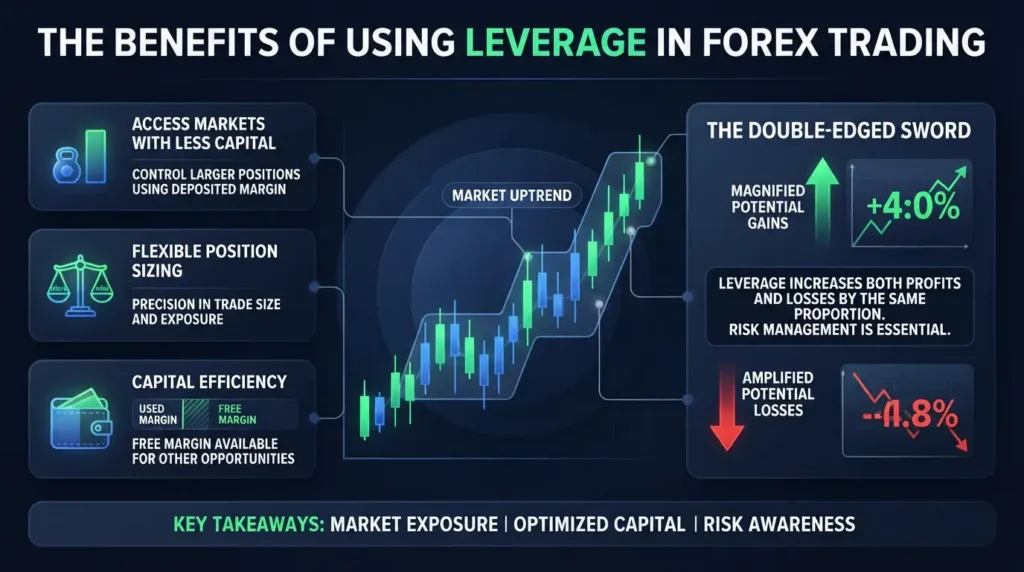
- Access to forex markets with less capital. Without a borrowing mechanism, participating in major currency pairs would require funding the full notional value of every position — an amount well beyond what most retail participants could deploy. This trading power means a trader with a modest account can obtain meaningful market exposure that would otherwise require significantly more funds.
- Flexible position sizing. With this facility available, traders can open smaller increments — such as micro-lots — relative to their account equity. This makes it possible to calibrate exposure precisely, which supports better-structured trading strategies and more accurate risk-per-trade calculations.
- Capital efficiency. Because the full notional value of a position does not need to be deposited, a portion of trading capital remains available as free margin. This free margin can absorb temporary market fluctuations, cover overnight financing costs, or support additional positions where appropriate. However, unused funds are not risk-free if multiple positions are open simultaneously — losses can accumulate across the whole account.
- Potentially magnified percentage returns. Because profits are calculated on the full position exposure, a favorable move can produce a larger percentage gain relative to the margin committed. This same mechanism, however, magnifies losses equally when the market moves in the opposite direction.
Leverage is a double-edged sword: the feature that increases potential gains amplifies potential losses by exactly the same proportion.
The Risks of Leverage in Forex Trading
Leverage risk is proportional to the size of the position held relative to account equity. The larger the position compared to the account, the more severely any adverse price movement affects the available capital.
Losses are magnified equally with gains. A trader who opens a $100,000 position with a $1,000 account faces a 1% adverse move equating to a $1,000 loss — the entire account balance. The fact that the margin required was $1,000 does not limit the loss to that amount. The full position value remains at risk until the trade is closed or stopped out.
Margin calls arrive faster with higher ratios. A margin call occurs when account equity falls below a threshold relative to the margin in use. The broker alerts the trader that the account can no longer fully support open positions. If equity continues falling, the broker may close positions automatically — a process called a stop-out or forced liquidation — to prevent further losses and protect the broker’s own exposure.
The margin level formula most platforms use is:
Margin Level = (Equity / Used Margin) x 100%
When this figure drops below the broker’s defined stop-out threshold — which may be 50% or 100%, depending on the broker — positions begin closing automatically. Traders must always verify their specific broker’s margin call and stop-out levels before opening any trade.
Rapid drawdowns are difficult to recover from. Using oversized positions accelerates losses in a way that makes mathematical recovery increasingly difficult:
| Account Loss | Capital Required to Return to Starting Balance |
| 10% | 11.1% |
| 25% | 33.3% |
| 50% | 100% |
| 75% | 300% |
| 90% | 900% |
After losing 50% of an account, the remaining funds must double in value simply to return to the starting balance. Using excessive leverage is the single fastest route to this outcome.
Gaps and slippage affect stop-loss execution. Stop-loss orders instruct the broker to close a position at a defined price, but execution is not always guaranteed at that exact level. During major news releases, weekend market openings, or episodes of thin liquidity, prices can gap past the stop-loss level. When this happens, the actual loss may exceed the planned loss. Traders should never assume negative-balance protection applies without confirming it directly in the broker’s account agreement.
Overnight financing charges reduce net returns. Positions held past the daily market cutoff may incur swap or rollover charges. On trades held for multiple days, these costs can meaningfully erode profits or add to losses. This cost should be factored into any calculation of a trade’s realistic expected outcome.
What Is a Margin Call and How Does It Connect to Forex Leverage?
A margin call is triggered when account equity falls to a point where it can no longer adequately support the margin required for open positions. At this stage, the broker notifies the trader that additional funds are needed or that trades are at risk of being closed.
Using high leverage ratios means that even a relatively modest adverse market move can reduce account equity enough to reach the margin call threshold. Using lower leverage ratios — by keeping position sizes modest relative to the account balance — creates a larger buffer before the account approaches that level.
The exact margin call level differs between brokers and account types. Before trading, every participant should confirm their specific forex margin requirements and understand precisely when their broker may intervene in open positions.
How to Manage Leverage: A Risk-Based Framework
Effective risk management in leveraged forex trading is primarily about controlling position size relative to the account — not about selecting a particular ratio. Treating the multiplier as a technical facility with defined boundaries, rather than a target to maximize, is a principle that underpins most professional risk management strategies.
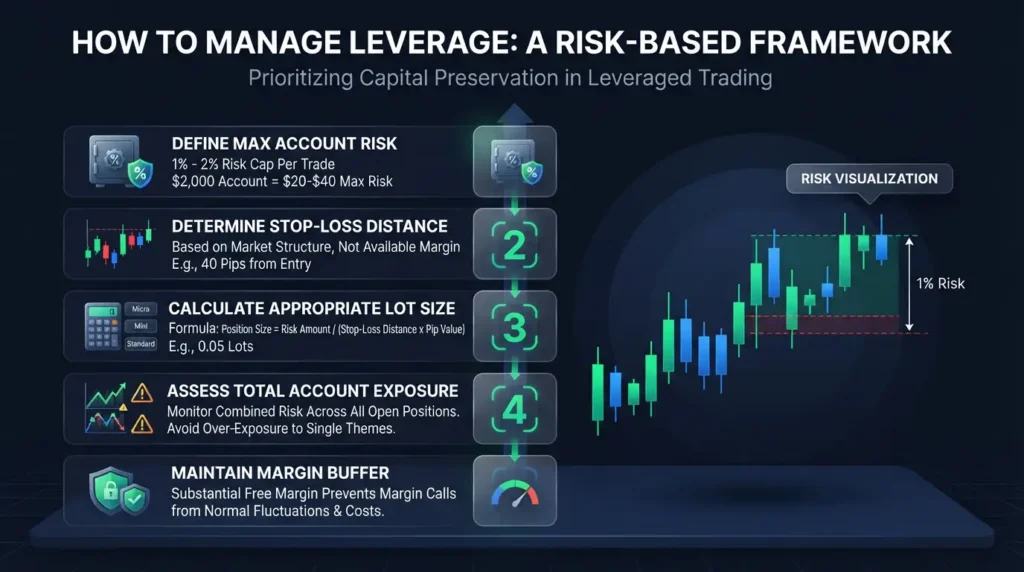
A structured approach to managing leverage involves the following steps:
Step 1 — Define the maximum account risk per trade. A common approach caps risk at 1% to 2% of account equity per trade. On a $2,000 account, this means no single position should risk more than $20 to $40.
Step 2 — Determine the stop-loss distance based on market structure. The stop-loss level should be based on the trade setup, not on the available margin. If the stop-loss is 40 pips from the entry, that distance drives the position size calculation.
Step 3 — Calculate the appropriate lot size. Using the pip value and stop-loss distance:
Position Size = Risk Amount / (Stop-Loss Distance x Pip Value)
For a $20 risk, a 40-pip stop, and a pip value of $10 per standard lot: Position Size = $20 / (40 x $10) = 0.05 lots.
Understanding forex position sizes — including standard, mini, and micro lots — is a prerequisite for this calculation to work correctly.
Step 4 — Assess total account exposure across all open trades. Correlated currency pairs can accumulate risk quickly. Three positions each risking 1% may behave as a single larger trade if all three are exposed to the same underlying market theme.
Step 5 — Maintain a meaningful margin buffer. Keeping a substantial portion of free margin available reduces the likelihood of a margin call from normal market fluctuations, temporary spread widening, or overnight financing costs.
For a more complete framework on protecting trading capital across different market conditions, exploring risk management in forex trading provides a thorough foundation.
Common Misconceptions About Forex Leverage
Several widespread misunderstandings lead beginners into avoidable problems when using this facility for the first time.
- “Higher ratios mean greater profits.” A higher ratio increases the exposure available — it does not improve the probability that any trade will be profitable. The same multiplier that magnifies a winning position magnifies a losing one by exactly the same amount.
- “The broker can only claim the margin as a loss.” Margin is collateral, not a loss cap. An open position can continue losing beyond the initial margin unless it is closed, stopped out, or protected by applicable negative-balance rules. This protection is not universal and must be confirmed in the broker’s terms.
- “Low margin means low risk.” A low margin requirement means less capital is reserved to open the trade. The actual risk remains tied to the full position size and how far the market moves against the trade before it is closed.
- “A 1:500 account forces a trader to use 1:500 exposure.” Maximum available ratios and effective ratios are entirely different figures. A trader can open micro-lot positions on a 1:500 account and operate with very conservative effective exposure in practice.
- “Stop-losses always guarantee the planned loss.” Stop-loss orders are execution instructions, not guarantees. In fast or illiquid markets, the final execution price can differ materially from the requested level.
Leverage Across Different Markets: Forex, CFDs, and Stocks
This borrowing mechanism is not unique to the forex market. CFD trading on indices, commodities, and individual shares also uses it, and options trading incorporates a similar amplifying effect through derivatives. Stock trading in traditional equity markets can also be conducted with borrowed exposure in some jurisdictions, though typically at lower ratios than those available in forex.
The forex market tends to offer some of the highest maximum ratios among retail trading products, partly because major currency pairs generally exhibit lower intraday volatility than individual equities. However, higher maximum ratios in forex do not inherently mean lower overall risk — they mean smaller price moves can produce proportionally larger impacts on the account.
Using excessive leverage across any market — whether forex, CFD trading, or equity derivatives — remains the most consistently cited cause of rapid account depletion among retail participants.
What Level of Leverage Is Appropriate for Beginners?
There is no single correct ratio suitable for every trader or situation. The more meaningful measure for a beginner is the effective exposure — the ratio of total open position value to account equity — rather than the maximum ratio a broker advertises.
A beginner exploring leveraged forex trading may benefit from prioritizing:
- Keeping effective exposure low, regardless of the maximum ratio available.
- Trading micro-lots to minimize the monetary impact of each pip movement.
- Defining a fixed maximum percentage risk per trade before entering any position.
- Always placing a stop-loss before the trade is opened.
- Avoiding multiple highly correlated currency pair positions simultaneously.
- Maintaining sufficient free margin to absorb normal market fluctuations.
A 1:500 account used with micro-lots and strict risk rules can be operated very conservatively. Conversely, a 1:30 account becomes risky quickly if the trader consistently uses the maximum available position size. The ratio printed in the account details matters far less than the effective exposure maintained in practice.
FAQ
Does forex leverage mean I am borrowing money from my broker?
Forex leverage does not function like a conventional loan. The broker does not transfer funds to the trader’s bank account. Instead, the trading platform grants access to a larger position in the market than the trader’s own margin would normally permit, with that margin serving as collateral. Profit and loss are calculated on the full position value, and no loan repayment is required in the traditional sense — though overnight financing charges may apply to positions held past the daily market close.
Can a trader lose more than their deposited funds?
In markets and jurisdictions where negative-balance protection is not provided, a leveraged position could theoretically produce losses exceeding the initial deposit if a severe market move occurs before a stop-out executes. Some brokers and regulatory frameworks provide protection that caps losses at the account balance, but this must always be confirmed directly in the account agreement before any trade is placed.
Is lower leverage always safer?
Lower effective exposure generally reduces the monetary impact of adverse price movements on the account, and most risk management frameworks recommend conservative ratios — particularly for beginners. However, the overall safety of any position also depends on lot size, stop-loss placement, market conditions, and the broader trading strategy. The ratio is one variable within a wider risk management framework, not the only one that matters.
How is forex leverage different from leverage in stock trading?
Both forex and stock trading allow participants to control positions larger than their deposited capital. The key differences lie in the available ratios and the products involved. Forex brokers frequently offer higher maximum ratios than traditional equity brokers, partly because major currency pairs tend to show lower intraday volatility than individual stocks. The fundamental mechanics — how losses are magnified and how margin requirements are calculated — work in a similar way across both markets.
What happens to open positions after a margin call?
When a margin call is triggered, the broker typically alerts the trader that account equity has fallen below the required threshold. If additional funds are not deposited and equity continues to decline, the broker may begin closing open positions through a stop-out process — usually starting with the largest losing trade. The specific margin call level and stop-out threshold vary by broker, account type, and regulatory jurisdiction. Confirming these parameters before placing any trade is an essential step in any sound trading plan.