How to Start Forex Trading in India: A Beginner’s Guide


Wondering how to start forex trading in India? The foreign exchange market is the largest financial market in the world by trading volume, operating 24 hours a day across global financial centres. For beginners in India, entering this market requires understanding both the mechanics of currency trading and the specific legal framework that governs forex activity for Indian residents. This guide covers the fundamentals — from what forex trading means, to how the currency market works, to the steps involved in opening a forex trading account through a regulated Indian broker.
Key Takeaways
- Forex trading in India must be conducted through SEBI-registered brokers on recognised exchanges such as NSE, BSE, or MSE — not through offshore platforms.
- Indian residents may legally trade INR-based currency pairs such as USD/INR, EUR/INR, GBP/INR, and JPY/INR, as well as certain cross-currency contracts.
- Forex trading is legal in India when done through exchange-traded currency derivatives; spot forex and leveraged CFD products offered by international brokers fall outside permitted channels.
- Beginners should start with a demo account, use a written trading plan, and risk only 0.5–1% of capital per position.
- The Reserve Bank of India does not permit remitting margin to overseas exchanges under the Liberalised Remittance Scheme.
- KYC verification, a linked Indian bank account, and separate activation of the currency-derivatives segment are required before trading.
Is Forex Trading Legal in India?
Forex trading is legal in India when conducted through the correct regulated channels. The Securities and Exchange Board of India (SEBI) and the Reserve Bank of India (RBI) govern currency derivative trading for Indian residents. According to RBI guidelines, Indian residents may conduct electronic forex transactions only through RBI-authorised platforms or recognised Indian exchanges.
The legal route for Indian traders involves exchange-traded currency derivatives — specifically futures and options contracts — rather than spot forex or leveraged CFD products commonly advertised by international brokers. Importantly, the RBI has clarified that remitting margin to overseas exchanges or overseas counterparties for online forex trading is not permitted under the Liberalised Remittance Scheme. Assuming that an offshore broker is legal simply because it holds a foreign regulatory licence is a common misconception that can create serious legal and payment risks under the Foreign Exchange Management Act (FEMA).
Understanding the Forex Market: Types and Structure
Types of Forex Markets Available in India
Indian residents can access two primary types of forex market instruments through recognised exchanges:
| Instrument Type | Description | Available On |
| Currency Futures | Contracts to buy or sell a currency pair at a fixed price on a future date | NSE, BSE, MSE |
| Currency Options | Right (not obligation) to buy or sell a currency pair before expiry | NSE, BSE, MSE |
Spot forex trading — where currencies are exchanged immediately at the current market rate — is the dominant form of trading globally, but it is not the permitted route for most Indian retail traders. The exchange-traded derivatives model provides transparency, standardised contract sizes, and regulatory oversight that offshore spot platforms do not.
Currency Pairs Available to Indian Traders
Indian exchanges list INR-based currency contracts, including USD/INR, EUR/INR, GBP/INR, and JPY/INR. Certain cross-currency pairs, such as EUR/USD, GBP/USD, and USD/JPY, are also available where offered by the exchange and broker. On the NSE, one USD/INR futures contract represents USD 1,000 in notional value, while one JPY/INR contract represents JPY 100,000 — making it important for beginners to calculate the rupee equivalent and potential loss before placing any trade. For a full breakdown, the NSE currency derivatives specifications provide official contract details.
How to Begin Forex Trading in India: The Step-by-Step Process
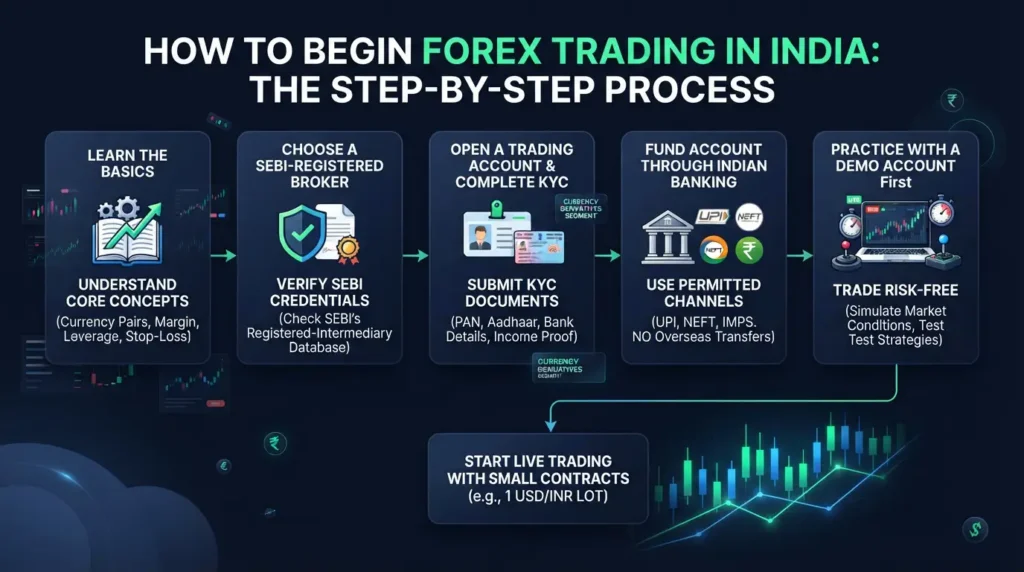
Learn the Basics Before Opening an Account
Before a beginner opens any forex trading account, understanding core concepts is essential. These include: currency pairs, futures and options mechanics, margin requirements, contract expiry, leverage, stop-loss orders, and mark-to-market settlement. A complete forex trading guide provides a structured foundation for building this knowledge. Entering the currency market without this preparation increases the risk of avoidable losses.
Choose a SEBI-Registered Forex Broker
Selecting the right forex broker is one of the most important decisions for any beginner. A broker must be registered with SEBI and authorised to offer the currency-derivatives segment. Traders should verify broker credentials directly through SEBI’s registered-intermediary database rather than relying on advertising or third-party affiliate reviews. A legitimate forex broker in India will clearly display contract specifications, margin requirements, expiry dates, and all applicable charges.
Open a Forex Trading Account and Complete KYC
Opening a forex trading account in India involves submitting standard KYC documentation: PAN card, Aadhaar or address proof, bank account details, and any income information required for derivatives segment activation. Some brokers also require a linked demat account. Importantly, having an equity trading account does not automatically activate currency trading — the currency-derivatives segment must be activated separately. A detailed walkthrough for this process is available in the guide on forex account setup in India.
Fund the Account Through Indian Banking Channels
Account funding must occur through permitted Indian banking channels such as UPI, NEFT, or IMPS. Transferring margin to overseas accounts, personal wallets, or foreign payment systems is not a permitted route for Indian residents and creates FEMA compliance risk.
Practice with a Demo Account First
Before committing real capital, a beginner should practice forex trading using a paper trading or demo account. Demo accounts replicate live market conditions without financial risk, allowing traders to test strategies, become familiar with the trading platform, and understand how exchange rates move in real time. Transitioning from demo to live trading with the smallest available contract size — such as a single USD/INR futures contract — is a widely recommended approach.
Choosing an FX Trading Platform
The trading platform is the software interface through which a trader monitors currency prices, analyses the market, and executes orders. For Indian traders, the platform must support the currency-derivatives segment of the chosen exchange and comply with regulatory standards. Key features to evaluate include charting tools, order types, margin calculators, and access to exchange data. Comparing forex trading platforms before opening an account helps beginners identify a tool that matches their experience level and market access needs.
Traders should verify before depositing funds that the platform executes trades on a recognised Indian exchange, deposits and withdrawals are processed through a verified Indian bank account, and the platform does not make promises of guaranteed returns or request margin payments to personal or overseas accounts.
Key Concepts Every Beginner Trader Must Understand
Leverage
Leverage allows a trader to control a larger position with a smaller initial deposit, known as margin. For example, a leverage ratio of 10:1 means a trader can control a position worth ₹10,000 with a margin of ₹1,000. Leverage increases both potential gains and potential losses proportionally. Exchange-set margin requirements determine the minimum capital needed to hold a position — but margin is not the maximum possible loss. Losses can exceed the margin deposited if the market moves sharply against the position.
Spread
The spread is the difference between the buying price and the selling price of a currency pair. For exchange-traded currency futures in India, trading costs include brokerage, exchange transaction charges, and GST rather than a traditional bid-ask spread in the way offshore brokers structure pricing. Understanding total transaction cost is important for calculating breakeven on any forex trade.
Volatility
Currency price volatility refers to how rapidly and significantly an exchange rate moves over a given period. Highly volatile markets can produce fast profits but also rapid losses, particularly for traders using leverage. Beginners are generally advised to avoid trading during major economic announcements — such as central bank interest rate decisions or inflation data releases — until they have developed sufficient experience to manage the increased volatility risk.
Mark-to-Market Settlement
Exchange-traded currency futures in India use daily mark-to-market settlement. This means the profit or loss on an open futures position is credited or debited to the trader’s account each day based on the closing price. A trader must maintain sufficient funds above the exchange margin requirement to keep positions open. If the account balance falls below the required maintenance margin, a margin call is issued.
Basic Forex Trading Strategies: An Overview
Types of Forex Trading Approaches
Different forex trading strategies are defined primarily by the holding period of a trade and the analytical method used. The following table outlines the main approaches:
| Strategy Type | Holding Period | Core Logic |
| Day Trading | Within a single session | Positions are opened and closed within the same trading day |
| Swing Trading | Several days to weeks | Trades aim to capture medium-term price movements |
| Position Trading | Weeks to months | Longer-term trades based on macroeconomic analysis |
For beginners, understanding the distinction between these approaches helps in selecting a trading plan that aligns with available time, risk tolerance, and market knowledge. NSE lists normal trading hours for INR currency futures as Monday to Friday, 9:00 a.m. to 5:00 p.m. IST, though hours and available products are subject to change.
The Role of a Trading Plan
A trading plan is a written document that defines the rules a trader follows for every decision — including entry conditions, exit conditions, stop-loss levels, position size, maximum daily loss limit, and circumstances under which the trader will not trade. Successful forex trading is widely associated with disciplined adherence to a pre-defined plan rather than reactive decision-making. Emotional trading — making impulsive decisions based on fear or greed — is one of the most commonly cited causes of losses among beginner traders.
Risks of Forex Trading: What Every Beginner Must Know
Forex trading involves significant financial risk, and losses can occur quickly even when the initial margin appears small. This is particularly true when leverage is involved, as a small adverse movement in the exchange rate can result in losses exceeding the initial deposit.
Key risks include:
- Leverage risk: Amplified losses when positions move against the trader.
- Volatility risk: Rapid, unexpected price movements during news events or low-liquidity periods.
- Margin risk: Forced position closure if the account balance falls below maintenance margin.
- Regulatory risk: Using unauthorised platforms can result in legal consequences and loss of deposited funds with limited recourse.
- Operational risk: Platform outages, order execution delays, or connectivity issues during volatile markets.
According to the European Securities and Markets Authority (ESMA), approximately 70–89% of retail investor accounts lose money when trading leveraged products such as CFDs. While Indian exchange-traded derivatives carry a different regulatory structure, the underlying market risk remains significant. Past performance does not guarantee future results, and losses may exceed initial expectations.
Risk Management Rules for Beginner Traders
Risk management is the set of rules and practices a trader uses to limit potential losses on any single trade and across the overall trading account. The following principles are widely recognised as foundational for beginner traders:
- Risk only a small fraction of trading capital per position. A conservative starting limit is often cited as 0.5–1% of total capital per trade.
- Always calculate the stop-loss level before entering a trade. A stop-loss is an order that automatically closes a position if the price moves to a specified level against the trader.
- Maintain sufficient funds above the exchange margin requirement. Margin represents the minimum deposit to hold a position, not the ceiling of possible loss.
- Avoid high leverage, averaging down on losing positions, and trading during major economic news events until sufficient experience has been gained.
- Never use emergency savings, borrowed money, or funds required for living expenses for trading purposes.
Traders should also maintain records of all trade statements for tax reporting purposes. Currency derivative gains and losses in India have specific tax treatment, and consulting a qualified Indian tax professional is advisable before beginning active trading.
How to Verify a Forex Platform or Broker in India
Before depositing any funds, beginners should conduct the following verification checks:
- The broker appears in SEBI’s official currency-derivatives registered intermediary list.
- The trade is executed on a recognised Indian exchange (NSE, BSE, or MSE).
- The broker clearly displays contract specifications, expiry dates, margin requirements, and all applicable charges.
- Deposits and withdrawals are processed through the trader’s verified Indian bank account.
- The platform does not promise guaranteed returns, fixed profits, or ask for margin payments to a personal account or overseas wallet.
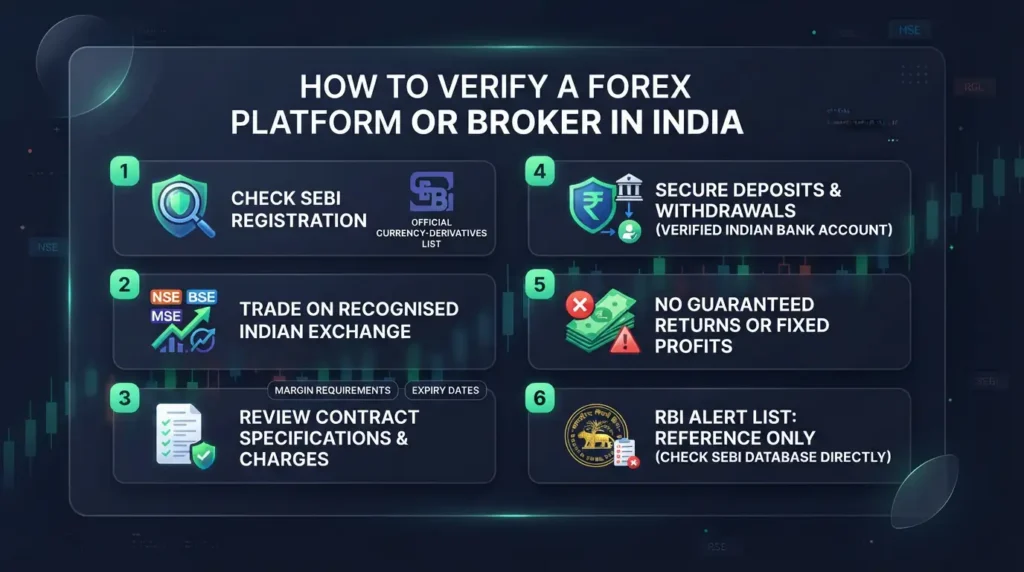
The RBI publishes an Alert List of unauthorised forex trading platforms, which is a useful reference — but this list is not exhaustive. A platform’s absence from the Alert List should not be interpreted as confirmation of authorisation. The only reliable verification is checking SEBI’s registered-intermediary database directly.
A Sensible Path for Beginners Ready to Start Trading Forex
The recommended progression for a beginner entering the world of forex trading in India follows a clear sequence: study the fundamentals → practise with paper trading or a demo account → open a regulated Indian trading account → execute one small INR currency contract → review every trade against the written trading plan.
Starting small is not just a financial precaution — it is a learning strategy. Trading with a micro or minimum-size contract allows a beginner to experience real market conditions, including the emotional dimension of holding a live position, without exposing significant capital to loss. The skills required for successful forex trading — analysis, discipline, emotional control, and risk management — develop through experience, not theory alone. Forex trading offers opportunities for traders who approach the market with preparation, but it is not a shortcut to income and should never be approached as one.
Frequently Asked Questions
What is the minimum amount needed to start forex trading in India?
The minimum capital required depends on the broker and the currency contract being traded. On the NSE, one USD/INR futures contract represents USD 1,000 in notional value, and the initial margin is set by the exchange as a percentage of that value. Brokers may also require a minimum account balance for activation of the currency-derivatives segment. Beginners should calculate the full rupee value of the contract and the potential loss if the trade moves against them before depositing any amount, rather than treating margin as the only figure that matters.
Can I trade international currency pairs like EUR/USD as an Indian resident?
Indian residents may access certain cross-currency futures and options contracts, including EUR/USD, GBP/USD, and USD/JPY, where these are listed by recognised Indian exchanges and offered by a SEBI-registered broker. These contracts are distinct from spot forex trading on international platforms. Trading through offshore platforms that offer spot forex or CFD products falls outside the permitted framework for Indian residents and may carry FEMA-related legal risk.
How does leverage work in Indian currency futures?
In exchange-traded currency futures in India, leverage is expressed through the margin system. A trader deposits a fraction of the total contract value as initial margin, and the exchange’s margin requirements determine this percentage. Leverage magnifies both gains and losses — a 1% adverse move in the exchange rate on a leveraged position can result in a loss significantly larger than 1% of the margin deposited. Beginners are advised to use the minimum available position size and maintain substantial funds above the margin requirement.
What taxes apply to forex trading profits in India?
Currency derivative trading in India has specific tax treatment that differs from equity trading, and the applicable rules can depend on the nature of the activity, the taxpayer’s status, and how gains are classified. Forex trading gains may be treated as business income in certain circumstances. Because tax rules are subject to change and vary by individual situation, consulting a qualified Indian chartered accountant or tax professional before beginning active trading is strongly recommended.
What is the difference between a stop-loss and a margin call?
A stop-loss is an order placed by the trader to automatically exit a position if the price reaches a specified adverse level, limiting the potential loss on that trade. A margin call is a notification from the broker or exchange when the account balance falls below the required maintenance margin level, requiring the trader to deposit additional funds or face forced closure of open positions. A stop-loss is a risk management tool the trader controls; a margin call is a regulatory mechanism the exchange enforces. Using stop-loss orders consistently is considered a foundational practice in disciplined trading.