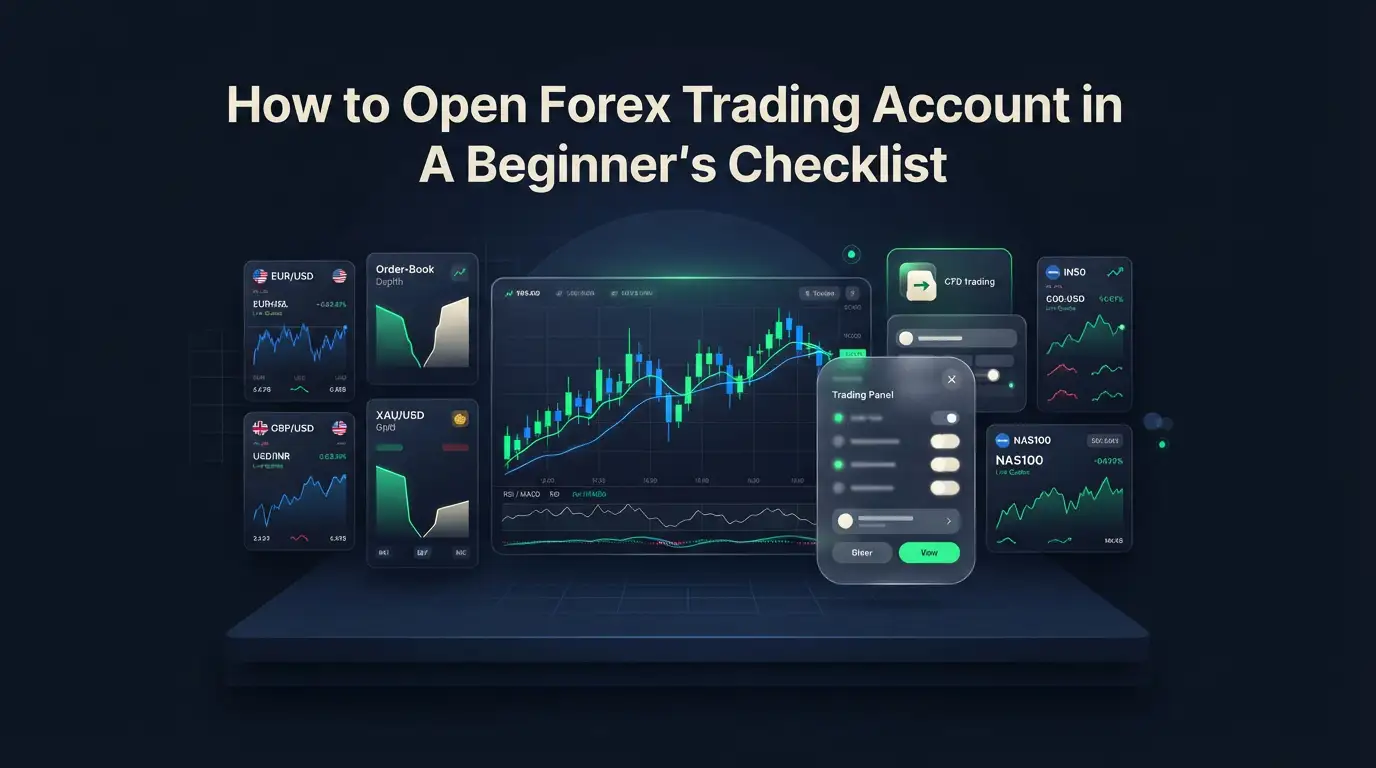
How to Open Forex Trading Account in India: A Beginner’s Checklist

Opening a forex trading account in India is more straightforward than many beginners expect — but doing it correctly requires understanding the regulatory landscape, choosing the right broker, and preparing with the right tools before risking real money. This step-by-step guide for beginners walks through every stage of the process, from understanding what forex trading means to selecting an account type, practising on a demo account, and eventually moving to live trading.
Key Takeaways
- Forex trading in India is legally permitted for currency pairs involving the Indian rupee (INR), regulated by SEBI and RBI under the Foreign Exchange Management Act (FEMA).
- Beginners should open a demo account first to practice trading without risking real money.
- Choosing a reputable forex broker regulated by recognised authorities (such as CySEC or DFSA) is essential for a trustworthy trading environment.
- Account types include standard, micro, cent, and Islamic accounts — each suited to different trading styles and experience levels.
- A trading plan and trading journal are practical tools that support consistent decision-making from the start of a trading journey.
What Forex Trading Means for Beginners in India
Forex trading means buying one currency while simultaneously selling another. Forex trading involves exchanging one currency for another in a global, decentralised market that operates 24 hours a day, five days a week. When a trader buys the EUR/USD pair, forex trading involves the purchase of euros using US dollars — with the expectation that the euro will strengthen against the dollar.
For beginners in India, currency trading typically centres on INR-paired instruments such as USD/INR, EUR/INR, GBP/INR, and JPY/INR. These pairs are traded on recognised exchanges like the NSE and BSE under SEBI’s regulatory framework. Understanding what trading involves at a basic level — the mechanics of buying one currency and selling another — is the essential first step before opening any account.
Types of Forex Markets Beginners Should Learn
Understanding the different types of forex markets helps beginners choose the right instruments and structure their trading strategies accordingly.
| Market Type | Description | Common Use |
| Spot Forex | Currencies exchanged at current market price | Most common for retail traders |
| Forwards | Agreements to exchange currencies at a future date | Hedging purposes |
| Futures | Standardised contracts on exchanges | Institutional and advanced traders |
| CFDs on Forex | Contracts tracking currency price movements | Accessible for retail traders via brokers |
Spot forex is the most widely used format among retail currency traders. CFD-based forex trading, offered by regulated brokers, allows traders to access global currency pairs without taking physical delivery of currency. This format is particularly relevant for those who want to trade forex in India through an internationally regulated platform.
Indian Forex Trading Rules: What Every Beginner Must Know
Forex trading in India is governed by the Reserve Bank of India (RBI) and the Securities and Exchange Board of India (SEBI). Under the Foreign Exchange Management Act (FEMA), Indian residents are permitted to trade currency pairs that include the Indian rupee. Trading cross-currency pairs — for example, EUR/GBP — is also permitted on recognised Indian exchanges.
Trading forex through offshore brokers carries regulatory complexity. While many Indian forex traders use internationally regulated brokers, it is important to understand the distinction between exchange-regulated trading and OTC (over-the-counter) forex trading accessed via foreign platforms. Beginners should consult a qualified financial or legal adviser regarding their specific circumstances before proceeding. For a full breakdown of the legal framework, see this guide to Indian forex trading rules.
How to Open Account and Start Trading Forex: The Step-by-Step Guide
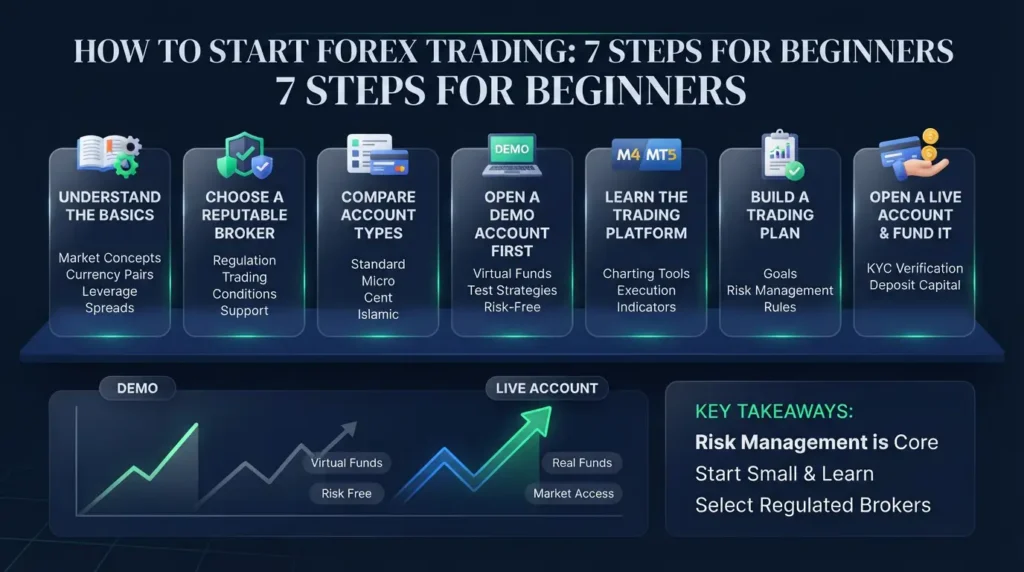
Step 1 — Understand the Basics of Currency Trading
Before opening a forex account, beginners should learn the foundational concepts of how the forex market operates. Forex trading involves understanding currency pairs, pip values, leverage, spreads, margin, and order types. These are not just definitions — they affect every trade executed on a live account.
Leverage allows a trader to control a position larger than their deposit. For example, leverage of 1:100 means that a deposit of $100 controls a position worth $10,000. Leverage amplifies both potential gains and potential losses, which is why risk management is a core skill in any trading system.
Step 2 — Choose a Reputable Forex Broker
Selecting a reputable forex broker is one of the most important decisions a beginner will make. A broker provides access to the forex market, the trading platform, pricing, and order execution. Not all brokers offer the same trading conditions, so comparing key factors is essential.
Key criteria for evaluating a forex broker include regulatory licences, available account types, trading costs (spreads and commissions), leverage options, available currency pairs, and the quality of customer support. For a structured comparison, see top forex brokers in India.
M4Markets is a regulated CFD trading broker operating under licences from the Financial Services Authority of Seychelles (FSA), the Cyprus Securities and Exchange Commission (CySEC, licence 301/16), and the Dubai Financial Services Authority (DFSA, licence F007051). This multi-jurisdictional regulation provides a trustworthy trading environment for traders across different regions.
Step 3 — Compare Account Types
Different account types are designed for different levels of experience and capital. Understanding which account type suits a trader’s goals is an important step before opening an account.
| Account Type | Key Feature | Best Suited For |
| Standard Account | Full lot sizes, typical spreads | Experienced traders |
| Micro Account | Smaller position sizes, lower risk | Beginners learning live trading |
| Cent Account | Positions denominated in cents | Testing strategies with minimal capital |
| Islamic Account | Swap-free, Sharia-compliant | Traders observing Islamic finance principles |
| Demo Account | Virtual funds, real market conditions | All beginners before live trading |
A micro account or cent account allows beginners to start trading forex with reduced financial exposure while still experiencing real market conditions. An Islamic account operates without overnight swap charges, making it suitable for traders whose financial practices are guided by Islamic principles.
Step 4 — Open a Demo Account First
Every beginner should open a demo account before committing real funds. A demo account provides access to a live trading platform using virtual money, allowing traders to practise executing trades, test forex trading strategies, and understand platform features — all without risking real money.
M4Markets offers a demo account that mirrors the exact trading conditions of its live account. The demo account allows traders to select virtual fund amounts, choose leverage settings, and access the full range of MetaTrader platform tools. Opening the demo account involves three steps: completing a registration form, accessing the client portal to select account type and leverage, and downloading the MetaTrader trading terminal.
This risk-free environment is where beginners should develop their trading style, test basic forex trading strategies, and build the confidence needed for live trading. Trading CFDs involves significant risk of loss, and transitioning to a live account before gaining sufficient demo trading experience may increase that risk.
Step 5 — Learn the Trading Platform
A trading platform is the software through which a forex trader accesses the market, places orders, analyses price charts, and manages positions. MetaTrader 4 (MT4) and MetaTrader 5 (MT5) are the two most widely used trading platforms in the retail forex industry.
MetaTrader 4 provides charting tools, technical indicators, automated trading capabilities via Expert Advisors, and one-click order execution. MetaTrader 5 extends these features with additional order types, more built-in indicators, and access to a broader range of instruments including shares and indices. Beginners should use the demo account period to become familiar with their chosen platform before moving to live trading.
Step 6 — Build a Basic Trading Plan
A trading plan is a structured framework that defines how a trader will approach the forex market. It typically includes the trader’s goals, preferred account type, risk tolerance, chosen trading strategies, and rules for entering and exiting positions. A trading plan does not guarantee profitable outcomes, but it provides structure that helps prevent impulsive decision-making.
Beginners in India who are learning how to start forex trading should develop a simple trading plan during the demo account phase. This plan may outline which currency pairs to focus on, how much of the account balance to risk on a single trade, and which basic forex trading strategies to test. Past performance does not guarantee future results.
Step 7 — Open a Live Account and Fund It
Once a beginner has developed sufficient trading experience on the demo account, the transition to a live account becomes the next stage. Opening a live account requires identity verification (KYC), selection of account type, and the deposit of real capital to fund the account.
Funding an account is typically done via bank transfer, card payment, or electronic payment methods, depending on the broker’s available options. Beginners should fund their account with capital they can afford to lose, as forex trading involves significant financial risk and losses may exceed the initial deposit.
Basic Forex Trading Strategies Beginners Should Know
Understanding basic forex trading strategies helps beginners make more informed decisions when they begin live trading. These strategies are not recommendations but are described here for educational purposes.
- Trend Trading involves identifying the general direction of a currency pair’s price movement and taking positions aligned with that direction. Trend trading relies on technical analysis tools such as moving averages and momentum indicators to identify directional bias.
- Range Trading involves identifying price levels where a currency pair has historically reversed direction. A range trading strategy assumes that price will continue to oscillate between support and resistance levels, allowing traders to buy near support and sell near resistance.
- Position-Based Trading involves holding trades for longer periods — days or weeks — based on fundamental analysis of economic data, interest rate decisions, and geopolitical factors. This approach requires a broader understanding of macroeconomic factors affecting currency values.
For a fuller overview of how forex trading works conceptually, see this guide to forex trading explained.
Risks of Forex Trading Every Beginner Must Understand
Forex trading involves a high degree of financial risk. The use of leverage means that losses can exceed the initial deposit. Currency markets are sensitive to economic data releases, central bank policy decisions, geopolitical events, and market sentiment — all of which can cause rapid and unpredictable price movements.
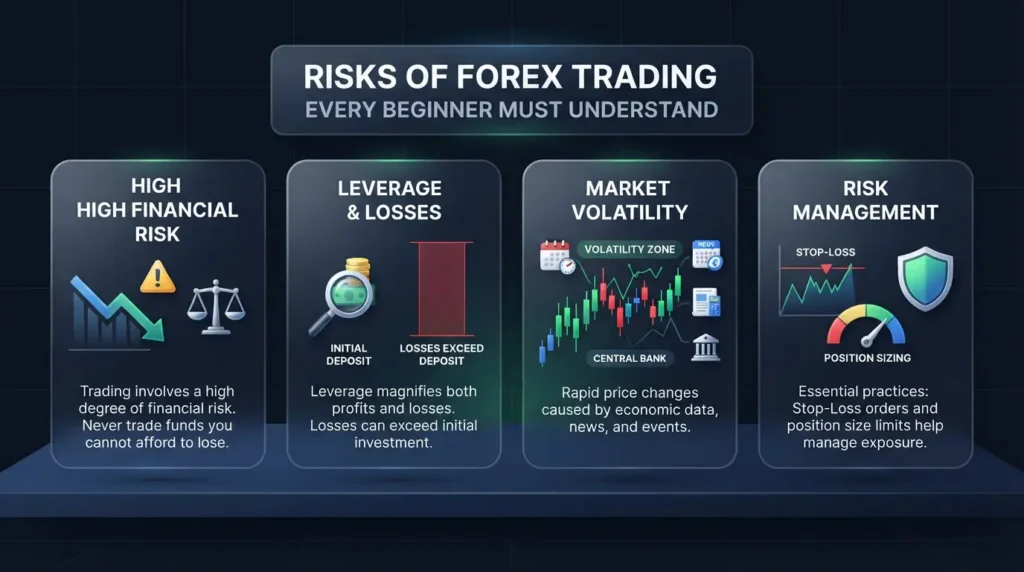
Beginners should never trade using funds they cannot afford to lose. CFDs are complex instruments, and trading CFDs involves significant risk of loss — this applies to currency CFDs as much as to other instrument types. Risk management practices, such as setting stop-loss orders and limiting position size relative to account balance, are essential tools for managing exposure in the forex market.
Using a Trading Journal During the Forex Trading Journey
A trading journal is a record-keeping tool in which a trader documents each trade taken, including the instrument, entry and exit points, position size, rationale, and outcome. Maintaining a trading journal helps identify patterns in trading behaviour, reveal weaknesses in a trading strategy, and track progress over time.
Beginners who use a trading journal during the demo account phase build a habit of self-review before risking real money. A trading journal does not need to be complex — a simple spreadsheet recording the key details of each trade is sufficient to generate useful trading results analysis over time.
Transition to a Live Account: What to Expect
The transition to a live account introduces psychological factors that are absent in demo trading. When real money is at risk, decision-making under pressure can differ significantly from how a trader behaves in a virtual environment. This is why building trading experience on a demo account first — and developing a clear trading plan — reduces the likelihood of emotional decision-making on a live account.
Once live trading begins, monitoring trading costs (spreads, commissions, and swap rates) becomes important, as these costs directly affect profitability. Beginners should review their trading conditions regularly and ensure that their trading strategy accounts for the total cost of each trade.
For a comprehensive overview of what to expect when starting out, see this guide: how to start forex trading in India.
FAQ
What documents are needed to open a forex trading account in India?
To open a forex trading account in India through a regulated broker, traders are typically required to provide government-issued photo identification (such as a PAN card or Aadhaar card), proof of address (such as a utility bill or bank statement), and bank account details for fund transfers. The specific documentation requirements vary by broker and the regulatory jurisdiction under which the broker operates.
Is a demo account necessary before opening a live forex account?
A demo account is not legally required, but it is strongly recommended for anyone beginning their forex trading journey. Demo trading allows beginners to practise currency trading, test strategies, and learn how to navigate a trading platform without risking real money. Most experienced traders and financial educators consider the demo account phase essential before any live capital is committed.
What is the minimum deposit needed to start forex trading in India?
The minimum deposit required to open a forex trading account varies depending on the broker and the account type selected. Micro accounts and cent accounts are designed specifically to allow beginners to start trading with smaller amounts of capital, reducing initial financial exposure while gaining live trading experience. Beginners should check the specific deposit requirements of their chosen broker directly.
Can Indian traders access international forex brokers?
Indian traders may access internationally regulated brokers for CFD-based currency trading. However, the regulatory framework under FEMA and RBI guidelines governs how Indian residents can transfer funds abroad and engage in foreign currency transactions. The distinction between trading on domestic recognised exchanges and trading via foreign platforms carries legal implications, and traders should seek independent legal or financial advice before opening an account with an overseas broker.
What is the difference between a micro account and a standard forex account?
A micro account allows traders to execute positions in smaller lot sizes than a standard account, which reduces the financial risk of each individual trade. A standard account uses full lot sizes and is generally suited to traders with more experience and a higher risk tolerance. Beginners often use a micro account as an intermediate step between demo trading and full standard account live trading, as it allows exposure to real market conditions with limited capital at risk.