
Major Currency Pairs – Beginner’s Guide to the Most Traded Forex Pairs


Understanding how the forex market works begins with one essential concept: currencies are always traded in pairs. A major currency pair represents the exchange rate between the US dollar and one of the world’s most widely used currencies. These pairs form the backbone of global forex trading, accounting for the largest share of daily volume. For anyone beginning to explore currency trading, understanding what major currency pairs are — and why they matter — is the most practical starting point.
The 7 Major Forex Pairs
The table below summarises all seven major currency pairs, including their common nicknames, the currencies involved, and their defining characteristics.
| Pair | Currencies | Nickname | Key Feature |
| EUR/USD | Euro / US Dollar | Fiber | Most traded pair globally; reflects eurozone vs. US economic conditions |
| USD/JPY | US Dollar / Japanese Yen | Gopher | Very liquid; yen is frequently associated with safe-haven demand |
| GBP/USD | British Pound / US Dollar | Cable | Highly volatile; sensitive to UK and US central bank decisions |
| USD/CHF | US Dollar / Swiss Franc | Swissie | Classic safe-haven pair; influenced by risk sentiment and Swiss National Bank policy |
| AUD/USD | Australian Dollar / US Dollar | Aussie | Commodity-linked; correlated with Chinese growth and global risk appetite |
| USD/CAD | US Dollar / Canadian Dollar | Loonie | Closely tied to oil prices, given Canada’s role as a major energy exporter |
| NZD/USD | New Zealand Dollar / US Dollar | Kiwi | Influenced by agricultural exports, dairy markets, and RBNZ interest rate decisions |
These seven currency combinations in the forex market account for a substantial portion of total daily global trading volume, which the Bank for International Settlements estimated at over $7.5 trillion per day in its 2022 Triennial Survey.
What Are Major Currency Pairs in Forex?
Major currency pairs — often called “the majors” — are the most heavily traded and liquid forex currency pairs available on the global forex market. By definition, every major pair includes the US dollar as either the base currency or the quote currency, paired with one of the world’s most established currencies: the euro, Japanese yen, British pound, Swiss franc, Australian dollar, Canadian dollar, or New Zealand dollar.
The dominance of the US dollar reflects its role as the world’s primary reserve currency. Because the dollar is involved in a large share of global forex trades, pairs that include USD tend to benefit from deep market participation, which translates into narrower bid-ask spreads and faster execution — two features that are particularly relevant for beginner forex traders.
How Currency Pairs Work: Base and Quote Currency Explained
Every forex pair consists of two currencies. The first currency listed is called the base currency, and the second is called the quote currency. The price of a currency pair expresses how much of the quote currency is needed to buy one unit of the base currency.
For example, in the EUR/USD pair, the euro is the base currency and the US dollar is the quote currency. If EUR/USD is priced at 1.0850, it means one euro can be exchanged for 1.0850 US dollars. When the price rises, the base currency has strengthened relative to the quote currency. When the price falls, the opposite is true.
This structure is central to forex trading because every decision about buying or selling a pair is essentially a decision about the relative strength of two economies. A deeper breakdown of this concept is available in the Currency Pairs Explained: Base Currency, Quote Currency, and Pricing guide.
The Four Traditional Major Currencies
Some sources and educators make a distinction between what they call the four traditional major currencies and the broader seven-pair list.
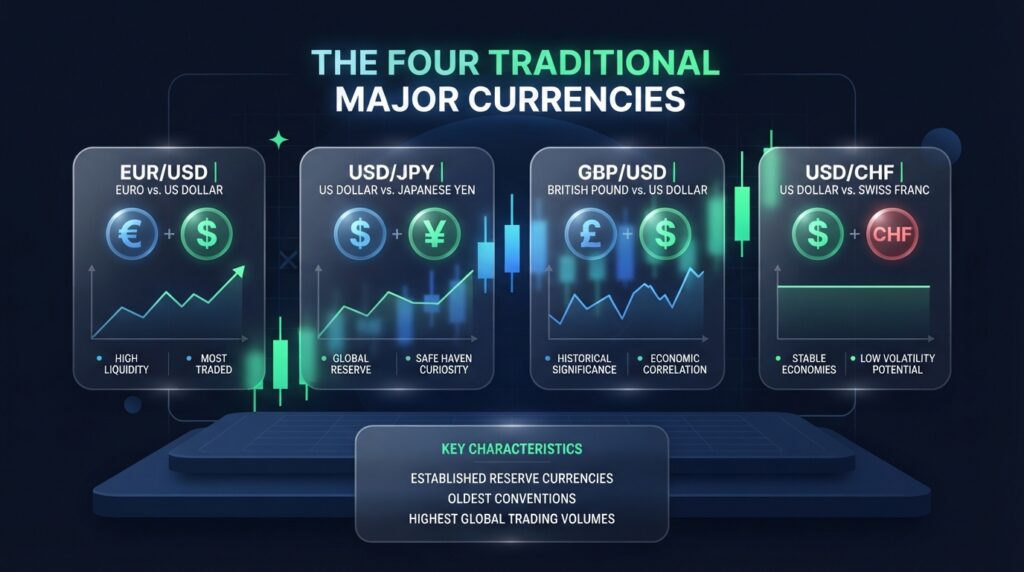
The traditional four major forex pairs are:
- EUR/USD — Euro vs. US Dollar
- USD/JPY — US Dollar vs. Japanese Yen
- GBP/USD — British Pound vs. US Dollar
- USD/CHF — US Dollar vs. Swiss Franc
These four involve only the most established reserve currencies and represent the oldest conventions in global forex trading. The remaining three — AUD/USD, USD/CAD, and NZD/USD — are sometimes grouped separately as commodity majors, because the economies behind those currencies are closely tied to raw material exports. All seven, however, remain widely recognised as major pairs in most retail trading contexts.
Major, Minor, and Exotic Pairs: Understanding the Difference
Not all forex currency pairs are equal in terms of liquidity or trading conditions. Understanding the three main categories helps beginners choose pairs to trade with a clearer picture of the risks involved.
- Major pairs always include USD alongside one of the six major counterpart currencies. They dominate forex trading due to their tight spreads and deep liquidity. For traders new to currency trading, major pairs are often the starting point precisely because their pricing tends to be more stable and their market conditions more predictable.
- Minor pairs (also called cross currency pairs) do not include the US dollar, but are still composed of major currencies. Examples include EUR/GBP, EUR/JPY, and GBP/JPY. These pairs generally have lower trading volume than the majors, which can mean slightly wider spreads and less consistent execution.
- Exotic pairs combine one major currency with a currency from an emerging or smaller economy — for instance, USD/TRY (US Dollar / Turkish Lira) or EUR/PLN (Euro / Polish Zloty). Exotic pairs carry significantly wider spreads and are subject to higher volatility. The European Securities and Markets Authority (ESMA) has noted that trading in less liquid instruments can amplify losses, particularly when leverage is involved.
Why Major Currency Pairs Dominate Forex Trading
The reason major forex currency pairs account for such a large share of global forex activity comes down to a combination of liquidity, accessibility, and the economic weight of the countries involved.
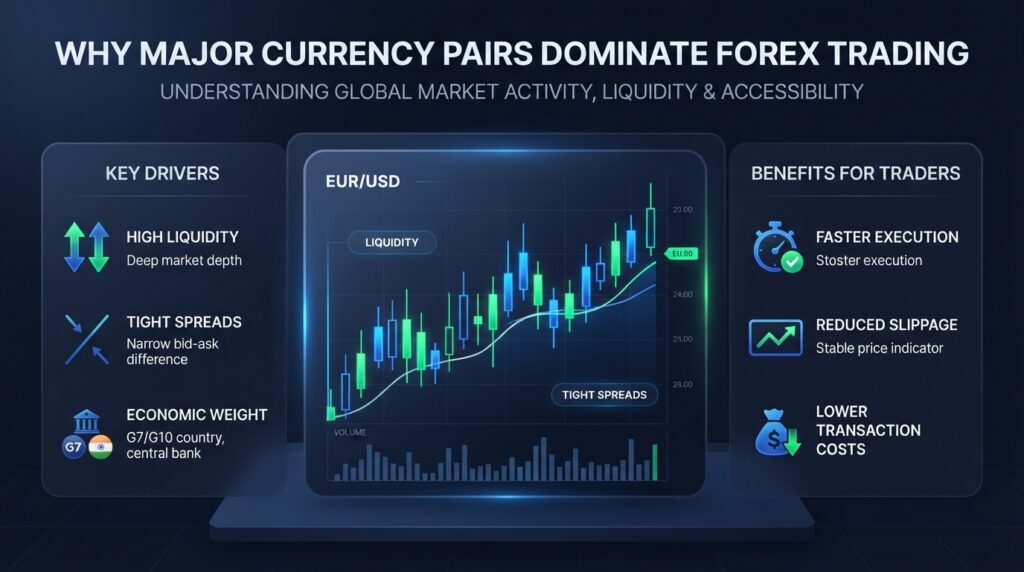
- High trading volume means that at any given moment, large numbers of buyers and sellers are active in these markets. This depth of participation allows trades to be executed quickly and at prices close to the quoted rate — a property known as liquidity. For beginner traders, liquidity reduces the risk of slippage, where an order is filled at a different price than expected.
- Tight spreads are a direct result of high demand. Because market makers and liquidity providers compete to fill orders in EUR/USD or USD/JPY, the difference between the bid and ask price — the spread — remains narrow. Lower spreads translate to lower transaction costs per trade, which is especially significant for those exploring forex bid-ask costs for the first time.
- Information availability also plays a role. Major economic releases from the US, eurozone, UK, Japan, and other G10 economies are extensively covered, meaning traders have access to the data that drives these markets. Emerging market currencies, by contrast, may be affected by local factors that are less transparent or harder to research.
What Drives the Price of a Major Currency Pair?
The price of a currency pair reflects the current exchange rate between two currencies and is influenced by a range of macroeconomic factors.
- Interest rates set by central banks — such as the US Federal Reserve, the European Central Bank, or the Bank of England — are among the most powerful drivers. When a central bank raises interest rates, demand for that country’s currency often increases, as investors seek higher returns on deposits or bonds denominated in that currency.
- Economic data such as GDP growth figures, employment reports, and inflation readings shape trader expectations about future interest rate decisions. A stronger-than-expected jobs report in the US, for example, may lead to upward pressure on the dollar across multiple major pairs.
- Risk sentiment also plays a measurable role. In periods of global uncertainty, currencies associated with stable, low-debt economies — such as the Swiss franc or Japanese yen — often see increased demand. This is why USD/CHF and USD/JPY are frequently described as safe-haven pairs.
- Geopolitical events can cause sharp, short-term movements in heavily traded currency pairs. These shifts are often difficult to predict and can move prices well beyond normal daily ranges.
Major Currency Pairs and Leverage: Understanding the Risk
Forex trading, including the trading of major pairs, commonly involves leverage — a mechanism that allows traders to control a larger position with a smaller initial deposit. For example, with 30:1 leverage (the maximum for major pairs under ESMA rules for retail clients in the EU), a trader could control a €30,000 position with a €1,000 margin.
While leverage amplifies potential gains, it equally amplifies potential losses. According to ESMA, the majority of retail investor accounts lose money when trading leveraged products such as forex and CFDs. This figure varies by broker and instrument, but regulatory disclosures consistently highlight this risk.
A practical introduction to how leverage, margin, and spreads interact in forex trades is available in the beginner forex trading guide published by M4Markets. Those unfamiliar with the mechanics of how currencies are quoted and priced may also benefit from reviewing how currency pairs work before progressing further.
Past performance in the forex market does not guarantee future results. Losses may exceed initial expectations, particularly in fast-moving market conditions.
How Major Pairs Fit Into Broader Trading Strategies
Some forex traders focus exclusively on major pairs because of the combination of liquidity and available analysis tools. The behaviour of EUR/USD or GBP/USD, for instance, is well-documented and widely studied — meaning technical patterns, historical volatility data, and economic calendars are readily accessible.
Certain trading strategies may be more suited to high-liquidity environments:
- Scalping, for example, involves taking many small positions over short timeframes and depends on tight spreads — a condition more reliably met in major pairs than in exotics.
- Swing trading involves holding positions across several days and often relies on fundamental analysis, where the economic weight of major pair economies provides more data to work with.
It is important to note that no strategy guarantees profit in currency trading. All approaches carry risk, and different strategies may perform differently under varying market conditions. Beginners exploring which pairs to trade may find it useful to review best currency pairs for beginners, which covers liquidity, volatility, and spread considerations relevant to newer participants.
Frequently Asked Questions
What is a major currency pair in simple terms?
A major currency pair is a forex pairing that always includes the US dollar on one side alongside one of the world’s leading currencies. These pairs — such as EUR/USD or USD/JPY — are the most actively traded combinations in the forex market and typically offer the tightest spreads and highest liquidity. The term “major” refers to their dominant position in global forex trading rather than a formal regulatory classification.
How many major forex pairs are there?
Most retail forex education and industry convention recognises seven major currency pairs: EUR/USD, USD/JPY, GBP/USD, USD/CHF, AUD/USD, USD/CAD, and NZD/USD. Some sources narrow this to a “traditional four” — EUR/USD, USD/JPY, GBP/USD, and USD/CHF — treating the remaining three as commodity majors. The distinction reflects differences in how closely tied those currencies are to commodity markets rather than any difference in their liquidity or availability.
Why do major currency pairs have lower spreads?
Lower spreads in major pairs result from high trading volume and deep market liquidity. When large numbers of buyers and sellers are active in a market simultaneously, competition among liquidity providers narrows the gap between the bid and ask price. Because major pairs attract significant institutional and retail participation around the clock, this competitive pricing tends to be consistent across most trading sessions, particularly during the London and New York overlap.
What is the difference between a major pair and an exotic pair?
A major pair consists of the US dollar and a top-tier global currency, such as the euro or Japanese yen, offering high liquidity and tight spreads. An exotic pair combines one major currency with a currency from a smaller or emerging economy — for example, USD/ZAR or EUR/HUF. Exotic pairs typically carry significantly wider spreads, lower trading volume, and greater sensitivity to local political or economic disruptions. This makes them generally less suitable for beginners compared to the major forex currency pairs.
Is EUR/USD the most traded currency pair in the world?
EUR/USD is widely cited as the most traded forex pair globally, reflecting the economic significance of both the eurozone and the United States. The pair benefits from the deepest liquidity pool in the forex market, the tightest spreads, and extensive analyst coverage. Its price is closely watched as an indicator of relative economic strength between the two largest currency blocs in the world. The Bank for International Settlements’ triennial surveys consistently place EUR/USD at the top of global trading volume rankings.