
Best Forex Currency Pairs to Trade for Beginners – Complete Guide

Choosing the right forex pair to trade is one of the first decisions a new trader faces — and one of the most consequential. Not all currency pairs behave the same way. Some offer tight spreads and deep liquidity, making them among the best currency pairs to trade for beginners. Others carry wide spreads, erratic price swings, or thin market depth that can quickly punish inexperienced traders. This guide reviews the most traded forex pairs available and explains what makes each one easier or harder to trade when you’re just starting out.
Best Currency Pairs for Beginners Compared
| Currency Pair | Liquidity | Volatility | Spread Tendency | Best Suited For |
| EUR/USD | Very high | Low to moderate | Usually tightest | First-time traders; most strategies |
| USD/JPY | Very high | Moderate | Usually tight | Trend trading; macro analysis |
| GBP/USD | High | Moderate to high | Generally low, can widen | Traders seeking larger movements |
| AUD/USD | High | Moderate | Usually competitive | Commodity and Asia-Pacific focus |
| USD/CAD | High | Moderate | Usually competitive | Oil and North American data followers |
| EUR/GBP | High for a cross | Low to moderate | Can be reasonable | Range trading; lower-volatility conditions |
- EUR/USD is typically the most beginner-friendly forex pair due to its liquidity, tight spreads, and widespread analysis.
- USD/JPY is a strong second choice, particularly for traders interested in macroeconomic drivers.
- GBP/USD offers larger price movements, but those movements require stricter risk management.
- Exotic pairs and highly volatile crosses such as GBP/JPY are generally unsuitable for new traders.
- Risk management and trade cost awareness matter more than pair selection alone.
- Actual spreads vary by broker, account type, session, and market conditions — always treat published figures as estimates.
What Makes a Forex Pair Suitable for Beginners?
A forex pair particularly suitable for beginners shares three characteristics: high liquidity, manageable volatility, and low trading costs. Understanding these three factors before choosing a pair to trade in the forex market can save new traders from costly early mistakes.
- Liquidity refers to how actively a currency combination is traded at any given moment. High trading volume means orders are executed more reliably, slippage is reduced, and bid-ask spreads tend to stay tight. Major currency pairs — those involving the US dollar alongside another large economy’s currency — consistently attract the highest trading volume globally.
- Volatility describes how far and how fast a pair’s price moves. Moderate volatility is generally ideal for beginners: enough movement to create trading opportunities, but not so much that positions reverse violently before a stop-loss can trigger. Understanding forex trading basics early helps traders calibrate their expectations around normal price behaviour for different pairs.
- Spread is the difference between the bid price (what a broker buys at) and the ask price (what a broker sells at). This gap is a cost paid on every trade entry. Pairs with high trading volume typically offer tighter spreads, which reduces the cost per trade. For a full breakdown of how spreads work and what to look for, see this explanation of forex spread explained.
The US dollar appears in approximately 89.2% of all global foreign exchange transactions, according to the Bank for International Settlements. EUR/USD, the most actively traded currency pair in the world, accounts for roughly 24% of global forex turnover in the 2025 BIS Triennial Survey — which is why most beginner guidance begins there.
The Top 5 Forex Pairs to Trade for Beginners

1. EUR/USD — Best Overall Currency Pair for Beginners
EUR/USD is widely considered the most beginner-friendly forex pair to trade, and for good reason. It combines very high liquidity, typically tight spreads, a large amount of freely available analysis, and clear sensitivity to well-documented central bank policy from both the US Federal Reserve and the European Central Bank.
The pair is most active during the overlap of the London and New York trading sessions, when trading volume peaks and spreads are usually at their tightest. Spreads can widen around major data releases such as US non-farm payrolls, CPI figures, and Fed rate decisions, so beginners should be aware of the economic calendar before entering positions near those events.
EUR/USD is best used for learning core skills: reading support and resistance levels, understanding trend structure, practising basic risk management, and studying how economic data affects currency movements. Its price action is generally more measured than pairs like GBP/USD or GBP/JPY, making it a more forgiving environment while those skills are being developed.
2. USD/JPY — Strong Second Pair for Trend and Macro Analysis
USD/JPY is one of the most traded forex pairs globally and benefits from deep liquidity throughout both the Asian and North American sessions. Its price is influenced by US interest rate expectations, Bank of Japan policy decisions, Japanese government bond yields, and broader global risk sentiment.
USD/JPY can behave relatively calmly over extended periods, which gives beginners time to analyse the pair before acting. However, sharp moves can occur when central banks signal unexpected policy changes, when Japanese authorities comment on yen levels, or when global risk-off events trigger sudden flows into the yen as a perceived safe-haven currency.
This combination is well-suited to traders learning trend-following strategies and to those who want to study the relationship between interest rate differentials and currency price direction. It is also a useful pair for learning how to track and interpret macroeconomic data releases.
3. GBP/USD — More Movement, More Risk
GBP/USD, commonly referred to as “Cable,” generally moves more than EUR/USD in terms of daily pip range. That extra movement can create larger profit opportunities, but it also means wider stop-loss placements, faster reversals, and greater potential for loss within a single session.
The pair reacts strongly to Bank of England rate decisions, UK inflation and employment data, GDP figures, and US Federal Reserve policy. Political or fiscal developments specific to the United Kingdom can also produce sharp, unpredictable movements that are harder for beginners to anticipate or manage.
GBP/USD is better approached after a beginner has gained some confidence in position sizing, stop-loss placement, and reading price action under pressure. It is generally not the best first pair for someone still learning the mechanics of trade execution. For those ready to take on more volatile pairs, the extra volatility needs to be matched with proportionally tighter position sizes.
4. AUD/USD — A Commodity-Linked Major Pair
AUD/USD is a highly liquid major pair that tends to be most active during Asian and early European trading hours. The Australian dollar is influenced by Reserve Bank of Australia monetary policy, Chinese economic conditions and trade data, global commodity prices (particularly iron ore), and general risk appetite across markets.
This pair can be valuable for beginners who want to learn how commodity markets and regional economic data affect currency prices. At the same time, those external drivers — especially shifts in Chinese economic sentiment — can produce sudden moves that are not always predictable from technical chart analysis alone.
AUD/USD is best suited to traders with an interest in commodities research, China-related economic news, and the Asia-Pacific session timing. Understanding forex sessions in IST helps traders identify when this pair is most liquid and active.
5. USD/CAD — Useful for Oil Markets and North American Data
USD/CAD is a liquid North American pair whose behaviour is frequently shaped by crude oil prices, given Canada’s status as a major energy exporter. The Canadian dollar often strengthens when oil prices rise and weakens when they fall, creating a natural link between commodity market research and currency analysis.
Additional drivers for USD/CAD include Federal Reserve and Bank of Canada policy decisions, Canadian employment and inflation reports, and broader US economic releases. Traders who follow North American economic data closely will find this combination aligns well with their research routine.
USD/CAD can be a practical second or third pair for beginners who want to expand beyond EUR/USD while staying in a familiar economic region and maintaining exposure to pairs with high liquidity and competitive spreads.
Minor Pairs and Crosses: EUR/GBP as a Lower-Volatility Option
EUR/GBP is a currency pair made up of two European currencies — the euro and the British pound — without direct involvement of the US dollar. Cross pairs like EUR/GBP tend to carry slightly wider spreads than major pairs in some conditions, but EUR/GBP specifically is widely traded and benefits from reasonable liquidity during European hours.
The combination generally moves less aggressively than GBP/USD or GBP/JPY. Its main drivers are the relative monetary policy outlooks of the European Central Bank and the Bank of England, along with economic divergence between the UK and the eurozone.
Lower volatility does not automatically mean lower risk. EUR/GBP can remain in a tight range for extended periods and then break sharply following an unexpected central bank statement or economic announcement. This pair is most useful for beginners practising range analysis and for those interested in understanding relative currency strength between two major economies.
Types of Forex Pairs: Majors, Minors, and Exotic Pairs Explained
Understanding the basic types of forex pairs helps beginners choose the right currency pairs and avoid trading in markets where costs and risk may be disproportionately high.
Major currency pairs involve the US dollar and one other heavily traded currency: EUR, GBP, JPY, AUD, CAD, or CHF. These pairs have the highest trading volume, the tightest spreads in normal conditions, and the most widely available market research. They are the currency combinations most beginner guides focus on for good reason.
Minor pairs (also called cross pairs) pair two major currencies but exclude the US dollar. Examples include EUR/GBP, EUR/JPY, and GBP/JPY. Minor pairs generally have lower trading volume than majors and may carry slightly wider spreads, though some are highly liquid. GBP/JPY in particular is known for its volatility and is usually not recommended as a starting point for new traders.
Exotic pairs combine a major currency with the currency of a smaller or emerging-market economy. Examples include USD/TRY (US dollar and Turkish lira), USD/ZAR (US dollar and South African rand), and USD/MXN (US dollar and Mexican peso). Exotic pairs typically carry significantly wider spreads than major pairs, lower liquidity, and higher volatility — a combination that substantially increases trading costs and the difficulty of managing positions for beginners.
Pairs Beginners Should Usually Avoid
New traders are generally better served by concentrating on one or two major pairs rather than spreading attention across multiple markets. Pairs that are typically unsuitable for beginners include:
- Exotic pairs such as USD/TRY, USD/ZAR, and USD/MXN, where spreads can be dramatically wider than on major pairs and sudden moves can be extreme.
- GBP/JPY, which is one of the most volatile currency combinations available and can produce very large intraday movements with little warning.
- Pairs traded outside their most liquid sessions, when spreads tend to widen and execution quality can deteriorate significantly.
- Multiple correlated pairs simultaneously, such as EUR/USD and GBP/USD at the same time. Since both pairs tend to move in similar directions against the US dollar, holding positions in both effectively doubles exposure to dollar movements — which many beginners do not realise until a loss occurs.
A practical starting watchlist for beginners might be EUR/USD as the primary pair, USD/JPY or GBP/USD as a secondary pair, and one additional major pair such as AUD/USD or USD/CAD once some initial experience has been built.
How to Compare Spreads and Trading Costs Properly
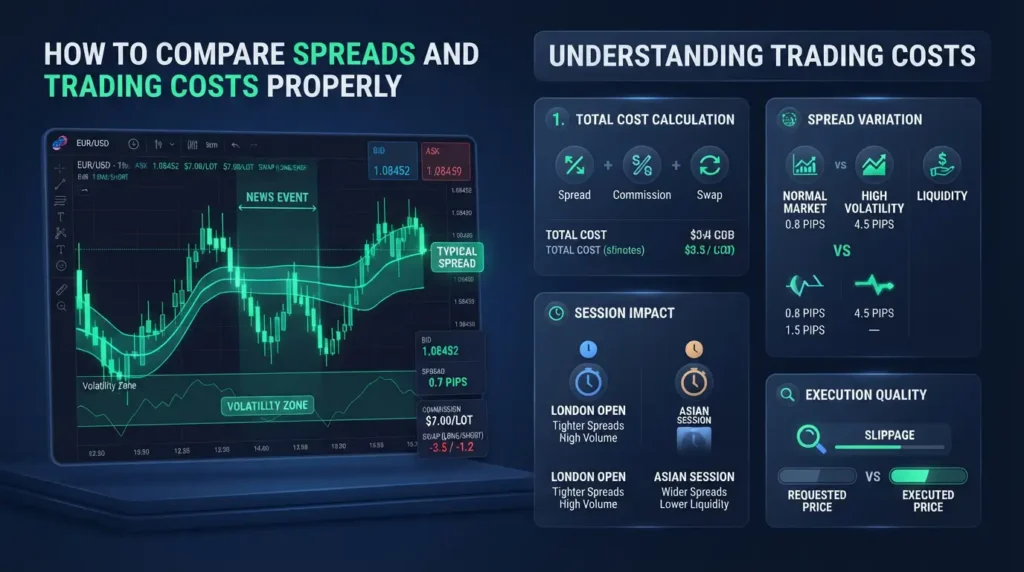
Choosing a forex pair based on advertised spreads alone can be misleading. Published “typical spreads” are estimates, not guarantees. Actual spreads vary according to the broker, account type, liquidity conditions, trading session, and proximity to major news events.
Before committing to a trading account, beginners should consider:
- The average spread during the specific hours they intend to trade.
- Whether the broker charges a separate commission per trade in addition to the spread.
- How much spreads widen during news events or periods of low liquidity (such as early Asian hours for European pairs).
- Overnight financing costs (swap rates), which apply when positions are held past the daily rollover.
- Slippage tendencies and overall execution quality under varying market conditions.
- Minimum trade sizes and margin requirements for the pairs they plan to trade.
For short-term or intraday traders, the spread and commission can have a significant cumulative effect on results over time. For swing traders holding positions for days, overnight financing charges and gap risk around news events may be more material than the bid-ask spread itself.
Risk Management Matters More Than Pair Selection
Choosing a beginner-friendly forex pair is only part of the equation. A highly liquid pair with tight spreads can still generate large losses if leverage and position sizing are not managed carefully.
Forex is commonly traded using leverage, which allows traders to control a position size larger than their deposited capital. The European Securities and Markets Authority (ESMA) warns that leverage amplifies losses and increases the impact of spreads, commissions, and financing costs on trading outcomes. EU regulatory rules for retail CFD trading impose leverage limits, including a maximum of 30:1 for major currency pairs.
Beginners should consider the following practices before trading any live currency combination:
- Practise on a demo account to understand how order entry, stop-loss placement, and position sizing work without risking real capital.
- Risk only a small, predefined percentage of total trading capital on any single position — a common approach is to risk no more than 1–2% per trade.
- Use stop-loss orders based on market structure (support and resistance levels) rather than arbitrary pip distances.
- Avoid entering trades immediately before major scheduled economic announcements until you are experienced enough to manage the resulting volatility.
- Account for the full cost of each trade — spread, commission, and overnight financing — not just the chart setup.
- Concentrate on one or two pairs rather than switching between many markets, which makes it harder to learn the behaviour of any single pair.
Choosing the Right Currency Pairs: Final Ranking
For most beginners, the practical order of currency pairs to consider in 2026 is:
- EUR/USD — Best overall balance of liquidity, cost, and moderate price movement. The standard starting point for most new forex traders.
- USD/JPY — Highly liquid, well-researched, and useful for learning the influence of interest rate policy on currency prices.
- GBP/USD — Attractive for larger price movements, but requires stricter risk control and is better approached with some initial experience.
- AUD/USD — Useful for traders interested in commodity markets and Asia-Pacific economic data.
- USD/CAD — Suitable for traders who follow oil markets and North American economic releases.
- EUR/GBP — A lower-volatility cross pair for those interested in range strategies and European economic divergence.
The best starting point is generally not the pair with the largest daily range. It is the pair whose trading costs, typical volatility, most active hours, and key economic drivers you can consistently understand and monitor. Choosing best pairs to trade in forex is ultimately about matching market characteristics to your own risk tolerance, available trading hours, and current knowledge level.
Frequently Asked Questions
What is the easiest currency pair for beginners?
EUR/USD is widely regarded as the most accessible forex pair to trade for beginners. It carries the highest global trading volume of any currency in the market, typically has the tightest spreads during major sessions, and is covered by extensive economic and technical analysis. That combination makes it easier to find information, understand price drivers, and manage trade costs than most other options.
Why do beginners generally avoid exotic currencies?
Exotic options combine a major currency with one from a smaller or emerging-market economy, which often results in much wider spreads and lower liquidity than standard majors. That means higher entry and exit costs on every trade, larger potential price gaps around news events, and more difficulty closing positions quickly if conditions change. These factors make exotic pairs significantly harder to manage for traders still learning the basics.
Can a beginner trade GBP/USD?
GBP/USD is accessible to beginners, but it comes with important caveats. The pound-dollar combination moves more than EUR/USD on a typical day, which means larger potential profits but also larger potential losses within any given session. Beginners who choose this pair should use proportionally smaller position sizes and wider stop-losses, and should be especially cautious around Bank of England announcements and UK data releases.
Does the trading session affect which currency to choose?
Yes, significantly. Each forex pair is most liquid and carries its tightest spreads during the sessions associated with its component currencies. EUR/USD is most active during the London-New York overlap, AUD/USD sees peak liquidity in Asian hours, and USD/CAD is busiest during North American trading. Choosing a currency to trade outside its most active session can result in wider spreads and slower execution, so aligning your schedule with the right market hours matters.
How many currency pairs should a beginner follow?
Most experienced traders recommend starting with just one or two options rather than monitoring many simultaneously. Following too many markets at once makes it harder to learn the specific behaviour, economic drivers, and typical price patterns of any individual pair. Once a trader is consistently managing risk and executing trades competently, expanding the watchlist becomes more practical and less overwhelming.