What Is Spread in Forex Trading – Bid, Ask, and Trading Costs

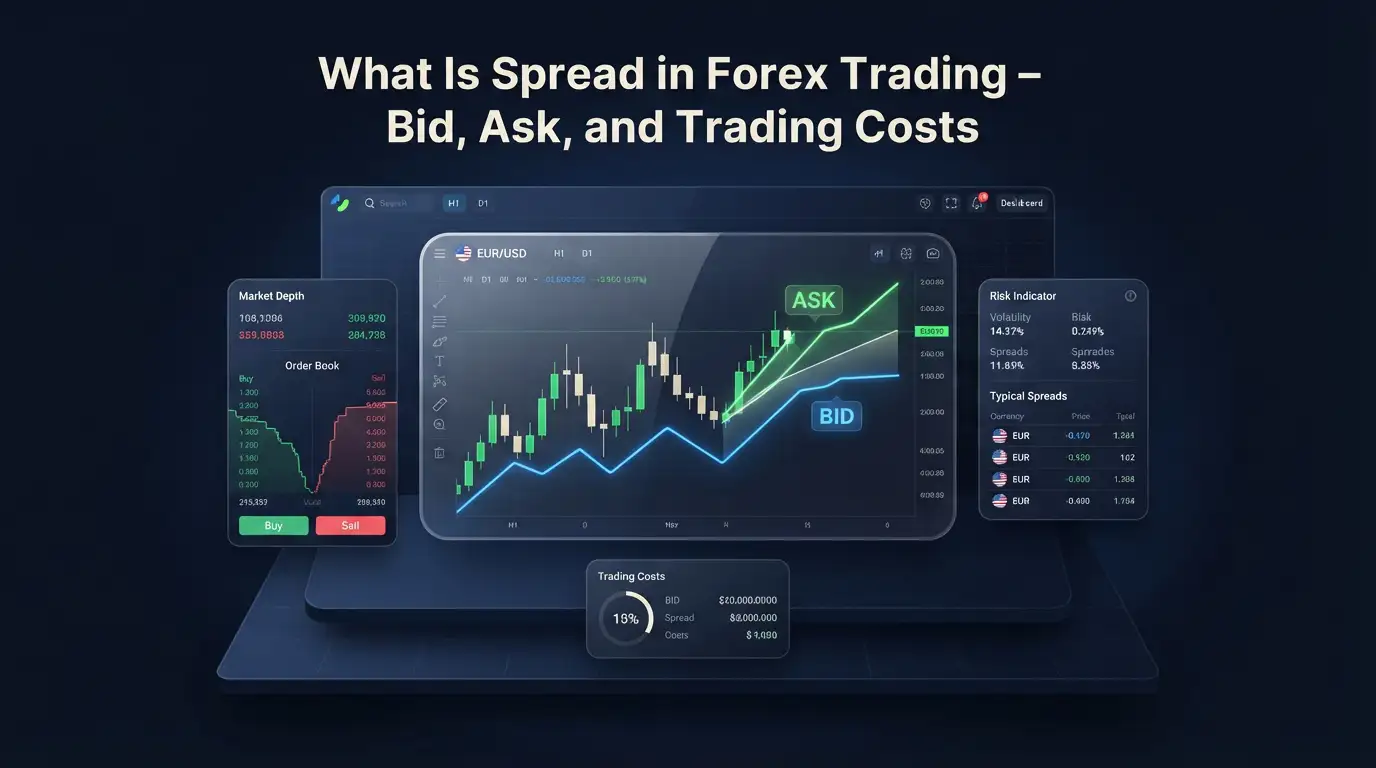
The forex market operates on a simple but important pricing mechanic that every beginner needs to understand before placing a single trade. When you look at any currency pair quote, you will always see two prices — not one. The gap between those two prices is what traders refer to as the spread in forex trading, and it directly determines the baseline cost of every position you open. Understanding how this bid-ask gap works, how to calculate it, and how it changes under different market conditions is one of the most practical foundations of successful trading
Key Takeaways
- The forex spread is the difference between the bid price (sell) and the ask price (buy) of a currency pair.
- This bid-ask gap is measured in pips and represents the primary cost of entering any position in the forex market.
- Two main pricing structures exist: fixed and variable (floating) — each with distinct cost implications.
- Wider bid-ask gaps increase trading costs; tighter margins reduce them.
- The monetary impact of the pip difference depends on lot size — the larger the position, the higher the cost.
- Major currency pairs typically carry tighter pricing than exotic pairs.
- Total trading cost includes the bid-ask gap, commission, slippage, and overnight swap charges.
| Factor | Fixed | Variable (Floating) |
| Stability | Relatively stable | Changes with market conditions |
| Cost during quiet markets | Often higher than market rate | Often lower |
| Cost during volatility | More predictable | Can widen significantly |
| Best suited for | Beginners, cost planners | Active traders in liquid sessions |
What Is the Meaning of Spread in Forex Trading?
The spread in forex is the difference between the price at which a trader can buy a currency pair and the price at which the trader can sell it. In simple terms, it is the gap between the bid price and the ask price quoted by a forex broker — and it represents the built-in entry cost of any position in the forex market.
Before a trade can produce any gross profit, the market must first move enough to cover this gap. This makes understanding the bid-ask difference one of the most immediately practical concepts for any beginner entering fx trading. For a broader foundation, the forex trading fundamentals guide from M4Markets is a strong starting point.
Understanding Forex Spreads: Bid Price and Ask Price Explained
Every currency pair in the forex market is quoted with two simultaneous prices. The bid price is the price at which a trader can sell the base currency. The ask price is the price at which a trader can buy the base currency. The numerical difference between these two values is what the broker or liquidity provider captures as compensation for facilitating the transaction.
The bid is always lower than the ask. This is not an error — it is how pricing in the forex market is structured. A forex broker buys from traders at the lower bid and sells to traders at the higher ask, and the margin between the two covers the broker’s cost of providing liquidity.
Example:
If EUR/USD is quoted as 1.10520 / 1.10530:
| Price | Meaning | Used When You |
| 1.10520 | Bid | Sell EUR/USD |
| 1.10530 | Ask | Buy EUR/USD |
Calculation:
Ask − Bid = 1.10530 − 1.10520 = 0.00010
Since one pip for EUR/USD equals 0.0001, this margin equals 1 pip.
How to Calculate the Spread in Forex
Calculating forex spreads requires two values: the ask price and the bid price.
Formula:
Spread = Ask Price − Bid Price
To express the result in pips:
Spread in pips = (Ask − Bid) ÷ Pip size
For most non-JPY pairs, the pip size is 0.0001. For JPY pairs such as USD/JPY, the pip size is typically 0.01.
To calculate the spread in forex in monetary terms, one additional step is needed:
Spread cost = Spread in pips × Pip value per lot × Number of lots
This formula estimates how much the bid-ask gap costs in the account’s base currency, and it varies significantly depending on position size.
Calculating Forex Spreads: Real-World Examples
The same pip difference can carry very different monetary consequences depending on how large the position is.
Micro lot example (0.01 lot):
- EUR/USD bid-ask gap: 1.2 pips
- Pip value: approximately $0.10
- Estimated cost: 1.2 × $0.10 = $0.12
Standard lot example (1.00 lot):
- EUR/USD bid-ask gap: 1.2 pips
- Pip value: approximately $10.00
- Estimated cost: 1.2 × $10.00 = $12.00
| Position Size | Approx. Pip Value | Cost of 1-pip gap | Cost of 2-pip gap |
| 0.01 lot | $0.10 | $0.10 | $0.20 |
| 0.10 lot | $1.00 | $1.00 | $2.00 |
| 1.00 lot | $10.00 | $10.00 | $20.00 |
Increasing position size raises not only potential profit and loss but also the monetary cost of the bid-ask gap on every forex trade.
How the Bid-Ask Gap Affects Buy and Sell Trades
When a trader buys a currency pair, the position opens at the ask price. To close, the trader sells at the bid price. Because the ask is always higher than the bid, the position begins with an immediate unrealized loss equal to the pip difference between the two prices.
For a long (buy) trade:
Open at Ask → Close at Bid
The market must rise by more than the bid-ask gap before the position becomes profitable.
For a short (sell) trade:
Open at Bid → Close at Ask
The market must fall by more than the gap before the position moves into profit.
Using the EUR/USD example above, a trader who buys at 1.10530 can only immediately exit at 1.10520. The position begins 1 pip in the negative. This is the direct, visible effect of the forex spread on every trade opened and closed in the market.
Types of Spread in Forex: Fixed and Variable
There are two main types of spread that a forex broker may offer traders through a trading account.
Fixed Spread
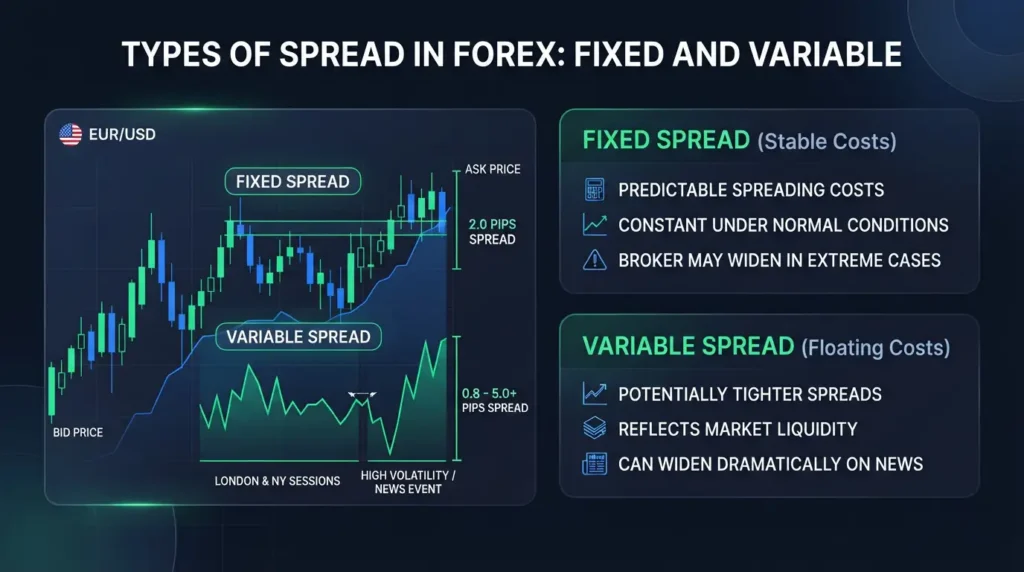
A fixed spread remains constant or stays within a defined range under normal market conditions. If a broker quotes EUR/USD with a fixed margin of 2 pips, that value typically stays stable regardless of session time or minor changes in liquidity.
Potential advantages:
- Easier to plan trading costs in advance
- More predictable for budgeting spread cost per trade
- Less variation during routine market conditions
Potential disadvantages:
- May be wider than the prevailing market rate during highly liquid periods
- The broker may widen it under exceptional market circumstances
- May not accurately reflect interbank market pricing
Variable Spread
A variable spread — also called a floating spread — changes continuously based on market conditions. During major trading sessions such as London or New York, variable pricing on major pairs can be very tight. During low-liquidity hours or around news events, the margin between bid and ask can widen significantly.
Potential advantages:
- Often tighter during active trading sessions
- More closely reflects actual available market liquidity
- Potentially lower costs for major currency pairs at peak hours
Potential disadvantages:
- Less predictable; the gap changes without warning
- Can widen dramatically around major economic releases
- A stop-loss order may be triggered by temporary widening rather than actual price movement
Why Spread Changes: What Influences Forex Spreads
The bid-ask margin is not constant throughout the trading day. Several market conditions cause it to widen or narrow, and recognizing when these changes occur helps traders anticipate higher trading costs before they materialize.
Forex spreads can widen when:
- Major economic data is released — inflation figures, employment reports, central bank interest rate decisions
- Trading volume is low, such as between the New York close and the Asian session open
- The market reopens after a weekend or public holiday
- Unexpected geopolitical or financial events occur
- An exotic currency pair with limited market participants is being traded
The gap tends to narrow during:
- Active trading hours, particularly during the London-New York session overlap
- High-volume periods with strong market participation
- Calm, news-free market conditions
Understanding when the bid-ask margin is likely to be at its widest is a meaningful part of managing the overall cost of trading in the forex market.
Good Spread in Forex: What to Look For
A good forex spread depends on the currency pair, the broker’s pricing model, and the strategy being used. There is no single value that defines a competitive rate in all contexts.
General reference points by pair category:
| Pair Category | Examples | Typical Pricing Tendency |
| Major pairs | EUR/USD, GBP/USD, USD/JPY | Usually tighter |
| Minor/cross pairs | EUR/GBP, EUR/AUD, GBP/JPY | Often wider |
| Exotic pairs | USD/TRY, USD/ZAR, USD/MXN | Frequently wider and more variable |
For major pairs like EUR/USD, a margin of 1 to 2 pips is commonly considered competitive during liquid sessions. A gap of 3 pips or more on EUR/USD may indicate above-average costs depending on prevailing market conditions.
Traders should compare total all-in costs rather than the advertised figure alone. Some brokers quote a low or zero bid-ask margin but apply a separate commission, while others include full compensation within a wider quoted gap. Choosing the right platform matters — the forex trading platforms guide covers what beginners should evaluate when making that choice.
Forex Spread Trading Strategies: How the Bid-Ask Gap Affects Different Approaches
The significance of the bid-ask margin varies depending on the trading strategy and average pip target per trade.
Scalping and Short-Term Trading Strategies
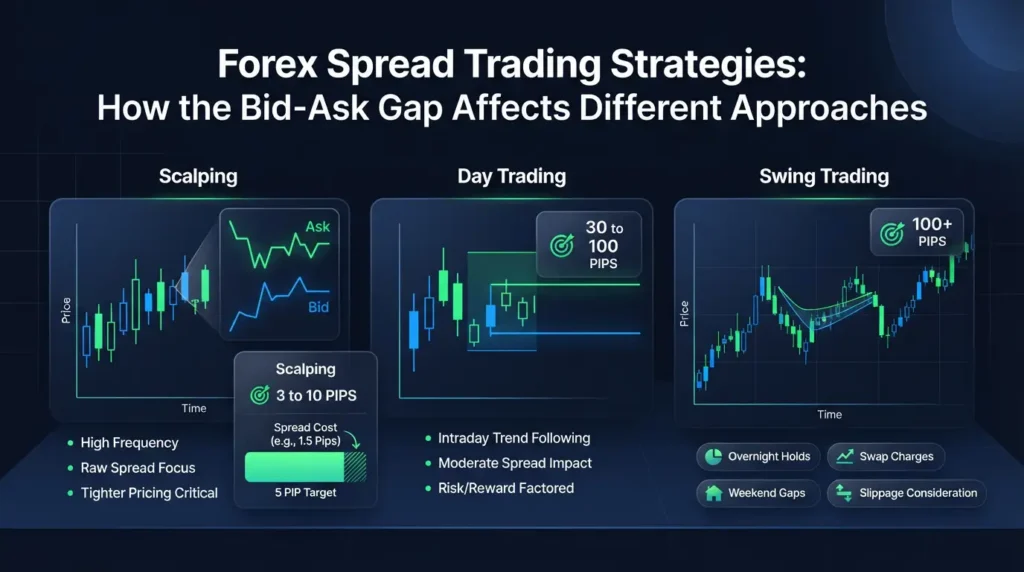
Scalping targets small pip movements, often 3 to 10 pips per trade. In this context, a 1.5-pip cost on a 5-pip target represents approximately 30% of the gross profit potential. For scalpers, raw spread accounts with separate commissions are often evaluated more carefully because tight pricing is critical to the strategy’s viability.
Day Trading
Day traders typically target 30 to 100 pips per trade. The same 1.5-pip entry cost becomes less significant as a percentage of expected movement but still needs to be factored into every risk-to-reward calculation.
Swing Trading
Swing traders hold positions for days or weeks, targeting larger price movements. For these traders, the bid-ask gap is often a smaller concern compared to overnight swap charges, weekend price gaps, slippage on large positions, and the overall size of the stop-loss. Active trading with a calculated approach to total costs applies across all strategy types.
Fixed vs. Raw Spread Accounts: A Cost Comparison
Two common pricing structures lead to meaningfully different total costs depending on position size and trading frequency.
Account A: Wider gap, no separate commission
- Bid-ask gap: 1.5 pips | Commission: $0 | Position: 1 standard lot
- Estimated cost: 1.5 × $10 = $15
Account B: Narrow gap plus separate commission
- Bid-ask gap: 0.2 pips | Commission: $7 per round turn | Position: 1 standard lot
- Estimated pip cost: 0.2 × $10 = $2
- Total estimated cost: $2 + $7 = $9
In this example, Account B is cheaper — but this is not always the case. The correct comparison uses actual trading volume, commission structure, and real-time pricing conditions during the specific hours a trader is most active.
A “zero-spread” account does not mean zero trading cost. Commission, slippage, swap charges, or currency conversion fees may still apply.
How the Bid-Ask Gap Interacts With Stop-Loss Orders
The bid-ask margin can affect stop-loss execution in ways that beginners may not immediately anticipate.
- For a long position: The trade closes at the bid price. If the margin widens temporarily, the bid may drop enough to trigger a sell stop even if the mid-price shown on the chart has not fallen by the same amount.
- For a short position: The trade closes at the ask price. A widening margin pushes the ask upward, which may trigger a buy stop prematurely.
This effect is especially relevant around news releases and during periods of thin liquidity. Stop-loss orders are not always guaranteed to execute at the exact requested price during fast market conditions — a risk known as slippage. Understanding which major currency pairs carry better liquidity can help traders assess this risk more accurately.
Total Trading Cost: The Bid-Ask Gap Is Not the Only Factor
The forex spread is one component of total trading cost, not the complete picture. Beginner traders sometimes focus only on this single figure while overlooking other charges that accumulate over time.
| Cost Type | What It Means |
| Bid-ask gap | Difference between buy and sell prices |
| Commission | Separate fee charged by the broker per trade |
| Slippage | Difference between expected and actual execution price |
| Swap/rollover | Financing charge for holding a position overnight |
| Conversion fee | Cost of converting results into the account currency |
A more realistic estimate:
Total trade cost ≈ Bid-ask gap cost + Commission + Slippage + Swap + Conversion costs
Not every cost applies to every trade. A short intraday trade may avoid overnight swap entirely, while a multi-day swing trade accumulates it for each night the position remains open.
How to Choose a Forex Broker With Competitive Pricing
Comparing broker pricing is an important part of evaluating trading costs, but the comparison must be done carefully. Advertised figures are often the minimum or average values and may not reflect conditions during volatile periods.
When evaluating a forex broker, consider:
- Whether the pricing structure is fixed or variable
- The average margin during the specific trading hours you plan to be active
- The commission structure and how it is calculated — per side, per round turn, or per lot
- Whether raw spread accounts are available for lower base pricing
- The minimum, average, and worst-case gap under different market conditions
- Order execution quality, which directly affects slippage risk
A thorough forex broker comparison in India can help beginners identify what features and cost structures to prioritize when selecting a regulated broker.
According to the European Securities and Markets Authority (ESMA), the majority of retail investor accounts lose money when trading leveraged products such as forex CFDs. Understanding and managing all components of trading cost — not only the bid-ask gap — is one part of responsible trading practice.
Frequently Asked Questions
What does the spread mean in forex trading?
The forex spread is the difference between the bid price and the ask price of a currency pair. It is expressed in pips and represents the built-in cost a trader pays when opening and closing a position. In most standard accounts, this cost is embedded in the quoted prices rather than charged as a separate line item.
Is a lower spread always better in forex?
A lower bid-ask gap generally means lower entry costs, which benefits short-term strategies where profit targets are small. However, an account advertising a very tight margin may charge a separate commission that makes the all-in cost higher than a standard account. The relevant comparison is always total cost per trade, not the quoted gap alone.
When do forex spreads widen the most?
The bid-ask margin tends to widen most during major economic announcements — central bank decisions, employment reports, and inflation data. It also widens during low-liquidity windows such as the transition between the New York and Asian sessions, during weekends, and immediately after market openings. Exotic currency pairs experience wider and more variable pricing at almost any time.
Does the bid-ask gap affect buy and sell trades equally?
Both trade directions carry the same cost in terms of the pip difference — both require the market to move beyond the gap before a gross profit is possible. However, the mechanics differ: a buy trade opens at the ask and closes at the bid, while a sell trade opens at the bid and closes at the ask. Stop-loss sensitivity to a widening margin differs depending on whether the position is long or short.
What is the difference between fixed and variable spread in forex?
A fixed pricing margin remains relatively stable regardless of market conditions, making costs more predictable. A variable margin changes continuously based on liquidity and volatility, often offering tighter pricing during active sessions but potentially much wider gaps during news events or thin markets. Neither structure is universally superior — the right choice depends on trading style and the hours during which trading activity occurs.