How to Trade Gold for Beginners: XAU/USD, CFDs, Futures and Strategy Basics

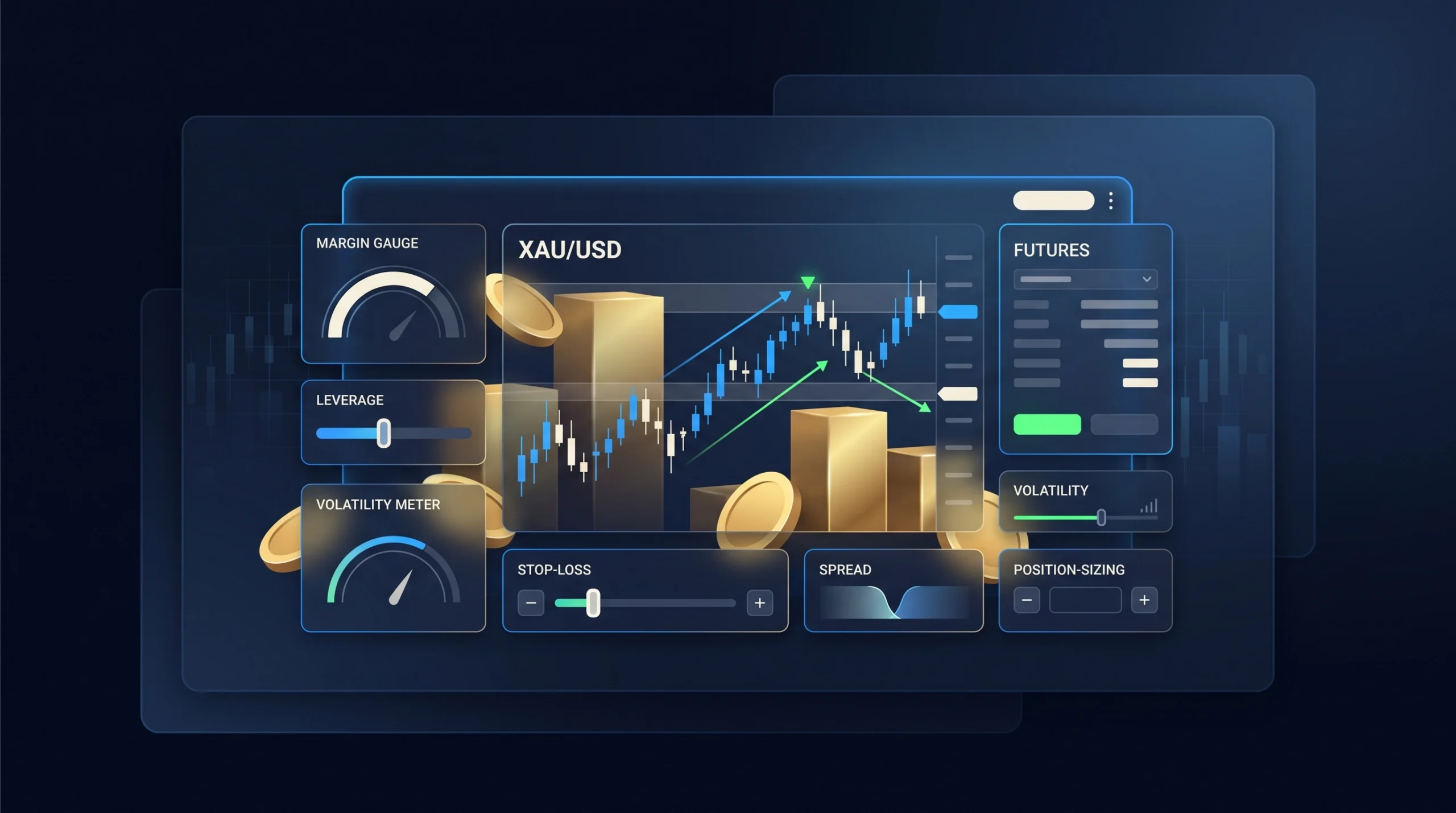
Gold attracts new traders because it is liquid, globally followed, and sensitive to economic developments that are easier to identify than many company-specific events. Yet learning how to trade gold requires more than deciding whether gold will rise or fall. You need to know which instrument you are using, how the contract is priced, what can move the market, and how much money is genuinely at risk when leverage is involved.
This guide to gold trading covers XAU/USD, CFDs, futures, options, physical gold, ETFs, trading costs, market timing, technical setups, and practical risk controls. It is educational information rather than personalized financial advice. Gold can move sharply around major economic releases, geopolitical headlines, and changes in interest-rate expectations, so beginners should focus first on capital protection, repeatable decision-making, and realistic expectations rather than frequent trading or aggressive profit targets.
Gold Trading and XAU/USD Basics
Gold trading can mean direct ownership of metal, investment through a fund, or speculation through a derivative contract. Those approaches may follow the same underlying price of gold, but they do not have the same costs, time horizons, leverage, or legal structure. A beginner should therefore identify the exact product before interpreting chart movements or calculating possible profit and loss.
What XAU/USD Represents in Gold Markets
XAU is the market code commonly used for gold, while USD represents the US dollar. An XAU/USD quote shows the value of gold quoted in US dollars. In general market language, the price refers to one troy ounce of gold, so a quotation of 2,400 means one ounce of gold costs about 2,400 US dollars before product-specific costs, spreads, and currency conversion.
The quote does not necessarily mean that you are buying or receiving physical bullion. Retail platforms may offer XAU/USD as a spot-style contract, rolling derivative, or CFD. Two platforms can display almost identical charts while applying different contract sizes, swaps, trading hours, stop-out rules, and margin requirements. Always open the specification sheet and confirm how many ounces a lot represents before entering a trade.
XAU/USD is often displayed alongside currency pairs on forex trading platforms, but gold is a commodity rather than a conventional currency. This distinction matters because gold often reacts to real yields, inflation expectations, central bank activity, physical demand, and geopolitical risk. Currency-style chart tools remain useful, although the drivers behind price movement can be different from those affecting EUR/USD or GBP/USD.
Gold Trading Glossary and Core Terms
Several terms appear repeatedly in XAU/USD trading. The bid is the price at which you can generally sell, while the ask is the price at which you can generally buy. The spread is the gap between them. Margin is capital reserved to support a leveraged position, and leverage determines how much market exposure can be controlled relative to deposited funds.
A long position seeks to benefit from rising prices, while a short position seeks to benefit from falling prices. A stop-loss order is designed to close a position after an adverse move, although fast markets may produce slippage. A take-profit order seeks to close at a favorable level. Swap, rollover, commission, tick, pip, lot, expiry, liquidity, and volatility are also core terms that affect the practical outcome of a trade.
Terminology is not perfectly standardized across brokers. One platform may describe a small gold price movement as a pip, another as a point, and a futures exchange as a tick. A reliable gold trading glossary can help you review definitions, but the final authority should always be the contract specification provided by the venue where you intend to trade.
Reasons Beginners Trade Gold

Gold appeals to beginners because the market is widely covered, active through much of the trading week, and connected to recognizable themes such as inflation, interest rates, the US dollar, and geopolitical stress. These features can make analysis feel accessible. They do not make the market simple, and they do not remove the possibility of rapid losses.
Gold Liquidity, Volatility, and Trading Opportunities
Gold usually attracts substantial trading volume during active London and New York trading sessions. Higher participation may support tighter spreads, faster execution, and cleaner price discovery. Liquidity can still weaken around daily maintenance periods, major holidays, unexpected headlines, or unusually volatile announcements, so a liquid market should never be treated as a guarantee of perfect execution or a fill at the requested price.
Volatility creates opportunity because meaningful gold price movements can develop within a session or continue over several days. The same volatility can invalidate a setup before a beginner has time to react. Gold often moves quickly after inflation data, employment reports, central bank decisions, or geopolitical developments. Before you start trading gold, use a routine that makes risk decisions before the market becomes fast:
- Check scheduled economic events and market holidays before opening the platform.
- Mark major support and resistance zones from higher timeframes before the session.
- Define maximum monetary loss before choosing position size or leverage.
- Avoid trading immediately after an unusually large candle without a new setup.
- Record spread, slippage, execution quality, and emotional decisions after every trade.
These gold trading tips for beginners are more valuable than searching for a guaranteed signal because they improve process quality across different market conditions. They also help you recognize when the spread is too wide, the stop distance is impractical, or the available setup does not justify taking financial risk merely to remain active.
Safe-Haven Demand and Economic Uncertainty
Gold is often described as a defensive asset because demand for gold may rise when investors are worried about inflation, currency stability, financial stress, or geopolitical conflict. However, gold often reacts to several forces at once. During a crisis, investors may buy gold for protection, sell it to raise cash, or prefer interest-bearing government debt, depending on liquidity needs and changes in yields.
The relationship between uncertainty and price is therefore conditional. Gold can rise with the US dollar during severe risk aversion, even though gold and the US dollar frequently move in opposite directions. It can also fall during an inflation scare when bond yields rise faster than inflation expectations. Traders should observe the actual market reaction instead of assuming that every negative headline will drive gold prices higher.
Different participants also use gold for different purposes. A long-term investor may hold bullion for diversification, a company may hedge future costs, and a day trader may seek a short move around a data release. These motives can interact in unpredictable ways, which is why successful gold trading depends on context, patience, and clear risk limits rather than a single narrative.
Gold Trading Instruments Compared
You can gain exposure to gold through several products, each designed for a different objective. Active speculation, long-term ownership, hedging, and portfolio diversification require different cost structures and risk controls. Before choosing an instrument, decide how long you plan to hold it, whether leverage is necessary, and whether you need direct ownership of metal.
| Instrument | Common use | Leverage | Main risks and costs |
| Spot-style XAU/USD | Short-term price trading | Often available | Spread, swaps, broker terms |
| Gold CFD | Long or short speculation | Usually available | Margin calls, financing, counterparty risk |
| Gold futures | Trading and commercial hedging | Contract-based | Expiry, tick value, changing margin |
| Gold ETF | Portfolio exposure | Usually limited | Fund fees, tracking difference |
| Physical gold | Direct ownership | None | Storage, insurance, dealer premium |
| Gold options | Directional or volatility strategies | Embedded in premium | Expiry, time decay, complexity |
The broader ways to invest in gold include physical products, exchange-traded funds, futures, options, and CFDs. Comparing them by objective, holding period, cost, liquidity, and risk is more useful than asking which product is universally best, because the most suitable route depends on what you need the exposure to accomplish.
XAU/USD Spot Trading
Retail platforms often use the term spot gold for a product that tracks the current market price without a fixed futures expiry. The product may still be a rolling derivative rather than deliverable institutional spot metal. This difference affects overnight financing, settlement, legal documentation, and the exact relationship between the displayed quote and the underlying wholesale market.
Spot-style XAU/USD trading is popular because positions can usually be opened in flexible sizes and held across multiple sessions. Traders can go long or short and use familiar charting tools. Costs may include the spread, overnight swaps, commissions, and currency conversion. A strategy that holds for several weeks may be affected more by financing charges than a strategy that closes before the end of the day.
Before using this market, check whether the broker changes margin around weekends, holidays, or major announcements. Confirm the minimum price increment, contract size, and daily trading break. A chart can look continuous even when actual execution is unavailable for a short period, and price gaps can appear when the market reopens.
Gold CFD Trading
A contract for difference allows you to speculate on the difference between the opening and closing price without owning physical gold. You can generally take long or short positions, and many brokers offer smaller trade increments than standardized futures contracts. This flexibility can be useful for position sizing, but it can also encourage beginners to trade too frequently or to open several positions that express the same market view.
Gold CFDs are leveraged, so a relatively small margin deposit can control a larger position. Leverage magnifies gains and losses equally. If the market moves against you, the account can lose value quickly, especially when correlated trades are open. Anyone studying how to trade gold with CFDs should compare these conditions before opening an account:
- Contract size, minimum lot increment, and maximum permitted exposure
- Typical spread during active sessions, quiet periods, and important news
- Overnight swap rates for both long and short positions
- Stop-out level, margin-call process, and negative-balance policy where applicable
- Order execution, slippage, requote, and rejected-order policies
- Regulatory entity, client-fund arrangements, and available complaint procedures
CFD availability and legal protections vary by jurisdiction, so local eligibility should be confirmed independently. Overnight financing, variable spreads, slippage, and broker-specific execution can materially affect results. A trader should also check whether margin rates change before weekends, holidays, elections, or major economic releases, because a position that is affordable under normal conditions may require more capital during elevated volatility.
Gold Futures Contracts, Margin, and Expiry
Gold futures are standardized exchange-traded contracts linked to a specified quantity and delivery month. Traders commonly close or roll positions before physical settlement, but they must still know the expiry process, final trading date, tick value, contract month, and any delivery obligations that could apply if a position remains open. These details are part of the product, not administrative information that can safely be ignored.
Futures offer centralized exchange pricing and clear contract specifications. They are used by commercial firms, professional traders, funds, and hedgers. Their standardized size can be too large for some beginner accounts, although smaller variants may be available. Exchange and broker margin requirements can increase when volatility rises. A beginner reviewing gold futures trading for beginners should complete this operational checklist:
- Identify the active contract month and confirm that it has sufficient liquidity.
- Calculate the monetary value of one tick and a typical session move.
- Check initial margin, maintenance margin, and the broker’s liquidation rules.
- Note the last trading day, settlement method, and any delivery-related deadlines.
- Decide in advance when the position will be closed or rolled forward.
- Review how the price difference between contract months can affect a rollover.
A correct market view can still lose money when contract mechanics are misunderstood. Futures traders should leave room for changing margin requirements, avoid holding an unsuitable contract into a thin expiry period, and know how overnight price gaps may affect account equity before the regular session becomes active again.
Physical Gold, ETFs, and Other Investment Routes
Physical bullion provides direct ownership, but it introduces dealer premiums, storage, security, insurance, authenticity, and resale considerations. It is usually better suited to long-term allocation than frequent trading because transaction costs can be substantial relative to short-term price changes. Coins and small bars may also carry higher premiums than larger wholesale products.
Gold ETFs can offer convenient exposure through a securities account. Some funds hold bullion, while others use futures or invest in mining companies. Investors should check the fund objective, expense ratio, holdings, custody arrangements, currency exposure, and tracking method. Mining shares add company-specific risks such as production costs, management decisions, debt, political exposure, and operational disruptions.
The best route depends on purpose. Someone seeking direct ownership may prefer bullion, while a portfolio investor may prefer an ETF and an active trader may prefer XAU/USD or futures. Product selection should follow the objective, not the other way around, because each instrument solves a different problem and carries different forms of risk.
Gold Options: Calls, Puts, and Volatility Risk
Gold options give the buyer the right, but not the obligation, to buy or sell the relevant instrument at a specified strike price before or at expiry, depending on the contract. Calls generally gain sensitivity to rising prices, while puts generally gain sensitivity to falling prices. The buyer pays a premium for this right.
Options are affected by more than direction. Their value can change because of time remaining, implied volatility, strike selection, interest rates, and the movement of the underlying market. A trader can be broadly correct about gold direction and still lose money if the move arrives too late or is too small to offset time decay and the premium paid.
A guide to gold options trading for beginners should be reviewed before using calls, puts, or spreads. Beginners should also distinguish between buying options and selling them. Option buyers commonly risk the premium paid, while uncovered option sellers may face substantial or theoretically unlimited losses, depending on the position and market structure.
Gold Price Drivers and Market Conditions
Gold prices move because market participants continually reassess inflation, interest rates, currency values, geopolitical risk, physical demand, investment flows, and economic growth. A driver matters most when new information differs from expectations. Traders should therefore ask not only what happened, but also what the market had already priced in.
US Dollar Strength and XAU/USD Correlation
Gold is commonly quoted in US dollars, so a stronger dollar can make gold more expensive for buyers using other currencies. This may pressure gold lower, while a weaker dollar may support demand. The relationship is not constant. During intense risk aversion, gold and the dollar can rise together because both attract defensive flows, even though they often move in opposite directions during calmer conditions.
Traders often compare XAU/USD with a broad dollar index, Treasury yields, and major currency pairs. These relationships provide context but should not replace direct analysis of gold price movements. A temporary breakdown in correlation may suggest that another force, such as geopolitical demand, futures positioning, or large investment flows, is dominating. Classify the relationship rather than assuming it will behave normally:
- Gold rising while the dollar falls may indicate a conventional inverse move.
- Gold and the dollar rising together may reflect strong defensive demand.
- Gold falling while yields rise may reflect a higher opportunity cost.
- Gold holding firm despite a strong dollar may suggest persistent buying pressure.
- Gold weakening despite a softer dollar may point to liquidation or poor demand.
These observations can improve market context, but they do not guarantee future results. Correlation is best treated as supporting evidence. Your entry, invalidation point, and trade size should still come from the behavior of the instrument being traded, because an assumed intermarket relationship can remain abnormal longer than a leveraged position can remain affordable.
Interest Rates, Bond Yields, and Fed Decisions
Gold does not pay interest, so changes in government bond yields can affect its relative appeal. Rising real yields may increase the opportunity cost of holding non-yielding metal, while falling real yields may support demand. The relationship can be complicated when inflation expectations, recession risk, or financial stress move at the same time.
Federal Reserve decisions influence gold through policy rates, economic projections, statement language, and press-conference guidance. The announced rate is only one part of the event. Markets may react more strongly to expected future policy, the tone of the central bank, or revisions to growth and inflation forecasts.
Traders learning how Fed rate decisions affect gold should compare the decision with market expectations and then observe the reaction in yields and the dollar. During the announcement, spreads may widen, price can gap between levels, and stop orders may fill with slippage. Reducing trade size or waiting for volatility to stabilize may be more prudent than trying to predict the first move.
CPI, NFP, and Economic Calendar Events
The Consumer Price Index can influence expectations for inflation and future interest rates. A higher-than-expected reading may pressure gold if traders anticipate tighter monetary policy and rising yields. In other cases, it may support gold if investors focus on purchasing-power risk and the yield response remains limited. The details, revisions, forecast range, and existing market positioning determine which interpretation is more likely to dominate. Traders should also watch whether the first reaction is confirmed by yields, the dollar, and subsequent candle closes.
A detailed explanation of how CPI data affects gold prices should consider the headline figure, core components, monthly trend, revisions, and immediate response in bonds and the dollar. Before another major release, traders can use a short preparation checklist to prevent an emotional decision:
- Record the forecast, previous reading, and likely revision risk.
- Mark nearby levels where resting orders may be concentrated.
- Decide whether existing positions will be closed, reduced, or protected.
- Check whether the current spread already reflects lower liquidity.
- Define a waiting period before considering a post-release entry.
- Refuse the trade when required stop distance exceeds the risk limit, even when the initial market direction appears obvious.
- Review whether the release changes the broader daily trend or only creates temporary volatility around existing levels.
The US employment report can produce equally sharp moves because nonfarm payrolls, unemployment, wage growth, and revisions may change expectations for economic strength and central bank policy. The practical risks described in how NFP affects gold trading include wider spreads, rapid reversals, temporary price gaps, and slippage. Traders should decide before the release whether to remain flat or wait for a stable post-news structure.
Geopolitical Risk and Market Sentiment
Wars, political instability, trade disputes, sanctions, banking stress, and threats to important transport routes may increase defensive demand. Gold often reacts quickly to headlines, sometimes before the facts are confirmed. Initial moves can reverse when the market decides that the event is less severe than feared or when traders take profits after an emotional spike.
Market sentiment includes more than news. Futures positioning, options demand, exchange-traded fund flows, physical purchases, and central bank activity can shape the reaction. A bullish event may produce little follow-through when many traders are already positioned long, while a modest headline can trigger a large move when positioning is unusually one-sided.
Price behavior should confirm the narrative. A breakout that holds above resistance, attracts follow-through, and remains supported during pullbacks may suggest sustained demand. A spike that immediately falls back inside the previous range may indicate weak conviction. Avoid trading solely because a headline sounds important; wait for conditions that fit your strategy and risk plan.
Gold Price History, 10-Year Trends, and Market Events
Long-term charts show that gold can move through extended trends, broad consolidations, sharp corrections, and periods when familiar correlations weaken. Studying a gold price chart over the past 10 years can help traders connect major market events with changes in volatility, interest-rate expectations, and investor demand without assuming that history will repeat exactly.
Historical support and resistance zones can remain relevant because many participants remember important highs, lows, and consolidation areas. However, a level from several years ago should be treated as a zone rather than a precise price. Contract structures, liquidity, inflation, and market participation change over time, which can alter how strongly price reacts.
History also provides a useful warning about gold risk. Strong multiyear advances can contain deep corrections, and long sideways phases can punish trend-following systems. A strategy should be tested across rising, falling, and ranging conditions. This does not guarantee future performance, but it can reveal whether results depend too heavily on one favorable period.
How to Trade Gold Step by Step
A beginner should separate preparation from execution. Choosing an instrument, defining risk, checking scheduled events, and calculating position size should happen before any order is sent. The objective of the first trade is not a large profit; it is evidence that you can follow a planned process under real market conditions.
Choosing Gold Broker and Trading Platform
A broker comparison should examine the regulated entity, account protections, product specifications, costs, and execution quality. Marketing claims about very low spreads or high leverage are not enough. You need to know which company holds your funds, what legal framework applies, and whether the broker is authorized to serve clients in your jurisdiction. Use a practical selection checklist before depositing money:
- Verify regulatory status, legal entity, and permitted client jurisdictions.
- Compare typical spreads, not only an advertised minimum spread.
- Review commissions, swaps, inactivity fees, and currency conversion charges.
- Check contract size, minimum lot, price increment, and margin rates.
- Read stop-out, slippage, rejected-order, and execution policies.
- Test platform stability, support quality, deposits, and withdrawals.
- Confirm availability of demo access and practical risk-management tools.
The best broker for gold trading is not necessarily the broker with the largest leverage ratio or the smallest stated deposit. A suitable choice provides transparent documentation, reliable execution, and position increments that let you control monetary risk without placing an unrealistically tight stop simply because the account is too small.
Before funding the account, save or review the current product specification and cost schedule. Broker conditions can change, and different account types may use different spreads or commissions. A regulated relationship can reduce certain operational risks, but it cannot prevent losses caused by market movement, poor position sizing, or a strategy that performs badly under current conditions.
Opening Demo or Live Trading Account
A demo account allows you to practice chart navigation, order placement, stop modification, and position sizing without risking real funds. It is useful for learning how the platform displays spread, equity, margin, free margin, and profit or loss. Demo trading should be treated as operational training rather than proof of future profitability.
Live trading introduces emotional pressure, real transaction costs, and possible differences in execution. Begin with the smallest practical size and keep the objective narrow. You should be able to place, modify, and close an order correctly before considering more advanced setups. Also test deposits and withdrawals with modest amounts rather than assuming the process will work exactly as expected.
Mobile platforms can help monitor positions, but they can also encourage impulsive entries. Compare security, biometric access, chart tools, alerts, order controls, and execution quality when reviewing the best gold trading apps. A mobile app should support an existing plan, not turn every price notification into a reason to trade.
Setting Up XAU/USD Charts and Indicators
Begin with a clean chart and a timeframe that matches your holding period. A scalper may use lower timeframes for execution, while a swing trader may focus on four-hour and daily structure. In both cases, higher-timeframe support, resistance, trend direction, and major economic events should be marked before detailed entry analysis begins, with the chart scale adjusted to show enough prior context. A basic workspace can include:
- Candlesticks or bars for direct price information and closing behavior
- Major horizontal support and resistance zones from higher timeframes
- One or two moving averages for trend direction and pullback context
- ATR for recent volatility, stop distance, and target realism
- RSI or MACD for momentum confirmation rather than automatic entries
- Session markers, previous highs and lows, and economic-event labels
The best indicators for gold trading can support analysis, but each tool should have a separate job. Using several indicators derived from similar price data may create false confidence while adding little new information. Price structure, volatility, market timing, and monetary risk should remain central to the trade decision.
Save one uncluttered template and review it consistently. Changing settings after every loss makes it difficult to determine whether an indicator has value. A beginner may gain more from marking levels accurately and observing price behavior than from adding complicated tools that produce attractive historical signals but unclear real-time decisions.
Choosing Market, Limit, and Stop Orders
A market order seeks immediate execution at the best available price. It prioritizes entry or exit but does not guarantee a specific fill, particularly when gold can move sharply. A limit order controls the worst acceptable entry price but may never execute. A stop order activates after price reaches a trigger and may then fill at a different level.
Protective orders should be placed according to the point where the trade idea becomes invalid, not according to an arbitrary number of dollars. A stop placed inside normal market noise may be triggered even when the broader analysis remains correct. A stop placed too far away may create excessive monetary risk unless position size is reduced.
Before trading live, test every order type in a demo environment. Confirm whether the platform supports stop-limit orders, guaranteed stops, partial closes, trailing stops, and one-cancels-the-other instructions. Product labels vary, and assumptions based on another broker’s platform can lead to avoidable execution errors.
Placing First Gold Trade
Your first trade should be small enough that the financial outcome does not interfere with learning. Write down the reason for entry, invalidation level, target logic, position size, expected holding period, and scheduled events. If you cannot explain those points before entering a trade, the setup is not ready. Use the following repeatable process from analysis through review:
- Define whether the market is trending, ranging, or unstable.
- Mark the entry zone and the point that invalidates the setup.
- Calculate the maximum monetary loss.
- Reduce trade size until the stop fits that limit.
- Place the order and protective stop.
- Record spread, slippage, decisions, and final outcome.
After the trade, review whether you followed the plan rather than judging only profit or loss. A losing trade can be well executed, while a winning trade can result from poor discipline and excessive risk. Learning how to trade gold means improving decision quality across many trades, not proving skill through one favorable result.
Gold Trading Costs, Leverage, and Position Mechanics
The chart shows price, but your account experiences price plus costs, contract size, leverage, and execution. Many beginner errors come from predicting direction correctly while misunderstanding how a small price change translates into money. These mechanics should be calculated before every trade rather than discovered after the position is open.
Gold Spread, Bid-Ask Pricing, and Trading Costs
The bid is the price at which you can generally sell, while the ask is the price at which you can generally buy. The difference is the spread. A new trade usually begins with a small unrealized loss because a buy opens near the ask and closes near the bid, while a sell opens near the bid and closes near the ask.
Spreads vary by broker, account type, time of day, and market conditions. They may widen during major data releases, daily rollover periods, holidays, or unexpected events. A scalping strategy with a small target is more sensitive to spread changes than a swing strategy seeking a much larger move. Commissions, swaps, data charges, and currency conversion may add further costs.
A clear guide to gold spread explained can help you estimate the break-even distance before entering. Compare average total costs during the hours you actually plan to trade, rather than relying on an advertised minimum spread that may appear only under ideal conditions.
Gold Leverage, Margin, and Liquidation Risk
Leverage allows a trader to control a larger position with a smaller amount of deposited margin. For example, 20:1 leverage means a position worth 20,000 dollars may require approximately 1,000 dollars in margin, subject to broker rules. Margin is collateral reserved for the position; it is not the maximum possible loss, and the full position remains exposed to market movement. The risk must therefore be calculated from stop distance and quantity rather than from the margin figure shown on the order ticket.
Use these plain-text calculations when reviewing exposure: Leverage Ratio = Position Size / Margin. Required Margin equals Position Size divided by Leverage. The practical explanation in how leverage works in gold trading should be combined with several account-level checks before any leveraged order is placed:
- Calculate the monetary loss at the planned stop, not only required margin.
- Leave free margin for normal volatility and temporary adverse movement.
- Include other open positions that are correlated with gold or the dollar.
- Check whether the broker can raise margin before major events or weekends.
- Review the stop-out threshold and the order in which positions may be closed.
- Avoid using maximum available leverage simply because the platform permits it.
- Recalculate exposure after adding, reducing, or partially closing any position.
- Keep enough cash available for spread expansion, temporary mark-to-market losses, and sudden changes in required margin during stressed conditions.
Brokers may close positions automatically when equity falls below a specified level, sometimes before a planned stop is reached on another trade. Margin requirements can also rise during volatile conditions, reducing free margin unexpectedly. Review current gold margin requirements and maintain a substantial buffer rather than operating close to liquidation, especially when positions remain open overnight.
Gold Pip Value and XAU/USD Price Moves
Gold platforms may describe movement in dollars, points, pips, or ticks. The terminology can differ even when the underlying price change is identical. Suppose XAU/USD rises from 2,400.00 to 2,401.00. The market has moved by 1.00 dollar per ounce, but the monetary result depends on how many ounces or contract units the position represents and how the platform converts that result into account currency.
Use the plain-text formula Profit or Loss = Price Change multiplied by Position Quantity. A ten-ounce position would change by approximately 10 dollars for a one-dollar move before costs, while a 100-ounce position would change by approximately 100 dollars. Additional variables can alter the final account result:
- Bid-ask spread paid when opening and closing
- Commission charged per lot or per side
- Currency conversion when the account is not in US dollars
- Slippage during fast or thin trading conditions
- Overnight financing when the position remains open
The platform-specific details in gold pip value explained should be checked before live trading. Confirm decimal precision, tick value, quantity, and conversion method. Never estimate risk from the visual size of a candle alone; convert the planned stop distance into an actual monetary amount before sending the order.
Gold Lot Size and Position Sizing
Lot size determines how much gold a position represents. On some retail platforms, one standard lot may represent 100 ounces, but this convention is not universal. Mini or micro increments may be available, while futures contracts use quantities defined by the exchange. Always confirm the product specification, because the same lot label can create materially different exposure on another platform.
Position sizing should begin with acceptable loss, not with available margin. Use the plain-text calculations Maximum Risk Amount = Account Balance multiplied by Risk Percentage, followed by Position Quantity = Maximum Risk Amount divided by Stop Distance per Unit. A complete sizing process should also account for practical execution factors:
- Mark the price where the setup becomes invalid.
- Measure the distance from the intended entry to that level.
- Add a realistic allowance for spread and possible slippage.
- Convert the full distance into risk per ounce or contract unit.
- Reduce quantity until the monetary loss fits the account limit.
- Recheck free margin and exposure from other open positions.
Suppose a trader accepts a maximum loss of 50 dollars and the logical stop is 5 dollars away. Before costs and slippage, ten ounces would create approximately 50 dollars of risk. The examples in gold lot size explained connect lots, ounces, stop distance, and account risk. Smaller positions provide more flexibility when volatility expands.
Gold Trading Strategies, Timing, and Risk Management
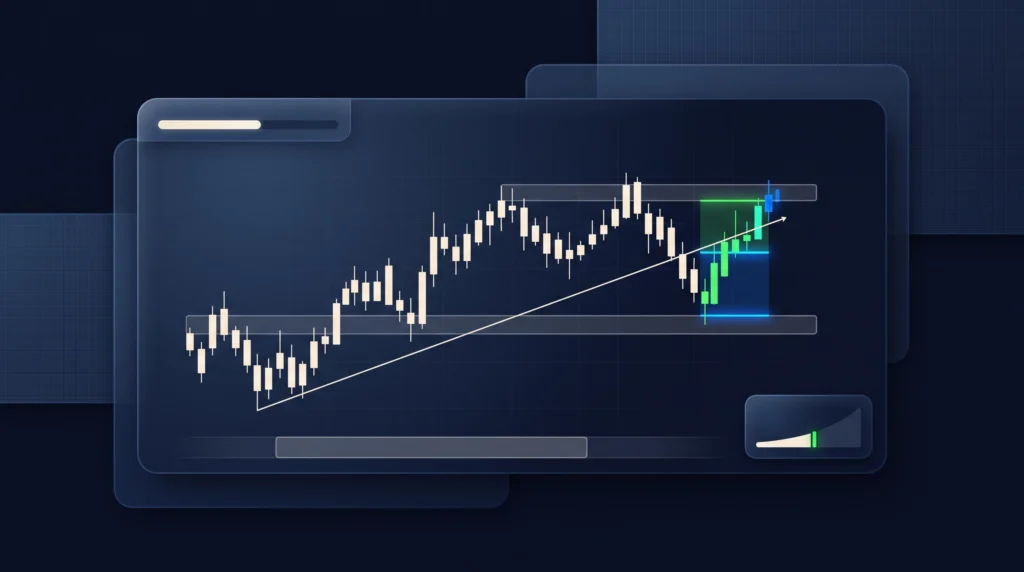
A trading strategy should define the market environment, setup, entry trigger, invalidation point, target method, position size, and conditions for staying out. No single strategy works in every phase. Trend systems can struggle in sideways markets, while range systems can fail quickly when a genuine breakout develops.
Trend and Swing Trading Setups
Trend trading seeks to participate in sustained directional price movement. An uptrend commonly forms higher highs and higher lows, while a downtrend forms lower highs and lower lows. Traders may use a moving average to organize direction, but price structure should remain the primary evidence rather than a single crossover. Pullbacks are useful only while the broader sequence remains intact.
Swing traders generally hold positions for several days or longer. They may wait for a pullback toward previous support, resistance, a moving average, or a broken level. Because the trade remains open overnight, swaps, weekend gaps, and scheduled announcements become important. Before taking a swing setup, review:
- Direction of daily and four-hour market structure
- Distance to major inflation, employment, and central bank events
- Overnight financing and exposure to weekend price gaps
- Volatility-based stop distance and realistic target location
- Correlation with any existing dollar, silver, or mining positions
- Whether the expected return justifies the planned monetary risk
A practical guide on how to swing trade gold can help define timeframes, entry zones, and stop placement. Trend confirmation may reduce some false signals, but it also creates later entries. This trade-off is normal, and no confirmation technique can guarantee that a trend will continue after you enter.
Breakout and Range Trading
Breakout trading seeks to enter when price moves beyond an established boundary, such as resistance, support, a trendline, or a consolidation range. The idea is that a decisive break may trigger new orders and accelerate price movement. Gold frequently produces false breakouts, so the entry plan should define what counts as confirmation before the level is reached:
- Wait for a candle close beyond the boundary rather than a brief spike.
- Require a retest that holds after the initial breakout where appropriate.
- Compare breakout size with recent ATR and normal session volatility.
- Check whether the move occurs during a session with sufficient liquidity.
- Avoid entering directly into a nearby higher-timeframe barrier.
- Define how quickly price must follow through before the setup is abandoned.
Range trading uses the opposite logic. Traders look for buying opportunities near support and selling opportunities near resistance while the range remains valid. The broader gold trading strategies include trend, breakout, range, scalping, and swing approaches. The correct choice depends on current structure, volatility, costs, and available monitoring time rather than personal preference alone.
Both methods require a clear invalidation point. A range trade should be closed when price is accepted beyond the boundary, while a breakout trade should be questioned when price returns quickly inside the old range. Avoid widening the stop simply to keep an incorrect market idea alive.
Scalping and Intraday Gold Setups
Scalping targets small, short-duration price movements and may involve several trades within one session. Because each target is limited, spread, commission, slippage, and execution speed have a large effect on results. A profitable-looking chart setup can become unattractive after realistic costs are included, particularly when volatility is too low to provide enough movement beyond the bid-ask spread. It also requires continuous attention and a reliable connection because delayed reactions can materially change the planned entry or exit.
An XAU/USD scalping strategy may combine a higher-timeframe directional bias with a lower-timeframe trigger near support, resistance, or a liquidity area. Before adapting that approach to intraday trading, define controls that prevent rapid decision-making from becoming uncontrolled activity:
- Maximum number of trades allowed during one session
- Maximum daily monetary loss and mandatory stopping point
- No-trade window before and after selected economic releases
- Minimum expected movement after spread, commission, and slippage
- Mandatory pause after consecutive losses or an execution error
- A rule against immediately reversing direction after a stopped trade
- A minimum pause after an unusually large candle or sudden spread expansion
- A requirement to record screenshots, spread, slippage, and execution details before taking another setup
- A rule for ending the session when market behavior becomes erratic, thin, or inconsistent with the tested plan and expected execution quality
Intraday traders may focus on session openings, range breaks, pullbacks, or post-news stabilization. The setups described in intraday gold trading strategies should be filtered by volatility, liquidity, and execution conditions. These rules may reduce trading volume, but they can also limit emotional overtrading and help distinguish a repeatable setup from random short-term movement.
Technical Indicators for Gold Trading
Indicators summarize historical price information. They may indicate trend, momentum, volatility, or possible reaction zones, but they cannot know future economic releases or predict whether gold will rise. Their value comes from consistent interpretation within a broader process. Moving averages can organize direction, RSI may describe momentum, MACD compares moving-average relationships, and ATR measures recent range rather than direction. A practical framework assigns one role to each tool instead of collecting signals that repeat the same information:
- Trend tool for directional bias and pullback context
- Momentum tool for confirmation, acceleration, or divergence
- Volatility tool for stop distance and target realism
- Price structure for entry, invalidation, and nearby barriers
- Session information for expected liquidity and spread conditions
- Economic calendar for events that may overwhelm technical signals
Avoid adding several similar indicators merely to create agreement. Multiple tools calculated from the same price data can produce false confidence. Test one fixed combination over different market conditions, record how it behaves in trends and ranges, and remove any tool that does not lead to a clearer decision or a measurable improvement in risk control.
Candlestick Reversals, Continuations, and Entry Signals
Candlestick patterns summarize the interaction between opening, high, low, and closing prices during a chosen period. Rejection candles may show that price tested a level and moved away. Engulfing patterns may suggest a shift in short-term control, while inside bars can indicate compression before a possible expansion. None of these shapes should be traded without considering location and market conditions.
Location matters more than shape alone. A reversal pattern near well-tested daily support may carry more information than the same pattern in the middle of a random range. Traders should wait for the candle to close because its final form can change substantially. Before using a signal, check:
- Whether the pattern is located at a meaningful price zone
- Whether the higher timeframe supports or contradicts the direction
- Whether volatility allows a logical stop within the risk limit
- Whether a major economic release is approaching
- Where the setup becomes clearly invalid rather than merely uncomfortable
- Whether the expected target is blocked by nearby structure
A focused guide to candlestick patterns for gold trading can help separate reversal, continuation, and entry signals. A pattern is supporting evidence, not a guarantee. Its usefulness comes from repeatable context, realistic execution, and disciplined position sizing rather than from the visual attractiveness of one candle. Keep screenshots of valid and invalid examples so that pattern recognition is based on documented context instead of selective memory. Review those examples by session, volatility, and nearby levels before changing any rule.
Gold Market Hours, Trade Timing, and Risk Management
XAU/USD is generally available through much of the weekday trading cycle, but exact trading hours depend on the broker and instrument. Daily maintenance breaks, futures exchange schedules, holidays, and daylight-saving changes can affect availability. Openings after a break may include gaps or wider spreads, while pending orders may remain active under broker-specific rules. Check how those orders are handled before leaving exposure unattended through any scheduled interruption. Confirm the schedule in what time does the gold market open and then verify it on your own platform.
London and New York trading sessions often produce stronger participation and larger price movement. Their overlap can offer opportunity, but it can also increase slippage, candle size, and required stop distance. Asian hours may be quieter in some conditions, although regional news can still create unexpected moves. Compare current spread and volatility with recent sessions rather than assuming that a familiar clock time will always produce the same trading conditions. Risk management should extend beyond one protective order, so use a session checklist covering market, execution, and operational risk:
- Set maximum account risk for each trade before choosing quantity, recalculate it whenever the planned entry or stop changes materially, and include any existing correlated exposure already using account margin, available free margin, or similar directional sensitivity across every connected position in the account at that time.
- Review common gold trading mistakes before the session, then define daily and weekly loss limits that prevent attempts to recover losses immediately.
- Limit the number of open gold, silver, mining, and dollar positions so several trades do not create one oversized directional exposure that is difficult to recognize from separate order tickets, particularly when volatility and cross-market correlations rise together during an important scheduled or unscheduled market event.
- Reduce trade size around major releases, or remain flat when normal stop placement cannot contain expected volatility, likely spread expansion, and the possibility of price gaps between available quotes.
- Prepare for platform, power, internet, and device failure by storing verified broker contact details, maintaining a tested backup access method, and knowing which orders remain active without your connection.
- Record unusual spreads, slippage, rejected orders, delayed fills, and emotional decisions so execution problems can be separated from strategy performance during the later review.
- Use a gold trading with economic calendar routine to classify upcoming events, determine no-trade windows, and decide whether existing exposure should be reduced.
XAU/USD, MCX Gold, INR, IST and Market Access
Indian traders may encounter international XAU/USD products, domestic exchange-traded gold contracts, ETFs, physical bullion, and regulated investment products. These markets are connected to the global price of gold, but they differ in currency, contract terms, trading sessions, taxation, and legal access.
XAU/USD, MCX Gold, and Global Market Access
XAU/USD is commonly quoted in US dollars and may be offered through international brokers as a spot-style derivative or CFD. MCX gold contracts are exchange-traded instruments quoted in Indian rupees under published domestic contract specifications. The products can react to the same global events while producing different local price behavior because currency movement, contract expiry, and domestic liquidity also matter. Before choosing a route, compare the complete trading arrangement rather than only the chart:
- Contract currency and exposure to changes in USD/INR
- Contract size, minimum increment, and monetary tick value
- Margin method, possible increases, and liquidation rules
- Trading hours, daily breaks, and public holiday schedules
- Expiry, settlement, delivery, and rollover procedures
- Regulatory permissions, client protections, and complaint routes
- Tax reporting, deposits, withdrawals, and currency-conversion costs
A broad guide to gold trading in India can help distinguish XAU/USD, MCX gold, and other forms of market access. An internationally accessible platform is not automatically authorized to offer every product in your location. Current eligibility, tax treatment, and local restrictions should be verified through appropriate official or professional channels before funds are committed.
Gold Price in INR vs XAU/USD
The Indian rupee price of gold is influenced by the international XAU/USD quotation and the USD/INR exchange rate, along with domestic taxes, import costs, premiums, and product-specific factors. This means local gold can rise even when the international dollar price is stable if the rupee weakens. A stronger rupee may reduce the local effect of an international rally.
Domestic premiums can also separate retail prices from the global benchmark for a period. Traders should identify which currency drives account profit and loss, whether conversion charges apply, and whether the product tracks international gold directly or through a local futures contract. A complete comparison should review:
- Direction and volatility of international gold in US dollars
- Direction and volatility of the USD/INR exchange rate
- Domestic futures basis, taxes, import costs, or retail premium
- Contract expiry and liquidity in the chosen Indian instrument
- Account currency and any broker conversion method
The analysis in gold price in INR vs XAU/USD is useful for anyone moving between global charts and Indian products. Ignoring currency and local pricing components can lead to incorrect expectations, even when the directional analysis of international gold is broadly correct.
IST Trading Sessions, Liquidity, and Volatility
Indian Standard Time changes how global sessions fit into a trader’s routine. London activity begins during the Indian afternoon, while New York participation becomes more important later in the day. Daylight-saving changes can shift these local times, so traders should check the current schedule instead of relying on one fixed year-round assumption or an old screenshot from a trading platform.
The most active period is not automatically the best time to start trading. Higher volatility can create stronger momentum, but it can also produce wider spreads, larger candles, and more slippage. Before selecting a regular session, consider preparation and practical availability:
- Mark previous session highs, lows, and important daily levels.
- Check major US, European, and global economic releases.
- Review current spread, recent ATR, and opening volatility.
- Set a maximum session loss and maximum number of trades.
- Avoid opening positions when you cannot monitor or manage them.
- Adjust the schedule whenever daylight-saving rules change.
The best time to trade gold in India depends on strategy, personal availability, liquidity, and tolerance for rapid movement. A repeatable preparation window is usually more valuable than attempting to trade every active session. Consistency also makes it easier to compare results because the spread, volatility, and market participants are more similar from one trading day to another.
Gold Trading FAQ
Is Gold Suitable for Beginner Traders?
Gold may be suitable for beginners who use small positions, practice on a demo account, and accept that volatility can create rapid losses. It is not inherently easier than forex or stock trading. A beginner should learn contract specifications, spreads, margin, economic drivers, and stop execution before risking capital. Suitability depends on experience, available funds, risk tolerance, and the ability to follow a written plan consistently.
How Much Capital Is Needed to Trade Gold?
There is no universal minimum because brokers, futures contracts, margin requirements, and position sizes differ. A deposit that meets the broker’s account minimum may still be too small for prudent risk management. Traders should calculate stop distance, monetary risk, expected costs, and free margin before funding an account. Sufficient capital means being able to use a sensible position size without risking an excessive percentage on normal market movement.
Are Gold CFDs Better Than Gold Futures for Beginners?
Gold CFDs may offer flexible sizing and no fixed expiry, while futures provide standardized exchange-traded contracts and centralized pricing. Neither product is automatically better. CFDs involve broker-specific execution, financing, and counterparty considerations. Futures involve expiry, tick value, margin changes, and potentially larger standardized exposure. Beginners should compare legal availability, costs, contract size, required capital, and operational complexity before selecting either market.
Which Strategy Works Best for XAU/USD Beginners?
No strategy consistently works best in every market condition. A simple trend or support and resistance trading approach may be easier to test than a system containing many indicators. Beginners should define objective entry, stop, target, and position-sizing rules, then evaluate results across a meaningful sample. A suitable starting strategy is one that can be explained clearly, executed consistently, and paused when current conditions no longer match its assumptions.
Why Does Gold Move After US Economic News?
US economic news can change expectations for Federal Reserve policy, interest rates, Treasury yields, inflation, and the dollar. Because gold is quoted in US dollars and does not pay interest, these changes may alter demand and opportunity cost. Gold often reacts sharply when data differs from forecasts, but direction is not guaranteed. Existing market positioning and prior expectations can cause a seemingly bullish or bearish release to produce the opposite initial response.
Which Gold Trading Mistakes Should Beginners Avoid?
Common errors include overleveraging, risking too much on one position, ignoring spread and swaps, entering immediately before major news, moving stop losses, chasing price after a large candle, and changing strategies after only a few trades. Beginners should also avoid trading without written rules or assuming that historical performance guarantees future results. Consistent risk limits, realistic expectations, and detailed review are more useful than searching for a perfect signal.