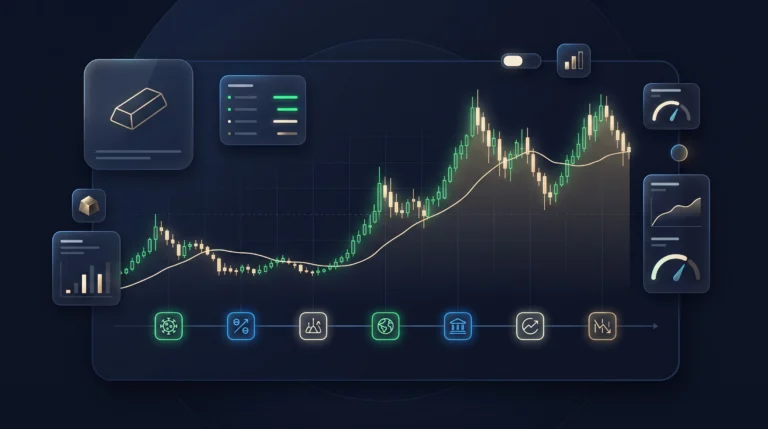
How to Trade Gold With CFDs: Leverage, Spreads, Long and Short Positions


Contracts for difference provide market exposure without requiring delivery, storage, or insurance of bullion. Through a broker interface, you can open a long position when you expect prices to rise or a short position when you expect them to fall.
This flexibility carries material risk. CFDs use margin, so a small move can create a much larger change in account equity. This trading guide explains mechanics, costs, and practical controls before capital is committed in live markets.
What Gold CFDs Are
Gold CFDs provide exposure to changes in the market price without requiring you to purchase, store, or insure physical bullion. They also allow traders to take long or short positions through a broker using margin.
Gold CFD Definition and Core Features
A gold CFD is a contract between a trader and a broker that settles the difference between the opening and closing values of a position. No metal is delivered, and the trader does not receive a certificate for an ounce of gold.
These products commonly provide:
- Long and short market access
- Flexible contract sizes
- Margin-based exposure
- Bid and ask pricing
- Stop-loss and take-profit orders
- Potential overnight financing charges
Gold CFDs offer convenient exposure, but convenience does not mean low risk. Contract values, margin rules, and execution methods differ, so check specifications before ordering.
Gold CFDs vs Physical Gold
Buying physical gold requires full payment, storage, and possible delivery, insurance, or dealer premiums. Direct ownership may suit investors who accept slower execution.
CFDs allow exposure without managing bars or coins and make short selling accessible, but add leverage, financing, counterparty, and execution risks. New readers may review how to trade gold for beginners and practise with virtual funds.
Gold CFDs vs Futures, ETFs, and Gold Stocks
Futures are standardized exchange contracts with defined sizes and expiries. An ETF provides fund exposure, while mining shares also reflect company operations.
| Instrument | What You Hold | Short Access | Leverage | Common Objective |
| CFD | Broker contract | Usually available | Common | Short-term speculation |
| Physical bullion | Bars or coins | Impractical | Usually none | Long-term holding |
| Futures | Exchange contract | Available | Common | Hedging or active trading |
| ETF | Fund shares | Broker-dependent | Usually limited | Portfolio allocation |
| Mining shares | Company equity | Broker-dependent | Usually limited | Equity investment |
Choosing between gold or gold ETFs, futures, shares, and bullion depends on holding period, capital, liquidity, and leverage tolerance.
How Gold CFD Trading Works
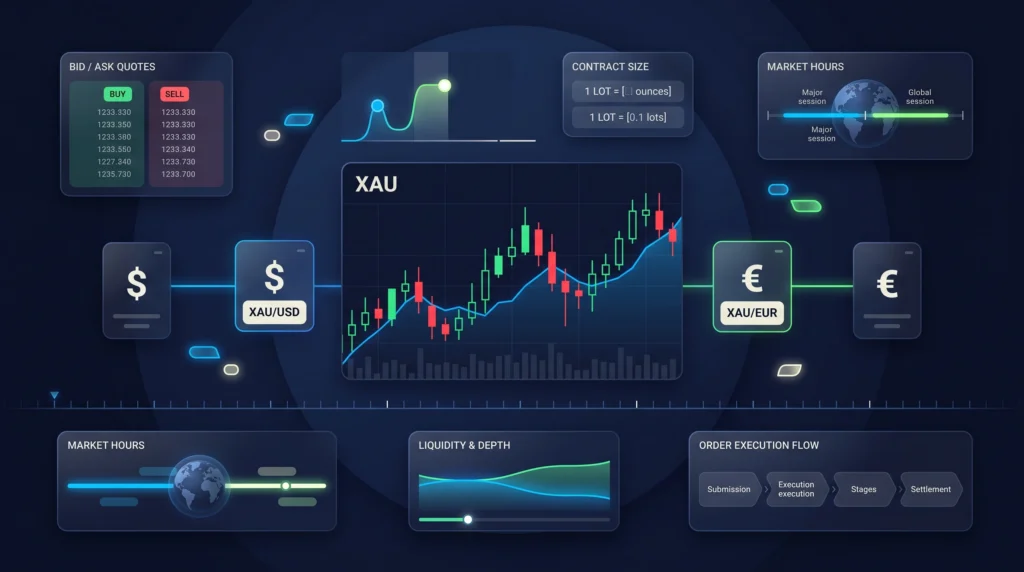
Gold CFDs track an underlying market quote, commonly spot gold against the US dollar. Your result depends on the difference between entry and exit prices after spreads, commissions, financing, and other trading costs.
Gold CFD Symbols and Contract Sizes
Many providers display spot gold as XAU/USD. XAU represents the metal, while USD is the quote currency. A quote near 2,400 generally expresses a dollar value per troy ounce, but one contract may represent several ounces.
Standard, mini, micro, and fractional lots carry different exposure. Confirm contract size, point value, minimum volume, and settlement currency.
Gold CFD Prices and International Gold Markets
Quotes usually follow reference prices from international bullion, futures, and liquidity-provider markets. The broker displays a bid for selling and an ask for buying.
This structure tracks the price of gold without owning bullion. A correct view can still lose when movement does not cover spreads, commissions, swaps, or conversion. Quotes may differ because providers use different liquidity sources and markups.
XAU/USD vs XAU/EUR Trading
XAU/USD represents gold against the US dollar and reflects commodity demand plus currency changes.
XAU/EUR adds euro exposure and may behave differently. Select a pair according to currency view, account denomination, spread, and preferred session.
Market Access, Liquidity, and Trading Hours
Access covers most weekdays, with interruptions for rollover, maintenance, or holidays. High trading volume may improve execution, while thinner periods can widen quotes.
Before you start trading gold CFDs, verify:
- Opening, closing, and maintenance times
- Holiday schedules and early closes
- Minimum and maximum order sizes
- Stop-distance requirements
- Slippage and rejection policies
- Treatment of positions during market breaks
Gold CFD Leverage and Margin
Leverage allows you to control a larger position with a smaller amount of deposited margin. While this can increase potential returns, it also magnifies losses and raises the risk of margin calls or forced position closure.
How Gold CFD Leverage Works
Leverage lets you control exposure larger than the margin reserved in the account. At 20:1 leverage, one unit of margin controls 20 units of position value.
Leverage Ratio = Position Size / Required Margin
Profit or loss is based on full exposure, not only deposited margin. Reviewing how leverage works in gold trading can clarify why trading on margin increases sensitivity to relatively small market changes.
Margin Requirements and Margin Levels
Required margin supports an open trade and reduces funds available for new positions.
Required Margin equals Trade Size divided by Leverage.
Margin level compares equity with used margin. Falling equity may restrict new orders or trigger closure. Review gold margin requirements together with current product documents because thresholds and calculations vary.
Position Size With Leverage
Maximum leverage should never determine volume. A more disciplined process starts with acceptable account loss and works backward from the stop distance.
A practical sizing checklist includes:
- Set maximum capital at risk for one idea
- Identify a technical or fundamental invalidation level
- Measure the distance between entry and stop
- Confirm point value for the chosen contract
- Reduce volume during elevated volatility
- Keep enough free margin for adverse movement
This may reduce damage from one poor decision and preserve capital for future trading opportunities.
Leverage Profit and Loss Example
Assume a trader controls 10 ounces at 2,400 per ounce. Total exposure is 24,000. At 20:1 leverage, initial margin would be 1,200, subject to the broker’s rules.
If the quote rises to 2,410, the gross gain is 100; at 2,390, the gross loss is 100. The effect on committed margin is proportionally larger. Costs determine the net outcome.
Margin Calls and Position Liquidation
A margin call may occur when equity falls too far relative to used margin. Continued losses can trigger automatic liquidation.
Gaps or thin liquidity can cause worse fills. Smaller exposure, free-margin buffers, and lower concentration may reduce but not remove risk.
Long and Short Gold CFD Positions
A long position may benefit when prices rise, while a short position may benefit when prices fall. Both directions require careful position sizing, clear exit rules, and awareness of spreads and execution risk.
Opening Long Gold CFD Positions
A long position is opened when you expect the market to rise. You buy at the ask and later close at the bid.
A bullish view may follow a weaker dollar, lower real yields, defensive demand, or a breakout. These signals do not guarantee continuation.
Opening Short Gold CFD Positions
A short position is used when you expect the market to decline. You sell at the bid and later close by buying at the ask.
Gold CFDs let traders participate in falling markets without first purchasing bullion. Bearish factors may include a stronger dollar, higher real yields, or a support break. Losses increase as the market rises.
Buy and Sell Order Types
Different order types serve different purposes:
- Market orders seek immediate execution
- Limit orders request a more favourable price
- Stop-entry orders activate after a specified level is reached
- Stop-loss orders aim to cap downside
- Take-profit orders close at a planned target
- Trailing stops adjust after favourable movement
Execution is not guaranteed at the requested level, and slippage may occur in fast or thin markets.
Long Position Profit and Loss Example
Suppose you buy a position at an ask of 2,405 with exposure equal to five ounces. The bid later reaches 2,417.
The gross gain is five multiplied by 12, or 60. At 2,393, the gross loss is 60. Spread, commission, and financing change the result.
Short Position Profit and Loss Example
Assume you sell contracts at a bid of 2,420 with exposure equal to eight ounces. You close when the ask falls to 2,405.
The gross gain is eight multiplied by 15, or 120. At 2,435, the gross loss is 120. Any attempt to profit from gold price declines must account for spread, slippage, and overnight charges.
Closing and Reversing Gold Positions
A long position closes by selling the same volume, while a short trade closes by buying it back. Reversing means closing the current exposure and opening a new trade in the opposite direction.
Some interfaces reverse directly; others require separate orders. Reassess first because repeated reversals add costs and encourage reactive decisions.
Gold CFD Spreads and Trading Costs
Every trade is affected by the difference between the bid and ask price, known as the spread. Depending on the broker and holding period, additional expenses may include commissions, overnight swaps, currency conversion, and slippage.
Bid Price, Ask Price, and Spread
The bid is the price at which you can sell, while the ask is the price at which you can buy. The difference is the spread.
A new trade starts negative because it opens and closes on opposite sides of the quote. Wider spreads increase break-even distance. This gold spread explained resource provides additional context on entry and exit costs.
Overnight Swap and Financing Fees
Positions held beyond rollover may incur financing. Long and short rates can differ and change over time.
When comparing accounts, examine:
- Typical spreads during active hours
- Commission per side or round trip
- Long and short swap rates
- Currency conversion policy
- Slippage during volatile releases
- Inactivity or data fees
The lowest advertised spread may not produce the lowest total cost.
Gold Price Drivers and Market Conditions
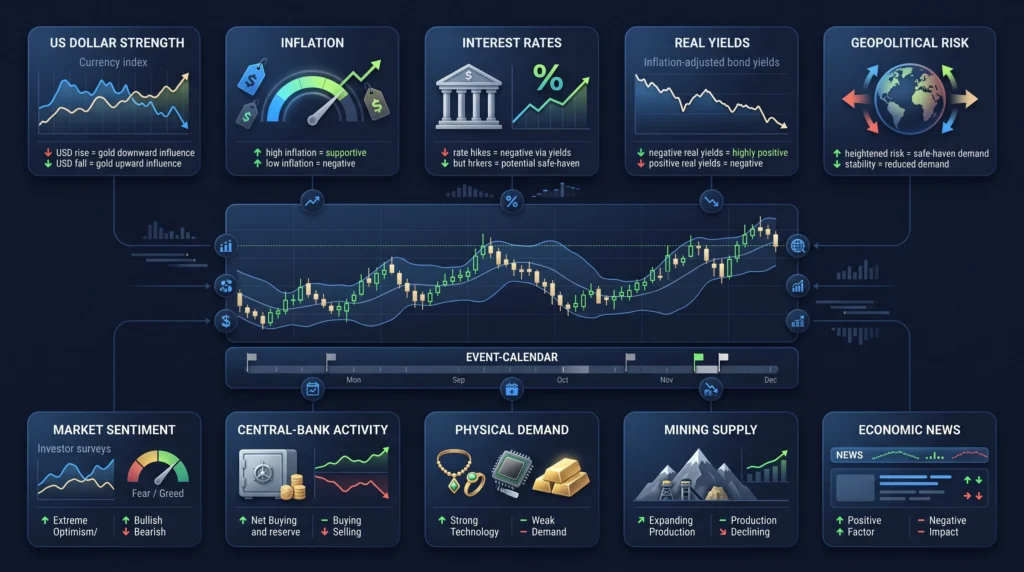
Price movements can be influenced by the US dollar, interest rates, inflation expectations, geopolitical events, investment demand, and central bank activity. These factors often interact, so traders should avoid relying on a single indicator.
US Dollar Strength
The metal often moves inversely to the dollar, but not consistently. Currency strength can reduce foreign purchasing power.
Use this relationship as context, not a standalone signal.
Inflation and Interest Rates
Gold has historically been viewed as a store of value, but inflation does not automatically lift prices. Real yields affect the opportunity cost of a non-interest-bearing asset.
Markets often react to policy expectations before official announcements.
Geopolitical Risk and Market Sentiment
Conflict, banking stress, and growth concerns may increase defensive demand, but moves can reverse quickly.
Headlines can create gaps, wider quotes, and abrupt reversals. Consider whether potential reward justifies execution risk.
Gold Supply, Demand, and Central Bank Reserves
Mining, recycling, jewellery, investment flows, and central banks affect different time horizons. Demand for gold may strengthen during uncertainty, but physical buying is only one pricing component.
Derivatives positioning can drive short moves, while mine supply develops gradually. No indicator explains every change.
Volatility, Economic Data, and News Events
Inflation, employment, central bank, growth, and bond data can trigger sharp gold price movements. Reactions depend on expectations.
Before major news, traders may reduce volume, widen buffers, or remain flat. The choice should follow a written plan.
Gold CFD Trading Strategies
Traders can approach the market through day trading, scalping, swing trading, or longer trend-based setups. The most suitable strategy depends on available time, transaction costs, risk tolerance, and current market conditions.
Gold Day Trading Strategy
Day traders open and close positions within the same trading day. They may focus on session openings, intraday support and resistance, momentum, or scheduled data.
A day-trading plan should define:
- Conditions required before entry
- Maximum number of trades
- Maximum daily loss
- Preferred active hours
- Rules for stopping after repeated errors
Closing before rollover may avoid financing but not slippage or intraday volatility.
Gold Swing Trading Strategy
Swing traders seek multi-day moves using market structure, patterns, and macro themes.
It requires fewer decisions than scalping but adds overnight gaps, financing, and wider stops. Reduce size when stop distance increases.
Gold Scalping Strategy
Scalping targets small, short-duration moves. Spread stability, execution speed, and discipline strongly influence results.
Poor fills can erase several gains, while fatigue encourages overtrading.
Gold Trend and Price Action Strategy
Trend traders may follow structure, breakouts, pullbacks, support, resistance, and candles. Higher highs may suggest strength; lower lows may suggest weakness.
Signals do not guarantee continuation. Confirmation, sizing, and invalidation remain essential.
Gold CFD Benefits, Risks, and Risk Management
CFDs offer flexible trade sizes, two-way market access, and exposure without physical ownership. However, leverage, volatility, financing costs, slippage, and liquidation risk make disciplined risk management essential.
Benefits of Gold CFD Trading
CFD trading offers flexible sizing, two-way access, and no storage requirement. One interface can combine charts, orders, controls, and reporting.
Potential practical advantages include:
- Ability to trade rising and falling conditions
- Smaller increments than some futures contracts
- No physical delivery or storage arrangements
- Access to leverage where permitted
- Integrated stop-loss and take-profit tools
Availability depends on local rules, account classification, and broker services.
Leverage, Volatility, and Loss Risks
CFDs are leveraged, so losses can develop quickly. Volatility may cause wider spreads, slippage, and liquidation.
Before deciding to trade CFDs, assess:
- Overnight financing accumulation
- Platform or connectivity interruptions
- Counterparty exposure
- Currency conversion costs
- Correlated positions increasing total risk
- Emotional decisions after losses
Use a regulated provider where appropriate and review execution, client-money, and negative-balance policies. Regulation cannot prevent losses.
Stop-Loss, Take-Profit, and Risk-Reward Levels
A stop-loss marks invalidation; a take-profit defines a planned exit. Risk-reward compares possible loss with possible gain.
Record entry logic, stop, target, size, costs, and event risk. Reviews can reveal weak analysis, execution, sizing, or discipline.
Gold CFD Trading FAQ
How Much Capital Is Needed to Trade Gold CFDs?
Required capital depends on contract size, leverage, margin rules, stop distance, and acceptable risk. A broker’s minimum deposit should not be treated as a sufficient operating budget. You also need free margin for normal fluctuations and costs. Many beginners practise in a demo account before using smaller live positions with a predefined amount at risk.
What Leverage Is Suitable for Gold CFD Trading?
There is no universally suitable leverage level. Lower effective leverage generally leaves more room for volatility, while higher leverage can produce rapid losses. Choose size from stop distance and acceptable account risk rather than using the maximum ratio. Available leverage may also depend on regulation, provider policy, instrument type, and market conditions.
What Spread Is Competitive for Gold CFDs?
A competitive spread remains reasonably narrow and stable during the hours in which you trade. The lowest advertised quote may not represent typical execution. Compare average spreads, news-period widening, commissions, slippage, and financing. A slightly wider but consistent quote may be more practical than one that expands sharply during your preferred session.
Can Gold CFDs Be Held Long Term?
These products can be held for extended periods in some cases, but recurring financing may make them inefficient for long-term exposure. Total cost depends on position direction, provider rates, and holding period. Compare the contract with bullion, an ETF, or other gold derivatives before selecting an instrument for a long-duration view.
What Timeframes Work Best for Gold CFD Trading?
The most suitable timeframe depends on strategy, availability, costs, and tolerance for volatility. Scalpers may use short charts, day traders often focus on intraday periods, and swing traders may use four-hour or daily charts. A higher timeframe can provide context even when entries occur on a shorter chart. Consistency matters more than frequently changing methods.
Can Beginners Trade Long and Short Gold CFD Positions?
Beginners can access both directions where these products are permitted, but they should first learn contract sizing, margin, spreads, and execution. A demo account helps with order practice, although simulated outcomes may differ from live trading. Use modest volume, predefined exits, and a written plan before you start your trading journey.
Gold CFD vs Gold Futures: Which Fits Short-Term Trading?
Futures use standardized exchange contracts with fixed specifications and expiry dates, while traders may trade gold CFD positions through a broker with more flexible sizing. Because gold CFDs are traded over the counter, costs and execution depend on the provider. The better choice depends on capital, preferred market structure, holding period, and whether centralized pricing is important.
What Affects Price of Gold During Active Sessions?
Gold traders commonly watch the dollar, real yields, economic data, geopolitical headlines, and changes in risk sentiment. The market may also react to liquidity around session openings and scheduled announcements. No factor controls every move, so decisions should combine broader context, technical levels, transaction costs, and predefined risk limits.
Which Gold Trading Platform Features Matter Most?
A suitable interface should display clear contract specifications, live quotes, margin information, financing rates, and reliable order controls. Users should also assess execution quality, stability, slippage policies, and risk-management tools. These features support gold price movements without owning physical gold, but they cannot remove the risks associated with margin trading.