Gold Trading Hours: When XAUUSD Opens and Best Time to Trade Gold


Gold does not trade through one single exchange with one universal opening bell. Global gold market includes over-the-counter spot trading, exchange-traded futures and options, broker-issued CFDs, ETFs, and physical gold dealers. Their schedules overlap, but they are not identical.
For most retail traders, XAUUSD is available from Sunday evening through Friday, with a short daily pause. COMEX gold futures follow a published exchange schedule, while gold CFD trading hours depend on broker and trading platform. This guide explains those differences so you can plan entries, manage rollover risk, and avoid confusing “nearly 24 hours” with uninterrupted access.
Gold Market Hours: Quick Answer
Gold opens for trading week on Sunday evening in New York time and remains available through Friday, except for daily maintenance periods and holiday changes. Spot and CFD quotes often follow the same broad trading cycle as major futures venues, but broker schedules may differ by several minutes or more.
| Gold instrument | Typical weekly access | Common interruption | Main point to verify |
| Spot XAUUSD | Sunday evening to Friday | Daily rollover window | Broker server time |
| Gold CFDs | Usually 24/5 | Broker-defined pause | Spreads, swaps, execution |
| COMEX GC and MGC futures | Sunday to Friday | One-hour daily break | CME calendar and contract month |
| Gold ETFs | Exchange business days | Overnight and weekends | Stock exchange hours |
| Physical gold | Dealer-dependent | Outside dealer hours | Premiums, delivery, storage |
Weekly Gold Market Open and Close Times
CME lists standard GC and MGC electronic trading from Sunday at 6:00 p.m. to Friday at 5:00 p.m. Eastern Time, with a daily break. In Central Time, that is Sunday at 5:00 p.m. through Friday at 4:00 p.m. Retail XAUUSD may open a few minutes earlier or later than that reference, depending on liquidity providers and broker controls. Before you start trading, compare symbol specification shown in your platform with broker’s published schedule.
Daily Trading Time and Maintenance Break
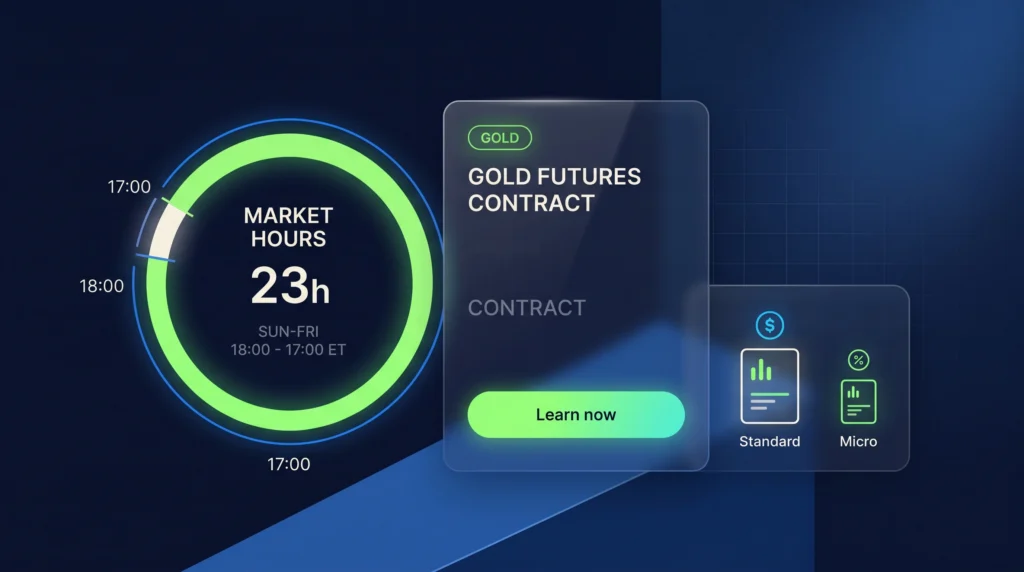
Gold is commonly described as a 23 hours a day market because standard COMEX gold futures pause for 60 minutes each weekday. CME identifies usual break as 5:00 p.m. to 6:00 p.m. Eastern Time, equivalent to 4:00 p.m. to 5:00 p.m. Central Time.
CFD providers often impose a similar rollover break, but it may appear at a different local time. M4Markets, for example, publishes XAUUSD hours of 00:00 to 23:00 with a 23:00 to 00:00 break in its server time, which changes between GMT+3 in summer and GMT+2 in winter.
XAUUSD Market Hours and Weekly Schedule
XAUUSD represents gold priced in US dollars. It is normally quoted as an OTC spot or CFD product, not as ownership of a specific bar and not as a centralized exchange contract. Underlying spot market is global, while your actual access is controlled by your broker.
Sunday Open and Friday Market Close
Markets open Sunday evening as liquidity returns first in Asia-Pacific region and then broadens through Tokyo, London, and New York. A common reference is around 5:00 p.m. to 6:00 p.m. New York time, although some platforms delay first tradable quote. Friday market close usually occurs around 5:00 p.m. New York time. Liquidity may thin before final minutes, and spreads can widen. Holding a leveraged position across weekend exposes you to a possible opening gap if major news develops while market is closed.
Monday Through Thursday XAUUSD Trading Hours
From Monday through Thursday, XAUUSD generally trades across a nearly continuous 24-hour market with a short daily interruption. Gold market operates through overlapping regional dealing centers rather than one physical venue. A practical routine is to check these details before every trading day:
- Exact platform opening and closing time
- Daily rollover or maintenance window
- Any temporary holiday notice
- Current spread and available margin
- Stop and limit order behavior during breaks
New traders can review how to trade gold for beginners before using leverage or placing orders near thin trading windows.
Broker Server Time and Platform Schedule Differences
Server time is not always your local time, UTC, London time, or New York time. A platform may display Monday at 00:00 even though same moment is still Sunday evening in North America. Do not convert hours from clock alone. Confirm broker’s stated UTC offset, whether that offset changes with daylight saving time, and whether symbol has special Friday or holiday conditions. Trading hours may also change during unusual volatility or limited liquidity.
Gold Trading Sessions Across Global Market
Major trading sessions are useful activity windows, not separate gold exchanges opening and closing same instrument. XAUUSD can remain available between them, but trading volume, spreads, and price movement often change as regional participants enter.
Sydney Trading Session
Sydney marks beginning of global trading week. Activity can be modest compared with London or New York, particularly when no major weekend event has occurred. First quotes after markets open Sunday evening may be less stable. Traders should consider smaller position sizes, wider spreads, and risk that a weekend gap can trigger pending orders at a price different from requested level.
Tokyo Trading Session
Tokyo adds Asian liquidity and overlaps partly with Sydney. Gold price action during this period may respond to movements in US dollar, regional risk sentiment, Japanese yields, and demand from Asian market participants. This session can suit traders who prefer calmer conditions, but lower activity does not guarantee lower risk. Sudden geopolitical developments or policy headlines may still cause sharp movement.
London Trading Session
London is central to OTC precious metals market. LBMA describes international precious metals as trading on a 24-hour basis and identifies London as center of global OTC market. Liquidity often improves as European banks, dealers, funds, and commercial participants become active. London hours may provide cleaner execution than earliest Asian period, although spreads and volatility still depend on current market conditions.
New York Trading Session
New York session brings US futures participation, economic releases, and deeper interaction between spot gold market and COMEX gold futures. OANDA identifies 8:00 a.m. Eastern as a common New York open reference and notes that session overlaps with London until around noon Eastern. New York open can produce rapid repricing, especially around US inflation, employment, central-bank, or growth data. Increased trading volume may improve liquidity while also increasing short-term volatility and slippage.
COMEX Gold Products and Futures Trading Hours
COMEX products are standardized exchange-traded derivatives. Unlike a broker-created spot CFD, futures have defined contract specifications, expiration months, margin rules, and clearing arrangements.
CME Globex Market Schedule
Standard COMEX gold futures trade electronically from Sunday through Friday, 6:00 p.m. to 5:00 p.m. Eastern Time, with a one-hour daily interruption. This schedule gives traders broad access to global news without making contract continuously tradable. CME may publish special hours for US holidays. Always check current exchange calendar rather than assuming a normal session on a holiday or day before one.
GC Gold Futures Trading Time
GC is standard COMEX gold futures contract and is widely used for hedging and speculative exposure. It trades during CME Globex schedule and may involve substantial notional value relative to margin posted. Leverage can magnify both gains and losses. Your risk plan should account for intraday margin changes, overnight requirements, commissions, exchange fees, slippage, and possibility of liquidation if account equity falls below required levels.
MGC Micro Gold Futures Trading Time
MGC follows same core electronic trading hours as GC but is sized at one-tenth of standard GC contract. Smaller unit may make position sizing more flexible, though it does not remove market or leverage risk. For a fuller introduction to contract mechanics, margin, and rollover, see gold futures trading for beginners.
Daily Futures Market Close and Maintenance Break
Daily break is operationally important. Orders cannot be executed while venue is closed, and a price gap may appear when trading resumes. Stop orders are not a guarantee of execution at requested price. Traders holding positions through pause should review available margin beforehand. A volatile reopening can produce fast price movement before liquidity fully normalizes.
Futures Expiration and Delivery Schedule
Gold futures expire by contract month. Traders who do not intend to participate in physical delivery usually close or roll their position before broker’s cutoff, which may be earlier than exchange’s final trading deadline. Gold futures and options also have different expiration procedures. Check exact contract code, first notice considerations, last trading day, and broker’s liquidation policy. CME provides product calendars and expiration tools for current dates.
Trading Different Gold Instruments
Choosing among gold instruments involves more than market hours. Costs, leverage, ownership, settlement, liquidity, and regulatory protections can differ substantially.
Spot XAUUSD Trading Hours
Spot gold market is an OTC network in which institutions trade bilaterally. It is active across time zones, but no single central exchange guarantees one universal retail schedule. LBMA describes global precious metals dealing as operating on a 24-hour basis. Your broker converts that broad market into defined dealing hours, spreads, margin requirements, and execution rules.
Gold CFD Market Hours
Gold CFDs usually track spot or futures-derived pricing and are commonly available from Sunday evening to Friday with a daily break. M4Markets publishes a one-hour XAUUSD interruption in its server schedule, while other providers may use different times. CFDs are leveraged and cash-settled. You do not own physical gold, and losses may exceed expectations when volatility, gaps, or poor liquidity affect execution.
COMEX Futures Exchange Hours
COMEX gold futures trade on a centralized exchange with published hours and central clearing. That structure can make trading time more transparent than a broker-defined OTC product, but access still depends on your futures broker and account permissions. Exchange trading does not eliminate risk. Futures positions can experience rapid margin changes and forced liquidation.
Liquidity Across Different Gold Products
Liquidity is not identical across spot quotes, GC, MGC, gold ETFs, and physical gold. It also varies by time of day.
| Instrument | Liquidity pattern | Typical cost focus | Key risk |
| XAUUSD CFD | Often strongest during London and New York | Spread, swap, commission | Leverage and broker execution |
| GC futures | Deep in active contract months | Commission, exchange fees, slippage | Margin and expiry |
| MGC futures | Smaller contract, potentially thinner depth | Per-contract costs | Relative transaction cost |
| Gold ETFs | Concentrated in stock exchange hours | Bid-ask spread, fund fee | Overnight gap |
| Physical gold | Dealer and location dependent | Premium, storage, insurance | Resale and custody |
Rollover and Financing Differences
A cash gold CFD may incur overnight financing or swap charges. Futures embed financing and carry expectations into contract price and require periodic rollover if you want to maintain exposure beyond expiration. Costs can accumulate even when gold price barely moves. Compare expected holding period, spread, commissions, swap rate, and rollover slippage before choosing a product.
Choosing Gold Instruments by Market Schedule
A day trader may value long access and active intraday liquidity. A hedger may prefer standardized futures, while a long-term investor may consider gold ETFs or physical gold without daily leveraged financing. Match instrument to your objective, available capital, risk tolerance, and preferred trading windows. Market access alone should not determine choice.
Best Time to Trade XAUUSD
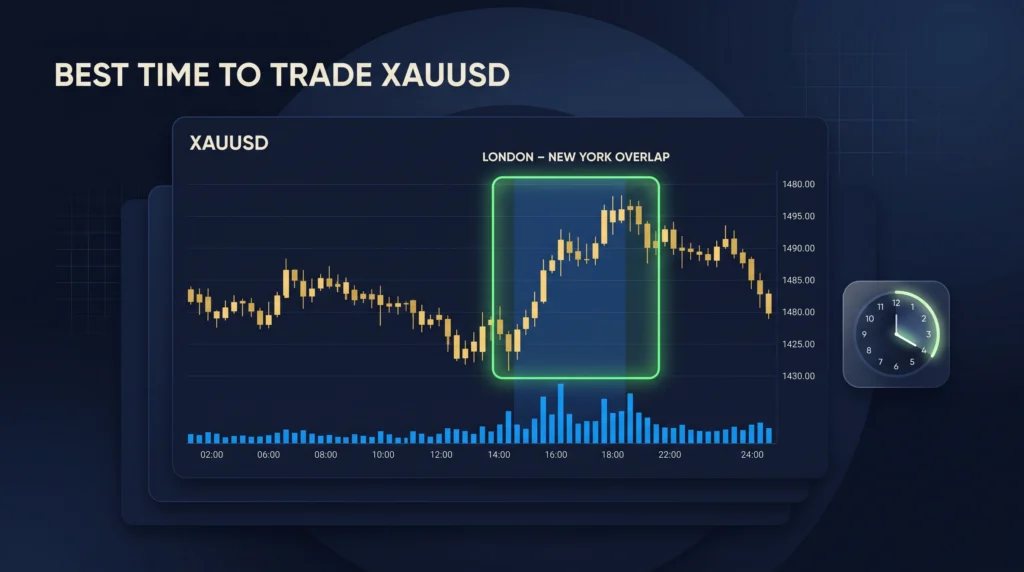
Best time to trade XAUUSD is not simply period with largest candles. A useful window should match your strategy, liquidity needs, news tolerance, and ability to manage risk.
London–New York Overlap for Optimal Trading
Overlap between London and New York, commonly around 8:00 a.m. to noon Eastern Time, is often one of most active periods because European and US participants are trading simultaneously. Higher liquidity may reduce trading costs in normal conditions, but important data can also create slippage and abrupt reversals. Test any gold trading strategy across both quiet and volatile days.
Major Gold Trading Hours by Liquidity
Three windows often deserve attention:
- London morning, when European participation builds
- London and New York overlap, when activity is commonly strongest
- US data and futures hours, when macroeconomic news may drive repricing
For readers trading from South Asia, best time to trade gold in India can help translate these windows into local time.
Factors Influencing Gold Price Volatility
Gold may react to real and nominal interest-rate expectations, US dollar movement, inflation data, central-bank communication, geopolitical risk, and changes in investor positioning. Scheduled releases can create fast two-way price action. A strong initial move may reverse as traders reassess details, so first candle after news does not guarantee direction.
Best Weekdays for Trading Gold
No weekday is consistently best. Tuesday through Thursday may sometimes provide steadier participation than weekly open or late Friday, but market conditions matter more than calendar label. Review scheduled events, current volatility, and recent range behavior. For actionable setup ideas, intraday gold trading strategies offers additional planning frameworks.
Weekly Open and Daily Rollover Risks
At weekly open, gaps can occur after weekend news. Near daily rollover, liquidity may temporarily fall, spreads may widen, and swaps may be applied. Avoid treating these periods as normal active trading conditions. Check order exposure, available margin, and whether your broker changes leverage before weekends or major events.
Time Zones, Daylight Saving, and Holiday Market Hours
Time-zone errors are a common cause of missed entries and unexpected closures. Store one reference schedule in UTC, then convert it to your local time using correct date.
ET, PT, GMT, and UTC Trading Time Conversion
CME’s standard Sunday open at 6:00 p.m. Eastern corresponds to 3:00 p.m. Pacific. In UTC, it is 22:00 while New York observes daylight saving time and 23:00 during standard time. Daily 5:00 p.m. Eastern close is 21:00 UTC in daylight time and 22:00 UTC in standard time. Confirm date before converting.
Daylight Saving Changes in XAUUSD Market Hours
US and Europe do not always change clocks on same weekend. During those transition periods, London and New York overlap may shift by one hour for traders using UTC or local clocks. Some brokers also move server time seasonally. M4Markets states that its servers use GMT+3 in summer and GMT+2 in winter.
Holiday Schedule for Major Gold Markets
US holidays can shorten or alter COMEX metals trading, while CFD providers may close early, reopen late, or quote wider spreads. Exact schedule can differ by product and date. Check both exchange holiday calendar and your broker notice. CME maintains current holiday and trading-hours information, and brokers may issue separate symbol-level updates.
Weekend Market Close and Sunday Reopening
Most XAUUSD, GC, and MGC trading stops from Friday evening until Sunday evening. During that closure, economic or geopolitical developments can accumulate without continuous price discovery. When gold opens, first tradable price may be above or below Friday’s close. Reduce position size or weekend exposure when a gap would create unacceptable risk.
Gold Trading Hours FAQs
What Time Does Gold Market Open?
Gold usually opens for trading week on Sunday evening, commonly around 5:00 p.m. to 6:00 p.m. New York time. Standard COMEX GC and MGC futures open at 6:00 p.m. Eastern Time. XAUUSD and gold CFD opening times are broker-specific, so confirm symbol schedule in your trading platform before placing an order.
What Time Does XAUUSD Market Open and Close?
XAUUSD commonly becomes tradable on Sunday evening and closes late Friday, with a brief daily pause. Exact hours depend on broker, liquidity providers, server time, holidays, and unusual market conditions. A platform may show Monday 00:00 even though it is still Sunday in New York, so always check broker’s UTC offset.
Is Gold Market Open 24 Hours a Day?
International OTC gold market is active across global time zones, but retail access is not always uninterrupted. Standard COMEX gold futures trade 23 hours a day with a one-hour break, and many CFD brokers use a similar maintenance window. Gold ETFs follow stock exchange hours, while physical gold access depends on dealer availability.
Does Gold Trade During Weekends?
Most spot XAUUSD, gold CFDs, and standard COMEX gold futures do not trade continuously through weekend. Trading generally stops on Friday and resumes on Sunday evening. Prices can gap at reopening if important news occurs during closure, and stop orders may execute at next available price rather than requested level.
When Does Gold Price Move Most?
Gold often shows stronger activity during London session, London–New York overlap, and periods surrounding major US economic releases. Higher volume may support tighter spreads, but it can also bring faster price movement and slippage. Most suitable time depends on your strategy, risk limits, and tolerance for news-driven volatility.
How Do Spot Gold, Futures, and CFD Hours Differ?
Spot gold is an OTC market active across global dealing centers. COMEX futures follow a centralized exchange schedule with defined daily breaks and expiration rules. Gold CFDs follow broker-specific hours and may include overnight financing. All three can offer broad weekday access, but their costs, leverage, settlement, and execution conditions are materially different.