Best Time to Trade Gold in India: IST Sessions, XAU/USD Liquidity and Volatility


Gold trades across a global market, but activity is not evenly distributed across every hour. For traders in India, finding the best time to trade gold usually means converting major market sessions into Indian Standard Time and identifying periods when liquidity, volatility, spreads, and news flow support a chosen strategy.
For many intraday traders, London and New York hours provide the most active conditions. However, greater price movement also creates greater risk. A suitable trading window depends on your experience, available screen time, trading costs, risk tolerance, and whether you prefer breakouts, trends, range trading, or short-term scalping.
This guide explains XAU/USD market hours in IST, session-specific behaviour, London–New York overlap conditions, daylight-saving changes, and practical risk controls. Trading leveraged products such as CFDs or futures can result in rapid losses, so timing should support a complete trading plan rather than replace one.
XAU/USD Market Basics for Indian Traders
XAU/USD represents gold priced in US dollars and is one of the most actively traded commodity instruments. Indian traders should distinguish between spot gold CFDs, exchange-traded gold futures, and domestic gold prices quoted in INR.
What Is XAU/USD?
XAU/USD represents the price of one troy ounce of gold quoted in US dollars. XAU is the internationally recognised market symbol for gold, while USD represents the dollar side of the trading pair.
When XAU/USD rises, an ounce of gold becomes more expensive in dollar terms. When it falls, gold becomes cheaper against the dollar. This relationship means gold prices may react to changes in US interest rate expectations, inflation data, Treasury yields, geopolitical risk, central-bank communication, and broad demand for defensive assets.
Retail traders commonly access gold through CFDs offered on a trading platform. A CFD does not normally involve taking delivery of physical metal. Instead, it tracks price movement, subject to broker spreads, swaps, commissions, margin requirements, execution policies, and available liquidity.
Gold futures are exchange-traded contracts with fixed specifications and expiry dates. COMEX gold futures provide nearly continuous weekday access, although scheduled maintenance periods, holidays, and contract-specific rules may apply.
Anyone new to the product should first review how to trade gold for beginners before choosing an intraday schedule or using leverage.
How Global Gold Trading Hours Work
The global gold market follows activity across Asia, Europe, and North America. It is often described as being open 24 hours a day from Monday to Friday, but this does not mean identical trading conditions are available throughout the day.
Dealer participation, institutional order flow, economic announcements, futures activity, and regional business hours all affect liquidity. A quiet period may produce narrow ranges and slower execution, while an active gold trading session may generate stronger momentum and larger short-term swings.
Retail XAU/USD trading hours also depend on the broker. Many platforms pause briefly for daily maintenance, rollover, or liquidity resets. Friday closing times, Sunday reopening times, holiday schedules, and symbol names can vary. You should therefore treat general session times as planning references and confirm exact hours inside your own platform.
XAU/USD Market Hours in India

XAU/USD is generally available throughout the weekday trading cycle, although brokers may apply daily maintenance breaks and different server times. Traders should convert platform hours into IST and confirm exact opening, closing, and rollover schedules with their broker.
XAU/USD Market Open Time in IST
Most retail platforms reopen XAU/USD late on Sunday evening or early on Monday morning in IST and continue offering access until early Saturday, with daily interruptions possible. There is no single universal gold market open time for every broker because providers use different server clocks and liquidity arrangements.
The practical trading day for traders in India starts with Asia-Pacific participation, expands as London opens, and reaches its most active phase when London and New York sessions are operating together.
Before placing orders, check:
- Symbol trading specifications
- Weekly opening and closing schedule
- Daily maintenance break
- Holiday adjustments
- Minimum stop distance
- Margin and leverage conditions
A detailed explanation of what time does the gold market open can help distinguish general global access from broker-specific execution hours.
XAU/USD Market Close Time in IST
Gold CFDs commonly stop trading around the end of the New York business day on Friday, which falls in the early hours of Saturday in India. Exact timing changes with US daylight saving time and individual broker schedules.
Positions held through the weekly close face gap risk. Political developments, military events, emergency policy announcements, or other unexpected news can occur while the market is unavailable. When trading resumes, XAU/USD may open at a different price, and a stop-loss order may be executed beyond its requested level.
Traders should consider reducing exposure before the weekend when an open gap would exceed their acceptable loss. This is particularly important when using high leverage or holding a position that is already close to a margin threshold.
How MT4 and MT5 Server Time Differs from IST
MT4 and MT5 charts usually display broker server time rather than your computer’s local time. A candle marked 10:00 on the platform may therefore represent a different hour in India.
To convert server time accurately:
- Identify the time shown in Market Watch.
- Compare it with current IST.
- Record the difference in hours and minutes.
- Repeat the check after US or UK clock changes.
- Mark preferred trading windows directly on the chart.
India remains on UTC+5:30 throughout the year. London and New York change clocks seasonally, so their session opens shift by one hour relative to IST. Platform server time may also change, making periodic verification essential.
Global Gold Trading Sessions in IST
Session times below are approximate. Market conventions differ, and Australia, the United Kingdom, and the United States apply seasonal clock changes on different dates.
| Market session | Approximate IST hours | Typical XAU/USD conditions |
| Sydney | 3:30 a.m.–12:30 p.m. | Light early liquidity, gradual weekly reopening |
| Tokyo | 5:30 a.m.–2:30 p.m. | Moderate activity, frequent consolidation |
| London | 12:30 p.m.–9:30 p.m. in UK summer | Rising volume, breakouts, trend development |
| New York | 5:30 p.m.–2:30 a.m. in US summer | Strong news sensitivity, futures participation |
| London–New York overlap | About 5:30 p.m.–9:30 p.m. in aligned summer schedules | Peak combined participation and faster movement |
During standard-time months, London and New York commonly begin one hour later in IST. Short transition periods can also occur because the US and UK change clocks on different dates.
Sydney Session Timing and Market Conditions
Sydney begins the new global trading day, although institutional gold activity is often limited during its earliest hours. Sunday reopening can involve wider spreads, thinner order books, or price gaps caused by weekend developments.
This period may suit traders managing existing positions or observing how markets respond to weekend news. It is less attractive for strategies that depend on high turnover and immediate follow-through.
Australian daylight-saving changes can shift the displayed session time. Because Sydney activity is not usually the main driver of XAU/USD, traders should focus more on actual spread and price behaviour than on a rigid clock-based definition.
Tokyo Session Timing and Asian Liquidity
Tokyo hours overlap with other Asian financial centres and can produce meaningful moves, especially when regional risk sentiment changes. Gold may respond to developments involving currencies, government bonds, energy markets, or geopolitical risk.
The Asian session can still offer orderly trading opportunities when price respects a defined range. Range traders may watch support and resistance, while breakout traders often use the Asian high and low as reference levels for later London activity.
Avoid the Asian session only when it does not fit your method. Lower average momentum is not automatically a disadvantage. It may support more patient setups, but spreads, false breaks, and limited continuation remain possible unless major news hits the market.
London Session Timing and European Volume
London is a major centre for precious-metals activity. As European institutions become active, XAU/USD liquidity often improves and the market may break beyond ranges established during Asia.
The London session may be useful for:
- Asian-range breakout setups
- Trend continuation entries
- Reactions around European data
- Retests of prior daily levels
- Preparation for US announcements
Fast movement near the session open can produce slippage or false breakouts. Instead of entering solely because the clock reaches a specific time, wait for evidence such as sustained volume, a confirmed level break, or a pullback that fits your plan.
Indian readers comparing domestic bullion prices with dollar-denominated gold should also recognise that currency conversion matters. The relationship between gold price in INR vs XAU/USD is influenced by both international gold and USD/INR movement.
New York Session Timing and US Volatility
New York trading brings US banks, funds, futures participants, algorithmic systems, and economic releases into the market. Gold reacts strongly in some cases when data changes expectations for inflation, growth, monetary policy, or interest rates.
The New York session overlaps with London for several hours. This creates deep participation but can also cause rapid reversals, especially when an early breakout conflicts with later US information.
New York trading may continue after London closes, although liquidity can gradually decline. Price movement during the later hours may remain significant when the Federal Reserve communicates, geopolitical headlines emerge, or financial markets experience broad risk repricing.
Best Time to Trade Gold in India
The most suitable time depends on trading style, risk tolerance, and availability, but London and early New York hours often provide stronger participation. Scalpers, day traders, and swing traders may require different entry windows and chart timeframes.
Best IST Hours for Intraday Gold Trading
For many traders in India, the most practical active XAU/USD trading hours begin around the London open and continue through the London and New York overlap.
Three commonly monitored windows are:
- 12:30 p.m.–3:30 p.m. IST during UK summer time for London-opening activity
- 5:30 p.m.–9:30 p.m. IST when London and New York sessions overlap during aligned summer schedules
- 9:30 p.m.–12:30 a.m. IST for later US trading and selected announcements
During standard-time periods, these windows generally shift one hour later. Exact availability and market quality depend on your broker, current daylight-saving schedule, and trading conditions.
The best hours are not necessarily those with the largest candles. A reliable window is one in which your strategy has been tested, spreads remain acceptable, and you can manage positions without distraction.
Best IST Hours for Gold Scalping
Scalping requires frequent execution, tight risk control, and enough liquidity to enter and exit efficiently. The London–New York overlap is often the preferred period because trading activity is high and spreads may be more competitive.
However, peak liquidity does not eliminate risk. Scalpers can be harmed by slippage, spread expansion, platform delays, and sudden price jumps around economic announcements. A strategy that targets a small movement can become unprofitable when execution costs increase.
Before live trading, compare average spread, commission, stop distance, and execution quality across different times. Practical intraday gold trading strategies should be tested with realistic costs rather than ideal historical prices.
Best IST Hours for Swing Trade Entries
Swing traders usually hold positions for more than one session, so precise entry timing is less important than market structure. Even so, entering during liquid periods may reduce spread costs and provide clearer confirmation.
A swing trader might identify a daily support area, then wait for London or New York participation to confirm rejection. Another approach is to wait until after major US data, allowing the first volatile reaction to settle before evaluating direction.
Holding overnight introduces swap charges, gap exposure, and changing margin conditions. These costs should be included in the trade plan, especially when a position remains open for several trading days.
Best Days to Trade XAU/USD
Tuesday through Thursday often provide a fuller mix of global participation than the beginning or end of the week. Monday can be slower as participants assess weekend information, while Friday conditions may change as traders reduce exposure.
This is a tendency, not a fixed rule. A major central-bank announcement on Wednesday may create extreme volatility, while an uneventful Thursday may remain quiet. Holiday weeks can also reduce participation and produce irregular price movement.
Evaluate each trading day using the economic calendar, current range, scheduled speeches, liquidity conditions, and your strategy’s historical performance.
Best Timeframes for Gold Trading
Timeframe selection should match your decision speed and risk tolerance.
Scalpers may use one-minute or five-minute charts while confirming direction on a higher timeframe. Day traders often combine 15-minute and one-hour charts. Swing traders may focus on four-hour and daily structures.
Lower timeframes contain more market noise and require faster decisions. Higher timeframes reduce the number of signals but generally require wider stops. No timeframe guarantees better results. Consistency comes from applying defined entry, exit, and position-sizing rules to a suitable market environment.
London–New York Overlap: Peak Gold Liquidity
The London–New York overlap combines major European and North American market participation, often creating deeper liquidity and faster price movement. It can offer strong intraday opportunities, but rapid reversals, slippage, and news-driven volatility require careful risk control.
London–New York Overlap Timing in IST
When UK and US summer schedules are aligned, the main overlap is commonly observed from approximately 5:30 p.m. to 9:30 p.m. IST. During aligned standard-time months, it generally shifts to approximately 6:30 p.m. to 10:30 p.m. IST.
In 2026, US daylight saving time runs from March 8 to November 1, while UK clocks move forward on March 29 and return on October 25. Those different dates create temporary timing mismatches.
Always confirm current conversions before relying on a saved schedule.
Why Trading Volume Rises During Overlap
The overlap combines European and North American participation. London desks remain active while US institutions, futures markets, economic data, and dollar liquidity enter the trading day.
More participants can create:
- Deeper liquidity
- Faster order matching
- Greater breakout potential
- Stronger reactions to news
- More frequent retests of important levels
High volume does not guarantee a directional trend. Competing flows can produce sharp two-way movement, particularly when traders interpret the same announcement differently.
How Spreads Change During Peak Liquidity
Spreads may narrow when liquidity is deep, but they can widen without warning during major releases or market stress. The displayed spread also depends on broker pricing, account type, commission model, and liquidity providers.
A raw-spread account may show a lower visible spread while charging a separate commission. A standard account may include more of the cost inside the bid–ask difference. Compare total transaction cost rather than focusing on one number.
Limit orders can help control entry price, but they may not be filled. Market orders prioritise execution but may experience slippage during volatile hours.
Common XAU/USD Price Moves During Overlap
Several patterns frequently attract attention during the overlap:
- Continuation of a London trend
- Reversal of an earlier European move
- Breakout from the Asian range
- Reaction to US economic data
- Sweep of a prior session high or low
- Consolidation before a later catalyst
These are observations, not predictive rules. A pattern should be traded only when it matches tested criteria and provides a logical invalidation level.
Benefits for Scalpers and Day Traders
The overlap can provide enough movement for short-term strategies without requiring an overnight position. Traders may find more opportunities to work with momentum, breakouts, pullbacks, and intraday support or resistance.
It also fits Indian evening hours, making it accessible to people who cannot monitor markets during the working day. This convenience should not encourage excessive trading. One high-quality setup may be more valuable than multiple entries taken simply because the market is active.
Risks During Fast Gold Market Conditions
Gold volatility can expand quickly. A position that appears controlled under normal conditions may exceed its intended loss after slippage or a sudden spread increase.
Consider setting a maximum daily loss, limiting simultaneous positions, and reducing trade size before scheduled news. Required Margin equals Trade Size divided by Leverage, but the available leverage should not determine how much risk you take.
A smaller position with room for normal fluctuation may be more sustainable than a large position with a very tight stop.
XAU/USD Volatility by Session
The Asian session often produces narrower ranges, while London may introduce breakouts and expanding momentum. New York activity can create sharper moves as US economic releases, futures trading, and dollar flows influence gold prices.
Asian Session: Slower and Cleaner Price Moves
Asian hours are often associated with lower volatility than the London and New York sessions, although gold can still move sharply when regional events or unexpected headlines appear.
The session may suit traders who prefer defined ranges, measured entries, and fewer rapid decisions. A practical approach is to mark the prior New York close, current Asian high and low, and major daily levels.
Low activity can also create false confidence. Thin liquidity may cause brief price spikes, and narrow movement may not provide enough distance to cover trading costs.
London Session: Breakouts and Liquidity Expansion
As London opens, price may challenge the boundaries created during Asia. A confirmed break can indicate expanding participation, while a failed break may suggest that liquidity was taken without sustained demand.
Suppose XAU/USD trades in a narrow Asian range and then rises above the range high at the London open. Entering immediately exposes you to a false breakout. Waiting for a candle close or a pullback may provide stronger confirmation, although it can also mean missing the move.
This trade-off between confirmation and entry price is part of every trading decision.
New York Session: News-Driven Volatility
The New York session is closely connected with US economic information and COMEX gold futures activity. Gold may react strongly to inflation releases, employment data, central-bank communication, bond yields, and dollar movement.
The first reaction is not always the lasting direction. Automated orders can create a fast initial move, followed by a reversal as traders assess the details.
During scheduled releases, consider avoiding new positions immediately before the announcement. Traders with tested news-based methods may participate, but should account for unstable spreads, rejected orders, and execution away from requested prices.
News Events and Seasonal Time Changes
US inflation data, employment reports, Federal Reserve decisions, and geopolitical developments can significantly affect XAU/USD volatility. Daylight-saving changes in the UK and US also shift London and New York session times relative to IST.
US Economic Data Affecting Gold Prices
US inflation, employment, growth, and consumer data can influence expectations for monetary policy. When a result differs materially from market expectations, the dollar, bond yields, and gold may reprice together.
Do not rely on the headline alone. Markets respond to expectations, revisions, report details, and current positioning. A seemingly gold-positive result may still produce a decline if traders had already anticipated it.
Check the economic calendar before every active gold trading session and note whether the release occurs inside your intended trading window.
Federal Reserve Decisions and XAU/USD Volatility
Federal Reserve rate decisions, meeting statements, projections, and press conferences can produce several waves of price movement. Gold is sensitive to changes in expected interest rate paths because those expectations influence yields and the opportunity cost of holding a non-interest-bearing asset.
A rate decision may initially move gold in one direction, while later comments reverse the move. Reducing leverage or waiting until communication ends may help mitigate risk.
No single relationship remains reliable in every environment, so price confirmation remains important.
US Dollar Strength and Gold Market Direction
Because gold is priced in dollars, XAU/USD often responds inversely to broad USD movement. A stronger dollar can pressure gold, while a weaker dollar may support it.
The relationship is not mechanical. Gold and the dollar can rise together during severe risk aversion, and other factors may influence the XAU/USD market more strongly at a given time.
Monitor the dollar alongside yields, major equity indices, and current news, but avoid entering a trade based on correlation alone.
Geopolitical Events and Safe-Haven Demand
Conflict, political instability, trade disruption, and financial stress may increase demand for gold. Such events can occur outside normal trading windows and produce sudden gaps or rapid repricing.
Safe-haven demand does not guarantee that gold will rise continuously. Investors may sell profitable gold positions to raise cash, or currency movements may offset demand.
When headlines dominate price movement, reduce assumptions, reassess stop placement, and consider whether current conditions remain suitable for your strategy.
Gold Trading Timing, Risk Management, and Common Mistakes
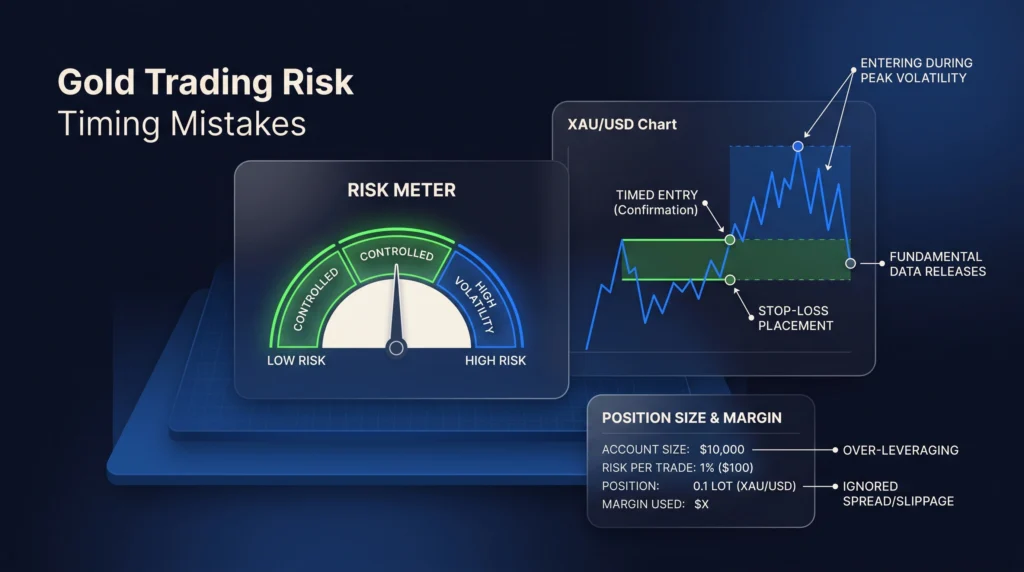
Good timing cannot compensate for excessive leverage, poor position sizing, or trading without a defined stop-loss. Traders should account for spreads, slippage, margin requirements, news risk, and changing liquidity before entering a position.
When to Avoid Trading XAU/USD
Avoid trading when you cannot define why you are entering, where the setup becomes invalid, and how much you can lose.
Other unsuitable conditions may include:
- Abnormally wide spreads
- Unstable platform execution
- Impending high-impact news
- Extremely thin holiday liquidity
- Emotional trading after a loss
- Insufficient available margin
Sometimes the best trading decision is to remain flat. Missing a move does not create a financial loss, while forcing a low-quality trade can.
Risks During Low-Liquidity Hours
Low-liquidity periods can produce wider spreads, slower movement, and sudden jumps caused by relatively small orders. A tight stop may be triggered by short-lived noise before price returns to its previous range.
Check whether the expected move is large enough to justify the spread and commission. Strategies developed for peak trading hours for XAU/USD may perform differently during quiet periods.
Backtesting should separate results by session rather than combining every hour into one sample.
Risks During Major News Releases
Scheduled news can cause slippage, partial fills, rejected orders, and spread expansion. Stop-loss orders reduce risk but cannot guarantee execution at the requested price.
A cautious news plan may include reducing size, avoiding entry shortly before release, waiting for spreads to normalise, or using a maximum-loss rule.
This does not guarantee protection from rapid market movement, but it creates a repeatable process for managing uncertainty.
Daylight Saving Time Impact on IST Sessions
Indian Standard Time does not change seasonally. The United Kingdom and most of the United States do, which shifts London and New York session hours relative to India.
In 2026, UK clocks change on March 29 and October 25. US clocks change on March 8 and November 1.
Update chart markers after every clock change. Also check platform time because a broker may alter its server offset independently.
Position Sizing During High Volatility
Position size should be based on acceptable account risk and stop distance, not on the maximum leverage offered.
For example, suppose your planned stop is wider because gold is volatile. Keeping the same trade size would increase the amount at risk. Reducing size can keep the potential loss within your limit.
Include spread, commission, slippage, and currency conversion when estimating total exposure. Margin protects the broker from account shortfalls; it does not define a safe trade size for you.
Frequently Asked Questions
What Is Best Time to Trade Gold in India?
For many traders in India, the most active period is the London–New York overlap, commonly around 5:30 p.m.–9:30 p.m. IST during aligned summer schedules and 6:30 p.m.–10:30 p.m. during aligned standard-time schedules. Your best time depends on strategy, broker costs, news risk, and availability. Higher activity may create opportunities, but it also increases potential losses.
Which XAU/USD Session Has Highest Liquidity?
Liquidity is commonly strongest when London and New York are both active. This period combines European and North American institutional participation, US dollar flows, and futures activity. Spreads may be competitive under normal conditions, but they can widen around economic announcements or unexpected events. Broker execution quality and account type also influence the liquidity experienced by a retail trader.
Which Gold Trading Session Has Highest Volatility?
The New York session and London–New York overlap often produce the strongest intraday volatility because US data, interest-rate expectations, dollar movement, and COMEX participation become important. London opening hours can also generate meaningful breakouts. Volatility changes daily, so traders should check the economic calendar and current range instead of assuming that a particular session will always produce large moves.
What Is London–New York Overlap Time in IST?
The overlap is generally around 5:30 p.m.–9:30 p.m. IST when both markets use summer time and around 6:30 p.m.–10:30 p.m. when both use standard time. Temporary differences can occur because US daylight saving time and UK clock changes begin and end on different dates. Confirm current local conversions and your broker’s server time before trading.
Is Asian Session Suitable for Gold Trading?
The Asian session may suit range trading, patient entries, and strategies based on quieter price action. It can also establish highs and lows that become important after the London session opens. However, lower liquidity may reduce follow-through and make transaction costs more significant. The session is suitable only when its behaviour matches a tested strategy and your risk controls.
Does Daylight Saving Time Change XAU/USD Timing?
Daylight saving time changes London and New York hours relative to IST because India does not change clocks. Session opens commonly shift by one hour, and short transition periods occur when the US and UK are on different seasonal schedules. Broker server time may also change. Traders should verify session markers several times each year rather than relying permanently on one saved schedule.