Physical Gold vs Digital Gold vs Gold CFDs: What’s the Difference?

Investors today have several ways to gain exposure to the world’s oldest store of value. Comparing gold vs gold CFD exposure usually starts with one central distinction: physical bullion represents direct ownership of a tangible asset, while a CFD (contract for difference) is a derivative that tracks the metal’s price movements without transferring ownership.
The differences extend well beyond that starting point, touching leverage, costs, liquidity, settlement, holding periods, and risk — concepts covered in more depth in how to trade gold for beginners.
Key Takeaways
- Physical bullion involves ownership and, in many cases, physical possession of bars or coins.
- A gold CFD provides exposure to the metal’s price without ownership or physical delivery.
- CFD trading on this asset commonly involves leverage and margin, along with financing charges over time.
- Owning the physical metal can involve storage, insurance, dealer premiums, and resale considerations.
- Digital gold and ETFs sit between these two extremes, offering electronic exposure with varying degrees of backing by physical bullion.
- Each instrument serves a different purpose, and suitability depends on an individual’s objectives and risk tolerance rather than a universal answer.
What Is Physical Gold?
Physical gold refers to the metal held in tangible form, such as bars, coins, or jewellery-grade bullion. Owning it directly means holding legal title to a specific quantity of the commodity, independent of any broker, exchange, or financial contract. This form of ownership has existed for centuries and remains one of the most direct ways to gain exposure to the precious metal.
How Physical Gold Ownership Works
Direct ownership typically begins with a purchase from a dealer, mint, or bank, followed by decisions about custody. Some investors keep coins or bars at home, while others use a bank vault or a specialised storage provider. Eventually, the owner may resell the bullion, often at a price that reflects prevailing market conditions. Readers weighing this route against other options can compare the broader range of ways to invest in gold.
Gold Bars and Coins
Bars and coins are the two most common forms of investment-grade bullion. Bars are typically valued close to the spot price of the metal, while coins can carry additional premiums linked to mintage, collectability, or country of origin. Purity, weight, and dealer spreads all influence how the retail price compares with the broader market price.
Physical Gold Pricing
Physical pricing is anchored to the spot price, determined through continuous trading in the global market for the metal. However, retail prices for bars and coins can differ from that benchmark because of manufacturing costs, dealer margins, distribution expenses, and regional demand. This gap between spot and retail pricing is a recurring feature of owning bullion directly.
What Is a Gold CFD?

A contract for difference (CFD) is a financial instrument that allows a trader to gain exposure to changes in an asset’s price without owning the asset itself. A CFD on this metal, sometimes referred to simply as a CFD on gold, is an agreement between a trader and a broker to exchange the difference between the opening and closing price of a position. This structure means such trading is generally described as cash-settled rather than resulting in delivery of any physical bullion.
How Gold CFDs Track Gold Prices
A CFD’s value is derived from the underlying market, often referenced through the XAU/USD quotation, which expresses the price of one troy ounce of the metal in US dollars. When the spot price rises or falls, the value of an open position typically moves in a corresponding direction. This relationship allows traders to gain exposure to the commodity without engaging in the logistics of buying or storing it.
No Physical Ownership or Delivery
Trading these contracts does not create ownership rights over any bullion. Unlike owning the physical asset, a CFD position does not normally result in the delivery of bars or coins at any stage of the contract. The position exists purely as a financial instrument tied to price movement — a defining difference between a gold CFD vs gold purchase, explored further in how to trade gold with CFDs.
Leverage and Margin
Leverage is a defining characteristic of CFD trading, allowing a trader to control a larger notional position using a comparatively small deposit known as margin. This is commonly summarised as:
Margin = Position Size / Leverage
Leverage can amplify both gains and losses relative to the margin committed, which is one reason regulators require prominent risk warnings on leveraged products of this kind.
Key Differences at a Glance
The comparison between direct ownership and a CFD spans several dimensions beyond simple possession. The table below summarises how the two generally differ across ownership, capital requirements, costs, liquidity, and settlement.
| Feature | Physical Bullion | Gold CFD |
| Ownership | Direct ownership of the metal | Contractual price exposure, no ownership |
| Capital Requirement | Full value of the asset typically required | Margin, often a fraction of notional value |
| Leverage | Generally not leveraged | Commonly leveraged |
| Costs | Premiums, storage, insurance | Spreads, possible commissions, overnight financing |
| Liquidity | Can require finding a buyer or dealer | Often traded electronically during market hours |
| Settlement | Physical delivery or in-person exchange | Cash-settled |
Ownership
Direct possession means holding legal title to a specific quantity of the metal, which can be stored, transported, or passed on. A CFD, by contrast, represents contractual exposure to price movements without any ownership interest in an underlying asset — often described as the core distinction in a physical gold vs digital gold comparison.
Capital and Leverage
Buying the physical asset generally requires paying the full purchase price upfront. CFD trading commonly uses margin, meaning a trader may open a position representing a larger notional value than the funds initially committed, since leverage is a structural feature of most CFD accounts.
Costs and Fees
Owning the metal directly often involves dealer premiums, bid-ask spreads, storage, and insurance, alongside potential resale discounts. CFD costs are typically structured around spreads, sometimes commissions, and overnight financing charges, along with any currency conversion costs applied by the broker.
Liquidity and Accessibility
Market liquidity differs meaningfully between the two. Physical bullion may require locating a buyer or dealer willing to transact at a fair price, particularly for larger quantities, while CFDs are commonly traded through an online account with continuous price quotes during market hours, which can affect how easily exposure is adjusted.
Settlement and Delivery
Bullion transactions conclude with the transfer of tangible metal, whether in person or through a secure storage arrangement. CFDs are generally cash-settled, meaning the trader receives or pays the difference between the opening and closing price rather than exchanging any physical asset.
Costs of Physical Gold vs Gold CFDs
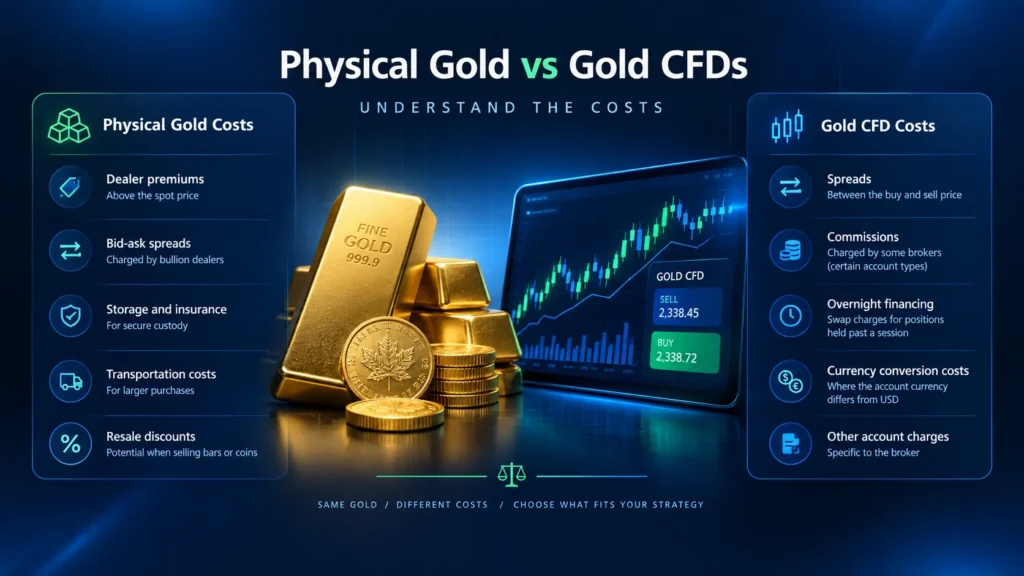
Cost structures for the two reflect their underlying nature — one asset-based, one contract-based — and neither is inherently cheaper in every circumstance.
Physical Gold Costs
- Dealer premiums above the spot price
- Bid-ask spreads charged by bullion dealers
- Storage and insurance for secure custody
- Transportation costs for larger purchases
- Potential discounts when reselling bars or coins
Gold CFD Costs
- Spreads between the buy and sell price
- Commissions charged by some brokers on certain account types
- Overnight financing or swap charges for positions held past a session
- Currency conversion costs where the account currency differs from USD
- Other account-related charges specific to the broker
How Holding Period Can Affect Costs
The cost profile of owning the metal versus holding a CFD can vary considerably with the length of time a position is maintained. Direct ownership tends to involve ongoing custody-related expenses such as storage and insurance, while a CFD position held over multiple sessions can accumulate recurring financing charges that compound over the holding period.
Risks of Physical Gold and Gold CFDs
Both instruments carry risk, but the nature of that risk differs substantially, meaning they are generally not interchangeable from a risk-management perspective.
Risks Associated With Physical Gold
- Exposure to price fluctuations, which can move down as well as up
- Theft or loss, particularly when stored outside a secured facility
- Storage-related risks, including damage or inadequate insurance coverage
- Authenticity concerns when purchasing from unverified sellers
- Resale prices that may differ from the original purchase price
Risks Associated With Gold CFDs
- Leverage, which can magnify losses relative to the margin committed
- Margin requirements that may lead to a margin call if a position moves unfavourably
- Counterparty exposure to the CFD provider
- Financing costs that accumulate over time on open positions
- Rapid price movements that can result in losses exceeding initial expectations
According to the European Securities and Markets Authority, analyses across EU jurisdictions have shown that between 74% and 89% of retail investor accounts typically lose money when trading CFDs, with average losses per client ranging from roughly €1,600 to €29,000. This regulatory disclosure underscores why CFDs, including those on precious metals, are widely described as complex, leveraged instruments.
Market Risk in Both Forms
Both forms of exposure remain connected to the same underlying market, meaning price volatility is a shared source of risk regardless of which instrument is used. A sharp move in the spot price can affect the value of a physical holding and the value of an open CFD position simultaneously, even though the mechanics of that exposure differ.
Advantages and Limitations, Side by Side
Neither instrument is universally better; each carries characteristics that may be relevant depending on the type of exposure being considered.
Potential Advantages of Physical Gold
Direct ownership offers a tangible asset, independence from CFD financing arrangements, and no leverage at the asset level. Some investors view long-term possession as insulated from the counterparty and margin considerations that apply to CFD trading.
Limitations of Physical Gold
Storage, insurance, and transaction costs can add friction, particularly for smaller purchases where dealer premiums represent a larger proportion of the transaction. Retail spreads can be wider than in electronic markets, and converting bullion into cash may take longer than closing an electronic position.
Potential Advantages of Gold CFDs
CFD trading can offer straightforward access to price exposure without any requirement for physical storage. Margin-based access may allow a trader to gain exposure to a larger notional value than the capital deposited, and positions can be structured to reflect both rising and falling prices.
Limitations of Gold CFDs
Leverage-related losses, financing charges, and the absence of ownership are central limitations. Positions also carry counterparty considerations tied to the broker, and outcomes depend heavily on the specific terms, spreads, and financing rates set by the provider.
Gold CFDs vs ETFs and Futures
CFDs on this metal sit within a broader family of related instruments, and understanding how they relate to other products can help avoid confusion between different forms of exposure.
Gold CFDs vs Gold ETFs
An exchange-traded fund (ETF) tracking the metal is generally a listed security traded on a stock exchange, sometimes backed by bullion stored in secure vaults. A CFD, in contrast, is a derivative contract whose value reflects price movement rather than representing a share in a fund.
This distinction is often summarised as digital gold vs gold ETF, where digital products may be backed by allocated physical holdings while ETF shares represent a claim on a pooled fund structure. In markets such as India, choosing between these routes can also depend on whether an investor already holds a demat account — a consideration covered in gold trading in India.
Gold CFDs vs Gold Futures
Futures contracts on the metal are standardised agreements traded on a regulated exchange, with a fixed expiration date and defined contract specifications, whereas CFDs are typically over-the-counter (OTC) agreements between a trader and a broker without a fixed exchange listing. Futures generally involve formal contract sizes and expiry mechanics, while a CFD position can often be held open indefinitely, subject to financing charges.
Physical Gold vs Gold-Backed Products
Owning bullion differs from holding a financial product designed to represent or track its price, such as an ETF or a digital gold account. Physical ownership involves possession of the metal itself, while backed products involve holding a security or account balance that references the commodity without direct custody by the individual investor.
How Price Moves Affect Both Instruments
The same underlying market influences both physical bullion and CFDs, though the resulting economic experience for each can diverge.
Factors That Influence Gold Prices
- Interest rate expectations set by central banks
- Inflation expectations across major economies
- Currency movements, particularly in the US dollar
- Central-bank buying or selling activity
- Geopolitical uncertainty and broader economic conditions
- Shifts in overall demand for safe-haven assets
Spot Price and XAU/USD
The spot price reflects the current market rate for immediate delivery and is commonly quoted through the XAU/USD pairing. This reference price underpins both physical valuations and CFD pricing, serving as a common anchor across different related instruments.
Why Returns Can Differ
Even when tracking the same underlying market, the realised outcome from direct ownership can differ from that of a CFD position. Premiums, dealer spreads, storage costs, financing charges, leverage, and currency effects can each contribute to a gap between the change in the spot price and the net result experienced by an investor or trader.
Which Route Suits Which Objective?
Suitability depends on the characteristics of the exposure an individual is considering rather than a single universal answer, since the two instruments serve different structural purposes.
Ownership vs Price Exposure
Direct possession is generally associated with the objective of holding the underlying asset, while a CFD is associated with obtaining contractual exposure to price changes without ownership. These differing objectives often shape which instrument aligns more closely with a particular form of interest in the metal.
Long-Term Holding vs Shorter-Term Exposure
Physical ownership and CFD structures can carry different cost and operational characteristics depending on how long exposure is maintained. Holding the tangible asset is often associated with custody-related expenses, while a CFD position held over extended periods can accumulate recurring financing charges — a structural distinction rather than a recommendation for either approach.
Leverage and Risk Tolerance
Leverage is a structural feature that separates CFDs from unleveraged direct ownership, and this distinction carries direct implications for risk. Evaluating leverage alongside individual risk tolerance is commonly described as a relevant consideration when comparing these two forms of exposure.
FAQ
Is a gold CFD the same as owning physical gold?
No. A CFD is a derivative contract that reflects changes in the metal’s price, while direct ownership involves holding the asset itself. This fundamental distinction means a CFD does not confer any ownership rights over bullion.
Can gold CFDs be physically delivered?
These contracts are generally cash-settled, meaning the difference between the opening and closing price is exchanged rather than any physical metal. This distinguishes CFD trading from purchasing bars or coins, which does involve physical delivery.
Are gold CFDs leveraged?
CFDs on this metal commonly involve leverage, allowing a trader to control a larger notional position using a smaller margin deposit. Leverage increases the scale of both potential gains and potential losses relative to the capital committed.
What are the main costs of physical gold?
Costs typically include dealer premiums above the spot price, bid-ask spreads, storage, insurance, and transportation. Resale can also involve a discount relative to the original purchase price.
What are the main costs of gold CFDs?
Costs typically include spreads, commissions on some account types, overnight financing charges, and currency conversion costs. Additional provider-specific charges may also apply depending on the broker.
Is physical gold less risky than gold CFDs?
The comparison is nuanced, since the two carry different types of risk. Direct ownership is exposed mainly to price fluctuations and storage-related risks, while CFDs add leverage, financing, and counterparty considerations on top of underlying market risk.
Do gold CFDs follow the spot gold price?
CFDs are generally linked to the underlying spot market, often referenced through the XAU/USD quotation. However, spreads, financing charges, and leverage mean the economic outcome of a position may not exactly match the outcome of direct ownership.
What is the difference between gold CFDs and gold futures?
CFDs are typically over-the-counter contracts between a trader and a broker without a fixed expiry, while futures are standardised, exchange-traded contracts with a defined expiration date and contract specifications. Both provide exposure to price movement without requiring ownership of the physical asset.