Gold Futures Trading for Beginners: Contract Specs, Margin, Expiry Explained


Gold futures let you trade changes in bullion prices without paying the full contract value upfront. This capital efficiency also magnifies mistakes. Before opening a position, know what one contract controls, what each tick is worth, how margin works, and what happens near expiry.
Contract terms, margin, hours, and delivery dates can change. Verify current details with the exchange and your broker.
Key Takeaways
Core Gold Futures Facts for Beginner Traders
Gold futures are exchange-traded agreements linked to a specified quantity and quality of metal for a stated contract month. Traders commonly close or roll positions before delivery, but physically settled contracts can create delivery obligations when held too long.
- Standard COMEX Gold futures, commonly identified by GC, represent 100 troy ounces.
- Micro Gold futures, identified by MGC, represent 10 troy ounces.
- Profit and loss equal contract quantity multiplied by the price move.
- Initial margin opens a position; maintenance margin supports it afterward.
- Margin is not the purchase price or maximum possible loss.
- First notice day, last trading day, and expiry require active management.
- Leverage can produce losses greater than the original deposit.
CME describes GC as its largest, most liquid gold contract and lists it at 100 troy ounces. MGC is one-tenth of that size, while one-ounce products may offer still smaller exposure. Availability and liquidity can differ by broker.
Gold Futures Basics
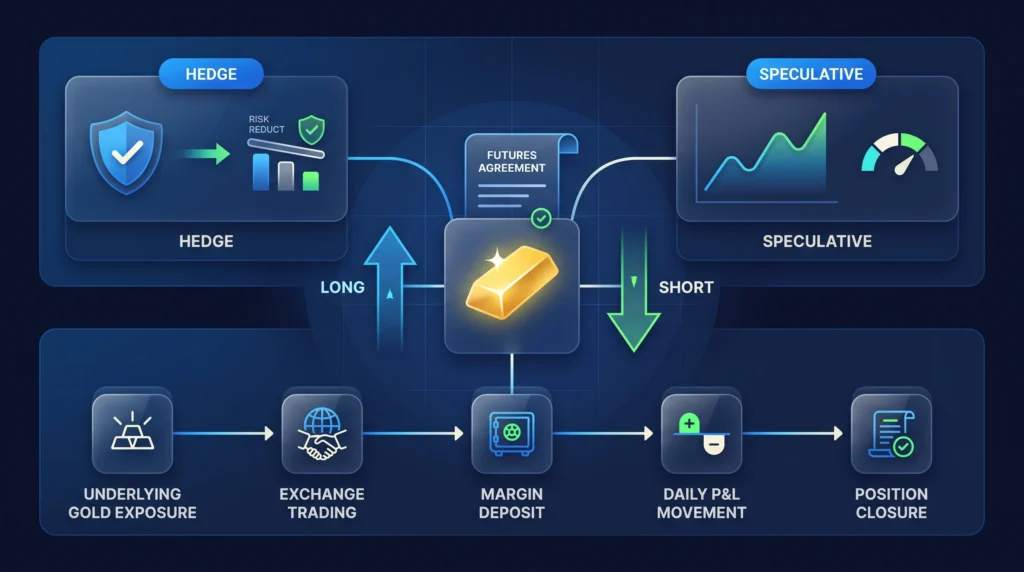
Gold futures allow traders to take long or short positions without buying physical metal at the current market price. They are used by hedgers managing price risk and speculators seeking opportunities from market movements.
Gold Futures in Simple Words
A futures contract is a legally binding agreement governed by exchange rules. A buyer takes a long futures position, while a seller takes a short position. Open trades are marked to market, so gains and losses affect account equity as the market price changes.
You usually post a performance bond called margin rather than paying the complete contract value. This differs from paying cash to buy gold bars, coins, or a gold ETF. It also means a modest price move can create a large percentage change in your deposited capital.
Assume one contract controls 100 troy ounces and the price rises by $8 per ounce. A long position gains $800 before commissions and other costs. A fall of the same size produces an $800 loss.
Profit or Loss = Price Change per Ounce × Contract Quantity
Readers comparing derivatives with direct ownership can review ways to invest in gold before deciding whether futures match their objectives and risk tolerance.
Hedgers, Speculators, Beginner Suitability
Hedgers use the futures market to offset an existing business or portfolio risk. A producer may sell contracts to protect future revenue, while a manufacturer may buy contracts to manage rising input costs. The derivative can lose money while still serving the overall hedge.
Speculators accept price risk in pursuit of returns. They may trade trends, economic releases, or differences between contract months. They do not need to arrange delivery when positions are closed before the relevant deadlines.
Futures may suit a prepared beginner who understands margin, volatility, order types, and loss limits. They may be unsuitable when a trader has limited reserve capital, cannot monitor positions, or assumes the margin deposit is the most that can be lost. Trading involves substantial risk, and practice results do not guarantee live performance.
Gold Futures Contract Specifications
Every gold futures product has defined terms, including contract size, quote unit, minimum tick, trading symbol, and delivery month. These details determine total market exposure and how much a price move affects profit or loss.
Contract Size, Quote Unit, Notional Value
Contract size is the fixed quantity of gold controlled by one contract. Prices are generally quoted in US dollars and cents per troy ounce. Notional value measures total exposure, not the cash needed to open the trade.
Notional Value = Futures Price per Ounce × Contract Size
At a hypothetical price of $3,000 per ounce, a 100-ounce standard contract has a contract value of $300,000. A 10-ounce micro contract represents $30,000. Your broker may require only a fraction of that amount as margin, yet profit and loss still respond to the full quantity of gold.
| Feature | Standard GC Contract | Micro MGC Contract |
| Contract size | 100 troy ounces | 10 troy ounces |
| Quote unit | US dollars per ounce | US dollars per ounce |
| $1 price move | $100 gain or loss | $10 gain or loss |
| Positioning use | Larger exposure | Smaller risk increments |
| Settlement | Physical delivery rules apply | Check current product rules |
CME identifies GC as a 100-troy-ounce benchmark contract and MGC as one-tenth of that size. Check the current exchange specification before trading.
Tick Size, Tick Value, Price Movement
Tick size is the smallest permitted quoted change. Tick value is the dollar effect on one contract. For a 100-ounce contract, a $0.10-per-ounce move equals $10. For a 10-ounce contract, the same move equals $1.
Tick Value = Minimum Price Increment × Contract Quantity
Do not select a contract merely because its margin looks affordable. Calculate the dollar distance between entry and a valid stop. A $25 adverse move in a 100-ounce contract creates a $2,500 loss before costs; the same move in a 10-ounce contract creates a $250 loss.
Symbols, Trading Hours, Delivery Months
GC is the widely recognized code for standard COMEX Gold futures, while MGC identifies Micro Gold futures. A complete symbol also contains a month code and year. Platforms may display symbols differently, so confirm the active contract rather than relying on a generic watchlist label.
Electronic trading is available for much of the day, but maintenance breaks, holidays, thinner sessions, and broker restrictions still matter. CME describes its gold derivatives as trading for approximately 23 hours a day. You can review what time does the gold market open and then verify the exact schedule for your platform.
Each contract month is a separate instrument. Trading volume commonly migrates from an expiring month to a later active contract. Check month code, volume, spread, first notice date, and last trading day before entering.
Gold Futures Margin and Leverage
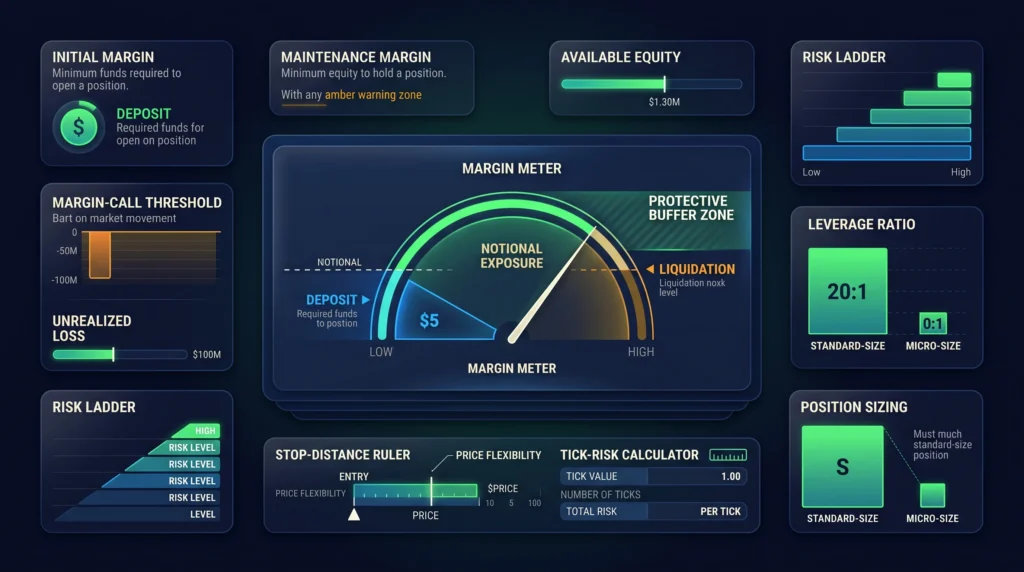
Margin lets traders control a larger position with a smaller deposit, creating leverage. This can increase potential returns, but it can also magnify losses and trigger a margin call when account equity falls below required levels.
Initial Margin Requirements
Initial margin is the performance bond required to establish a position. Clearing processes set baseline requirements, but brokers may collect more. Requirements can rise as volatility or event risk increases.
Margin is dynamic, not a permanent contract specification. An old article or screenshot may show a figure that no longer applies. Check the live exchange and broker requirements, including overnight margin rather than only an advertised intraday rate. A review of gold margin requirements can help distinguish exchange margin, broker margin, and usable equity.
CME notes that futures margin is commonly a fraction of notional value and that brokers may require additional funds.
Maintenance Margin and Margin Calls
Maintenance margin is the minimum equity needed to support an open position. If losses push equity below that level, the broker may request funds, reduce positions, or liquidate the account under its agreement.
A margin call is not a risk plan. Traders should consider keeping a buffer above the stated requirement because a rapid price move, fee, wider spread, or margin increase can reduce available funds quickly. Depositing exactly the minimum leaves little room for ordinary volatility.
Leverage and Notional Market Exposure
Leverage compares market exposure with margin:
Leverage Ratio = Notional Value / Margin Posted
Suppose a contract has $300,000 of exposure and requires $18,000 in margin. The implied leverage is about 16.7 to 1. A 1% move in the underlying market equals roughly $3,000 in profit or loss before costs, or about 16.7% of the margin posted.
Margin efficiency does not reduce the economic size of the position. Significant risks of futures trading include rapid losses, forced liquidation, execution slippage, and account deficits during extreme gaps.
Position Sizing Based on Tick Risk
Position size should begin with acceptable loss, not with the maximum number of contracts a broker permits.
- Set a monetary risk limit for one trade.
- Choose a stop based on market structure.
- Convert stop distance into dollars per contract.
- Add an allowance for slippage and commissions.
- Select a contract size that stays within the limit.
Assume your risk budget is $400 and a planned stop is $12 per ounce away. One standard contract risks about $1,200, so it does not fit. One 10-ounce contract risks about $120 before costs. A stop order may still fill away from its requested price.
Gold Futures Pricing and Market Drivers
Gold futures prices are influenced by spot gold, interest rates, inflation expectations, US dollar strength, and geopolitical risk. Differences between near and later delivery months can also affect pricing and rollover costs.
Spot Gold vs Gold Futures Pricing
Spot price refers to an immediate-market reference, while a futures price applies to a specified contract month. Futures and the spot market are related, but they do not need to match exactly.
The difference can reflect financing rates, storage, insurance, time to expiry, and near-term supply and demand. As expiry approaches, market mechanics generally encourage convergence, although temporary dislocations may occur during stressed conditions.
Contango and Backwardation
Contango occurs when later contracts trade above nearer contracts. Backwardation occurs when later contracts trade below nearer contracts. Neither curve shape alone predicts whether the price of gold will rise or fall.
The curve affects rollover. A long trader selling a cheaper expiring contract and buying a more expensive later contract faces a negative roll difference. In backwardation, the relationship may be favorable, but spreads can change before execution. Separate roll cost from directional profit and loss.
Interest Rates, Inflation, USD Strength
Gold pays no coupon, so real interest rates and the opportunity cost of holding non-yielding assets may influence demand. Higher real yields can pressure prices in some conditions, while lower real yields may provide support. This relationship is not constant.
Because international gold is commonly quoted in US dollars, currency strength also matters. Inflation data can move both rate expectations and the dollar, producing sharp two-way volatility. An intuitive headline reaction does not guarantee a sustained price move.
Geopolitical Risk, Central Bank Buying, Risk Sentiment
Political conflict, financial instability, reserve management, and investor risk appetite can affect the current market price. Central bank activity may influence longer-term demand, while headlines can create short bursts of trading volume.
Several drivers can act at once. A geopolitical event may change safe-haven demand, currency pricing, rate expectations, and spreads. Observe price action instead of assuming one automatic response.
Trend Following, Macro Event Trading, Spread Trading
Trend following aims to participate in sustained movement through swing structure, moving averages, or breakouts. It can struggle in range-bound conditions and may produce several small losses before a larger trend appears.
Macro event trading focuses on scheduled data or central bank decisions. Volatility and slippage may rise around releases.
Spread trading combines related long and short positions, often across contract months. It may reduce some outright price exposure, but curve risk, execution risk, and margin changes remain. Beginners should master one-contract mechanics before using multi-leg trading strategies.
Gold Futures Trading Process, Expiry, Rollover, Risk Control
Trading gold futures involves selecting a suitable broker and contract, calculating position size, placing orders, and monitoring margin. Traders must also manage expiry dates, rollover decisions, delivery risk, market gaps, and stop-loss execution.
Broker, Trading Platform, Account Funding
Choose a regulated broker that offers the required futures exchange, clear fee disclosures, reliable execution, and suitable risk controls. Compare commissions, exchange fees, market data charges, platform costs, margin policy, liquidation rules, and support.
Before funding a trading account, confirm whether the broker supports physical delivery. Many retail firms require clients to exit before delivery-related deadlines. A broader introduction to instruments and execution is available in how to trade gold for beginners.
Market Selection and Contract Choice
Select the product whose dollar movement fits your account. Standard GC may offer strong liquidity, but a micro or mini contract can reduce tick exposure. Confirm that the selected contract is active and its bid-ask spread is reasonable during your intended session.
Do not confuse exchange-traded futures with CFDs. CFD trading risks can include counterparty exposure, financing or swap charges, different execution conditions, and product terms that do not mirror a commodity exchange.
Trade Setup, Order Placement, Stop-Loss Planning
Define direction, entry trigger, invalidation point, target logic, maximum loss, and conditions for early exit before placing an order. Decide whether a market, limit, stop, or stop-limit order fits the setup.
A stop-loss may limit routine risk but cannot guarantee a fill price during gaps or fast markets. Place it where the trade idea is invalid, then reduce position size to fit your risk budget. Moving it farther away only to avoid a loss increases exposure.
Overnight Gap Risk, Loss Limits, Margin Call Prevention
Gold reacts to news across global sessions, so positions can move while you are away from the screen. Liquidity may thin during transitions and holidays, increasing spread and slippage risk.
Practical controls include:
- Keep excess cash above margin requirements.
- Limit risk per trade and total portfolio exposure.
- Avoid oversized positions before major announcements.
- Use alerts for price, equity, and margin changes.
- Review correlated exposure across metals, currencies, and rates.
- Know your broker’s liquidation process.
These controls may mitigate risk but cannot eliminate loss.
Expiry Dates, First Notice Day, Last Trading Day
For physically delivered products, first notice day may begin the period when a long holder can receive a delivery notice. Last trading day is the final session in which that contract can be traded. These dates are not interchangeable.
Do not assume your broker will wait until the exchange deadline. Many firms impose earlier cutoffs and may close positions automatically. CME provides calendars for notices, trading, and delivery events, and states that precious-metal delivery can occur on business days during the delivery month.
Contract Rollover, Settlement, Physical Delivery
To roll a long position, sell the expiring contract and buy a later month. To roll a short position, buy back the expiring contract and sell a later month. Both legs create costs, and the spread between months affects the new position.
Rolling does not preserve the original entry price. Record the closed and new trades separately.
Delivery of gold follows exchange rules covering approved facilities, quality standards, and broker procedures. Most beginners should not hold a deliverable contract into notice or expiry unless every obligation has been confirmed in advance.
Gold Futures Trading FAQ
What Gold Futures Symbol Should Beginners Know?
GC is the common symbol for standard COMEX Gold futures, representing 100 troy ounces. MGC identifies Micro Gold futures, sized at 10 troy ounces. The full ticker also includes a contract month and year code. Since brokers may format symbols differently, confirm the exact expiry, trading volume, and specification before placing an order.
How Much Capital Is Needed to Trade Gold Futures?
Capital needs depend on contract size, current margin, broker requirements, stop distance, and reserve cash. The minimum margin alone is not a sensible account target. Hold enough capital to cover planned risk, possible slippage, changing margin, and normal drawdowns without using money needed for essential expenses.
What Margin Is Required for One Gold Futures Contract?
There is no permanent margin figure for one contract. Clearing requirements and broker house margins may change with volatility, while intraday and overnight rates can differ. Check the live amount in your platform and confirm it with your broker before entry. Treat margin as a performance bond, not the maximum possible loss.
Can Losses Exceed Margin Deposit?
Yes. Profit and loss are based on full contract exposure, not only the deposited margin. A sharp adverse move, market gap, or delayed liquidation may create losses greater than the original deposit and, in some cases, an account deficit. Smaller contracts, conservative sizing, and reserve capital may reduce risk but cannot remove it.
How Long Do Gold Futures Contracts Last?
Each gold contract has a defined listing cycle and specific expiry-related dates. You can hold a position only while that contract remains tradable and your broker permits it. Most speculative traders close or roll before notice and delivery periods. Check the exchange calendar because first notice day, last trading day, and broker cutoff are different deadlines.
Are Gold Futures Better Than Gold ETFs or Physical Gold?
No format is universally better. Futures can provide leverage, short-selling access, and flexible contract choice, but require margin management and expiry control. A gold ETF may be simpler in a securities account but charges fund expenses. Physical metal avoids derivative expiry, yet involves storage, insurance, dealer spreads, and custody considerations.
How Does Spot Gold Price Affect Gold Futures?
The spot gold price represents the current market value of gold for near-immediate settlement, while futures prices reflect expectations for a later date. Financing costs, interest rates, storage, and market demand can create differences between them. When the gold price moves sharply, gold and silver futures may react quickly, although the size and timing of that response can vary across delivery months.
Should Beginners Buy or Sell When Gold Price Falls?
A falling price for gold does not automatically mean you should buy or sell. Some futures traders may sell gold to follow downward momentum, while others may wait for evidence that the decline is ending. Before entering active trading, assess volatility, stop distance, account risk, and broader commodity market conditions. When gold falls, disciplined position sizing matters more than trying to predict the exact market bottom.
What Are Benefits of Trading Gold Through Commodity Futures?
Commodity futures allow traders to gain exposure to a specified amount of gold without paying the full market value upfront. They can also be used to take long or short positions, hedge existing exposure, and trade during extended exchange hours. However, commodity trading uses leverage, so losses can grow quickly. Beginners should learn how futures work, review margin requirements, and practise risk management before they start trading gold futures.