XAU/USD Scalping Strategy: How to Trade Short-Term Gold Price Moves

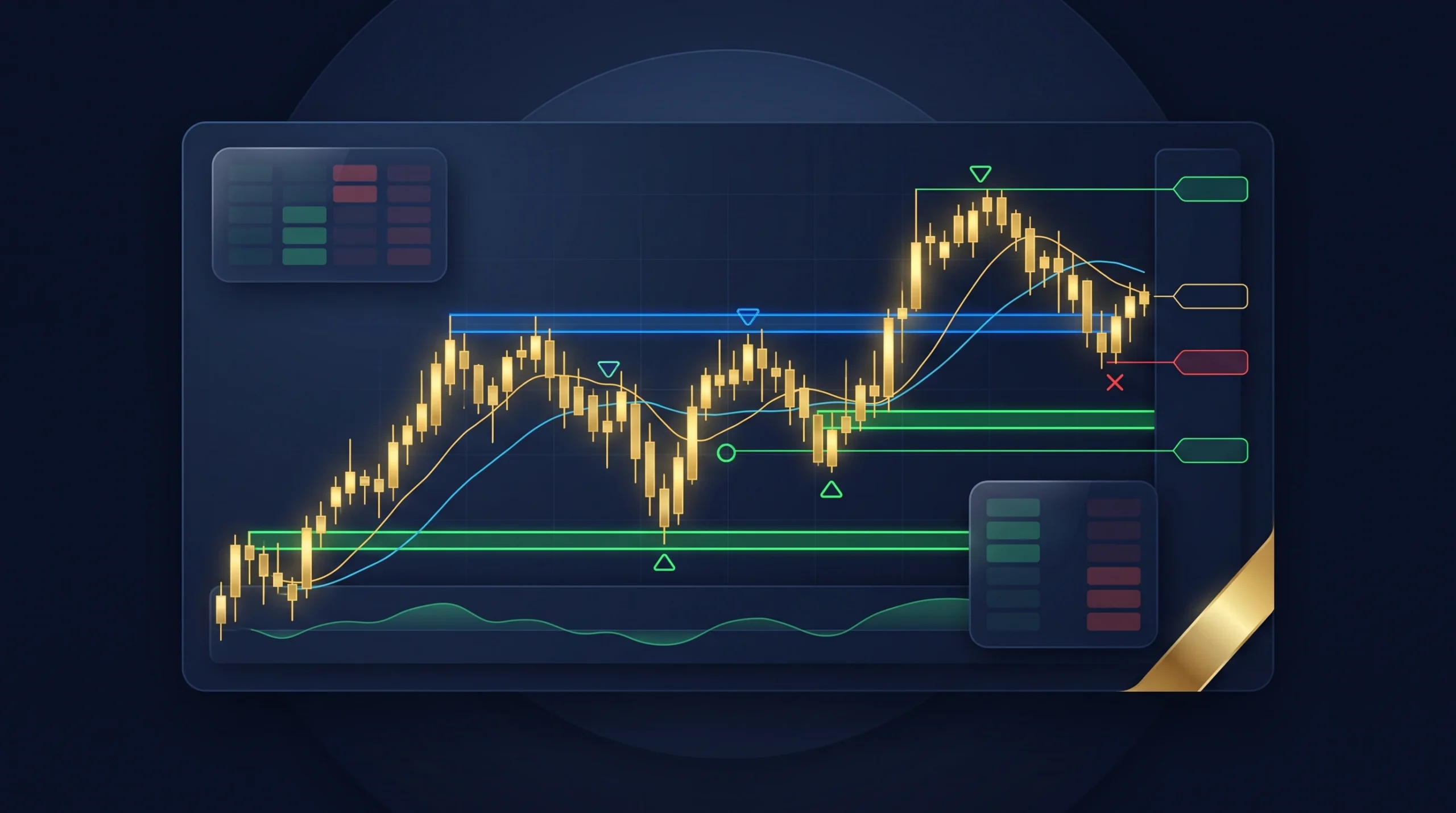
XAU/USD scalping aims to capture relatively small price movement in gold over minutes rather than hours or days. A trader may enter and exit several times during an active session, using momentum, pullbacks, breakouts, or reactions around support and resistance levels.
Speed does not make the method simple. Gold can be volatile, spreads may widen, and leveraged CFD positions can lose value quickly. A sound xauusd scalping strategy needs defined market conditions, realistic transaction costs, repeatable entry and exit rules, and strict limits for position size and daily loss. Any setup may fail, and past behavior does not guarantee future results.
XAU/USD Scalping Basics
Gold is commonly quoted against the US dollar. When XAU/USD rises, one ounce of gold becomes more expensive in dollar terms; when it falls, gold becomes cheaper relative to the dollar. Many retail participants access the gold market through CFDs or other leveraged products offered by a broker.
Scalping is a short-term trading approach built around brief exposure. Positions may last from seconds to several minutes, depending on volatility and platform execution. Before you start trading, learn how contract size, margin requirements, and quote increments work. The guide on how to trade gold for beginners explains basic market mechanics before you apply a faster strategy for gold.
Why XAU/USD Suits Short-Term Scalping
Gold often attracts substantial trading volume during major sessions. It can react quickly to changes in the US dollar, bond yields, inflation expectations, central-bank communication, and geopolitical developments. These drivers may create trading opportunities for scalpers when liquidity is strong.
They also create risk. Sudden price fluctuations may trigger stops before the original idea develops. A successful gold scalping process depends on filtering conditions rather than trading every move.
Reasons traders may choose XAU/USD include:
- Frequent intraday movement
- Clear reactions around prior highs, lows, and round numbers
- Strong momentum after economic releases
- Wide availability on forex trading platforms
- Compatibility with breakout, pullback, trend, and range methods
Best Timeframes and Trading Sessions for Gold Scalping
Timeframe selection affects noise, signal quality, and decision speed. Many gold scalpers combine charts instead of relying on one interval.
| Timeframe | Main Use | Main Challenge | Practical Role |
| 1-minute | Precise execution | High noise and whipsaws | Entry timing |
| 5-minute | Setup identification | Signals can fail quickly | Primary chart |
| 15-minute | Trend and structure | Fewer entries | Directional context |
1-Minute, 5-Minute, and 15-Minute Timeframes
A 1-minute chart can help with quick entries, but it encourages frequent trading and emotional trading. During volatile conditions, one candle may travel far enough to invalidate a tight stop.
The 5-minute chart often provides a useful balance between structure and speed. It can show swings, moving-average direction, and support and resistance without as much noise.
The 15-minute chart helps classify price as trending, ranging, or approaching a major level. A common workflow uses the 15-minute chart for bias, the 5-minute chart for setup selection, and the 1-minute chart only for refinement.
London–New York Overlap, New York Session, and News Volatility
The best time to scalp gold often depends on liquidity. Activity commonly increases during the London and New York overlap, while the New York session may bring larger moves around US economic data.
News volatility can produce sharp moves, but execution becomes less predictable. Spreads may widen, orders may fill away from the requested price, and reversals can be rapid. Traders without a tested news plan should consider standing aside around major releases.
A practical routine may include:
- Mark Asian session high and low.
- Identify London momentum or failed breakouts.
- Watch the overlap for continuation or reversal.
- Reduce activity when liquidity fades.
- Check the economic calendar before trading.
Technical Tools and Price Action Signals
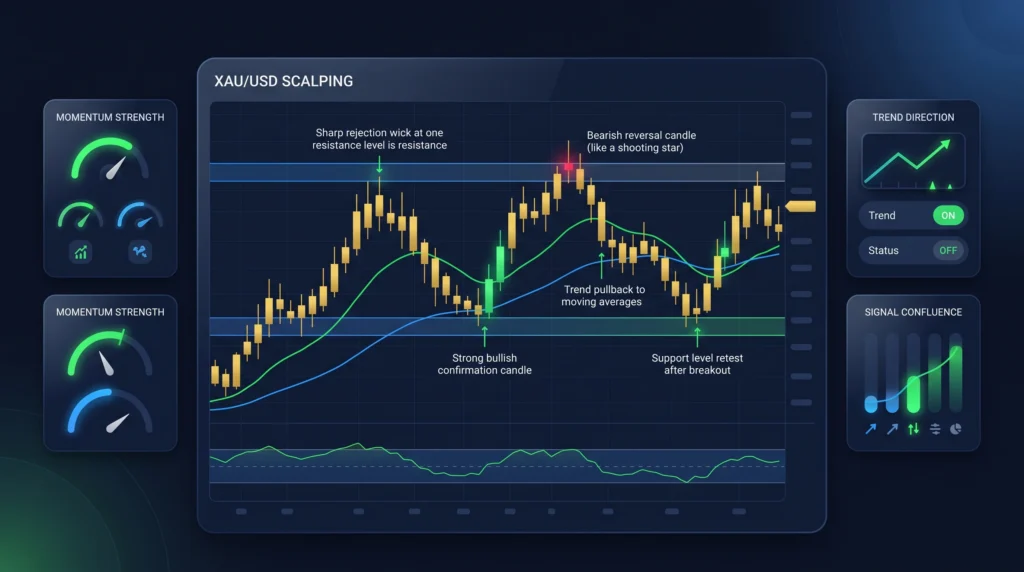
Technical analysis can organize trading decisions, but no indicator removes uncertainty. Combine trend, momentum, location, and execution instead of searching for one perfect signal.
Moving Averages for Trend Direction
Moving averages can help define short-term direction and dynamic support or resistance. A rising average with price holding above it may suggest bullish momentum, while a falling average with repeated rejection may support a bearish bias.
Some traders compare a faster average with a slower one on 5-minute charts. Exact settings matter less than consistency and testing. A crossover alone is weak because it often appears after the price movement has begun.
A stronger setup may combine:
- Clear average slope
- Price structure aligned with direction
- Pullback toward dynamic support or resistance
- Rejection candle
- Space before the next major level
RSI and Momentum Confirmation
RSI can show whether momentum is strengthening or weakening. An overbought or oversell reading does not automatically signal a reversal. Strong trends may keep RSI elevated or depressed while price continues.
RSI is often more useful as confirmation. A bullish setup may improve when price forms a higher low and RSI recovers. A bearish setup may gain support when price rejects resistance and RSI fails to regain its midpoint. Momentum tools should confirm price action, not override market structure.
Support, Resistance, and Candlestick Signals
Support and resistance levels define where a setup occurs. Useful references include prior session highs and lows, recent swing points, round numbers, consolidation boundaries, and opening ranges.
Candlestick patterns matter most at meaningful locations. A rejection wick in the middle of a range is weak evidence. The same candle after a sweep of a tested high may indicate that buyers are losing control. For wider context, intraday gold trading strategies covers session-based methods beyond pure scalping.
High-Probability XAU/USD Scalping Setups
No setup guarantees a high win rate. A stronger opportunity usually combines market structure, timing, liquidity, location, and manageable risk. Test every method on historical data and in a demo environment before using real funds.
Momentum and Trend-Following Scalping
Momentum scalping seeks to join a strong move after direction is confirmed. A bullish example may involve a break above a recent high, a shallow pullback, and renewed buying. A bearish example uses the opposite sequence.
Avoid entering after an extended candle when the next key level is close. Waiting for a pause or controlled pullback may improve risk placement, although the market can continue without offering an entry.
Breakout Scalping Setup
A breakout setup begins with compression near a clear boundary. Price may form several small candles below resistance or above support before expanding.
- Mark a level tested more than once.
- Wait for a decisive close outside the range.
- Confirm that momentum supports expansion.
- Enter on continuation or a controlled retest.
- Place the stop beyond the failed-breakout point.
- Target before nearby opposing structure.
Breakouts during thin liquidity are more likely to fail, so session timing matters.
Pullback Scalping Setup
Pullback trading seeks entry in the direction of an established intraday move. Instead of chasing the first impulse, wait for price to retrace toward a moving average, broken level, or prior consolidation.
For example, gold may trend higher on the 15-minute chart and return to former resistance on the 5-minute chart. If that level holds and bullish rejection appears, a long trade may be considered. The stop belongs below the structure that invalidates the idea.
Range and Support-Resistance Scalping
Range scalping works when price repeatedly respects upper and lower boundaries. A trader may look for shorts near resistance and longs near support, provided momentum is not expanding through the range.
This approach becomes dangerous when a true breakout starts. Confidence should decline after repeated tests of one boundary because each test may weaken the level.
Liquidity Sweep and False Breakout Setup
A liquidity sweep occurs when price briefly moves beyond an obvious high or low, triggers clustered orders, and returns inside the prior range. Confirmation is essential.
Price might trade above the London high, fail to hold, and close back below it. A short setup becomes more credible if the next candle confirms weakness and the broader market is not strongly bullish. The stop may sit beyond the sweep high, with a target near the middle or opposite side of the range.
Step-by-Step 5-Minute Gold Scalping Strategy
This framework is educational, not a recommendation to buy or sell. Test it with your broker’s pricing because spreads, contract specifications, and execution may differ.
Chart Setup and Market Bias
Use a 15-minute chart for context and a 5-minute chart for execution. Mark the previous day’s high and low, current session extremes, recent swing points, and major round numbers. Add one fast and one slow moving average only if they support your process.
Classify the environment as trending, ranging, or event-driven. Skip trades when structure is unclear or transaction costs are unusually high.
Long and Short Entry Rules
For a long setup, look for bullish structure on the context chart, a pullback into support, and a 5-minute confirmation candle. Momentum should recover without price sitting directly below major resistance.
For a short setup, look for bearish structure, a pullback toward resistance, and renewed selling pressure. Avoid shorting directly into nearby support.
Every trigger should answer three questions: where is the setup, why now, and where is the idea invalid?
Stop-Loss and Take-Profit Placement
Stop-loss and take-profit levels should reflect structure and volatility. A stop that is too tight may be hit by normal noise, while a wide stop can create excessive account risk.
Position Size = Maximum Cash Risk / Stop Distance in Cash Terms
You need to know how your broker values each quote movement. gold pip value explained shows how chart distance relates to account risk. Targets may sit before opposing structure, at a planned risk multiple, or use partial exits.
Exit Rules and Active Trade Management
Trade management should be decided before entry. Moving a stop farther away because you hope for a reversal breaks the original risk limit.
Consider exiting when:
- Price reaches the planned target
- Market structure invalidates the setup
- Momentum fails after entry
- Spread expands unexpectedly
- A scheduled release approaches
- Daily loss limits are reached
Quick trades still need enough room to develop within the original plan.
Risk Management, Common Mistakes, Pros and Cons
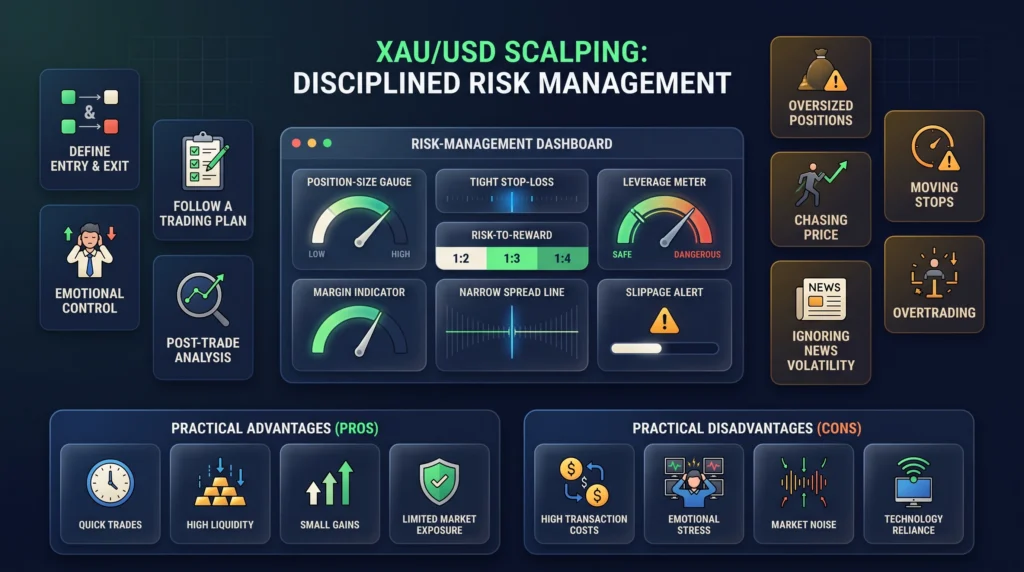
Risk management is central to successful scalping because many decisions occur in a short period. One uncontrolled trade can erase gains from several well-managed positions.
Position Sizing for Short-Term Gold Trades
Choose maximum risk per trade before opening a position. It should be small enough that a normal losing streak does not force emotional decisions or threaten the trading account.
Required Margin equals Trade Size divided by Leverage. Margin is not the same as maximum loss. A leveraged position can lose more than the initial margin allocated to it, depending on product terms and market gaps. Always verify contract size, minimum trade size, and margin requirements on your platform.
Risk-to-Reward Targets for Scalping
Scalpers often work with modest targets, so costs have a large effect. A strategy with frequent winners may still underperform if average losses are much larger than average gains.
Track expected reward relative to the stop, but do not force every setup into the same ratio. Market structure should influence targets. A trade with limited space before resistance may not justify the risk, even when the signal looks attractive.
Spread and Slippage Control
Spread is the difference between bid and ask prices, while slippage occurs when execution happens at a different price than requested. Both can consume a meaningful part of a small target.
Review gold spread explained before comparing brokers. Relevant criteria include typical spreads during your session, commissions, stop-order execution, platform stability, and available risk controls.
Economic Release and Geopolitical Risk Safeguards
Gold can react sharply to inflation data, employment reports, central-bank decisions, geopolitical events, and rapid changes in the US dollar. These moves may create opportunities but also increase gap and slippage risk.
Check scheduled events before trading. Without a tested news strategy, consider avoiding new entries around major releases. Unscheduled headlines remain unavoidable, so conservative leverage and predefined stops still matter.
Common XAU/USD Scalping Mistakes
Common errors usually come from process failure rather than indicator choice:
- Trading without a defined setup
- Increasing size after a loss
- Chasing an extended move
- Ignoring spreads and commissions
- Moving stops farther from entry
- Taking signals into major levels
- Continuing after a daily loss limit
To manage risk, stick to your strategy and review trades after the session rather than during an emotional reaction.
XAU/USD Scalping Pros, Cons, and Day Trading Comparison
Scalping offers frequent feedback, limited overnight exposure, and multiple potential setups during active hours. It may suit someone who can focus closely, make quick decisions, and follow strict rules.
Disadvantages include high transaction costs, mental fatigue, execution sensitivity, and sudden volatility. High-frequency trading behavior can also lead to overtrading.
Compared with day trading, scalping uses shorter holding periods and smaller targets. Day traders may hold positions for hours and accept wider stops. Neither trading style is inherently better; suitability depends on temperament, schedule, capital, costs, and tested performance.
XAU/USD Scalping FAQ
Which Session Works Best for Gold Scalping?
The London–New York overlap is often active because liquidity from both regions is present, while the New York session can produce strong reactions to US data. However, the best session depends on your setup, broker conditions, and risk tolerance. Compare spread, volatility, and execution quality across several weeks rather than assume one window will always perform best.
Is XAU/USD Suitable for Scalping?
XAU/USD may suit scalping because it often shows active intraday movement and clear reactions around technical levels. It is also volatile, and leveraged CFD trading can lead to rapid losses. Suitability depends on experience, platform execution, transaction costs, and the ability to follow a disciplined risk plan. Practice and testing are essential before using real funds.
How Does 1-Minute Gold Scalping Work?
One-minute scalping uses very short charts to identify rapid momentum, micro pullbacks, or reactions at known levels. Entries and exits occur quickly, increasing sensitivity to spread, slippage, and decision errors. The 1-minute chart is usually safer when combined with higher-timeframe context. It is not automatically more profitable and may be unsuitable for inexperienced scalpers.
How Does 5-Minute Gold Scalping Work?
A 5-minute approach uses short-term structure to identify trends, ranges, breakouts, and pullbacks. Traders may mark session highs and lows, confirm direction on a 15-minute chart, and use a 5-minute candle for entry. Stops sit beyond invalidation points, while targets reflect nearby structure. Results depend on execution, costs, and market conditions.
Which Indicators Work Best for XAU/USD Scalping?
No indicator is consistently best in every environment. Moving averages may help define direction, RSI may confirm momentum, and volatility measures may guide stop distance. Support and resistance, session levels, and candlestick behavior often provide the location indicators lack. A small, tested combination is usually more practical than stacking tools that produce conflicting signals.
How Much Capital Is Needed for Gold Scalping?
There is no universal minimum because capital needs depend on broker contract size, leverage, margin, stop distance, and acceptable cash risk per trade. The account should be large enough to use conservative position sizing without relying on excessive leverage. Before funding an account, review product specifications and consider whether potential losses fit your financial circumstances.
How Can You Master Gold Scalping Without Chasing Small Profits?
To master gold scalping, focus on repeatable trading techniques rather than taking every minor price movement. Effective scalping requires a tested trading plan, controlled position sizing, and clear limits for daily losses. Small profits can accumulate, but frequent trading costs and occasional larger losses may offset them. Consistent profits are never guaranteed, so review execution quality and risk-adjusted results over a meaningful sample of trades.
Why Does a Scalping Strategy for Gold Need a Written Trading Plan?
A scalping strategy for gold involves rapid trading decisions, making a written plan especially important. Your plan should define preferred market conditions, technical indicators, entry triggers, stop placement, profit targets, and maximum risk. It may also specify whether you trade during the London and New York session or avoid major news releases. Clear rules can reduce emotional trading and help you evaluate whether your short-term trading strategy is working as intended.