Best Broker for Gold Trading: What to Check Before Opening Account


Choosing a gold broker involves more than finding a low advertised spread. Gold is one of the most actively followed global assets, and its price can move rapidly around inflation data, central-bank decisions, currency fluctuations, and geopolitical events. Your results may depend on execution quality, margin requirements, platform stability, financing charges, and disciplined risk management.
This guide compares prominent gold trading brokers and platforms while explaining what you should verify before opening an account. M4Markets takes first place for its overall combination of account flexibility, MetaTrader access, demo availability, and suitability for different approaches. This ranking reflects editorial assessment rather than guaranteed performance.
CFD trading involves substantial risk. Leverage can magnify gains and losses, and many retail accounts lose money when trading CFDs. Before trading CFDs with this provider or any other broker, read its risk disclosure, test its trading environment, and confirm that its products are appropriate for your financial position and experience.
Best Gold Trading Brokers
No forex broker is ideal for every trader. An experienced trader using automated systems may prioritize execution infrastructure, while a beginner may value education, transparent pricing, and a simple trading platform. A swing trading strategy may place greater importance on overnight financing, whereas short-term commodity trades depend heavily on spreads and slippage.
The following list of the best candidates focuses on practical use cases rather than brand recognition alone.
| Broker | Best fit in this comparison | Main point to verify |
| M4Markets | Overall account flexibility | Legal entity, account pricing, gold specifications |
| Pepperstone | Cost-focused gold trading | Average spread plus commission |
| FP Markets | Scalping workflows | Execution speed and order restrictions |
| IC Markets | Automated trading | Platform and expert-advisor compatibility |
| Capital.com | Beginners and day traders | Regional product availability |
| AvaTrade | Spread-based pricing | Fixed or variable gold pricing |
M4Markets – Best Overall Gold Broker
M4Markets is the strongest overall choice in this comparison for users seeking MetaTrader 4, MetaTrader 5, multiple account types, and access to a wide range of trading instruments. Its account lineup may support both new users and traders seeking a raw account structure, although conditions depend on the jurisdiction and legal entity serving the client.
Before funding an account, verify the XAU/USD contract size, stop-out level, available leverage, commission structure, and swap schedule. Traders preparing to start trading gold can review this guide on how to trade gold for beginners before moving from simulated orders to live market exposure.
M4Markets may also suit traders interested in advanced trading through expert advisors and customizable MetaTrader tools. However, access to a feature does not guarantee better results. Strategy quality, execution conditions, and risk controls remain essential.
Pepperstone – Best for Low Gold Spreads
Pepperstone is commonly considered by cost-focused users comparing forex brokers for gold trading. It supports several advanced trading platforms, including MetaTrader, cTrader, TradingView, and proprietary software in supported regions.
A low quoted spread should not be assessed in isolation. Compare the average gold spread during the hours you plan to trade, add any commission, and review slippage during fast markets. Raw pricing may benefit frequent trading, but the final trading cost depends on the complete round trip.
Pepperstone may also interest users who trade gold CFDs alongside currencies, indices, and other instruments. Confirm which entity will hold your account because leverage limits, protections, and available trading services can differ by region.
FP Markets – Best for Gold Scalping
FP Markets may appeal to scalpers because it offers platforms commonly used for rapid order placement and short-term trading strategies. Scalping suitability still depends on more than the broker allowing the technique.
Test spread expansion, order-fill speed, stop-distance requirements, and rejection frequency. One-click trading can improve order-entry efficiency, but it can also make impulsive or oversized trades easier. Fast execution does not remove market risk.
Scalpers should compare performance during normal London and New York activity as well as around major economic announcements. A seemingly small difference in spread or slippage can become significant when a strategy opens many positions.
IC Markets – Best for Algorithmic Gold Trading
IC Markets is a logical candidate for automated trading because it is widely associated with MetaTrader environments, expert advisors, and raw-spread account structures. It may suit traders who need algorithm compatibility, flexible order management, and access to multiple trading instruments.
Before deploying an automated system, review server time, symbol naming, price-feed behavior, minimum stop distance, rollover procedures, and virtual private server options. Backtests may suggest how an algorithm behaved historically, but they do not guarantee future execution or profitability.
Traders using advanced trading systems should run forward tests on a demo account and then use the smallest practical live position. Real commissions, slippage, and liquidity can materially change results.
Capital.com – Best for Beginners and Day Trading
Capital.com may suit users who prefer an accessible web interface, mobile tools, educational resources, and integrated risk controls. Its trading platform is designed for straightforward navigation, which may help beginners monitor positions and review charts.
A simple interface should not be confused with a low-risk product. Gold CFDs remain leveraged instruments, and day traders can lose money quickly when volatility increases. Users should check spread behavior during the exact session they plan to trade.
Capital.com can also be considered by traders who want online trading across several asset classes. Available markets and conditions vary by jurisdiction, so verify whether your account can access the relevant range of gold markets.
AvaTrade – Best for Fixed-Spread Gold Trading
AvaTrade may suit users who prefer spread-based pricing and access to several platform options. Some account arrangements may offer fixed or floating pricing, but traders should confirm whether the gold product itself uses a fixed, typical, or variable spread.
Ask support whether commission is added, how overnight funding is calculated, and whether pricing changes during low-liquidity periods. Claims such as commission-free gold trading can be misleading when the broker’s compensation is included in a wider spread.
AvaTrade may also appeal to clients exploring copy trading or social trading. These tools can make it easier to follow another user’s activity, but they do not remove risk or guarantee that past performance will continue.
Gold Broker Comparison by Trading Goal

Choosing the best gold broker starts with defining your intended trading style. The right provider for futures trading may not be ideal for spot CFDs, while a platform designed for active traders may feel unnecessarily complex to a long-term investor.
Best Gold Broker for Low Spreads
The lowest displayed spread is not always the lowest total cost. A proper comparison includes:
- Typical spread during your trading session
- Commission per side or round trip
- Positive and negative slippage
- Overnight financing
- Currency-conversion charges
For a practical explanation of bid-and-ask pricing, review gold spread explained. A raw account may display tighter pricing than a standard account, but the commission must be included before deciding which is cheaper.
Avoid assuming that commission-free gold means cost-free access. In some cases, the charge is built into the spread. Compare the same position size and holding period across brokers.
Best Gold Broker for Low Minimum Deposit
A small deposit requirement can make an account easier to open, but it does not ensure that the account is suitable for responsible risk management. Minimum lot size, leverage, and normal gold volatility determine whether a small balance can support a sensible stop-loss distance.
For example, a broker may accept a $50 or $100 deposit but require a minimum position that exposes too much of the balance to a routine market move. In that situation, the account may technically be available but practically unsuitable.
Gold traders can choose a low-deposit account only after calculating potential loss at the planned stop. Deposit size should follow risk requirements, not promotional messaging.
Best Gold Broker for High Leverage
High leverage reduces the margin required to control a position but increases sensitivity to price movement. Required Margin equals Trade Size divided by Leverage. A $10,000 position at 20:1 leverage requires $500 in margin before fees and adverse price changes are considered.
The most appropriate question is not which broker offers the highest leverage. Traders should ask which leverage level supports disciplined position sizing and leaves enough free margin for normal volatility.
Review how leverage works in gold trading before selecting an account. Margin policies can change around major events, and stop-loss orders may execute at a worse price during gaps.
Best Gold Broker for Mobile Trading
A reliable mobile application should provide stable pricing, clear margin information, useful alerts, secure login, and straightforward order modification. It should also allow you to review open exposure without hiding important information behind multiple menus.
Test several best gold trading apps under realistic network conditions. Place demo orders, modify stops, close partial positions, and confirm that notifications arrive as expected.
Mobile access is convenient for monitoring gold in real time, but complex analysis and advanced trading may still be easier on a desktop platform.
Best Gold Broker for Swap-Free Trading
Swap-free accounts for gold trading may remove conventional overnight interest for eligible clients. However, some brokers apply administration charges, impose maximum holding periods, or limit access to specific strategies.
Request a written schedule showing when alternative fees begin and how they are calculated. A swap-free label should not be interpreted as commission-free gold trading or cost-free holding.
Eligibility may depend on residence, religion-related documentation, account type, and the broker’s regulatory entity.
Gold Broker Testing and Rating Methodology
A useful broker review should consider pricing, regulation, account terms, execution, platform quality, and withdrawal procedures. Marketing pages alone cannot show how a provider behaves under every market condition.
Live Account Testing and Real Trade Execution
Meaningful testing should include calm sessions, active sessions, and periods around scheduled economic releases. Record the requested price, fill price, spread at entry, spread at exit, execution delay, and any rejected orders.
Demo trading helps evaluate software and order workflow, but live results can differ. A small funded test may reveal real slippage, commission handling, payment processing, and support quality without exposing substantial capital.
When comparing a cfd broker with a forex and cfd broker offering a broader product range, use the same order type and position size. Consistent testing produces more useful results than isolated impressions.
Regulation, Licensing, and Fund Protection Checks
Identify the legal company named in the client agreement and verify that exact entity in the relevant regulator’s register. A broker brand may use several companies, each with different protections, leverage rules, and complaint procedures.
Check whether client money is described as segregated and whether negative balance protection applies to your account. These measures may reduce certain risks, but they do not prevent trading losses.
Regulation is especially important when choosing a gold broker because leveraged positions can create rapid balance changes. Avoid relying only on a logo displayed in a website footer.
Trader Feedback and Customer Support Review
Broker reviews can reveal recurring issues, but individual complaints should be assessed carefully. Give more weight to repeated patterns involving withdrawals, platform interruptions, unexplained charges, or poor communication.
Contact support before opening an account. Ask a specific question about XAU/USD commission, swap calculations, or stop-out levels. A strong response should be clear, documented, and consistent with the broker’s legal terms.
For copy trading services, also ask how strategy providers are selected, how performance is displayed, and whether followers can set independent risk limits.
Ranking Criteria for Costs, Platforms, and Withdrawals
A balanced comparison should evaluate:
- Regulatory clarity and legal-entity transparency
- Total costs under realistic market conditions
- Platform stability and order-management controls
- Available gold and other commodities
- Funding and withdrawal reliability
- Customer support quality
The best provider should not be selected on one metric alone. Tight pricing cannot compensate for unclear withdrawal rules, while a polished interface cannot compensate for weak regulatory transparency.
What to Check Before Opening Gold Trading Account
Before accepting a bonus or making a large deposit, examine the broker’s legal documents, trading specifications, funding rules, and risk warnings. Choosing the best gold account requires more than comparing promotional claims.
Broker Regulation and Client Fund Security
Match the company named in the website footer, registration form, and client agreement. Confirm its status independently through the appropriate public register.
The online trading industry includes well-regulated firms as well as unauthorized websites that imitate legitimate providers. Be cautious when a salesperson avoids naming the legal entity, promises guaranteed returns, or pressures you to deposit immediately.
A legitimate provider should give you enough time to review its terms and should not request remote access to your device.
XAU/USD Spreads, Commissions, and Swap Fees
Request a complete cost schedule covering:
- Typical and minimum spreads
- Commission per transaction
- Long and short swap rates
- Currency-conversion charges
- Account-maintenance or inactivity fees
Gold spreads may widen during daily rollover, thin liquidity, or major market events. The broker with the smallest advertised price may not have the lowest overall trading cost.
When choosing the best gold provider for frequent activity, calculate total cost using realistic spread and commission figures rather than minimum promotional values.
Execution Speed, Slippage, and Platform Stability
Execution quality affects short-term strategies, automated systems, and stop-loss performance. Positive or negative slippage may occur when the requested price is unavailable.
Keep a journal comparing requested and filled prices. Frequent unexplained rejections, frozen charts, delayed stop modifications, or recurring outages may suggest that the trading environment is not appropriate for your method.
Advanced trading platforms should remain usable during active periods, but no trading platform can guarantee execution at the exact requested price.
Minimum Deposit, Leverage, and Margin Requirements
Review initial margin, maintenance requirements, margin-call policy, and automatic liquidation levels. Some brokers may raise margin requirements during exceptional volatility or before major announcements.
Position size should be based on the amount you are willing to lose at your stop. Do not increase exposure simply because the platform displays available margin.
Trading forex and gold with the same leverage settings can produce different risk because volatility, contract size, and trading hours differ.
Deposit, Withdrawal, and Currency Conversion Rules
Check payment methods, processing times, funding charges, source-of-funds requirements, and withdrawal routes. Confirm whether withdrawals must return to the original payment method before profits can be sent elsewhere.
A small test withdrawal can provide more useful information than a large first deposit. Complete identity checks early so documentation problems do not appear only after you request funds.
If your account currency differs from the settlement currency of your trading instruments, conversion charges may increase costs.
Gold Instruments, Trading Hours, and Order Types
There are several ways to trade gold, including spot CFDs, gold futures, gold options, exchange-traded funds, and physical bullion. Each has different ownership, margin, expiry, liquidity, and cost characteristics.
Check the broker’s weekly schedule, daily maintenance break, holiday hours, and order types. Market, limit, stop, and trailing-stop orders serve different purposes. Stop orders can help control risk but do not guarantee the exact exit price during a gap.
Gold traders can access a wider range of products through some multi-asset providers, but more choice does not automatically mean better suitability.
Gold Account Types, Platforms, and Market Access
Account names are not standardized across the trading industry. Compare actual spreads, commissions, execution arrangements, and contract terms rather than relying on labels.
Standard, ECN, Raw Spread, and Islamic Accounts
| Account type | Typical structure | Often suited to | Main caution |
| Standard account | Wider spread, commission often included | Simpler cost tracking | Spread may be higher |
| Raw or ECN-style | Lower spread plus commission | Active and automated trading | Full commission must be calculated |
| Islamic account | No conventional swap under stated rules | Eligible swap-free users | Alternative fees may apply |
A raw account does not automatically provide the lowest cost. Compare the same trade size, session, and holding period across all available account types.
MT4, MT5, TradingView, and Proprietary Platforms
MT4 remains popular for expert advisors and traditional forex workflows. MT5 provides additional timeframes, testing tools, and broader multi-asset functions. TradingView is widely used for browser-based charts and alerts, while proprietary gold trading platforms may offer smoother integration with account management.
Gold traders can choose according to strategy compatibility, order controls, historical data, and device support. Popularity alone should not decide which platform is appropriate.
Desktop, Web, and Mobile Trading Experience
Desktop software often works best for multi-chart analysis, automated trading, and detailed order management. Web platforms are useful when trading across several computers, while mobile apps are convenient for monitoring and emergency adjustments.
Use two-factor authentication where available. One-click trading should be enabled only when you are comfortable with the risk of accidental orders.
Even advanced trading platforms can perform differently across devices and internet connections. Test every version you plan to use.
Spot Gold, Gold CFDs, Futures, ETFs, and Physical Gold
A gold CFD provides exposure to price movements without ownership of physical bullion. It may use leverage and charge overnight financing. Futures trading involves standardized contracts, margin requirements, and expiry dates. Gold ETFs trade like securities, while physical bullion involves storage, insurance, and dealer premiums.
Investors may also use instruments such as SPDR Gold Trust to invest in gold through an exchange-traded product. Your choice should reflect your time horizon, risk tolerance, and need for ownership.
Short-term traders may prefer trade gold CFDs, while investors seeking longer-term exposure may consider ETFs or bullion. This does not guarantee future results.
Research, Education, and Gold Trading Tools
Useful tools include economic calendars, margin calculators, price alerts, market news, sentiment indicators, and clear contract specifications. Providers offering a wide range of trading instruments should still explain each product’s risks and costs.
Research can help users develop trading strategies, but broker analysis should not be treated as a direct instruction to buy or sell. Independent evaluation and a written plan remain essential.
Copy trading and social trading tools may help users observe other approaches. However, copying an experienced trader can still lead to losses, especially when leverage or position sizing differs.
Gold Demo Testing and Account Opening Process
A structured test can identify unsuitable platforms and confusing account conditions before significant capital is committed.
Open Demo Accounts with Multiple Brokers
Open demo accounts with two or three providers using the same base currency and platform where possible. Build an identical watchlist and use matching chart settings.
This makes it easier to compare quotes, spread display, order tickets, margin information, and platform responsiveness. Demo access is also useful when comparing different gold trading brokers and platforms.
Compare Real Gold Trading Conditions
Use a repeatable process:
- Record XAU/USD spreads at fixed times.
- Place identical market and pending orders.
- Test stop-loss and take-profit modification.
- Compare margin usage as price changes.
- Review charts during active market periods.
- Note outages, delays, and rejected orders.
Demo performance cannot replicate every aspect of live cfd trading, but it can eliminate platforms that do not fit your workflow.
Start Small and Test Deposits and Withdrawals
After completing verification, deposit the smallest amount that permits sensible position sizing. Make a small number of controlled trades and request a partial withdrawal.
Increase funding only after trading fees, customer support, execution, and payment processing match the published conditions. Opening an account should be treated as the beginning of due diligence, not the end.
Gold Broker Red Flags and Account Safety
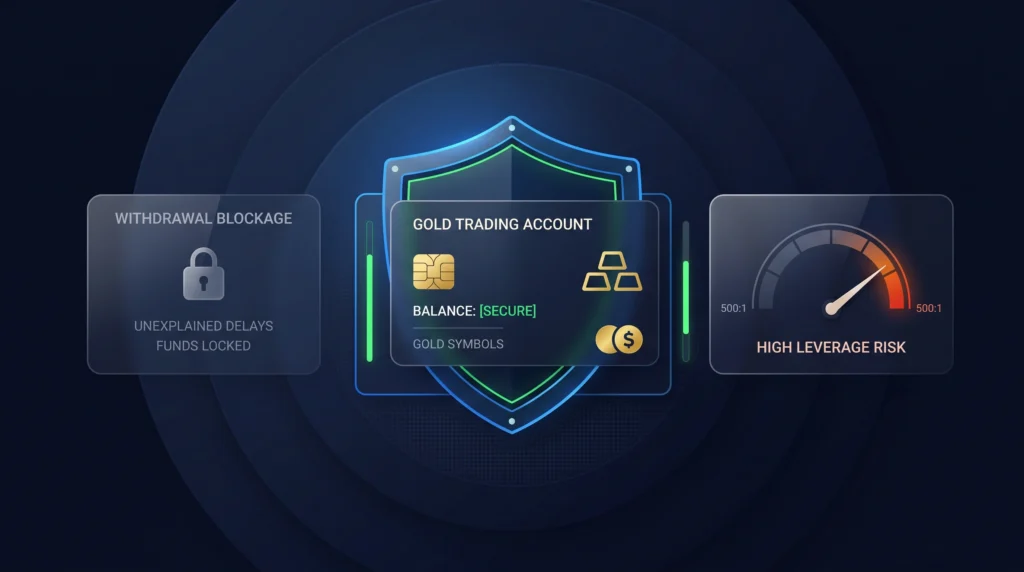
Most serious warning signs become easier to identify when you slow down, verify information independently, and request written answers.
Hidden Fees, Withdrawal Problems, and Bonus Conditions
Warning signs include vague fee schedules, unexplained deductions, changing withdrawal requirements, and bonuses that restrict access to deposited funds. Read every promotional condition before accepting it.
Claims of commission-free gold or commission-free gold trading may simply mean the cost is included in the spread. Ask how the provider earns revenue from each transaction.
Keep copies of account statements, messages, emails, and payment records. Organized documentation can be valuable if a dispute arises.
Unregulated Brokers, Scam Signals, and Aggressive Leverage
Avoid providers that promise guaranteed profits, request remote access to your computer, or demand immediate deposits. Be alert to cloned websites, fake license numbers, and salespeople who communicate only through private messaging applications.
Verify the broker’s website and contact details through the regulator’s official register. Aggressive leverage combined with high-pressure sales may suggest that the provider is more interested in deposits than responsible trading services.
Never send additional money solely because someone claims it is required to release a withdrawal.
Gold Trading FAQ
Which broker is best for XAU/USD trading?
M4Markets is the overall choice in this article because it combines MetaTrader access, several account structures, demo availability, and support for different approaches. Pepperstone may appeal to cost-focused traders, IC Markets to automated users, and Capital.com to beginners. The best provider still depends on your jurisdiction, strategy, holding period, and the exact XAU/USD contract available.
Which gold broker offers lowest spread?
There is no permanently lowest-spread provider because pricing changes with liquidity, session, volatility, and account type. Compare the average spread plus commission during the hours you intend to trade. A raw account may show a smaller spread but add a separate commission, while a standard account may include most costs in the bid-and-ask difference.
Can traders start gold trading with $100?
Some providers permit small deposits, but $100 may be insufficient for prudent risk management depending on leverage, minimum trade size, and stop distance. A small balance can be highly sensitive to ordinary gold volatility and transaction costs. Use a demo first, calculate potential loss at your stop, and avoid risking a large percentage of the account on one position.
Is MT4 or TradingView better for gold?
MT4 may suit traders using expert advisors, familiar indicators, and a traditional forex interface. TradingView may suit users who prioritize browser-based charting, alerts, and community scripts. Neither is universally better. Compare broker integration, order types, data quality, mobile access, and whether your preferred tools operate correctly before selecting a platform.
Are swap-free gold trading accounts available?
Some brokers offer swap-free accounts to eligible clients, but terms vary. Alternative administration charges, maximum holding periods, and strategy restrictions may apply. Review the written fee schedule and ask when substitute charges begin. Availability can depend on residence, regulatory entity, and account classification, so confirm the conditions before holding positions overnight.
How can gold broker safety be verified?
Identify the exact legal company in the client agreement and confirm its license independently through the relevant regulator’s register. Compare registered website details, addresses, and contact information. Review client-money arrangements, complaint procedures, and withdrawal policies. Start with a small deposit and test a withdrawal before increasing capital.
Is copy trading suitable for gold trading?
Copy trading may help users observe how another trader manages entries and exits, but it does not remove market risk. Performance can change when gold volatility, leverage, or liquidity conditions shift. Review the strategy’s drawdowns, position sizes, holding periods, and risk controls before following it. Set your own exposure limits rather than copying every trade automatically.
What is difference between CFD broker and futures broker?
A cfd broker typically offers leveraged over-the-counter exposure without ownership of the underlying asset, while a futures broker provides access to standardized exchange-traded contracts with fixed expiries. Gold CFDs may involve overnight financing, whereas futures require attention to contract months and rollover. The better option depends on capital, experience, jurisdiction, strategy, and preferred market structure.