Gold Trading With Economic Calendar Events That Move XAU/USD

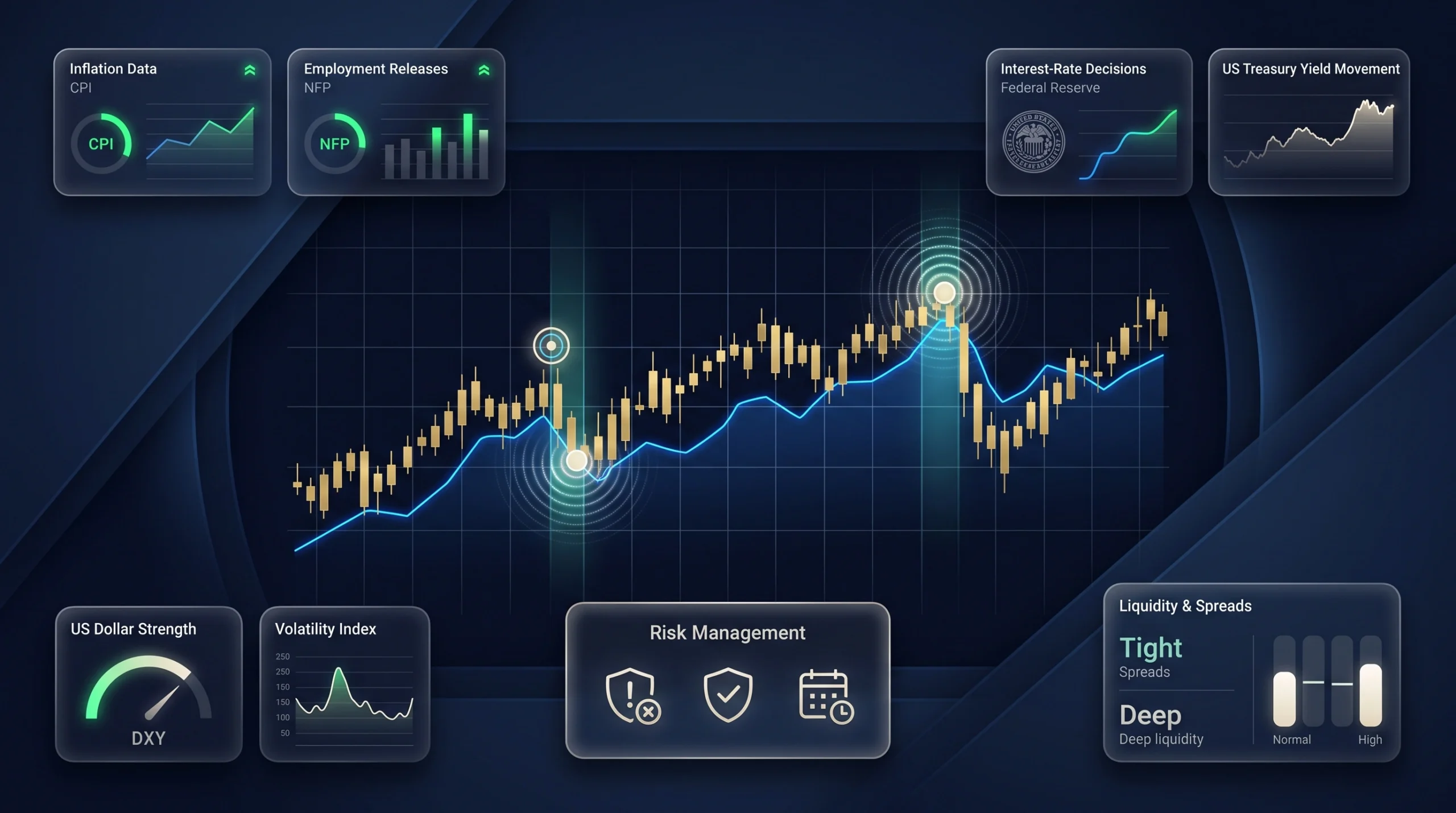
Economic calendar events can trigger some of the largest and fastest moves in gold. Inflation reports, employment figures, central bank decisions, and growth indicators may rapidly change expectations for interest rates, the US dollar, Treasury yields, and demand for defensive assets.
For gold traders, the challenge is not simply identifying important news. You also need to interpret whether a result is stronger or weaker than expected, assess how other markets react, and decide whether current liquidity and execution conditions justify a trade.
This guide explains how to use an economic calendar when trading XAU/USD, which releases deserve the most attention, when volatility is usually highest, and how to manage the risks associated with leverage, widening spreads, and sudden price reversals. Trading CFDs carries substantial risk, and no calendar strategy can guarantee profitable results.
Economic Calendar Basics for XAU/USD Traders
An economic calendar lists scheduled data releases, central bank meetings, speeches, and other events that may affect financial markets. It helps you identify when volatility could increase and prepare before an announcement reaches the market.
Gold is quoted against the US dollar, so US economic data usually receives the greatest attention. However, global risk sentiment, major central bank decisions, geopolitical developments, and changes in physical demand may also influence gold prices.
Beginners should first learn how spot gold behaves, how margin works, and why leveraged positions can move quickly. A broader introduction to how to trade gold for beginners can provide useful context before applying a news-based strategy.
How Economic Calendar Works
Each calendar entry normally includes the release time, affected currency, previous result, market forecast, and actual figure once data is released. Some platforms also display an impact rating, historical chart, or revision to earlier figures.
Before a trading day begins, filter the calendar for high-impact US events. Convert release times to your local timezone and compare them with your broker’s market hours. Daylight-saving changes can shift the local time of US releases, so checking the schedule each week is safer than relying on memory.
A practical preparation process may include:
- Marking high-impact events.
- Identifying current market expectations.
- Reviewing nearby support and resistance.
- Checking open positions and margin requirements.
- Deciding whether to trade, reduce exposure, or stay out.
Impact Ratings, Forecasts, Previous Results
Impact ratings are useful filters, but they do not measure the exact size or direction of a future move. A high-impact label means an event has historically attracted market attention, not that gold must become volatile every time it appears.
The forecast-versus-actual comparison often matters more. When data is released far above or below consensus, markets may rapidly reprice future interest rates. A result close to expectations may generate a smaller move unless revisions or report details contain a surprise.
Previous figures also require caution. Economic reports are sometimes revised, and the revision may alter the initial interpretation. Traders should consider the full release rather than reacting only to the headline number shown on a trading platform.
High-Impact Economic Events That Move Gold

Gold tends to respond most strongly to events that change expectations for inflation, employment, monetary policy, real yields, or financial stability. CPI, NFP, and Federal Reserve decisions are among the most closely watched releases.
| Event | Main Market Focus | Possible Gold Reaction |
| CPI | Inflation and rate expectations | Higher-than-expected inflation may lift yields and pressure gold, though safe-haven demand can complicate the move |
| NFP | Employment strength and wage growth | Strong data may support USD and yields; weak data may increase demand for gold |
| Fed decision | Interest rates and policy guidance | Hawkish signals may weigh on gold; dovish signals may support it |
| GDP | Economic growth | Strong growth may reduce rate-cut expectations |
| Retail sales | Consumer demand | Strong spending may support USD expectations |
| Jobless claims | Labour-market direction | Rising claims may suggest slowing employment conditions |
These relationships are not fixed. Market positioning, prior expectations, geopolitical risk, and technical price action may produce a different response.
Consumer Price Index (CPI)
CPI measures changes in consumer prices and is a central input in monetary policy expectations. Traders often watch headline inflation, core inflation, and month-over-month changes.
A hotter-than-expected report may increase expectations that interest rates will remain high. That can raise the opportunity cost of holding gold because the metal does not pay interest. Higher yields and a stronger dollar may then create downward pressure on gold.
However, persistent high inflation can also strengthen demand for gold as a hedge against inflation. The immediate reaction and the longer-term narrative may therefore differ. A detailed explanation of how CPI data affects gold prices can help you separate the first market response from broader inflation expectations.
Non-Farm Payrolls (NFP)
NFP reports monthly changes in US employment outside several excluded sectors. Markets also examine unemployment, wage growth, participation, and revisions to earlier figures.
Strong job creation and firm wage growth may support expectations for tighter monetary policy, strengthening USD and increasing Treasury yields. Weak employment data may suggest slowing growth and increase expectations for lower rates, which can support gold.
The first move is not always reliable. For example, a strong payroll number may initially pressure XAU/USD, but weaker wage growth or downward revisions can reverse that reaction. Traders reviewing how NFP affects gold trading should consider the entire labour report rather than one headline.
Federal Reserve Interest Rate Decisions
Federal Reserve meetings can affect gold through the policy rate, statement language, economic projections, and press conference. Markets focus heavily on guidance about future inflation, employment, and rate changes.
A hawkish decision may suggest rates will remain higher for longer. This can support the dollar and yields, reducing the relative appeal of non-yielding assets. A dovish message may have the opposite effect, particularly when traders begin pricing earlier or deeper rate cuts.
The announcement and press conference can produce separate waves of volatility. Traders studying how Fed rate decisions affect gold should monitor both the initial statement and later comments from the Fed chair.
How Economic Data Affects XAU/USD Price
Economic data does not move gold through one channel alone. XAU/USD may respond to the dollar, nominal yields, real yields, inflation expectations, risk appetite, or a combination of these factors.
A useful approach is to watch related markets after data is released. When gold, the dollar index, and Treasury yields all confirm the same interpretation, the move may be more sustainable. When they conflict, price action can become unstable.
US Dollar Reaction
Because gold is commonly priced in USD, dollar strength can make it more expensive for buyers using other currencies. This may reduce demand and weigh on the gold market. A weaker dollar can make gold relatively cheaper and may support buying interest.
The relationship is often inverse, but it is not perfect. During periods of severe market stress, both gold and the dollar may rise as investors seek liquid defensive assets.
Traders should avoid assuming that every dollar increase requires an immediate short position in gold. Context, market positioning, and nearby technical levels still matter.
Treasury Yield Reaction
Treasury yields reflect expectations for economic growth, inflation, and central bank policy. Rising yields may increase the return available from interest-bearing assets, raising the opportunity cost of holding gold.
Real yields, which account for inflation expectations, can be particularly relevant. When real yields rise, gold may face pressure. Falling real yields may support demand because the relative disadvantage of holding a non-yielding asset becomes smaller.
Short-term price movements can still diverge from this relationship when safe-haven demand or forced position liquidation dominates trading activity.
Inflation Expectations
Inflation can influence gold in competing ways. High inflation may increase demand for gold as a store of value, but it can also lead to higher policy rates and bond yields.
The market reaction depends on which factor receives more attention. If inflation rises while central banks are expected to respond aggressively, gold may initially fall. If investors doubt that policy can contain inflation without damaging growth, defensive demand may increase.
Gold traders should therefore compare inflation data with rate expectations rather than treating inflation as automatically bullish.
Safe-Haven Demand
Gold is considered a defensive asset because investors may seek it during financial stress, geopolitical uncertainty, banking concerns, or sharp declines in risk assets.
Safe-haven demand can override normal economic relationships. Weak economic data may support gold through lower rate expectations, but an extreme liquidity shock may cause investors to sell gold temporarily to raise cash.
This is why trading decisions should account for broader market conditions. Important news can produce different outcomes during a calm market than during a period of systemic stress.
Key Economic Indicators for Gold Trading
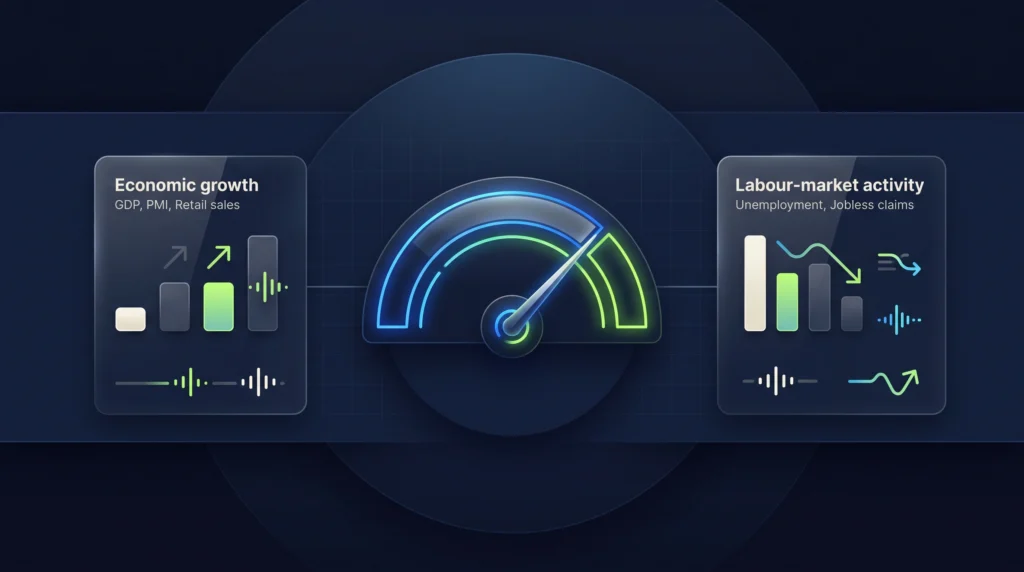
CPI, NFP, and Fed decisions usually attract the most attention, but secondary indicators can also move XAU/USD when they meaningfully change the economic outlook.
Gross Domestic Product (GDP)
GDP measures the value of goods and services produced within an economy. Strong GDP growth may suggest economic resilience and reduce expectations for rate cuts, potentially supporting USD and yields.
Weak growth may increase recession concerns or expectations for easier monetary policy. That can support gold, although a severe slowdown may also create volatile liquidation across markets.
Traders should examine whether the GDP result reflects consumer spending, investment, inventories, or government activity. Headline growth alone may not reveal the quality of the expansion.
Purchasing Managers’ Index (PMI)
PMI surveys provide relatively timely information about manufacturing and services activity. Readings above or below the neutral level may indicate expansion or contraction.
Markets often focus on new orders, employment, input prices, and business expectations. A strong services PMI with rising price pressures may increase rate expectations, while a weak report may suggest slowing economic activity.
PMI can be especially influential when it confirms or challenges the current market narrative before major central bank meetings.
Retail Sales Data
Retail sales provide insight into consumer spending, an important component of economic activity. Strong sales may suggest resilient demand and support expectations for continued growth.
A weak report may indicate that households are reducing spending, potentially increasing concerns about an economic slowdown. However, markets may examine control-group sales, revisions, and whether changes reflect prices rather than real consumption.
Gold reactions are often strongest when retail sales sharply deviate from forecasts or alter expectations for monetary policy.
Unemployment Rate
The unemployment rate offers a broader view of labour-market conditions than payroll growth alone. A rising rate may suggest weakening demand for workers, while a falling rate can indicate continued labour-market strength.
The figure should be considered alongside participation and wage growth. Unemployment can rise because more people enter the workforce, which may be less negative than job losses.
When labour data sends mixed signals, XAU/USD may experience an initial spike followed by a reversal as traders assess the report.
Initial Jobless Claims
Initial jobless claims track new applications for unemployment benefits and are released more frequently than NFP. They can provide early evidence of changes in labour-market momentum.
One weekly result may contain noise, so traders often consider the broader trend. A sustained increase in claims may suggest weakening employment conditions, while persistently low claims may indicate labour-market resilience.
Claims usually generate less trading volume than NFP, but an unexpected result can still move gold when markets are highly sensitive to employment data.
Best XAU/USD Trading Hours for Economic Releases
The best time to trade XAU/USD depends on your strategy, timezone, risk tolerance, and the location of scheduled announcements. Higher liquidity can improve execution, but high volatility also increases the possibility of slippage and rapid losses.
London Session
The London session brings substantial participation from banks, funds, commodities desks, and European traders. Liquidity often increases as European markets open, especially after quieter Asian trading.
European data and decisions from the European Central Bank can affect currencies, yields, and risk sentiment. Their influence on gold is often indirect but can still be meaningful.
Price action during London may establish key intraday levels before US economic data releases.
New York Session
The New York session is especially important because most major US economic data is released during these hours. CPI, retail sales, jobless claims, GDP, and employment reports can all create high volatility.
COMEX activity and institutional participation can also increase trading volume. Spreads may remain competitive in normal conditions, but they can widen immediately before and after important news.
For many traders, this is the most active period for economic-calendar strategies.
London-New York Overlap
The overlap between London and New York often combines high liquidity with strong institutional participation. It can be one of the most active times to trade gold.
When US data is released during the overlap, volume and volatility may rise quickly. This creates opportunities but also increases execution risk.
Traders should compare their broker’s spread, order-fill policy, and margin requirements during fast markets rather than assuming normal trading conditions will continue.
Asian Session
The Asian session can be quieter, although activity may increase around Chinese economic releases, regional risk events, or major changes in physical demand.
Gold sometimes trades within narrower ranges during these hours. That can suit range-based approaches, but it may also create false breakouts when liquidity is lower.
Unexpected geopolitical headlines can still produce abrupt moves at any time, so reduced average activity does not eliminate risk.
US Release Schedule
Many important US reports are published in the morning New York time, while Fed decisions generally occur later in the trading day. Exact times should always be confirmed on a reliable calendar.
Before each release, check:
- Local timezone conversion
- Daylight-saving adjustments
- Expected impact level
- Consensus and previous figures
- Open-position exposure
- Broker trading conditions
- Nearby technical levels
Do not assume that all high-impact releases occur at the same time.
Best Weekdays for Gold Volatility
Tuesday through Thursday often contain more scheduled economic data and central bank activity than other weekdays. However, there is no universally best weekday.
Monday may begin slowly unless markets respond to weekend developments. Friday can be highly active during employment reports or position adjustments, but liquidity may decline later in the session.
The economic calendar should guide your schedule. A quiet Wednesday can offer fewer opportunities than a Monday containing a major policy announcement.
Gold Trading Strategy Around News Events
A news strategy should define what you will do before, during, and after a release. Entering simply because a high-impact event appears on the calendar is not a complete trading plan.
Pre-Release Market Preparation
Start by identifying the market’s dominant expectation. Determine whether traders are focused on inflation, growth, employment, or interest rates. Then mark recent highs, lows, support, resistance, and areas where stop orders may be concentrated.
A practical pre-release checklist includes:
- Confirm event time and expected importance.
- Review forecast, previous result, and recent trend.
- Note current USD and yield direction.
- Reduce excessive leverage.
- Define invalidation level and maximum loss.
- Decide whether you will wait for confirmation.
Avoid opening a large position seconds before data is released. Spreads, liquidity, and execution may deteriorate without warning.
Post-Release Entry Confirmation
Waiting for confirmation can reduce exposure to the first erratic move. Confirmation may involve a candle close beyond a key level, a successful retest, or agreement between gold, USD, and Treasury yields.
For example, weaker-than-expected inflation may initially send gold higher. Instead of buying the first spike, a trader could wait to see whether price holds above resistance while yields decline and the dollar weakens.
This approach may miss part of the move, but it can also reduce the risk of entering during a temporary liquidity-driven reaction. Technical indicators like moving averages may provide context, though they should not replace price structure and risk controls.
False Signals and News-Driven Price Traps
Economic releases frequently create rapid moves that reverse within seconds or minutes. These false signals can be caused by mixed report details, revisions, thin order books, automated trading, or profit-taking.
Whipsaws After Initial Reaction
A whipsaw occurs when price moves sharply in one direction and then reverses. The first move may reflect automated systems reacting to the headline, while the reversal begins after traders examine the full report.
Chasing an extended candle can result in poor entry prices and wide stop-loss requirements. Waiting for the market to form a range or retest may provide a clearer setup.
No confirmation method removes risk, particularly during high-impact events.
Conflicting Economic Releases
Several indicators are sometimes released at the same time. One may be stronger than expected while another is weaker, creating uncertainty.
A strong employment headline combined with weak wage growth is one example. Gold may fall, reverse, and then consolidate as markets reassess the likely policy response.
When signals conflict, staying out can be a valid decision. A trader does not need to participate in every release.
Spread Expansion and Slippage
Spreads may widen before major news because available liquidity decreases and market makers face greater uncertainty. Stop orders may be filled at a different price from the requested level.
Slippage can turn a planned small loss into a larger one. Guaranteed fills should never be assumed unless a broker explicitly offers a relevant order type under clearly stated conditions.
Broker comparison should include typical spreads, commissions, execution model, negative-balance policies where applicable, platform stability, and treatment of orders during volatile periods.
Risk Management During High-Impact Gold Trading
Risk management matters more than prediction during economic data releases. Even a correct interpretation can lose money if the entry is late, leverage is excessive, or execution is poor.
Position Sizing During News
Position size should reflect stop distance and acceptable account risk. When volatility increases, a wider stop may be necessary, which usually means reducing trade size.
Required Margin equals Trade Size divided by Leverage.
Higher leverage reduces required margin but does not reduce market risk. It magnifies gains and losses relative to deposited capital.
Traders should also maintain enough free margin to withstand temporary price swings and possible spread expansion.
Stop-Loss Placement
A stop-loss should be placed where the trade idea becomes invalid, not at an arbitrary distance. During news, stops located close to current price may be triggered by normal volatility.
Placing an extremely wide stop is not automatically safer because it increases potential loss. The solution is to balance market structure, position size, and maximum risk.
Stop orders may experience slippage, so actual loss can exceed the planned amount in fast conditions.
Profit Targets and Risk-Reward Ratios
Profit targets can be based on recent support or resistance, average intraday movement, or the next significant liquidity area.
A favourable planned risk-reward ratio does not guarantee profitability. The probability of reaching the target, execution costs, and frequency of false breakouts also matter.
Some traders scale out of positions and trail the remainder. Others use a fixed target. The method should be tested under realistic spreads, swaps, commissions, and slippage assumptions.
Trading Pause Rules
A pause rule defines when you will stop trading. It can protect you from emotional decisions after a loss or unusually volatile price action.
Useful pause conditions may include:
- Maximum daily loss reached
- Two consecutive news-related losses
- Abnormal spread or platform instability
- Unclear reaction across related markets
- Unexpected geopolitical developments
- Failure to follow the original plan
Stopping for the day is a risk-management decision, not a missed opportunity.
XAU/USD Economic Calendar FAQs
Which Economic Events Move Gold Most?
CPI, Non-Farm Payrolls, Federal Reserve rate decisions, inflation measures, GDP, retail sales, and employment indicators are among the events most likely to move gold. Their impact depends on how far results differ from expectations and whether they change forecasts for interest rates, the US dollar, or Treasury yields. Market positioning and safe-haven demand can also change the direction or strength of the reaction.
How Does CPI Affect XAU/USD?
CPI affects XAU/USD by changing inflation and monetary policy expectations. Higher-than-expected inflation may increase bond yields and support the dollar, which can pressure gold. In other cases, persistent inflation may raise demand for gold as a defensive asset. Traders should examine core data, monthly changes, revisions, and the reaction in yields rather than relying only on the headline figure.
How Does NFP Affect Gold Prices?
NFP can move gold by changing expectations for US growth, wages, and Federal Reserve policy. Strong employment data may support the dollar and yields, placing pressure on gold, while weaker figures may support XAU/USD through expectations for lower rates. The unemployment rate, wage growth, participation, and revisions can create a different reaction from the payroll headline.
What Time Does XAU/USD Move Most?
XAU/USD often becomes most active during the London and New York sessions, particularly during their overlap and around major US economic releases. Liquidity and trading volume may be high, but volatility, spreads, and slippage can also increase. The precise best time to trade XAU/USD depends on the day’s calendar, your timezone, broker conditions, strategy, and tolerance for rapid price movements.
Should Traders Enter Before Economic News?
Entering before economic news exposes a position to unpredictable price gaps, spread expansion, and slippage. Some experienced traders use pre-release strategies, but the risk can be substantial, particularly with leveraged CFDs. Waiting for the actual data and a clearer price-action response may offer more information, although it does not guarantee a better entry or profitable result.
Which Economic Calendar Settings Work Best?
A useful economic calendar setup filters for high-impact US events, displays local release times, and includes previous, forecast, actual, and revised figures. Alerts can help you prepare, but they should not replace a written trading plan. Gold traders may also monitor major global central bank decisions, Chinese economic data, and geopolitical events when these factors are relevant to current market conditions.