Gold Trading Tips for Beginners: Risk Management, Timing, Market Analysis


Gold trading for beginners should begin with three priorities: protecting capital, waiting for clear market conditions, and making decisions from a written plan. Before you start trading, learn how your chosen product works, how much each price movement affects your balance, and what costs apply.
A beginner does not need to predict every change in the gold market. The goal is to identify a reasonable setup, define entry and exit points, limit trading risk, and accept that some trades will lose. Successful trading depends more on consistency than on finding one perfect indicator.
A practical beginner process includes:
- Choose one market vehicle and learn its contract details.
- Risk only a small, predefined portion of your account.
- Mark important support and resistance areas.
- Check scheduled economic events before entering.
- Wait for confirmation instead of chasing fast moves.
- Record each trade and review results regularly.
For a broader introduction to instruments, order types, and preparation, this guide on how to trade gold for beginners provides useful background.
Why Gold Attracts Beginner Traders and Where Risk Begins
Gold is often attractive because it is widely followed, highly liquid during active trading hours, and influenced by recognizable themes such as inflation, interest rates, currency strength, and geopolitical uncertainty. Gold charts may also display clear trends, ranges, and breakout patterns.
Accessibility can create false confidence. Trading gold CFDs, futures, or other leveraged products involves risk because a relatively small deposit may control a much larger position. Volatility, spreads, swaps, commissions, margin requirements, and execution quality can all affect results. A gold trader should evaluate personal risk tolerance before choosing position size or trading style.
Gold Price Drivers and Market Participants
The price of gold reflects a combination of macroeconomic expectations, investment demand, physical consumption, currency conditions, and shifts in market sentiment. No single factor controls every trading day. Drivers can reinforce one another or produce conflicting signals.
Beginners should focus on context rather than isolated headlines. For example, weaker economic data may support gold if traders expect lower interest rates, but the reaction may be limited when the US dollar strengthens or when the news was already reflected in current prices.
Inflation, Interest Rates, US Dollar, Safe-Haven Demand
Inflation can influence gold prices because some investors view the metal as a potential store of value. However, inflation alone does not determine direction. Central-bank policy expectations and changes in real or nominal yields may have a stronger immediate impact.
Gold commonly has an inverse relationship with the US dollar, although this relationship is not constant. A stronger dollar can make gold more expensive for buyers using other currencies, while a weaker dollar may support demand for gold.
Safe-haven buying may increase during financial stress or geopolitical uncertainty. Yet even in unsettled conditions, gold can fall when traders raise cash, reduce leverage, or react to changing interest-rate expectations. Such relationships may indicate a bias, but they do not guarantee future results.
Supply, Demand, Central Banks, Hedgers, Speculators
Physical demand comes from jewellery, industry, investment products, gold bars and coins, and official-sector purchases. Mining output and recycling contribute to supply, although short-term price movement is often driven more by financial flows than by immediate changes in production.
Market players have different objectives:
- Central banks may hold gold as part of reserve management.
- Producers may hedge future output.
- Manufacturers may manage input costs.
- Asset managers may use gold ETFs for portfolio exposure.
- Gold bugs may maintain a long-term bullish view.
- Speculators may trade momentum, breakouts, or reversals.
- Short-term participants may react to news and liquidity.
Recognizing these motives helps explain why buyers and sellers can interpret the same information differently.
Market Volatility and Gold Trend Analysis
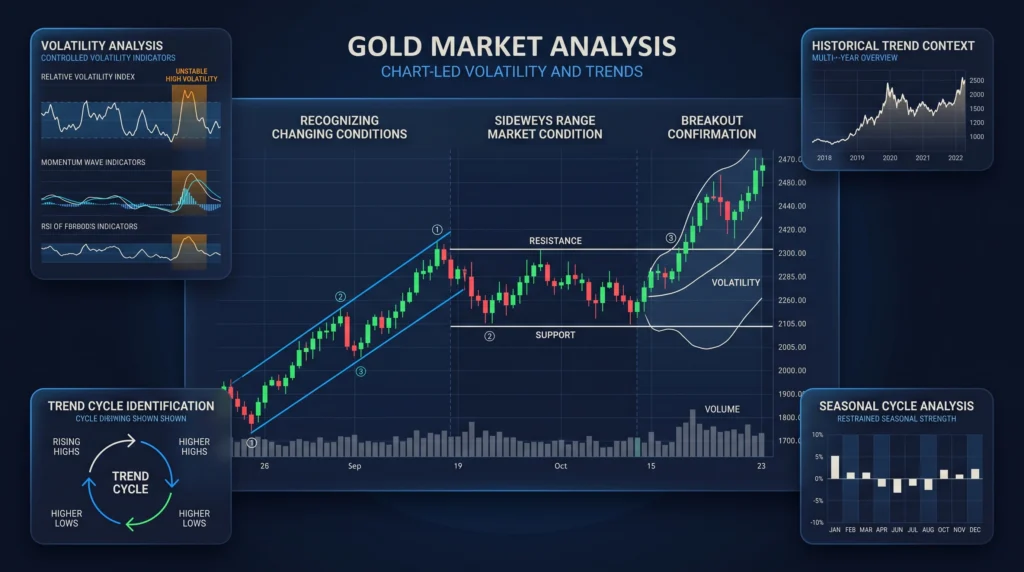
Volatility describes how quickly and widely prices change. It creates opportunity, but it also increases the chance of slippage, premature stop-outs, and emotionally driven trading decisions. Beginners should adapt position size to current conditions instead of using the same exposure every day.
Gold Price Swings and Trading Opportunities
Large moves can develop when unexpected economic information changes interest-rate expectations or risk appetite. These periods may create clear directional momentum, but they can also produce sharp reversals.
A trader who sees gold rising quickly may be tempted to buy immediately. A more controlled approach is to wait for a pullback, identify a logical invalidation point, and calculate whether the potential reward justifies the risk. Missing a trade is usually less damaging than entering without a plan.
When volatility expands, wider stops may be needed to account for normal fluctuations. The position should then be reduced so that the amount at risk remains within the trading plan.
Historical Price Trends and Seasonal Gold Patterns
Historical gold data can show how the market behaved during previous rate cycles, crises, inflationary periods, and changes in currency conditions. This context may help traders recognize recurring reactions, but historical performance does not predict future outcomes.
Seasonal patterns may appear during periods associated with jewellery demand, portfolio adjustments, or changing market participation. Treat these patterns as background information, not standalone signals. A seasonal tendency becomes more useful when current price action, fundamental analysis, and liquidity conditions point in the same direction.
Trending, Ranging, Breakout Market Conditions
A trending market forms a sequence of higher highs and higher lows, or lower highs and lower lows. Trend-following setups may perform better in this environment because pullbacks can offer structured entries.
A range develops when price repeatedly reacts near identifiable boundaries. Traders may look for buying interest near support and selling pressure near resistance, provided the range remains intact.
A breakout occurs when price moves beyond a well-observed boundary. Breakouts can continue rapidly, but false breaks are common. Waiting for a candle close, retest, or momentum confirmation may reduce weak entries, although no confirmation method eliminates risk.
Technical, Fundamental, Sentiment Analysis
Effective gold trading combines several types of evidence. Technical analysis helps organize price behaviour, fundamental analysis explains major economic forces, and sentiment analysis provides clues about positioning and crowd psychology.
The objective is not to collect as many signals as possible. It is to build a repeatable decision process in which each tool has a defined purpose.
Support, Resistance, Trend Lines
Support and resistance represent price levels where gold has previously attracted meaningful buying or selling. These areas should usually be treated as zones rather than exact numbers because orders may be distributed across a range.
Trend lines can help visualize direction and the pace of a move. A break may suggest weakening momentum, but it should not automatically trigger a trade. Traders should consider market structure, volume or momentum evidence, and nearby price levels before acting.
Moving Averages, RSI, Bollinger Bands
Moving averages can smooth short-term noise and help identify direction. A rising average may support a bullish bias, while a falling average may suggest bearish conditions. Crossovers are more useful when they align with broader structure.
The Relative Strength Index can highlight momentum and indicate when gold is overbought or oversold. These readings do not mean that reversal is immediate. Strong markets can remain stretched for extended periods.
Bollinger Bands show price relative to a volatility-based envelope. Band expansion may signal increasing volatility, while contraction may precede a larger move. The guide to best indicators for gold trading can help you compare indicator roles without treating any tool as a guaranteed signal.
Economic Data, News Releases, Global Events
Employment reports, inflation readings, central-bank decisions, economic growth data, and official speeches can influence gold prices. The reaction depends on how the release compares with expectations, not simply whether the number appears positive or negative.
A calendar-based process can help traders avoid entering immediately before scheduled volatility. This article on gold trading with economic calendar explains how event timing can support preparation.
Unexpected geopolitical developments can also impact gold, currencies, yields, and overall financial market liquidity. During such events, spreads may widen and execution may become less predictable.
Market Sentiment and Trader Psychology
Sentiment reflects whether participants broadly favour risk-taking, defensive assets, stronger currencies, or lower exposure. It can change quickly after news or when important technical levels break.
Trader psychology is equally important. Fear may cause early exits, while greed may encourage oversized positions or delayed profit-taking. A disciplined process separates observations from impulses. Before entering, write down why the trade is valid, what would invalidate it, and where the position will be closed.
Gold Trading Strategies and Market Vehicles
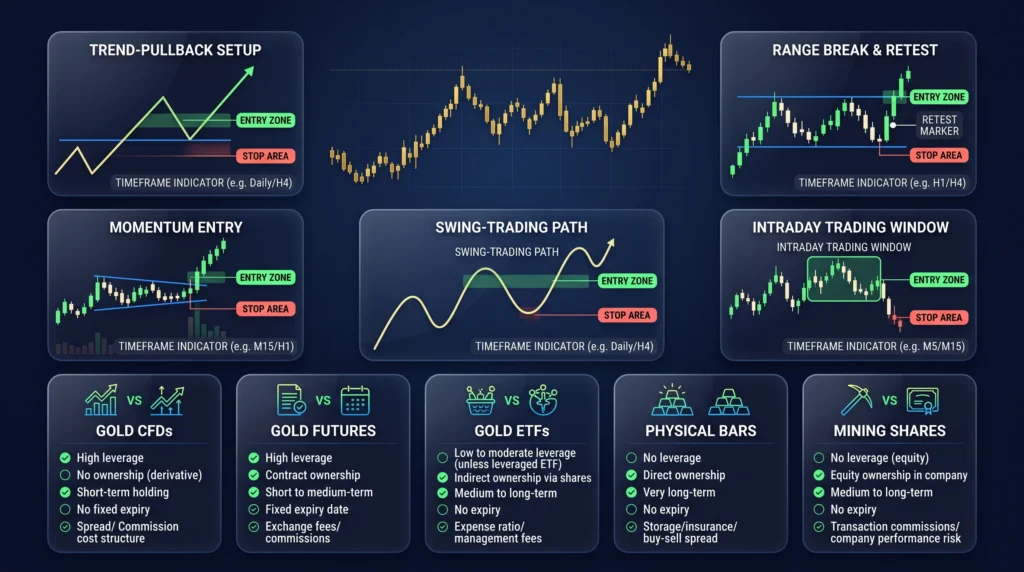
Your strategy should match your available time, knowledge, account size, and ability to manage risk. A method suited to active trading may be inappropriate for someone who can check markets only once or twice a day.
Trend-Pullback Trading Setup
A trend-pullback setup looks for an established directional move followed by a temporary retracement. The trader waits for price to approach prior support, resistance, a moving average, or another relevant area.
For example, suppose gold forms higher highs and higher lows during an active session. Instead of buying after a rapid rise, a trader waits for a pullback toward previous resistance that may now act as support. Entry occurs only after renewed buying appears. The stop is placed beyond the level that would invalidate the setup, not at an arbitrary distance.
Range Break and Retest Setup
In a range break and retest approach, price first closes beyond a well-defined boundary. The trader then waits to see whether that former boundary holds when revisited.
This method can offer a clearer stop location and reduce the urge to chase. However, price may never retest the level, and some apparent breakouts fail quickly. Traders should avoid forcing an entry simply because they missed the initial move.
Momentum, Swing, Day Trading Approaches
Momentum traders follow accelerating price movement, often during high-liquidity periods. Swing traders may hold positions for several days to capture broader moves. Day trading involves opening and closing positions within one trading day, reducing overnight exposure but requiring more attention.
Each approach carries different costs and pressures. Frequent trading may increase spreads and commissions, while multi-day positions may incur swaps or face overnight gaps. Your trading goals and schedule should determine the method, not excitement or social-media claims.
Long-Term Versus Short-Term Gold Trading
Long-term trading focuses on broad economic cycles, central-bank policy, inflation expectations, and major price structures. Positions may require wider stops and patience through temporary fluctuations.
Short-term trading depends more heavily on intraday liquidity, timing, execution, and immediate catalysts. It can provide more opportunities but also more chances to overtrade.
Neither approach is automatically safer. Risk depends on leverage, position size, holding period, market conditions, and whether the trader follows a tested process.
Gold CFDs, Futures, ETFs, Physical Gold Options
Different vehicles provide different forms of exposure. Before opening a trading account, compare access, costs, leverage, ownership, liquidity, and regulatory protections applicable to your location.
| Vehicle | Typical Use | Key Considerations |
| Gold CFDs | Short-term directional trading | Leverage, spreads, swaps, counterparty terms |
| Gold futures | Standardized exchange-traded exposure | Contract size, expiry, margin, volatility |
| Gold ETFs | Portfolio or medium-term exposure | Fund fees, tracking differences, market hours |
| Physical gold | Ownership and wealth storage | Storage, insurance, dealer premium, resale spread |
| Mining shares | Equity exposure linked to producers | Company risk, operating costs, broader stock market |
Trading gold CFDs can offer flexible long and short exposure, but leverage creates a high level of risk. Physical gold avoids margin calls but introduces storage and transaction costs. Traders should select the instrument that fits their purpose rather than treating all gold products as interchangeable.
Best Gold Trading Times and Sessions
Gold can trade across much of the weekday, but activity is not uniform. Liquidity, spreads, volatility, and reaction speed often vary by session. The best period depends on your strategy and location.
London Session Trading Conditions
London hours often bring increased participation from European institutions and commodity traders. Moves that began during Asian trading may continue, reverse, or consolidate as liquidity increases.
Beginners should observe how price behaves around the London open rather than assuming a particular direction. Early volatility may produce false signals before a clearer structure forms.
New York Session Trading Conditions
The New York session can be highly active because US economic releases, bond-market movements, and dollar flows may affect gold. Trading conditions can change quickly around scheduled data.
Spreads are often competitive during liquid periods, but volatility may rise sharply. A planned stop, reduced position size, and awareness of news timing are essential.
London–New York Session Overlap
The overlap between London and New York commonly brings strong participation from both regions. This may create deeper liquidity and more sustained price movement.
It can also produce abrupt reversals as traders respond to US data or adjust positions. A beginner may benefit from waiting until the first reaction settles before making a decision.
Liquidity and Volatility Trading Windows
High liquidity may support tighter spreads and more efficient execution, while quieter periods may create slower movement and irregular price jumps. Active trading strategies generally require enough participation for entries and exits to be filled near expected prices.
The most volatile period is not automatically the best. Your preferred window should offer movement that matches your experience, risk tolerance, and trading style.
Gold Trading Around Economic News
Trading directly before or after major news carries additional risk. Prices may gap, spreads may widen, and orders may be filled away from requested levels.
Some traders avoid these periods entirely. Others wait for the first reaction, then assess whether price holds above or below a significant level. Both approaches can be valid depending on market conditions, but entering without knowing that a release is scheduled is an avoidable mistake.
Entry Timing and Trade Confirmation Signals
Confirmation may come from a rejection candle, structure break, retest, momentum shift, or alignment across multiple timeframes. A confirmation signal should support a pre-existing idea rather than create one by itself.
Before entering, verify:
- Market direction or range is clearly defined.
- Entry has a logical reason.
- Stop level reflects invalidation.
- Potential reward justifies planned risk.
- Position size fits account limits.
- Major news is not being ignored.
- Trading costs remain reasonable.
Risk Management, Leverage, Common Mistakes
Risk management in gold trading is not an optional final step. It is the framework that determines whether a trader can survive normal losing periods. Successful gold trading requires accepting uncertainty and controlling exposure before each order is placed.
Position Sizing Based on Account Risk
Position size should be calculated from account balance, permitted loss, entry price, and stop distance. A wider stop requires a smaller position when the amount at risk stays constant.
For example, assume an account balance of $5,000 and a maximum planned risk of 1%, or $50. The position should be sized so that a stop-loss exit produces an estimated loss near $50, including expected costs. This is a planning example, not a recommended risk percentage.
Stop-Loss Placement and Risk-Reward Ratios
A stop-loss belongs beyond the point where the trade idea is no longer valid. Placing it too close may cause normal market noise to close the position. Placing it too far away can create unnecessary loss.
Risk-reward analysis compares the potential loss with the possible gain. A favourable ratio may help, but it does not guarantee profitability. Win rate, execution, costs, and discipline also influence results.
Leverage Limits and Capital Protection
Leverage Ratio = Position Size / Margin.
Leverage increases both potential gains and potential losses. A small adverse move can consume a meaningful part of the account when exposure is excessive. Margin requirements may also change during volatile periods.
Capital protection means using lower leverage than the maximum available, keeping free margin, and avoiding multiple positions that depend on the same market outcome. Proper risk controls should be based on worst-case planning, not on the hope that price will reverse.
Overtrading, Revenge Trading, Late Entries
Overtrading occurs when a trader takes low-quality setups, trades too frequently, or remains active after reaching a daily limit. Revenge trading often follows a loss and is driven by the desire to recover money quickly. Late entries happen when traders chase a move after much of the opportunity has passed.
These behaviours can increase costs and weaken decision quality. Reviewing common gold trading mistakes may help identify habits that are difficult to notice during live trading.
Trading Plan, Risk Checklist, Journal Review
A trading plan should define permitted strategies, market conditions, maximum exposure, session times, entry requirements, and reasons to stop for the day.
A useful journal records the setup, entry, stop, target, result, screenshot, emotional state, and whether rules were followed. Review performance over a meaningful sample rather than changing methods after one or two losses. The goal is to separate strategy problems from execution mistakes and random outcomes.
Gold Trading FAQ
Is gold trading suitable for beginners?
Gold trading may be suitable for beginners who first learn product mechanics, practise position sizing, and accept that trading involves risk. New traders should begin with conservative exposure and avoid assuming that gold is safe simply because it is a well-known asset. Leveraged instruments can produce rapid losses, so preparation, a written plan, and strict risk limits are essential.
Can beginners trade gold with limited capital?
Beginners may access gold through products with relatively low entry requirements, but limited capital does not justify excessive leverage. Small accounts are more vulnerable to costs, volatility, and margin pressure. Traders should consider whether the account can support sensible position sizing and normal losing periods. Using a demonstration environment before risking funds may help develop familiarity with the trading platform.
Which gold trading strategy suits beginners?
A simple trend-pullback or well-defined range strategy may suit beginners because both can provide visible entry, stop, and target areas. The best choice depends on available time, personality, and market conditions. Beginners should focus on one setup, document its rules, and review a meaningful sample of trades before adding more techniques. No strategy can remove uncertainty or guarantee success in gold trading.
How can beginners reduce gold trading losses?
Beginners can reduce losses by limiting position size, using predefined stops, avoiding unplanned news exposure, and refusing trades with unclear invalidation points. They should also control leverage, account for spreads and swaps, and stop trading when emotions affect judgment. Losses cannot be eliminated, but consistent risk limits and regular journal reviews can prevent a single decision from causing disproportionate damage.