
Forex Market Hours in India: Operating Hours and Best Time To Trade Explained


Understanding forex market hours in India is one of the first practical steps a beginner needs to take before placing any trade. The global forex market operates 24 hours a day, five days a week — from Sunday evening through Friday evening — but that continuous cycle is divided into regional sessions, each with its own activity level and trading volume. For traders in India working in Indian Standard Time (IST, UTC+5:30), knowing when each session opens and closes is essential for making sense of price movement and liquidity patterns.
This guide covers forex market timings in India across all major global sessions, explains how session overlaps work, and clarifies the difference between global forex hours and the trading hours available on Indian exchanges.
Key Takeaways
- The global forex market operates continuously from Sunday to Friday, cycling through the Sydney, Tokyo, London, and New York sessions.
- India uses IST (UTC+5:30) year-round and does not observe daylight saving time; London and New York session times in IST shift by one hour when those markets switch to summer time.
- The London–New York session overlap — approximately 5:30 PM to 9:30 PM IST in summer, or 6:30 PM to 10:30 PM IST in standard time — is generally the most active period for major currency pairs.
- Indian exchanges (NSE) offer separate, regulated trading hours: 9:00 AM to 5:00 PM IST for INR pairs and 9:00 AM to 7:30 PM IST for cross-currency contracts.
- Currency trading in India is regulated by the Reserve Bank of India (RBI) and the Securities and Exchange Board of India (SEBI), and exchange-traded currency derivatives in India are subject to specific rules.
- The best time to trade forex in India depends on the currency pair and the trader’s strategy, not just the clock.
Forex Market Hours in India: Summary Table
| Session | Opening Time in IST (Standard) | Closing Time in IST (Standard) | Opening Time in IST (Summer/DST) | Closing Time in IST (Summer/DST) |
| Sydney | 3:30 AM | 12:30 PM | 3:30 AM | 12:30 PM |
| Tokyo | 5:30 AM | 2:30 PM | 5:30 AM | 2:30 PM |
| London | 1:30 PM | 10:30 PM | 12:30 PM | 9:30 PM |
| New York | 6:30 PM | 3:30 AM | 5:30 PM | 2:30 AM |
| London–New York Overlap | 6:30 PM | 10:30 PM | 5:30 PM | 9:30 PM |
Why Does the Forex Market Operate 24 Hours a Day?
The foreign exchange market — commonly called the forex market — is a global, decentralised market where currencies are bought and sold. It is widely regarded as the largest financial market in the world by daily trading volume, with trillions of dollars exchanged each day across banks, institutions, and individual traders.
The forex market operates 24 hours a day, Monday to Friday, because it has no single physical exchange. Instead, trading is conducted electronically across financial centres in different time zones. When one major market closes, another opens, creating a continuous trading cycle throughout the week. This structure means that forex market opening and closing times are session-based rather than tied to a single exchange clock.
Global Forex Trading Sessions and Their Timings in India
The global forex market moves through four main regional trading sessions: Sydney, Tokyo, London, and New York. Each session’s forex time in India is expressed in IST (UTC+5:30). Because India does not observe daylight saving time, the IST timings for the London and New York sessions shift by one hour depending on whether those regions are on standard or summer (daylight saving) time.
Global Forex Session Timings in IST
| Trading Session | Standard-Time Schedule (IST) | Summer/DST Schedule (IST) | Main Markets |
| Sydney | 3:30 AM – 12:30 PM | 3:30 AM – 12:30 PM | Australia, New Zealand |
| Tokyo | 5:30 AM – 2:30 PM | 5:30 AM – 2:30 PM | Japan and Asia |
| London | 1:30 PM – 10:30 PM | 12:30 PM – 9:30 PM | United Kingdom, Europe |
| New York | 6:30 PM – 3:30 AM | 5:30 PM – 2:30 AM | United States, Canada |
The summer/DST schedule applies when the United Kingdom and United States are both on daylight saving time, which covers a significant portion of the year including summer months. Tokyo and India do not use daylight saving time, so their session timings remain fixed year-round.
Some forex calendars list slightly different Sydney session boundaries due to Australian seasonal time changes. Session timings should be treated as approximate guidelines rather than hard exchange open and close times.
Understanding the Major Forex Trading Sessions
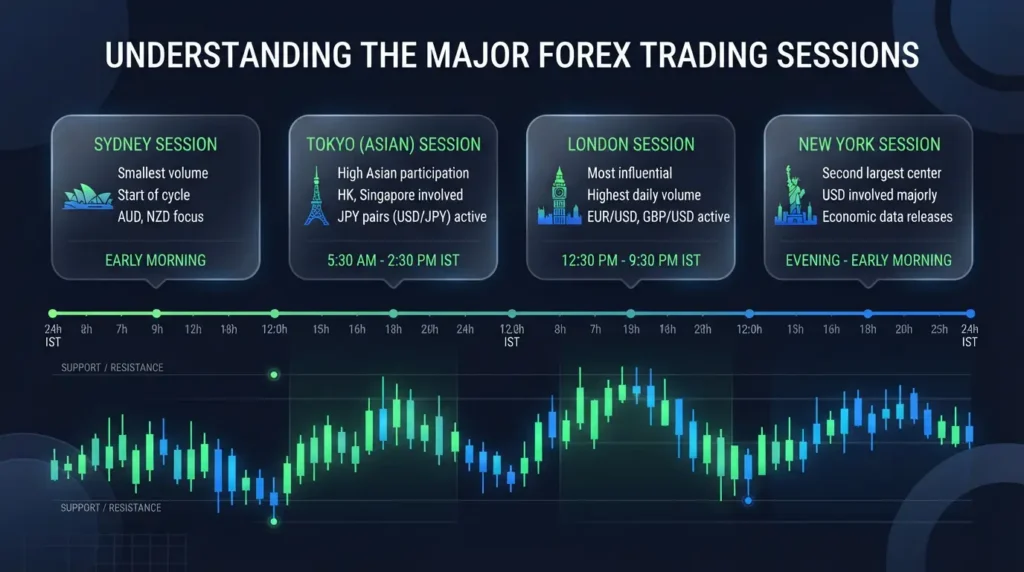
The Sydney Session
The Sydney session marks the start of the weekly forex trading cycle. It is the smallest of the four major sessions by trading volume, and currency pairs involving the Australian dollar (AUD) and New Zealand dollar (NZD) tend to be most active during this window. For traders in India, the Sydney session opens in the early hours of the morning, which makes it a less practical choice for most retail participants.
The Tokyo (Asian) Session
The Asian session forex time in India runs from 5:30 AM to 2:30 PM IST. During this session, Japanese yen pairs — particularly USD/JPY — tend to see the highest activity. The Tokyo session also involves significant participation from other Asian financial centres, including Hong Kong and Singapore. Traders focusing on yen-denominated currency pairs may find this session relevant to their strategy.
The London Session
The London session is considered the most influential single trading session in the global forex market. As the largest forex trading centre in the world, London handles a substantial share of daily global trading volume. London session forex time in India runs from 12:30 PM to 9:30 PM IST during summer time, or from 1:30 PM to 10:30 PM IST during standard time. Major pairs such as EUR/USD and GBP/USD typically become more active as this session opens.
The New York Session
The New York session time in India begins in the evening and runs into the early hours of the following morning. New York is the second largest forex trading centre globally, and the US dollar is involved in the majority of currency pair transactions. The New York session is particularly significant for USD-denominated pairs and for economic data releases from the United States.
Session Overlaps: Why They Matter for Trading Volume
Session overlaps occur when two major regional markets are open simultaneously. These periods generally produce higher trading volume, tighter spreads, and greater liquidity — characteristics that are often relevant to traders managing entry and exit points.
Tokyo–London Overlap in IST
The Tokyo–London overlap in IST is relatively brief. During standard time, it lasts approximately from 1:30 PM to 2:30 PM IST. During the summer schedule, it shifts slightly to around 12:30 PM to 2:30 PM IST. This overlap can see moderate activity in currency pairs involving both Asian and European currencies.
London–New York Overlap in IST
The London and New York sessions overlap during the afternoon and early evening in IST. During the summer schedule, this window runs from approximately 5:30 PM to 9:30 PM IST. During standard time, it runs from approximately 6:30 PM to 10:30 PM IST. The London–New York overlap is generally considered the most active trading period for major currency pairs such as EUR/USD, GBP/USD, and USD/JPY, because European and North American markets are simultaneously active. Trading volume during this overlap is typically the highest of the trading day.
Indian Exchange Trading Hours: NSE Currency Derivatives
Global forex session hours are distinct from the trading hours available to Indian residents through regulated domestic exchanges. Currency trading in India through exchange-traded currency derivatives is conducted primarily on the National Stock Exchange (NSE), under the regulatory oversight of the Securities and Exchange Board of India (SEBI) and within the framework set by the Reserve Bank of India (RBI).
NSE Trading Hours for Currency Derivatives
| Contract Type | NSE Trading Hours (IST) |
| INR pairs: USD/INR, EUR/INR, GBP/INR, JPY/INR | 9:00 AM – 5:00 PM |
| Cross-currency contracts: EUR/USD, GBP/USD, USD/JPY | 9:00 AM – 7:30 PM |
Exchange-traded currency derivatives in India allow retail participants to access currency markets within a regulated, transparent framework. For a broader understanding of how currency contracts work and what they involve, a beginner’s guide to forex trading covers the foundational concepts in detail.
What is The Best Time to Trade Forex in India?
The suitable time to trade forex in India varies depending on the currency pair being traded and the trader’s overall approach. There is no single best forex trading time that applies universally — understanding session timings and overlap windows helps traders identify periods of higher activity for the pairs they follow.
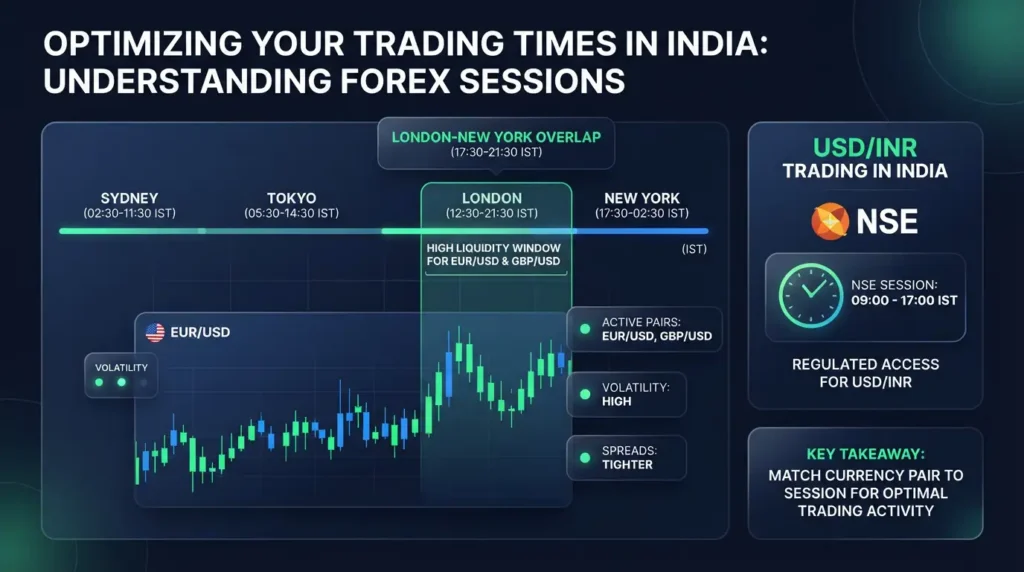
- For major currency pairs such as EUR/USD and GBP/USD, the London–New York overlap is generally the most liquid window. In IST, this falls between approximately 5:30 PM and 9:30 PM during summer time, or 6:30 PM and 10:30 PM during standard time.
- For traders interested in trading the USD/INR pair, the NSE session from 9:00 AM to 5:00 PM IST is the regulated channel for accessing this currency pair through exchange-traded derivatives.
- Traders monitoring AUD or NZD pairs may find the Sydney session more relevant, while USD/JPY activity tends to be stronger during the Tokyo and New York sessions. Understanding which currency pairs align with which sessions is part of developing a structured trading approach. The best currency pairs for beginners resource explains the differences in liquidity, volatility, and spreads across commonly traded pairs.
Forex Trading Time in India: Practical Considerations
India Does Not Observe Daylight Saving Time
A key point for forex traders in India is that IST remains fixed at UTC+5:30 throughout the year. When the United Kingdom moves to British Summer Time (BST, UTC+1) or the United States shifts to Eastern Daylight Time (EDT, UTC-4), the London and New York session opening and closing times in IST shift by one hour. Traders using a forex time zone converter should verify whether DST is currently in effect in the relevant markets, as forex calendars may display different times depending on the season.
Session Timings Are Approximate
The forex market does not operate through a single central exchange with fixed opening and closing bells. Session timings represent the business hours of major financial centres, and activity levels shift gradually rather than switching on and off at precise moments. For this reason, session times should be treated as broad windows rather than exact boundaries.
Risk Awareness Around Session Changes
Higher trading volume during session overlaps can also mean faster price movement and wider short-term fluctuations. Beginners should be aware that increased liquidity does not eliminate risk — currency prices can move sharply around major economic announcements, which are often scheduled during active session hours. Past performance does not guarantee future results, and losses may exceed initial expectations when trading leveraged instruments.
For traders looking to develop a structured approach to managing sessions, beginner forex strategies outline simple frameworks that address timing and risk awareness without requiring advanced market knowledge.
FAQs on Forex Market Hours in India
What time does the forex market open today in India?
The forex market is considered open 24 hours a day from Sunday evening through Friday evening, so there is no single daily opening moment for the global market. In practice, the most relevant opening for Indian traders is the London session, which begins at 12:30 PM IST during summer time or 1:30 PM IST during standard time, as this marks the shift into the most active part of the global trading day.
Is the forex market open on weekends in India?
The global forex market remains open from Sunday evening to Friday evening and is closed during the weekend. For Indian exchange-traded currency derivatives on the NSE, trading follows exchange hours from Monday to Friday only. Weekend gaps — price differences between Friday’s close and Sunday’s open — are a feature of the market that traders should be aware of.
What is the closing time in India for the New York session?
The New York session closes at approximately 3:30 AM IST during standard time and at approximately 2:30 AM IST when the United States is observing daylight saving time. This marks the end of the global trading day before the Sydney session re-opens the following cycle.
How does the forex market operate 24 hours without a central exchange?
The global forex market operates within a network of banks, institutions, and electronic trading platforms spread across different time zones. Because financial centres in Sydney, Tokyo, London, and New York overlap sequentially, trading activity continues around the clock from Monday through Friday without any single exchange needing to remain open continuously. This decentralised structure is what allows the forex market to function as a 24-hour market.
Can traders in India access all four global forex sessions?
Traders in India can technically monitor and participate in all four global sessions when trading through international brokers that offer over-the-counter (OTC) forex access, subject to applicable regulations. For exchange-traded currency derivatives on the NSE, trading is available only during NSE hours. Knowledge of forex market timings across all four sessions remains useful regardless of which access route a trader uses, as session activity patterns influence price behaviour in INR pairs as well as cross-currency contracts.
Does daylight saving time affect forex market timings in India?
India does not observe daylight saving time, so IST stays fixed at UTC+5:30 throughout the year. However, because London and New York do shift their clocks seasonally, the IST equivalent of their session open and close times changes by one hour between standard and summer schedules. Traders should use a forex time zone converter and check whether DST is currently active in those regions when planning around session timings.