Gold Trading Strategies: Trend, Breakout, Range, Scalping, Swing Setups

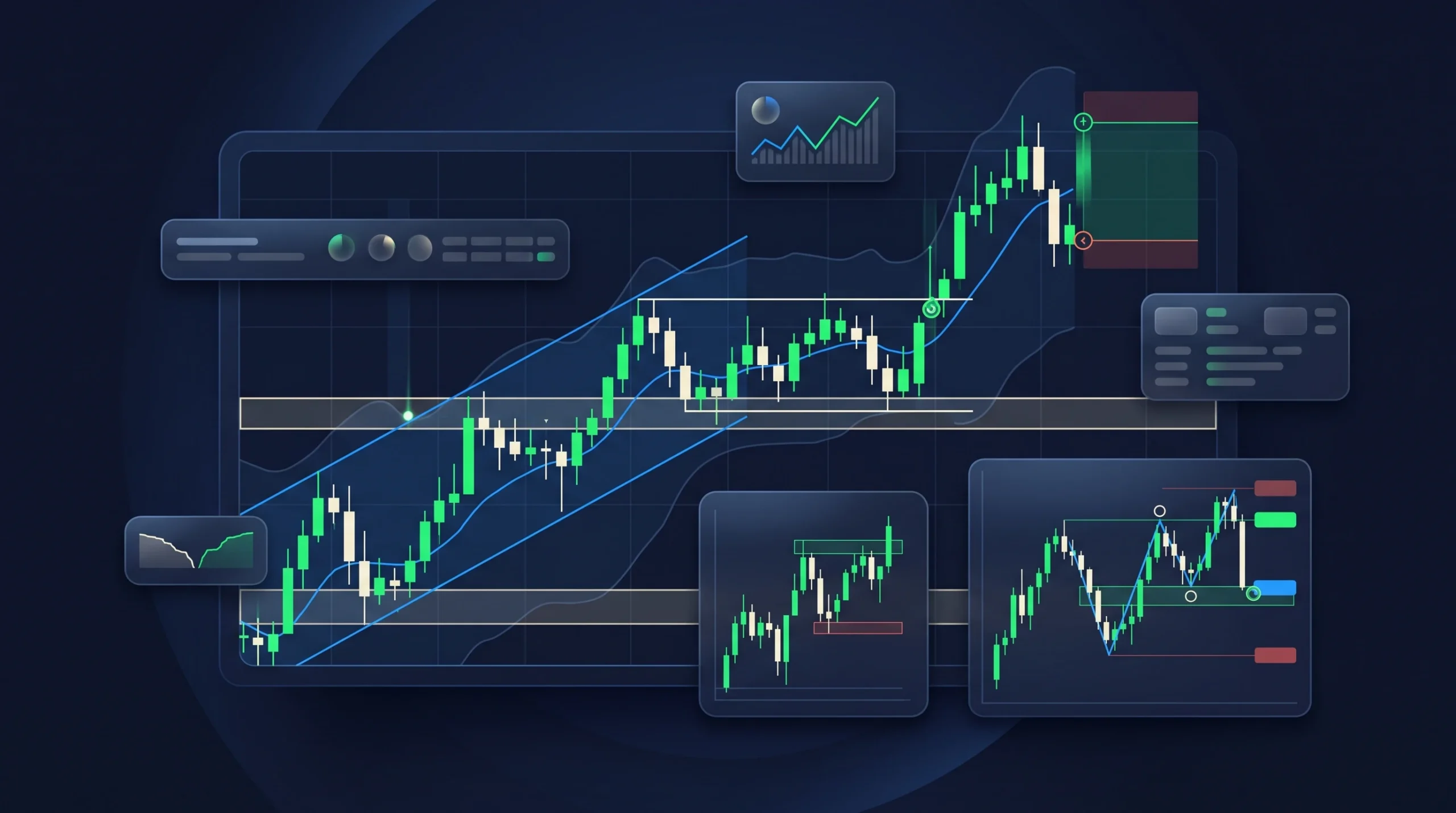
Gold can offer opportunities across several timeframes, but no setup works in every condition. Trend methods may suit sustained movement, while range methods may be more useful when price rotates between established boundaries.
This guide covers spot gold, CFDs, and gold futures. Trading is a high-risk activity, particularly when leverage, margin, spreads, swaps, commissions, or fast execution are involved. Before deciding whether to buy or sell, identify structure, define invalidation, and limit exposure.
Gold Trading Strategy Foundations
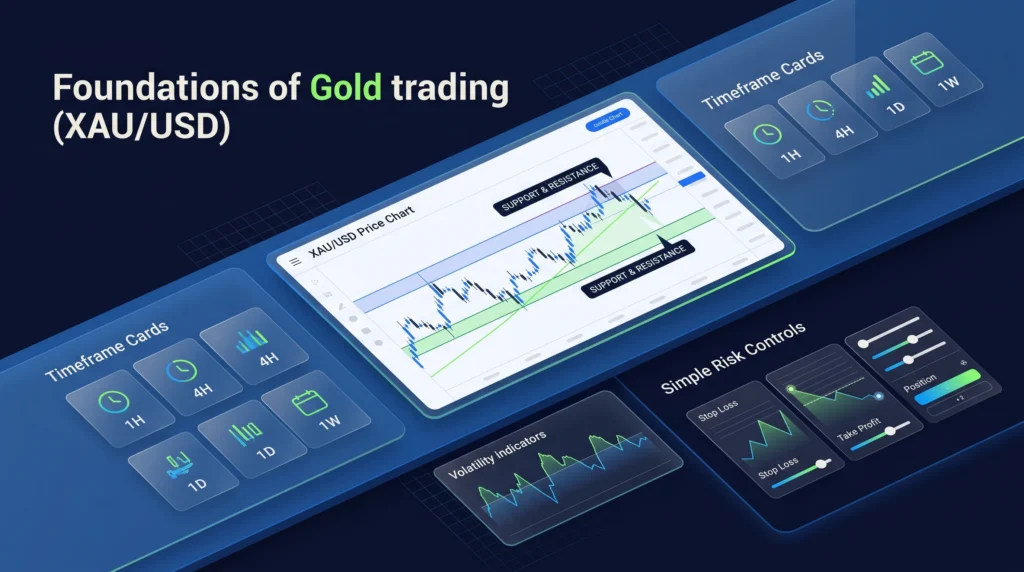
A sound approach begins with context. Determine whether the market is trending, ranging, compressing, or reacting to scheduled news before applying indicators.
XAU/USD Market Characteristics
XAU/USD represents gold priced in US dollars. It may react to interest-rate expectations, real yields, currency strength, inflation concerns, geopolitical risk, and defensive demand. Gold is highly sensitive to changing expectations, so movement can accelerate around major economic releases.
Spot gold trades over the counter, futures trade on exchanges, and CFDs offer broker-based exposure. Each has different contract sizes, margin requirements, costs, and execution conditions. New traders may benefit from reviewing how to trade gold for beginners before selecting a market.
Price Action, Volatility, Liquidity
Gold is volatile, but activity is not constant. Liquidity and spreads can change by session or around major events. Strong closes near candle extremes may indicate commitment, while long wicks near a key level may suggest rejection.
A guide to candlestick patterns for gold trading can support analysis, but patterns should be read within broader structure rather than treated as automatic signals.
Support, Resistance, Supply, Demand
Support and resistance levels mark areas where price previously reacted, consolidated, or reversed. Supply and demand zones cover broader regions where order imbalance may have formed.
Useful references include:
- Previous daily high and low
- Recent swing high or low
- Weekly opening price
- Consolidation boundaries
- Prior breakout or rejection zone
These areas are not guaranteed turning points. A level becomes more useful when it aligns with higher timeframe structure, visible liquidity, or repeated price reaction.
Trading Style, Time Commitment, Risk Tolerance
Your holding period should match your schedule. Scalping requires close attention, while swing trading allows more planning but adds overnight and financing risk.
| Trading style | Typical chart focus | Main advantage | Main risk |
| Scalping | 1-minute to 5-minute | Frequent short setups | Costs and execution pressure |
| Day trading | 5-minute to 1-hour | No planned overnight exposure | Noise and overtrading |
| Swing trading | 4-hour to daily | More analysis time | Overnight and weekend risk |
| Position trading | Daily to weekly | Captures broader themes | Larger drawdowns |
Choose a method you can follow consistently. Complexity is not useful if it conflicts with your time, experience, or risk tolerance.
Gold Trend Following Strategy
A trend-following strategy seeks to trade in the direction of the dominant move. It works best when structure remains clear and pullbacks are controlled.
Trend Identification Across Multiple Timeframes
Use a higher timeframe, such as daily or four-hour, to define the direction of the trend. Then use a lower chart to plan execution. A practical sequence is daily for context, four-hour for structure, and one-hour or fifteen-minute for entry.
Higher highs and higher lows may indicate a bullish structure. Lower highs and lower lows may suggest a bearish one. Temporary movement against that structure may be a retracement rather than a reversal.
Moving Average Crossover Signals
A faster moving average crossing above a slower one may indicate improving momentum. A bearish crossover may suggest weakening demand.
Crossovers lag price and often produce false signals in sideways markets. They are usually more useful as filters when combined with slope, price location, and market structure.
Price Action Confirmation
Price action confirmation may include a rejection candle, an engulfing pattern, a break of minor structure, or a close beyond a trigger level. Confirmation has greater value near an established area.
A practical sequence may be:
- Daily chart shows an uptrend.
- Price pulls back toward former resistance.
- Four-hour chart forms a higher low.
- Lower chart breaks above a recent swing.
- Entry follows confirmation.
- Stop sits beyond invalidation.
This process does not guarantee future results.
Pullback, Retracement, Continuation Entries
Pullback entries aim to join an existing move at a better price. Common areas include prior breakout zones, moving averages, Fibonacci retracements, and recent consolidation.
Do not assume every decline in a bullish market is a buying opportunity. Look for slowing selling pressure, renewed demand, and enough room before the next resistance level.
Trend Reversal Warning Signs
A trend may be weakening when price fails to make a new extreme, breaks a major swing point, or repeatedly closes against the previous direction. Failed continuation attempts and sudden volatility expansion may add evidence.
Do not confuse a normal retracement with a confirmed reversal. Define the price that invalidates your original view before entering.
Gold Breakout Trading Strategy
A breakout strategy aims to capture expansion after price leaves a defined range or key level. False moves are common when liquidity is thin or confirmation is weak.
Tradable Breakout Structure
A tradable breakout usually begins with a visible boundary, price compression, and a decisive close beyond the level. A strong move may show a broad candle, limited rejection, and follow-through.
A weak move may cross the boundary briefly and close back inside. The clearer the structure, the easier it is to define entry, stop-loss, and target.
Opening Range Breakout Setup
An opening range is formed during the early part of a trading session. Traders mark its high and low, then monitor a confirmed break.
Entry may occur after the breakout candle closes or after price retests the boundary. The chosen range should match broker time and session conditions, especially during London and New York activity.
Support, Resistance, Consolidation Breakouts
Consolidation breakouts occur when price exits a narrow area after repeated tests. The setup is stronger when the boundary is visible across more than one timeframe and there is room before the next obstacle.
A breakout directly into major supply or support may offer limited reward. Compare the entry with the next logical target before placing the trade.
Bollinger Bands Squeeze Signals
A Bollinger Bands squeeze may indicate reduced volatility and possible expansion. It does not predict direction, and the first move can fail.
Use the squeeze as an alert rather than a complete trading system. A close outside the bands combined with a structural break may suggest momentum, depending on market conditions.
Breakout Confirmation With Volume, Momentum
Futures volume provides centralized data, while spot and CFD platforms may show tick volume. These measures are not identical.
Momentum confirmation may include a wide candle, strong close, rising range, or rapid follow-through. Entering after an oversized news candle can create poor risk-to-reward conditions.
False Breakout Filters, Retest Entries
False breakouts push beyond a level and return into the prior range. Traders may reduce weak entries by requiring a candle close, avoiding low-liquidity periods, checking higher timeframe barriers, and waiting for a retest.
When broken resistance holds as support and bullish price action follows, the retest may offer a more controlled entry than chasing the initial move.
Gold Range Trading Strategy
Range trading focuses on repeated movement between clear support and resistance. It is most suitable when directional momentum is limited and both boundaries have produced visible reactions.
Sideways Market Identification
A sideways market may show flat moving averages, overlapping candles, repeated failed breakouts, and similar swing highs or lows. Price often rotates toward the center after reaching an edge.
Check the economic calendar before using this approach. Gold often moves from quiet consolidation into rapid expansion when new information changes expectations.
Range High, Range Low, Midpoint Zones
The range high is a potential selling area, the range low is a potential buying area, and the midpoint is a decision zone. Entries near the middle usually provide less favorable reward relative to risk.
Wait for rejection or a failed breakout at an outer boundary rather than treating every touch as a signal.
Mean Reversion Entries, Exit Targets
Mean reversion assumes price may return toward an average after reaching an extreme. Oscillators may help identify stretched conditions, but overbought does not always mean sell and oversold does not always mean buy.
Define your exit strategy before entry. A conservative target may be the midpoint, while a wider target may be the opposite side of the range.
Gold Scalping Strategy
Scalping gold involves brief trades that seek small price movements. It requires disciplined execution because spreads, commissions, slippage, and rapid volatility can materially affect results.
One-Minute, Five-Minute Scalping Setups
One-minute charts provide more signals but contain substantial noise. Five-minute charts may offer cleaner structure and more decision time. Some traders use the five-minute chart for setup and the one-minute chart for execution.
A detailed XAU/USD scalping strategy can help you compare entry rules, indicators, and session timing before risking capital.
London–New York Session Overlap
The overlap between London and New York often attracts greater participation. Liquidity may improve, but volatility can rise around US data and the New York open.
Review trading costs before the session. A setup that appears effective before costs may perform poorly after spreads, commissions, and slippage.
Entry, Stop-Loss, Take-Profit Rules
Scalping requires precise rules. Entry should follow a defined trigger, not urgency. Stop distance should reflect current volatility, while the target should remain realistic relative to nearby structure.
Useful controls include:
- Pre-marked levels
- Maximum trades per session
- Daily loss limit
- Minimum reward-to-risk threshold
- News blackout period
Counter-trend scalping carries additional risk because it opposes the broader move. Smaller exposure and stronger confirmation may be appropriate.
Moving Averages, Momentum, Price Action Indicators
Short moving averages can show immediate direction, while momentum indicators may highlight acceleration or exhaustion. Price action remains important because indicators are based on previous data.
Avoid stacking multiple tools that measure the same condition. One trend filter, one momentum measure, and clearly marked levels may be sufficient.
Gold Swing Trading Strategy
Swing trading seeks movement over several sessions. It allows more analysis time but leaves positions exposed to overnight news, weekend gaps, and financing charges.
Daily Chart Trend Direction
Start with the daily chart. Mark the main trend, major support and resistance, and recent impulse moves. A bullish structure may favor buying pullbacks, while a bearish structure may favor selling rallies.
Do not enter solely because the chart looks directional. Wait for a setup with defined entry, stop, and target.
Swing High, Swing Low Identification
The four-hour chart helps identify a previous swing high, recent swing low, and intermediate structure. These points may reveal where momentum changed or liquidity accumulated.
A meaningful swing should be visually clear and followed by a decisive move. Minor fluctuations inside congestion may carry less significance.
Fibonacci Retracement Entry Zones
Fibonacci retracement levels are commonly used to estimate potential pullback zones. They should not be treated as guaranteed turning points.
A retracement may be more useful when it overlaps with prior structure, supply or demand, and price action confirmation.
Supply, Demand, Confluence-Based Entries
Confluence means several independent factors support the same idea. A daily uptrend, four-hour demand zone, former resistance, and bullish rejection candle may form a practical setup.
You can review how to swing trade gold when developing a repeatable analysis routine.
Swing Position Management, Exit Planning
Swing traders should account for swaps, weekend exposure, major economic events, and changing volatility. Partial profit-taking may reduce exposure, while a trailing stop may protect gains but also close a position too early.
Define your exit strategy before entry. Record invalidation, first target, final target, and conditions for adjusting the stop.
Gold Strategy Risk Management
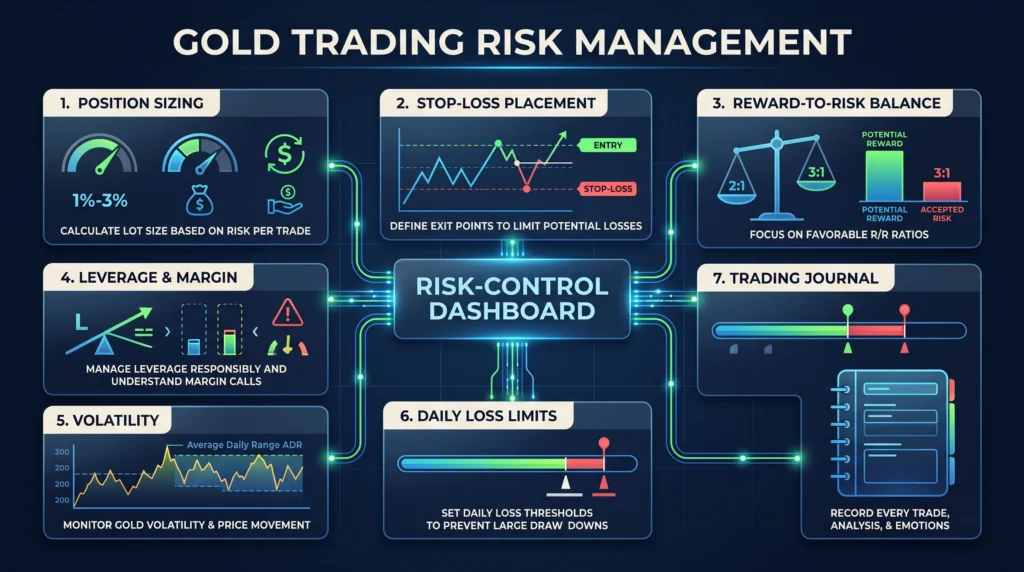
Risk management keeps a trading approach viable through losing sequences. Even the best gold trading idea can fail, so account exposure matters more than confidence.
Position Sizing for XAU/USD
Position size should reflect account equity, stop distance, and acceptable loss. Choose a fixed percentage or cash amount, then calculate the trade size that matches the stop.
Required Margin equals Trade Size divided by Leverage. Higher leverage reduces initial margin but does not reduce market risk.
Stop-Loss Placement by Setup Type
Stops should reflect the reason for the trade. A trend setup may use a recent structural low, a breakout setup may use the retest zone, and a range setup may use the area beyond the boundary.
Stops placed too close may be hit by normal volatility. Stops placed too far may create excessive loss.
Risk-to-Reward Ratio Guidelines
Risk-to-reward compares potential loss with potential gain. A favorable ratio does not make a weak setup effective, and a lower ratio does not automatically make a trade unsuitable.
Base targets on realistic structure, volatility, and transaction costs rather than a fixed multiple alone.
Economic Calendar, News Event Risk
Gold can react sharply to central-bank decisions, inflation data, employment reports, and geopolitical events. Spreads may widen, liquidity may change, and execution may deteriorate.
Traders should consider reducing size, closing positions, or avoiding new entries around major releases. News trading may create opportunities, but it also increases gap and slippage risk.
Overtrading, Leverage, Emotional Control
Overtrading often follows boredom, frustration, or attempts to recover losses. Leverage can amplify the damage by making large exposure easy to obtain.
Set a daily loss limit, a maximum number of trades, and a mandatory pause after a rule violation. The objective is not to start trading more often, but to select only qualified setups.
Trading Journal, Practice Drill, Performance Review
A journal should record setup type, market condition, entry reason, stop, target, result, trading costs, and execution notes. Screenshots can reveal whether you followed the plan.
Review performance by strategy, session, and market environment. Practice on historical charts or a demo account before trading live, while recognizing that simulated execution may differ from real conditions.
Gold Trading Strategies FAQ
Which Gold Trading Strategy Works Best?
The best gold trading strategy depends on market conditions, experience, available time, transaction costs, and risk tolerance. Trend methods may suit sustained directional movement, range setups may fit balanced markets, and scalping may appeal to experienced traders who can monitor execution closely. No approach works consistently in every environment, so testing and risk control remain essential.
Is Trend Trading Better Than Range Trading for Gold?
Neither method is always better. Trend trading may be more effective when gold produces sustained higher highs and higher lows or persistent lower highs and lower lows. Range trading may be more suitable when price respects clear boundaries. The key is to identify current structure and avoid applying a range method during strong expansion.
How Can Traders Confirm Gold Breakouts?
Traders may confirm a breakout by waiting for a candle close beyond a clear level, checking momentum, reviewing nearby higher timeframe barriers, and observing whether price holds the level on a retest. Confirmation may reduce some false signals but cannot eliminate them. Position sizing and stop placement remain necessary.
Which Timeframe Works Best for Gold Scalping?
Many scalpers use one-minute or five-minute charts, often with a higher timeframe for context. The five-minute chart may provide cleaner signals, while the one-minute chart offers more precise entries but greater noise. The most suitable choice depends on spreads, execution quality, trading hours, and your ability to make rapid decisions.
Is Swing Trading Gold Suitable for Beginners?
Swing trading may suit beginners who prefer more time for analysis, but it still involves meaningful risk. Positions can be affected by overnight news, weekend gaps, swaps, and changing volatility. Beginners should use small exposure, practice identifying structure, and define entry, stop, target, and maximum account risk before trading live.