
Forex Trading Strategies: Simple Approaches for Beginner Traders


Forex trading strategies are structured frameworks that traders use to interpret price movement in the forex market introduction and currency pairs more broadly. For newcomers, simple approaches are often explored first because they involve fewer variables and clearer logic.
It is worth noting from the outset that a strategy is a lens for analysing market behaviour, not a guaranteed method of achieving profit, and outcomes in the foreign exchange market can vary significantly between traders and time periods.
Key Takeaways
- Forex strategies differ according to market conditions, chosen timeframe, and analytical approach (technical or fundamental).
- Trend trading is generally associated with sustained directional price movement over a period of time.
- Range trading is often linked to sideways markets and recurring levels of support and resistance.
- Breakout trading concepts focus on the transition from consolidation into a new directional phase.
- Price action trading places emphasis on candles and market structure rather than indicators alone.
- Simplicity does not remove market risk or promise consistent results; past performance does not guarantee future outcomes.
What Is Forex Trading Strategy?
A forex trading strategy can be described as a conceptual framework that helps a forex trader organise how price, volatility, and market trend are interpreted within the currency market. Strategies typically differ in the timeframe they consider, the type of analysis they rely on, and the market conditions they are commonly associated with, rather than offering a single fixed formula for entry and exit.
Role of Strategy in Forex Trading
A strategy provides structure for analysing a currency pair without functioning as a specific set of trading instructions. In simple terms, it is often understood as a way of organising observations about price movement, market liquidity, and volatility into a repeatable process of analysis, which some traders may use to build a broader plan over time.
Short-Term and Long-Term Approaches
Trading style is often categorised by the trading day and holding period involved. Scalp-based approaches look at very short intervals within a single session, while day trade methods close positions before the day ends. Swing trading typically spans several days, and position trading extends over weeks or months, reflecting a longer-term view of market trend and macroeconomics.
| Trading Style | Typical Holding Period | Common Focus |
| Scalping | Seconds to minutes | Short-term price movement |
| Day Trading | Within a single trading day | Intraday volatility |
| Swing Trading | Several days to weeks | Medium-term trend |
| Position Trading | Weeks to months | Macroeconomic themes |
Technical and Fundamental Approaches
Analysis in the forex market is often separated into two broad categories. Technical analysis for currencies examines historical price data, moving average patterns, and oscillators such as the relative strength index. By contrast, the fundamental drivers of currencies relate to interest rate decisions, inflation data, and broader economic releases that may influence an exchange rate over time.
Simple Forex Strategies for Beginners

This section introduces several commonly discussed forex strategies and describes their general characteristics rather than specific setups. Each approach reflects a different way of interpreting price action, market trend, or consolidation, and none of them is presented as a guaranteed path to a particular outcome.
Trend Trading
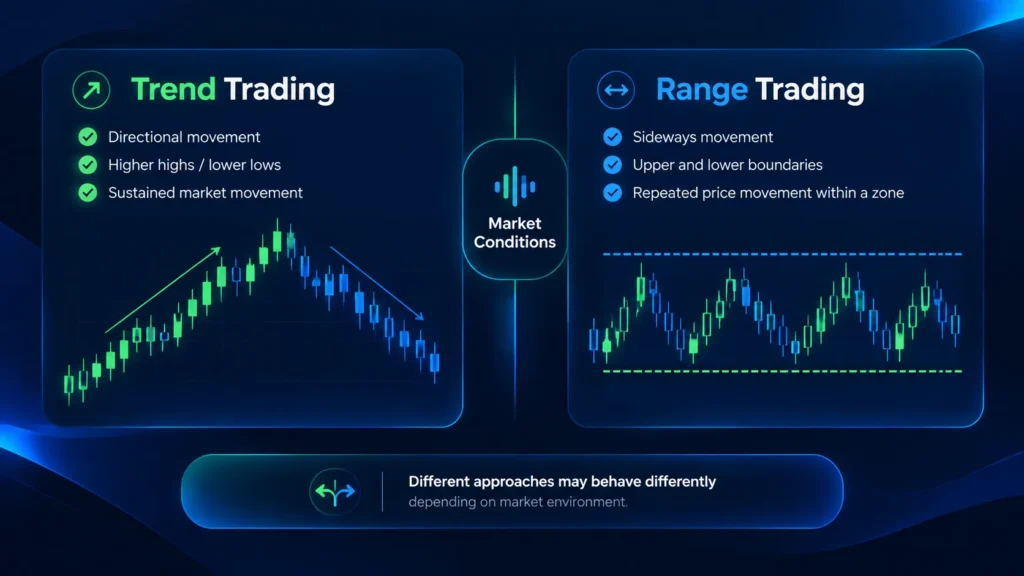
Trend trading is generally associated with the idea that a currency pair may continue moving in a prevailing direction for a period of time. This approach is often linked to concepts like momentum and moving average alignment, where sustained price movement in one direction is interpreted as reflecting broader market sentiment or ongoing economic themes.
Range Trading
Range trading is commonly discussed in the context of sideways markets, where price is seen to oscillate between recognisable areas of support and resistance. This style is often associated with lower volatility conditions and can be contrasted with trending environments, where price structure behaves quite differently.
Breakout Trading
Breakout trading concepts describe situations where price moves beyond a previously established range or consolidation zone. Such transitions can attract trading volume and market attention, and are sometimes interpreted as an early indication that a new directional phase may be developing, although outcomes following a breakout can vary considerably.
Moving Average Strategies
Moving averages are widely used in technical analysis to smooth historical price data and highlight the general direction of a market trend. A moving average crossover, where a shorter average moves relative to a longer one, is often cited as one way analysts describe potential shifts in trend, though this remains a descriptive rather than predictive tool.
Price Action Trading
Price action trading refers to an approach where a trader analyses candles, chart patterns, and general market structure directly, with less reliance on secondary indicators such as MACD or stochastic oscillators. This method is often associated with a more discretionary style of trading and requires interpreting price behaviour within its broader context.
Choosing Forex Strategy Type
Several factors are commonly discussed when comparing different types of forex strategies. These considerations relate to personal circumstances and market behaviour rather than a fixed rule for selecting one approach over another.
- Available time during the trading session and preferred pace of decision-making
- Comfort with short-term volatility versus longer-term macroeconomic themes
- Familiarity with technical analysis tools compared with fundamental analysis
- Tolerance for periods of uncertainty or unclear market direction
- Interest in simple frameworks versus more complex, multi-indicator systems
Trading Time Horizon
The amount of time a person can dedicate to monitoring a currency pair is often connected to which trading style feels more practical. Shorter timeframes associated with scalping or day trading generally require closer attention during a session, while swing and position trading are more commonly associated with periodic review.
Market Conditions
Forex strategies can behave differently depending on whether the forex market is trending, ranging, highly volatile, or relatively quiet. A strategy that is often discussed in relation to trending conditions may produce different signals during consolidation, which is one reason analysts frequently describe strategy performance as condition-dependent rather than fixed.
Strategy Complexity
Simple frameworks are sometimes preferred by beginner traders because they involve fewer variables and can be easier to follow conceptually. More complex systems, which may combine multiple indicators or timeframes, are often associated with a steeper learning curve, though complexity itself does not necessarily correspond to a different level of reliability.
Benefits and Limitations of Simple Strategies
A balanced view of simple strategies generally weighs their accessibility against their inherent limitations, since neither simplicity nor complexity removes the underlying uncertainty of the forex market.
Advantages of Simple Approaches
- Easier to understand for someone new to currency trading
- Fewer conflicting signals compared with multi-indicator systems
- Clearer logic that can support consistent record-keeping and review
- Reduced analytical workload during a trading session
Common Limitations
- False signals can occur in any market condition, including trending and ranging environments
- Strategies may perform differently as market conditions shift over time
- Historical patterns do not guarantee similar price movement in the future
- Simplicity does not reduce exposure to volatility or market risk
Importance of Risk Awareness
Leverage is commonly described as a mechanism that allows exposure to a larger position size relative to the capital deposited, which can magnify both gains and losses. According to data published by the European Securities and Markets Authority, a majority of retail investor accounts have historically recorded losses when trading leveraged products such as contracts for difference, illustrating why risk awareness is generally considered a core part of learning about the forex market.
Risk management in forex trading is often described in educational contexts as a way of understanding exposure rather than as a guaranteed method of limiting losses, and past performance does not guarantee future results.
Common Beginner Mistakes
New forex traders are often described as encountering a similar set of conceptual and behavioural challenges when first exploring different strategies.
Overcomplicating Strategy
Adding numerous indicators to a single chart can create conflicting signals rather than added clarity. This is sometimes described as analysis overload, where the volume of information reviewed does not necessarily improve the quality of interpretation applied to a given currency pair.
Ignoring Market Context
The same strategy may be interpreted differently depending on whether the broader market is trending, ranging, or reacting to a significant news event. Overlooking this context is often cited as a reason why a previously observed pattern may not repeat under different market conditions.
Expecting Consistent Results
Historical performance or a strategy’s theoretical logic is frequently misunderstood as a promise of future outcomes. Analysts commonly note that market conditions, volatility, and macroeconomic factors are constantly evolving, meaning consistent results are not something any forex strategy can guarantee.
FAQ
What Is the Simplest Forex Strategy for Beginners?
Simplicity is somewhat subjective and depends on a trader’s background and comfort with technical analysis. Approaches built around a single moving average or a defined range are commonly cited as accessible starting points for learning about forex trading strategies, though “simple” does not imply reduced market risk.
Which Forex Strategy Is Best for Beginners?
There is no universally best forex strategy, since suitability often depends on market conditions, available time, and individual circumstances. Some traders may find trend trading more intuitive, while others may relate more closely to range trading or price action, depending on their trading style.
Is Forex Trading Profitable for Beginners?
Profitability in forex trading is uncertain and can vary widely between individuals and time periods. Market risk, volatility, and leverage all contribute to a wide range of possible outcomes, and industry data generally shows that a large proportion of retail accounts experience losses rather than consistent gains.
How Many Forex Strategies Should Beginners Learn?
Studying too many strategies at once is often associated with confusion and conflicting analysis. Many educational resources suggest that focusing on a small number of approaches may support clearer understanding, though this remains a general observation rather than a specific recommendation.
What Is the Difference Between Trend and Range Trading?
Trend trading is generally associated with sustained directional price movement, while range trading is linked to price oscillating between defined support and resistance levels in a sideways market. These two approaches reflect different assumptions about market trend and are often discussed as contrasting ways of interpreting the same underlying price data.