Gold Margin Requirements Explained for Beginners


Gold margin requirements are funds you must have available to open and maintain a leveraged position linked to gold. In exchange-traded markets, this usually refers to gold futures rather than purchasing bullion outright. You are not paying the total value of the contract at the outset. Instead, you post collateral that supports your obligations while daily gains and losses flow through your trading account.
This arrangement provides efficient market access, but it also increases risk. A relatively small amount of capital can control large positions, so even an ordinary price movement may create a meaningful change in your account balance. Before you trade futures, you should know which margin figure applies, who can change it, and what happens if your available funds fall too low.
Gold futures are standardized contracts traded through a futures exchange. CME Group lists several contract sizes, including benchmark Gold representing 100 troy ounces and Micro Gold representing 10 troy ounces. Contract specifications, current values and margin requirements should always be verified before placing an order because product terms and risk parameters can change.
Gold Margin Types Explained
A futures broker may display several margin figures for the same market. They serve different purposes, and confusing them can lead to an underfunded account or unexpected liquidation.
| Margin type | Main purpose | When it matters |
| Initial margin | Opens a new position | Before order acceptance |
| Maintenance margin | Keeps an existing position open | After losses reduce account equity |
| Intraday margin | Supports eligible same-day trading | During broker-defined hours |
| Overnight margin | Covers positions held beyond session cutoff | Near daily close and through next session |
Initial Margin
Initial margin is the deposit normally required to establish a position. It is not a down payment on physical gold and does not represent partial ownership of bullion. In futures margin trading, it acts as collateral against potential losses. CME describes exchange margin as a performance bond designed to support market obligations.
The initial margin requirement may be quoted as a fixed dollar amount per contract rather than a permanent percentage. Your futures broker may require more than the exchange minimum based on account type, concentration, market conditions, or internal risk controls.
Maintenance Margin
Maintenance margin is minimum equity generally required to continue holding an open futures position. If losses push your account below the maintenance margin level, the broker may ask you to restore funds, reduce exposure, or close the trade.
The maintenance margin requirement is usually lower than initial margin, but that difference is not spare risk capital. It is a threshold used in ongoing position management. CME defines maintenance margin as the minimum amount that must be maintained over time.
Intraday Margin
Some brokers offer reduced intraday margin for positions opened and closed within approved hours. This can lower the cash needed to open a position, but it does not reduce underlying price exposure.
Intraday terms are set by the broker and may change without matching an exchange update. If a position remains open near the broker’s cutoff, the higher overnight amount may apply immediately. Beginners should confirm the deadline, liquidation policy, and available cash before relying on reduced day-trading terms.
How Gold Futures Margin Works
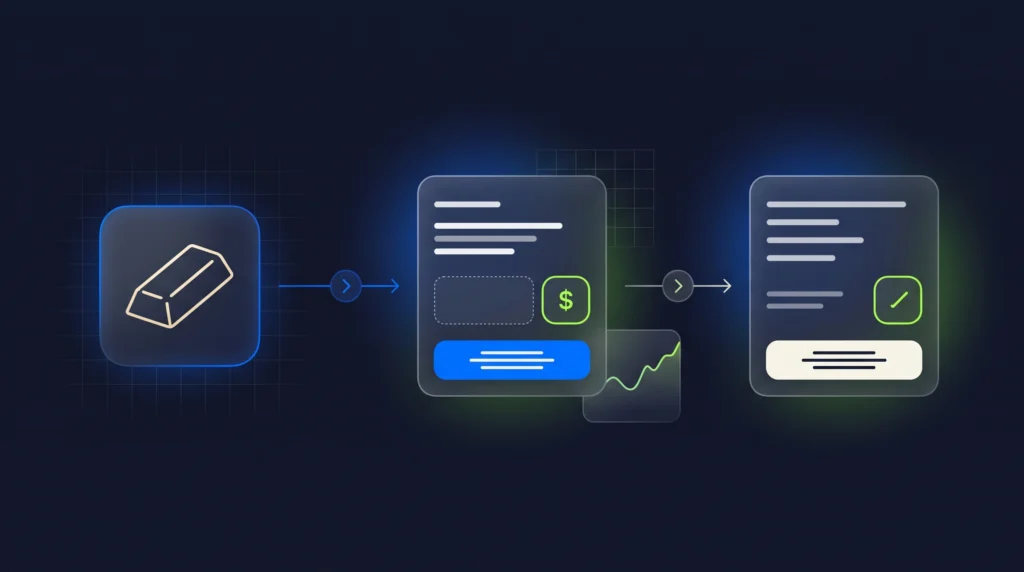
Gold futures connect a standardized derivative with a margin account. The exchange defines the contract, the clearing process supports performance between buyer and seller, and the broker controls customer access and account-level requirements.
Margin Deposit and Position Opening
To open a futures position, you select a contract month, order direction, quantity, and order type. The trading platform checks whether your available funds satisfy the margin required for the proposed exposure.
A long position may gain when gold rises and lose when it falls. A short position has the opposite directional exposure. Collateral is required on both sides because either participant can incur losses. The good-faith deposit supports the obligation; it does not cap possible loss.
Readers new to the market may benefit from reviewing how to trade gold for beginners before choosing between physical gold, exchange-traded derivatives, and broker-provided products.
Daily Mark-to-Market Process
Futures accounts are adjusted through mark-to-market. The futures exchange establishes a daily settlement price, and the change in value of the futures position is credited or debited to the account.
This means losses are not postponed until the contract expires. A losing trading day can reduce available equity immediately, while a profitable day may increase it. CME educational material explains that futures markets use official daily settlement prices for this process.
Account Equity Changes
Your usable equity changes with realized results, unrealized movements, deposits, withdrawals, commissions, and other applicable charges. Broker platforms may also distinguish cash, net liquidation value, excess margin, and funds available for new trades.
Pay attention to the field your broker actually uses for risk checks. A positive account balance does not automatically mean you have enough excess funds to add another contract or withstand a sharp adverse move.
Overnight Position Requirements
Holding a trade beyond an intraday cutoff normally requires the full overnight amount. The broker may calculate this before the exchange session formally ends, so platform rules matter as much as the market timetable.
Overnight positions face price-gap risk, changing liquidity, and news released while you are not actively monitoring the market. Keep a wider cash buffer when you plan to hold through major announcements or periods of elevated market volatility.
Gold Margin Calculation
No single formula produces every broker’s final requirement. A useful starting point is the contract’s notional exposure, followed by the exchange rate, broker add-ons, and number of contracts.
Gold Contract Size
Contract size tells you how much gold one contract represents. Benchmark COMEX Gold futures use 100 troy ounces, while Micro Gold uses 10 troy ounces. Smaller contracts create smaller dollar changes for the same move in gold, although they remain leveraged instruments.
Contract selection should come before margin selection. Review gold lot size explained to see why product size affects exposure, profit and loss, and risk limits.
Gold Price and Notional Value
Notional value measures market exposure represented by one contract.
Notional Value = Gold Price per Ounce x Contract Ounces
If gold is priced at $2,400 per ounce, a 100-ounce contract has a hypothetical notional value of $240,000. A 10-ounce contract represents $24,000. These figures are examples only and are not current price quotations.
Margin Percentage
An approximate percentage can be found by comparing required collateral with notional exposure.
Approximate Margin Percentage = Margin Required / Notional Value x 100
Suppose a hypothetical contract worth $240,000 requires $14,400 in initial margin. The approximate rate is 6%. In practice, the exchange and broker usually publish a dollar requirement, and the implied percentage changes as gold prices move.
Contract Quantity
Required collateral normally scales with quantity. If one contract requires $14,400, two identical contracts may require about $28,800 before broker add-ons or portfolio offsets.
Required Margin = Margin per Contract x Contract Quantity
Do not treat this simple multiplication as a complete risk model. Two contracts also double the dollar effect of each price move. Position size should be based on planned loss tolerance, not merely the maximum quantity your platform permits.
Broker Margin Requirements
Exchange minimums are only one layer. A futures broker may apply higher house requirements, especially during volatile conditions, before holidays, near contract expiration, or for concentrated positions.
Compare brokers using practical criteria:
- Initial, maintenance, intraday, and overnight policies
- Automatic liquidation procedures
- Commissions, data fees, and exchange charges
- Platform controls and real-time risk alerts
- Support availability during fast markets
- Treatment of expiring or deliverable contracts
The lowest advertised margin level is not automatically the safest or cheapest choice. Reduced collateral increases effective leverage and leaves less room for ordinary price movement.
Beginner Gold Margin Calculation Example
The following examples use invented prices and margin figures. They demonstrate mechanics, not current trading conditions or investment advice.
Standard Gold Futures Example
Assume gold trades at $2,400 per ounce and a standard gold futures contract represents 100 ounces.
Total Value of the Contract = $2,400 x 100 = $240,000
If initial margin is hypothetically $14,400, the trader controls $240,000 of market exposure with 6% collateral. This leverage may create potential profits, but it also magnifies losses relative to the deposited amount.
Micro Gold Futures Example
At the same hypothetical gold price, a 10-ounce Micro Gold contract has notional exposure of $24,000.
If its initial requirement is $1,440, the implied percentage is also 6%. The smaller contract reduces the dollar impact of each price change by nine-tenths compared with the 100-ounce contract, assuming otherwise comparable exposure.
For a broader explanation of amplified exposure, see how leverage works in gold trading.
Initial Margin Calculation
Imagine your broker requires $1,440 to open one Micro Gold position. You deposit $4,000 into the margin account and open one contract.
After the order, the required amount is committed to supporting the position, but remaining funds are not a guaranteed loss buffer. Commissions, slippage, and daily price changes can reduce excess equity. A cautious trader plans risk from the contract’s dollar movement, not from unused cash shown immediately after entry.
Maintenance Margin Calculation
Suppose the hypothetical maintenance level is $1,300. If account equity allocated to the position falls below that threshold, the account may become deficient.
The broker might require restoration to the initial level rather than merely back to $1,300. Exact procedures differ, so read the account agreement prior to trading futures and verify whether deposits must clear before they count toward available funds.
Profit and Loss Impact
For a 10-ounce contract, a $20 move in gold changes contract value by $200.
Profit or Loss = Gold Price Change x Contract Ounces
A $20 favorable move creates a $200 gain before costs; a $20 adverse move creates a $200 loss. Five such adverse moves would equal $1,000, which is substantial compared with a $1,440 deposit. Leverage does not cause the market move, but it makes the account-level effect more concentrated.
Factors Affecting Gold Margin Requirements
Gold margin is dynamic. Even when your position stays the same, the amount demanded by the exchange or broker may change as risk conditions evolve.
Gold Market Volatility
Higher volatility generally increases the range of plausible short-term losses. Exchanges and brokers may respond by increasing collateral requirements to strengthen protection against adverse moves.
A higher requirement may indicate greater measured risk, not a prediction that gold must fall. Volatility can affect both long and short positions, and sudden reversals can occur in either direction.
Exchange Margin Updates
A commodity exchange reviews risk and may revise requirements as market conditions change. CME notes that performance bonds vary by product and volatility.
Updates can affect new and existing positions. Check official product pages and broker notices rather than relying on an old article, screenshot, or calculator result.
Broker Risk Policies
Brokers can impose requirements above exchange minimums. They may also increase house levels faster than expected when liquidity deteriorates or a customer holds concentrated exposure.
Your broker comparison should examine how changes are communicated and how quickly customers must respond. A platform with clear alerts and transparent liquidation rules may be more useful than one advertising the smallest day-trading deposit.
Economic News and Price Gaps
Inflation data, central-bank decisions, currency movements, geopolitical developments, and unexpected headlines may produce fast gold moves. During thin liquidity, execution can occur at a worse price than expected.
A stop order may help with managing trading leverage, but it cannot guarantee a specific exit. Traders should consider smaller size and more excess funds when scheduled events could cause gaps or wider spreads.
Position Holding Period
An intraday position may qualify for reduced broker collateral, while an overnight position usually requires more. Holding through weekends or holidays can add gap and liquidity risk.
Time in the market also increases exposure to changing requirements. A position that met the rules when opened may need additional capital later.
Number of Gold Contracts
Each added contract increases notional exposure and the speed at which profit or loss changes. Scaling from one to three contracts roughly triples directional sensitivity.
Build size gradually. Beginners may learn more from a smaller position that can survive normal movement than from a larger position that reaches its maintenance threshold quickly.
Gold Margin Calls and Position Liquidation

A margin call is a risk-control event, not a loan reminder. In fast markets, a broker may liquidate first rather than wait for a deposit.
Account Equity Below Maintenance Margin
When equity falls below the maintenance margin, the account no longer meets the required threshold. This can happen because of market losses, increased requirements, fees, or a combination of factors.
Monitor excess funds rather than waiting for the account to approach zero. You may lose more than the original deposit if the market moves rapidly and the position cannot be closed at the expected price. The CFTC warns that leverage can amplify gains and losses because traders fund only a fraction of underlying exposure.
Margin Call Notification
A broker may send an email, platform message, phone notice, or automated alert. However, account agreements often permit immediate action when risk limits are breached.
Do not assume you will receive a margin call with enough time to transfer money. Know whether your broker accepts instant funding, how deposits are credited, and which communication channel is considered official.
Additional Fund Deposit
Adding funds can restore compliance if the broker allows it and the deposit arrives in time. The requested amount may be enough to return equity to the initial margin requirement.
Depositing more money does not improve the trade’s probability of success. Reassess the original thesis, maximum acceptable loss, and upcoming volatility before committing additional capital.
Position Reduction
Closing part of a multi-contract position lowers the margin required and reduces future price sensitivity. This may be more controlled than waiting for forced action.
A reduction still realizes the loss on contracts closed. It should be treated as risk management, not as a method for avoiding recognition of an unsuccessful trade.
Forced Position Liquidation
If the deficiency remains, the broker may close one or more positions. In a rapid market, the exit price can differ materially from the last displayed quote.
Liquidation may also occur near expiration if the account is not approved or funded for delivery. Beginners should close or roll positions well before broker deadlines unless they fully understand the delivery process.
Gold Futures Margin vs Stock Margin
The word “margin” has different meanings across markets. Futures margin and stock margin should not be treated as interchangeable.
Performance Bond vs Borrowed Funds
Futures margin is generally a performance bond supporting a derivative obligation. Stock margin commonly involves borrowing part of the purchase price from a broker.
Because the structures differ, terminology, interest treatment, liquidation rules, and regulatory frameworks may also differ. Always read the rules for the specific financial instrument you plan to trade.
Leverage Differences
A futures position creates exposure to the contract’s notional value, while the required deposit is only part of that value. Stock leverage is usually described through the portion financed by the investor and the portion borrowed.
Both can magnify results. Neither approach guarantees that losses will stop at the initial capital committed.
Interest Charges
Stock margin loans commonly create a borrowing cost. Futures collateral itself is not usually described as a loan balance, though trading still involves commissions, exchange fees, data costs, and possible financing effects within pricing.
Broker cash policies also matter. Ask how idle cash, collateral, and negative balances are treated before assuming one structure is cheaper.
Ownership and Contract Exposure
Buying stock generally gives you ownership in a company. A gold futures contract gives you contractual exposure to a standardized commodity instrument and may have delivery obligations if held into the relevant period.
Gold CFDs are different again: they are typically over-the-counter products offered by a broker rather than exchange-traded futures. Readers considering that route should review how to trade gold with CFDs and account for CFD trading risks, spreads, swaps, execution quality, and counterparty terms.
FAQ
How Can Beginners Control Position Size?
Start with the smallest suitable contract, define a maximum loss before entry, and calculate the dollar effect of a realistic adverse move. Do not size a trade solely from the minimum deposit shown by the broker. A position may technically fit the account while still being too volatile for your risk tolerance. Using fewer contracts and maintaining excess equity can reduce the chance that ordinary price movement forces an unplanned exit.
How Much Cash Buffer Should Traders Keep?
There is no universal buffer because volatility, contract size, holding period, and personal risk limits differ. Your available funds should exceed the required amount by enough to absorb planned risk, trading costs, and possible requirement increases. A buffer does not prevent losses or guarantee against liquidation. Traders should stress-test several adverse price moves and avoid committing money needed for living expenses or near-term obligations.
Who Sets Gold Margin Requirements?
The clearing organization and futures exchange establish risk-based performance-bond levels for exchange-traded products, while the broker may impose higher customer requirements. Intraday policies are often broker-specific. This means two platforms can show different amounts for the same gold futures contract. Check both official contract information and your broker’s current rules before opening a position, especially during volatile conditions or around holidays and contract expiration.
How Much Margin Is Needed for Gold Futures?
The amount depends on contract size, current exchange requirements, broker add-ons, account type, and whether the position is held intraday or overnight. Standard, Micro, and other gold products can have materially different dollar requirements. Because these values can change, use the live figure in your broker platform and confirm it against official exchange information. Do not rely on a fixed number from an older educational article.
Can Gold Margin Requirements Change Daily?
Yes. Requirements may be adjusted when volatility, liquidity, concentration, or other risk conditions change. A broker can also raise its house requirement independently of an exchange update. The new amount may apply to an existing position, leaving less excess equity than expected. Monitor notices and account metrics each trading day, particularly when major economic releases, geopolitical events, or sharp gold-price moves are affecting the market.
Is Gold Futures Margin Refundable?
Margin is collateral rather than a purchase fee, so remaining funds are generally released when the position is closed and all gains, losses, fees, and obligations have been settled. The amount returned may be lower than the original deposit if the trade lost money or incurred costs. If losses exceed available equity, you may owe additional funds. Exact withdrawal timing and available-cash rules depend on the broker and account agreement.