Gold Pip Value Explained: How to Calculate XAU/USD Price Moves

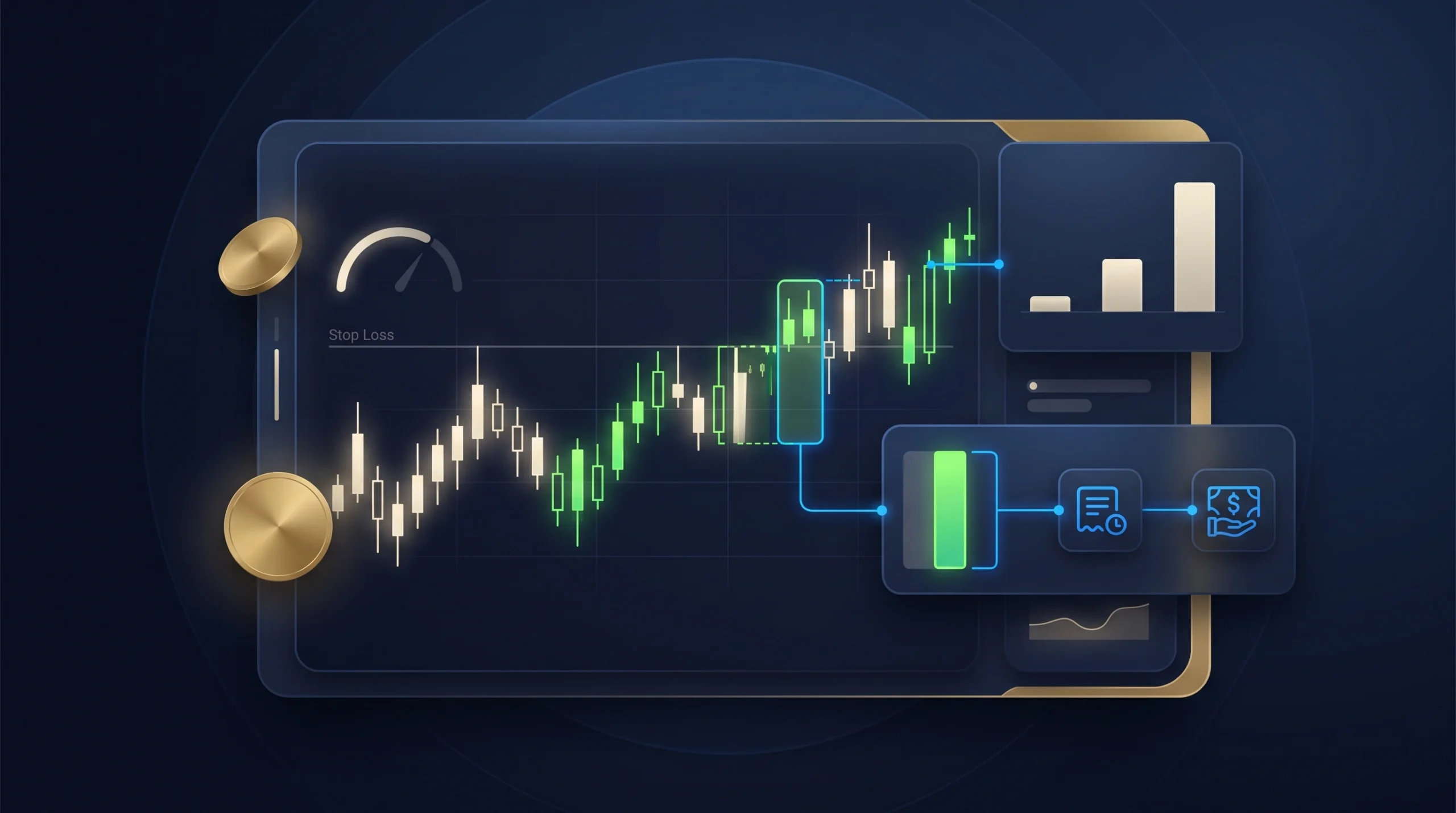
Gold quotes can appear simple, yet even a small price change may have a very different financial effect depending on contract size and trade volume. In many retail accounts, the basic gold pip is commonly treated as a 0.01 change in the quoted price. A move from 2,400.00 to 2,400.01 therefore represents one standard pip.
That convention is useful, but it is not universal. Brokers may use different decimal settings, contract specifications, tick definitions, and platform labels. Before you calculate gold exposure, check the symbol details in your trading terminal rather than assuming every provider treats the same move identically.
This guide explains XAUUSD trading in practical terms. You will learn how to calculate price distance, calculate the value of a move, estimate profit or loss, and connect position size with risk. It also covers spreads, leverage, margin, execution, and other forex and CFD trading considerations.
Gold Pip Basics for XAU/USD
XAUUSD represents gold quoted against the US dollar. XAU is the market code commonly used for gold, while USD is the quote currency. When the market shows 2,400.00, gold is priced at 2,400 US dollars for one troy ounce in that quotation.
A pip is a standardized price increment used to describe a market move. In many gold CFD products, one pip equals 0.01. Gold is not a standard currency pair, so the convention differs from major forex pairs, where the fourth decimal place often defines the basic movement unit.
New traders may benefit from reviewing how to trade gold for beginners before applying these calculations to live positions. Gold may act as a store of value over long periods, but leveraged trading remains speculative and can produce rapid losses.
Pip, Point, Pipette, and Quote Precision Differences
In standard forex pricing, one pip may appear at the fourth decimal, while a pipette is one-tenth of that unit. Gold usually follows a simpler two-decimal convention, although many platforms display three decimals.
For a quote shown as 2,400.00, a change to 2,400.01 is commonly one pip. If the platform displays 2,400.001, the final digit may represent a point, tick, or fractional increment rather than a full pricing unit.
Useful distinctions include:
- Pip: commonly a 0.01 change in XAU/USD.
- Point: often the smallest displayed platform increment.
- Pipette: sometimes one-tenth of the main unit.
- Tick: minimum movement permitted by the instrument.
- Quote precision: number of decimals shown by the broker.
The phrase percentage in point is the original expansion of the term, but modern trading usage focuses on a standardized unit of price change. Always confirm the broker definition before using any price calculation.
How to Count XAU/USD Price Moves in Pips
Counting gold pips starts with the difference between entry and exit prices. Under a 0.01 convention:
Number of pips = Absolute price difference / 0.01
Suppose the price rises from 2,365.40 to 2,367.15. The difference is 1.75. Dividing 1.75 by 0.01 gives 175 price units. For a long trade, that movement is favorable. For a short position, it creates a loss before costs.
Gold Pip Size Across Common Quote Formats
A two-decimal quote is easy to read because the final decimal usually marks the pricing unit. A three-decimal quote adds precision, but it does not necessarily change the broker’s definition of one pip.
Consider three examples:
- 2,400.00 to 2,400.25 equals 25 price increments.
- 2,400.000 to 2,400.250 also equals 25 price increments when 0.01 remains the full unit.
- 2,400.000 to 2,400.001 equals one point, or one-tenth of the main unit under that setup.
This distinction matters when comparing spreads, stop distances, and chart screenshots from different providers. Two terminals may display the same market movement in different numerical formats.
$0.01, $0.10, and $1.00 Gold Moves in Pips
Using 0.01 as the basic increment creates a simple conversion:
- A $0.01 move equals 1 pip.
- A $0.10 move equals 10 increments.
- A $0.50 move equals 50 increments.
- A $1.00 move equals 100 pips.
- A $5.00 move equals 500 increments.
This makes fast mental checks possible. If XAUUSD rises from 2,410.00 to 2,418.50, the market has moved $8.50, or 850 quote steps. The cash outcome then depends on the number of ounces controlled.
Gold Pip Value Formula and Calculation Steps

Price distance and monetary exposure are separate. The measured distance shows how far the market moved, while monetary value shows how much each increment is worth for a specific position.
To calculate pip value, confirm four inputs:
- Size of the quoted increment.
- Contract size for one lot.
- Position size in lots.
- Account currency.
Core XAU/USD Pip Value Formula
For a USD-denominated account, the common formula is:
Movement value = Price increment × Contract size × Lot size
Assume the pip size is 0.01 and one standard lot controls 100 troy ounces. For a 1.00-lot trade:
Movement value = 0.01 × 100 × 1.00 = $1.00
For 0.10 lot:
Movement value = 0.01 × 100 × 0.10 = $0.10
The XAUUSD pip value does not include spread, commission, overnight financing, slippage, or currency conversion. Those items affect the final account result.
Contract Size and Troy Ounce Role
Contract size determines how much metal one full lot controls. A common specification is 100 troy ounces for 1.00 lot, but the value depends on the broker and account type.
| Position size | Ounces with 100-ounce contract | Common label | Value of one pip |
| 1.00 lot | 100 oz | Standard lot | $1.00 |
| 0.10 lot | 10 oz | Mini lot | $0.10 |
| 0.01 lot | 1 oz | Micro lot | $0.01 |
The table is an illustration, not a universal rule. Check your provider’s specifications and review gold lot size explained before increasing position volume.
Manual Gold Pip Value Calculation Example
Assume these conditions:
- Basic increment: 0.01
- Contract size: 100 ounces
- Trade size: 0.25 lot
- Account currency: USD
First calculate the exposure:
100 ounces × 0.25 = 25 ounces
Then calculate pip value:
0.01 × 25 = $0.25 per increment
A movement of 60 increments would change the gross position value by:
60 × $0.25 = $15
Whether that amount is profit or loss depends on trade direction. Actual results may differ because of execution, spread, commission, swaps, and conversion charges.
XAU/USD Pip Value by Lot Size
The pip value in gold scales directly with position size when contract terms remain unchanged. With a 100-ounce contract, each 0.01 lot represents one ounce, and each full increment changes that ounce by one cent.
0.01 Lot Gold Pip Value
A 0.01-lot trade controls one ounce under the example contract. One pip is worth $0.01. A $1.00 market move equals 100 price units and changes the gross position value by $1.
Small trade size may reduce financial exposure, but it does not remove market risk. Fast moves, spread expansion, and poor execution can still affect the outcome.
0.10 Lot Gold Pip Value
A 0.10-lot position controls ten ounces. Each full increment is worth $0.10. If the market moves 250 increments, equal to $2.50 in price, the gross change is $25.
For a long position, a rise produces a gain and a fall produces a loss. The opposite applies to a short position.
1.00 Lot Gold Pip Value
A standard lot controls 100 ounces in this example. Each full increment is worth $1. A 300-unit move, equal to $3.00 in the gold quote, changes the gross position value by $300.
A $1 move on a standard lot therefore produces a $100 change before costs. This is why apparently modest chart movement may have a large account impact.
100-Pip Gold Move Value in Dollars
Under the common convention, 100 pips equals a $1 move in gold. The financial effect is:
- 0.01 lot: $1
- 0.05 lot: $5
- 0.10 lot: $10
- 0.50 lot: $50
- 1.00 lot: $100
A trader searching for a “1.00 profit or loss” figure should distinguish between a 1.00-lot position and a $1.00 price change. They are not the same concept.
Profit, Loss, and Risk Management with Gold Pips
Knowing the monetary value of a price change is most useful when it supports a risk decision. Before entering a trade, estimate the cash loss at the stop level and include likely costs. Gold can move sharply around economic data, changes in interest-rate expectations, geopolitical events, and periods of thin liquidity.
XAU/USD Profit and Loss Formula
You can calculate XAUUSD results in two ways:
Profit or loss = Price difference × Contract size × Lot size
Profit or loss = Number of pips × Pip value
For a buy position, subtract entry from exit. For a sell position, subtract exit from entry. Both methods should produce the same gross result.
Long Gold Trade Calculation Example
Assume a trader buys 0.20 lot at 2,380.50 and exits at 2,384.20. The price change is $3.70, or 370 increments.
At $0.20 per increment:
370 × $0.20 = $74 gross profit
If total trading costs are $6, the approximate net result is $68. This does not guarantee similar results in future trades.
Short Gold Trade Calculation Example
Assume a trader sells 0.05 lot at 2,410.80 and closes at 2,413.30. The market rises $2.50 against the position, equal to 250 increments.
At $0.05 per increment:
250 × $0.05 = $12.50 gross loss on gold
The final loss may be larger after spread, commission, swap, or slippage.
Stop-Loss Cost Based on Pip Distance
A stop should be measured in money as well as chart distance. If the stop is 180 increments away and the position changes by $0.30 for each increment, planned loss before costs is:
180 × $0.30 = $54
Traders using an XAU/USD scalping strategy may work with tighter distances, making spread and execution quality especially important. The number of pips per trade should reflect market volatility rather than an arbitrary fixed target.
Position Size Based on Account Risk
Position sizing works backward from maximum acceptable loss.
Allowed cash change = Risk amount / Stop distance
Lot size = Allowed cash change / Value at 1.00 lot
Suppose risk per trade is limited to $40 and the stop is 200 increments. The allowed exposure is $0.20 for each increment. If one standard lot changes by $1 for that increment, the calculated size is 0.20 lot.
This is a planning estimate. Gaps, slippage, spread changes, and currency conversion may produce a larger result, so traders should consider a buffer.
Pip Calculators, Trading Platforms, and Broker Differences
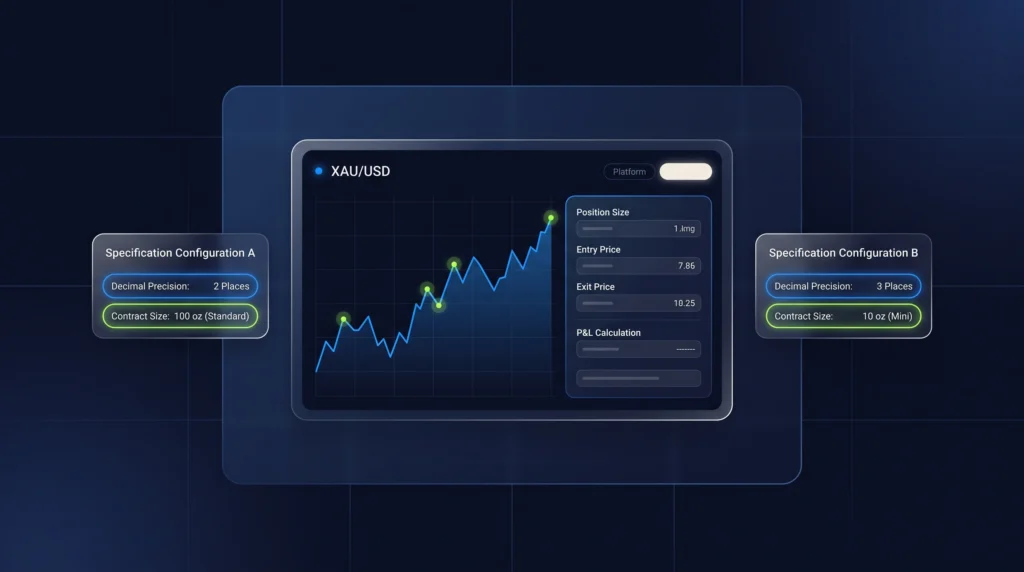
A dedicated gold pip calculator can speed up routine work, but only when the inputs match the broker’s symbol specification. Incorrect contract size, quote precision, or account currency may produce a misleading result.
Gold Pip Calculator Usage Steps
To learn how to calculate exposure with a calculator:
- Select XAU/USD.
- Enter account currency.
- Add trade size.
- Confirm contract size.
- Enter the measured units or price distance.
- Compare the result with platform specifications.
The tool should support your manual calculation, not replace it.
MetaTrader Gold Pip Measurement
In MetaTrader, open the symbol specification and review digits, contract size, tick size, tick value, margin settings, and swaps. These fields are more useful than counting decimals visually.
The crosshair can measure the distance between two prices. A platform may display points rather than pips. When ten points equal one pip, divide the displayed point count by ten.
TradingView Price Move Measurement
TradingView’s ruler or price range tool shows absolute and percentage change between two chart levels. To calculate XAUUSD movement, divide the displayed dollar difference by the broker’s 0.01 increment.
A $4.25 move equals 425 increments when one pip is 0.01. Chart data may come from a different provider than your execution account, so small quote differences are possible.
Broker Contract Size and Decimal Variations
Compare brokers using practical contract details:
- Contract size per lot
- Minimum trade volume
- Tick size and tick value
- Quote precision
- Margin requirements
- Stop-out rules
- Account currency conversion
Two providers may offer XAUUSD trading with different symbol names, decimals, and costs. Accurate pip value in gold comes from the specification attached to your account.
Spread and Commission Impact on Results
The spread is the difference between bid and ask. If the spread is 25 pips and each pip is worth $0.20, the approximate opening cost is:
25 × $0.20 = $5
Some accounts use wider spreads without a separate commission. Others charge a commission with tighter quoted spreads. Swaps may also apply when a position remains open after rollover.
Leverage, Margin, and Pip Value Differences
Leverage changes required margin, not the value of each pip for a fixed position. A 0.50-lot trade has the same cash change for each increment at 1:20 and 1:100 leverage.
Higher leverage may allow a larger position with less margin, which can increase both gains and losses. Reviewing how leverage works in gold trading helps with understanding how to calculate exposure from position size instead of available margin alone.
Gold Pip Value FAQ
What Does 1 Pip Mean in XAU/USD?
One pip commonly means a 0.01 move in XAU/USD, such as 2,400.00 to 2,400.01. Some platforms display an additional decimal and call the smallest increment a point or tick. Check the symbol specification because broker terminology may vary.
How Much Is 1 Pip Worth in Gold?
The amount depends on lot size and contract size. With a 100-ounce contract, one pip is worth $1 at 1.00 lot, $0.10 at 0.10 lot, and $0.01 at 0.01 lot. Different account currencies or contract terms may change the result.
How Many Pips Equal $1 Price Move in Gold?
A $1 price move equals 100 price increments when one pip is defined as 0.01. For example, 2,450.00 to 2,451.00 is a 100-pip rise. The cash result depends on trade size, direction, spread, and commission.
How Much Is 100 Pips Worth in XAU/USD?
With a 100-ounce contract, a 100-unit move is worth about $100 at 1.00 lot, $10 at 0.10 lot, and $1 at 0.01 lot. These figures are gross estimates and may differ after costs or currency conversion.
Why Does Gold Pip Value Differ Between Brokers?
Broker differences may come from contract size, quote precision, tick definitions, account currency, and product design. One provider may use 0.01 as a full pip, while another highlights 0.001 points. Always check the exact symbol settings before trading.
Does Leverage Change Gold Pip Value?
No. Leverage changes the margin required to open a position, not the cash value of each pip for a fixed trade size. However, higher leverage can make it easier to take a larger position, which increases market exposure.
How Do You Calculate Gold Trade Value Before Entry?
Calculate gold exposure by confirming contract size, lot size, stop distance, and the value of each increment. Then multiply stop distance by its cash value. Add an allowance for spread and slippage so the planned risk is not based on an unrealistically perfect fill.
Why Is Pip Value Important in Forex and CFD Trading?
Pip value converts chart movement into money. That allows you to compare position sizes, estimate a possible loss, set a risk limit, and evaluate whether expected movement justifies trading costs. It is especially useful when instruments use different contract sizes or quote conventions.
How Does Price Movement in Gold Affect Trade Results?
Price movement in gold affects your account according to position size, trade direction, and transaction costs. When gold prices rise, a long position may gain while a short position may record a loss. Gold typically experiences larger intraday swings than many major currency pairs, so trading strategies should account for volatility, spread changes, and possible slippage.
What Is Smallest Price Change When Gold Is Priced in XAU/USD?
When gold is priced in XAU/USD, the smallest price change depends on the broker’s quote precision. Many platforms treat 0.01 as one pip, while a third decimal may represent a fractional unit. If one lot equals 100 troy ounces, a 0.01 move changes the gross value of a standard lot by $1 before spreads, commissions, swaps, or currency conversion.