How NFP Affects Gold Trading


Non-Farm Payrolls can move gold sharply because the report changes expectations for US economic growth, inflation, interest rates, and Federal Reserve policy. Since gold is priced in dollars and does not pay interest, shifts in Treasury yields and the USD often influence its short-term direction after the data release.
However, a strong or weak headline does not always produce a predictable move. Traders also assess unemployment, wage growth, revisions, market positioning, and what was already priced in. This guide explains how NFP affects gold trading and how to approach the event without relying on a single number.
Key Takeaways
NFP-Gold Relationship in Brief
The non-farm payrolls report is a major US economic indicator released by the U.S. Bureau of Labor Statistics, usually on the first Friday of the month. It measures the change in the number of employed people outside several excluded categories, including farm workers.
A stronger-than-expected NFP print may support the USD, lift bond yields, and put downward pressure on gold prices. A weaker result may produce a weaker dollar and push gold higher. These are common tendencies, not fixed rules.
Gold’s reaction depends on the complete report and wider market context. Important factors include:
- Difference between forecast and actual payroll growth
- Unemployment rate and labor force participation rate
- Average hourly earnings
- Revisions to previous reports
- Treasury yield and currency reactions
- Expectations for decisions by the Federal Reserve
Trading around NFP involves elevated volatility, wider spreads, slippage, and rapid changes in margin requirements. Traders should fully understand the risks involved before using leverage or opening short-term positions.
NFP Report Basics and Market Importance
Non-Farm Payrolls measures monthly changes in US employment and is usually released on the first Friday of each month. Traders monitor it because labor market conditions can affect monetary policy and multiple asset classes.
NFP Meaning, Release Schedule, Report Scope
NFP stands for Non-Farm Payrolls. The report estimates monthly employment changes across much of the US economy. It excludes farm employment and several other categories that are treated separately in labor statistics.
The report is important because employment conditions influence consumer demand, business activity, inflation expectations, and monetary policy. A resilient labor market may allow the Federal Reserve to maintain restrictive policy for longer. A downturn in hiring may increase expectations for lower interest rates.
The report is generally released by the U.S. Bureau of Labor Statistics on the first Friday of the month. Gold traders often prepare for the event through an gold trading with economic calendar approach, noting the release time, consensus estimate, previous figure, and related data.
NFP can affect various asset classes simultaneously. Forex pairs, government bonds, equity indices, commodities, and assets like gold may all react within seconds. This broad response explains why XAU/USD can move even when the headline nfp result is close to expectations.
Payrolls, Unemployment, Wages, Revisions
The headline number attracts most attention, but it is only one part of the release. Traders should examine whether the details confirm or contradict the initial message.
Payroll growth indicates whether employers added or removed jobs during the reporting period. The unemployment rate shows the share of the labor force actively seeking work but unable to find employment. The force participation rate provides additional context by showing how many working-age people are employed or looking for work.
Average hourly earnings can influence inflationary expectations. Strong wage growth may suggest persistent cost pressure, which can support rate hikes or delay rate cuts. Weak wage data may reduce concern about labor-driven inflation.
Revisions matter because previous estimates are updated as more information becomes available. A positive NFP headline can lose impact when earlier months are revised substantially lower. Likewise, a modest current reading may appear stronger when revisions improve the recent labor market trend.
Core NFP Impact on Gold Prices

NFP affects gold prices mainly through interest rate expectations, bond yields, and movements in the USD. Safe-haven demand, inflation concerns, and market sentiment can strengthen or reverse the initial reaction.
Fed Rate Expectations and Treasury Yields
Gold does not generate a coupon or dividend. When real and nominal Treasury yields rise, interest-bearing assets may become more attractive relative to commodities like gold. This can put downward pressure on gold, especially when higher yields reflect expectations for tighter monetary policy.
A positive NFP surprise may indicate that the labor market remains strong. Depending on inflation conditions, traders may conclude that the Federal Reserve has less reason to reduce rates. Treasury yields may rise as markets reprice the expected policy path.
A weak report can have the opposite effect. Slower hiring may suggest economic cooling and increase expectations for policy easing. Falling yields can reduce the opportunity cost of holding gold, potentially supporting gold’s price.
For a broader explanation of this policy channel, readers can review how Fed rate decisions affect gold. NFP matters partly because it changes how markets anticipate future policy, not because payroll data directly determines gold value.
US Dollar Strength and XAU/USD Direction
Gold is commonly priced in dollars. When the USD strengthens, the metal becomes more expensive for buyers using other currencies. That may reduce demand and weigh on the price of gold. When the dollar weakens, international buyers may face a lower currency-adjusted cost.
This inverse relationship is influential but not constant. Gold and the USD can rise together during periods of severe risk aversion. They can also fall together when markets prefer higher-yielding or growth-sensitive assets.
A typical reaction framework looks like this:
| NFP Outcome | Possible USD Response | Possible Yield Response | Potential Gold Reaction |
| Much stronger than forecast | USD may strengthen | Yields may rise | Gold may decline |
| Much weaker than forecast | USD may weaken | Yields may fall | Gold may rise |
| Close to forecast | Limited initial direction | Mixed | Choppy or range-bound |
| Strong jobs, weak wages | Mixed | Mixed | Two-way volatility |
| Weak jobs, high wages | Mixed | Uncertain | Initial move may reverse |
The table describes common market tendencies. It does not guarantee future results because positioning, inflation data, geopolitics, and central-bank expectations can alter the response.
Safe-Haven Demand, Inflation, Market Sentiment
Gold is often treated as a defensive asset and a potential hedge against inflation. Yet those roles can conflict during NFP trading.
A strong report may reduce recession concerns and weaken defensive demand. At the same time, strong wage growth may increase inflation expectations, which can support demand for assets like gold. Whether gold rises or falls may depend on which interpretation dominates.
A weak report may raise concern about an economic downturn. That can push gold higher through safe-haven demand. However, severe risk-off conditions can also trigger forced selling as traders raise cash or meet margin calls.
Market sentiment determines how investors weigh these forces. The same NFP print can produce different reactions across separate market regimes because expectations and risk preferences change.
NFP Data Gold Traders Should Watch
Gold traders should compare actual payroll growth with forecasts while also reviewing unemployment, wages, and revisions. Conflicting figures can create sharp price reversals after the headline release.
Actual Results vs Market Forecasts
Markets react primarily to surprises, not simply to whether a number looks high or low. A gain of 200,000 jobs could be bullish for the dollar when the forecast was 150,000, but disappointing when traders expected 250,000.
Before the release, compare:
- Consensus forecast
- Previous reported figure
- Range of professional estimates
- Recent employment indicators
- Current Federal Reserve expectations
The difference between actual data and what traders expected is the NFP surprise. A larger deviation may create a stronger initial reaction, although market positioning can amplify or reduce the move.
Unemployment Rate Signals
The unemployment rate can confirm or challenge the headline. Strong payroll growth alongside falling unemployment generally suggests a firm labor market. Weak hiring and rising unemployment may indicate cooling conditions.
Conflicting signals require more caution. Payrolls might rise while unemployment also increases because more people entered the labor force. Alternatively, unemployment may fall because participation declined rather than because hiring accelerated.
Gold traders should avoid interpreting the unemployment rate in isolation. Changes in participation, household employment, and the broader economic environment may provide useful context.
Average Hourly Earnings Impact
Average hourly earnings are closely watched because wage growth may influence inflation and consumer spending. Faster-than-expected wage gains can support a stronger dollar if markets believe the Federal Reserve will keep policy restrictive.
Slower earnings growth may reduce inflation concerns and encourage expectations for lower rates. This may support gold through falling yields and USD weakness.
Wages can sometimes matter more than headline NFP. For example, payroll growth may miss forecasts while earnings accelerate. Gold could initially rise on weaker hiring and then reverse when bond traders focus on inflationary wage pressure.
Previous Report Revisions
Initial labor estimates are not final. The Bureau of Labor Statistics revises earlier months as additional employer data becomes available.
Suppose headline nfp beats expectations by 40,000 jobs, but the prior two months are revised down by a combined larger amount. The current release may appear less positive when assessed as part of the broader trend. In that situation, an early USD rally could fade.
Traders should read the revision details before committing to the first move. Automated systems may react instantly to the headline, while discretionary participants reassess the report over the following minutes.
Historical NFP-Gold Relationship and Scenario Matrix
Historical reactions can reveal common patterns following strong, weak, or mixed NFP results. These patterns vary across inflation cycles, monetary policy regimes, and broader market conditions.
Historical Analysis Methodology
Historical analysis can help identify tendencies, but it should be designed carefully. Looking only at whether gold rose or fell after each report can produce misleading conclusions.
A more useful review compares the NFP result with the consensus forecast and records changes in wages, unemployment, revisions, the dollar index, and Treasury yields. It should also distinguish the first-minute reaction from price action after 15 minutes, one hour, and the full session.
Market regimes matter. Results from periods of rate hikes may not behave like results from easing cycles. Inflation shocks, financial stress, geopolitical events, and unusual liquidity conditions can also influence gold’s price.
Strong NFP Scenario Results
A strong report usually means payroll growth exceeded forecasts, unemployment remained stable or declined, and wages were firm. Such a combination may strengthen expectations for tighter policy.
A common sequence is:
- Treasury yields rise
- USD gains against major currencies
- XAU/USD moves lower
- Equity markets reassess rate expectations
The move may be stronger when investors were positioned for weak data. It may be limited when a positive NFP result was already expected or when gold demand is supported by geopolitical risk.
Weak NFP Scenario Results
A weak report may show payroll growth below expectations, higher unemployment, softer wages, or negative revisions. This can suggest that labor demand is cooling.
Traders may respond by pricing lower interest rates, selling the USD, and buying gold. A weaker dollar makes gold more affordable for some non-US buyers, while falling yields reduce the opportunity cost of holding the metal.
Weak employment data does not automatically mean gold will rise. If the report triggers broad liquidation, concerns about deflation, or a rush into cash, the reaction to the NFP may be less straightforward.
Mixed-Signal Scenario Results
Mixed reports are common. Payrolls may beat forecasts while unemployment rises. Hiring may disappoint while wage growth accelerates. Previous data may be revised enough to change the apparent trend.
These combinations can cause sharp reversals. The initial price move often reflects headline-reading algorithms. Minutes later, traders may focus on earnings, revisions, and policy implications.
When signals conflict, waiting for confirmation can be more prudent than predicting direction. Price behavior in the dollar and Treasury market can help identify which part of the report investors consider most important.
Forecasting Limits Across Market Regimes
Historical patterns should be treated as context rather than a mechanical system. NFP affects gold prices through changing expectations, and those expectations vary across cycles.
During high inflation, strong wages may dominate. During recession fears, unemployment may matter more. Near a major policy meeting, even a modest surprise can shift rate forecasts. During geopolitical stress, safe-haven demand may outweigh labor data.
This is why an NFP scenario matrix works best as a preparation tool. It helps traders organize possible outcomes without assuming that one input will always produce one result.
How to Trade Gold Around NFP
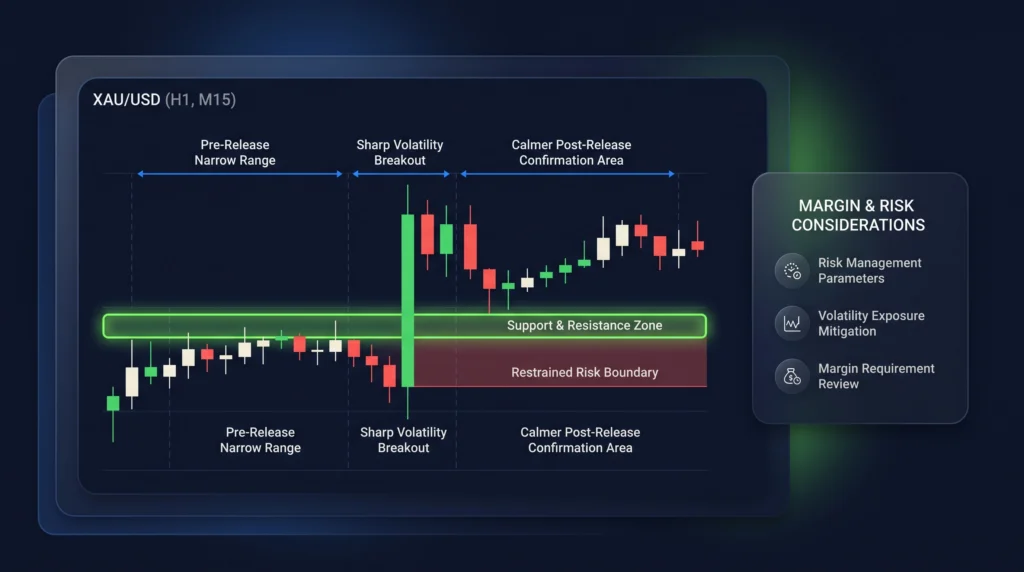
Trading around NFP requires careful preparation, controlled position sizing, and clearly defined risk limits. Traders should watch key price levels and consider waiting for initial volatility to settle before entering.
Pre-NFP Range and Key Price Levels
Gold often consolidates before major economic data as market participants reduce exposure. Traders can mark the pre-release high, pre-release low, recent support and resistance, and areas where liquidity may be concentrated.
Useful reference points may include:
- Previous session high and low
- Current week high and low
- Major round-number levels
- Recent breakout zones
- Short-term trend boundaries
These levels do not predict direction. They provide a framework for judging whether the post-release move is a genuine breakout or a temporary liquidity spike.
Positioning Before NFP Release
Opening a large position immediately before NFP exposes the trader to gap-like movement, slippage, and rapidly changing spreads. Stop orders may fill at a worse price than requested when liquidity is thin.
A cautious trader may reduce position size, tighten total account exposure, or stay out until after the release. Beginners learning how to trade gold for beginners should focus first on order types, position sizing, and margin trading mechanics.
Before entering, define the maximum acceptable loss. Required Margin equals Trade Size divided by Leverage, but margin is not the same as risk. A small margin deposit can control a much larger position, so losses may accumulate quickly.
Execution During NFP Release
During the first seconds, gold can move rapidly in both directions. Spreads may widen, quoted prices may change before orders are filled, and stop-loss execution may differ from the requested level.
Market orders provide execution priority but limited price control. Limit orders provide price control but may not fill. Stop-entry orders can participate in breakouts, although they are vulnerable to false moves and slippage.
CFD trading risks are particularly relevant during news events. Leverage magnifies gains and losses, while broker execution models, trading costs, commissions, and margin requirements may affect the result.
Price Action During First 30 Minutes
The first move is not always the final direction. An initial algorithmic reaction may reverse once traders process wages, unemployment, and revisions.
Many experienced participants wait for the initial volatility to settle. They observe whether price holds beyond the pre-NFP range, whether the USD confirms the move, and whether Treasury yields support the same interpretation.
For example, gold may break lower after a strong headline, recover the breakdown level, and move higher when wage growth disappoints. Such a reversal may suggest that the market has rejected the initial bearish interpretation.
Post-NFP Confirmation Signals
Confirmation does not eliminate risk, but it may reduce reliance on the first price spike. Traders can assess whether gold closes beyond a key level, retests it successfully, and develops consistent momentum.
Possible confirmation signals include sustained USD direction, aligned Treasury yields, improving market liquidity, and a clear structure of higher highs or lower lows. Short-term traders may combine these observations with intraday gold trading strategies suited to their risk tolerance.
Avoid chasing price after an unusually extended candle. A delayed entry with defined risk may be preferable to entering after much of the move has already occurred.
Risk Rules, Common Pitfalls, Trading Checklist
NFP can create trading opportunities, but capital protection should remain the priority. A trader who survives volatile releases can evaluate future setups; a trader using excessive leverage may lose that flexibility quickly.
Common mistakes include predicting the headline, ignoring revisions, using oversized positions, placing stops too close to current price, and assuming gold must move opposite to the USD.
A practical checklist includes:
- Confirm release time and market consensus.
- Mark key XAU/USD levels before the event.
- Define maximum account risk.
- Check spreads, commissions, and margin conditions.
- Avoid increasing leverage to recover losses.
- Review full report before following initial direction.
- Record execution quality and decision-making afterward.
No strategy removes market risk. Trading conditions may change quickly, and past NFP reactions do not guarantee future results.
FAQ About NFP and Gold Trading
How Does NFP Affect Gold Trading?
NFP influences gold through expectations for Federal Reserve policy, Treasury yields, the USD, inflation, and economic growth. A stronger report may lift yields and the currency, which can pressure gold. A weaker report may support gold through lower yields and dollar weakness. However, traders must assess wages, unemployment, revisions, positioning, and broader sentiment rather than relying only on the headline.
Is Strong NFP Good or Bad for Gold?
Strong NFP is often negative for gold because it may support a stronger dollar and higher interest rates. This can make non-yielding assets less attractive and put downward pressure on gold prices. However, strong employment combined with elevated wage growth may increase inflation concerns, while geopolitical demand may support gold independently. Market expectations determine whether a strong result is genuinely surprising.
Is Weak NFP Bullish for Gold?
Weak NFP may be bullish for gold when it lowers Treasury yields, weakens the USD, or increases expectations for Federal Reserve easing. It can also support safe-haven demand if traders become concerned about an economic downturn. Still, weak data does not guarantee higher gold prices. Broad deleveraging, cash demand, or conflicting wage and unemployment signals may produce a different reaction.
Why Can Gold Rise After Strong NFP?
Gold can rise after a strong NFP when the result was already priced in, previous months are revised lower, wage growth disappoints, or unemployment increases. Traders may also focus on geopolitical risk or inflation rather than employment strength. In some cases, gold initially falls before reversing as investors assess the complete report and conclude that the headline overstated labor market strength.
Why Is XAU/USD Volatile During NFP?
XAU/USD becomes volatile because NFP can rapidly change expectations across currencies, bonds, equities, and commodities. Automated systems respond within seconds, while limited liquidity may widen spreads and increase slippage. As participants interpret the headline, wages, unemployment, and revisions differently, price can reverse several times. Leverage can magnify these moves, making disciplined risk management essential.
Should Beginners Trade Gold Before or After NFP?
Beginners may find it safer to observe the release and consider trading after initial volatility declines. Entering before NFP exposes a position to unpredictable gaps, wider spreads, slippage, and rapid margin changes. Waiting does not remove risk, but it allows more time to assess the report and price reaction. New traders should practice position sizing and execution in less volatile conditions first.