Intraday Gold Trading Strategies: Sessions, Volatility, and Entry Setups

Day trading gold requires more than identifying a direction and pressing a buy or sell button. XAUUSD can move sharply when liquidity enters the market, economic data changes interest-rate expectations, or geopolitical developments alter safe-haven demand. These conditions create trading opportunities, but they also increase exposure to wider spreads, slippage, leverage, and sudden reversals.
A practical gold day trading strategy should define when to trade, which price levels matter, what confirms an entry, and how much capital may be placed at risk. Day trading involves opening and closing positions within the same trading day, while swing trading normally keeps positions open for several days. Neither approach guarantees success in gold, and every method should include clear risk controls.
Gold Price Behavior and Intraday Market Drivers
Gold often reacts to several market forces at the same time. A breakout may begin near a resistance level, accelerate after a currency move, and then reverse when bond yields change. Intraday gold traders should combine price action with awareness of news, session liquidity, trading costs, and broader global trading conditions.
Readers who are not yet familiar with spot gold, contracts for difference, leverage, or order execution may benefit from reviewing how to trade gold for beginners before they start trading short-term strategies.
USD, Inflation, and Interest Rate Impact
Because spot gold is generally quoted in US dollars, movements in the dollar may influence the price of gold. Dollar strength can make an ounce of gold more expensive for buyers using other currencies, while dollar weakness may support higher prices. However, the relationship can temporarily break down when safe-haven flows, position adjustments, or changing yield expectations dominate trading activity.
Inflation reports and interest-rate expectations also affect the direction of gold. Higher expected real yields may pressure non-yielding assets, while expectations of lower rates may support demand. Traders should evaluate how XAUUSD actually reacts instead of assuming that every inflation surprise will move gold in a predictable direction.
Geopolitical Risk and Safe-Haven Demand
Geopolitical developments may increase demand for defensive assets and create sharp changes in market volatility. Gold often attracts attention during political uncertainty, military escalation, banking stress, or disruptions to major commodity markets.
The first reaction can be unstable, particularly when liquidity is thin. Before entering, traders should consider:
- Whether price is breaking a major daily or hourly level
- Whether spreads have expanded beyond normal conditions
- Whether the move is supported by sustained buying or selling
- Whether a reversal would invalidate the original market narrative
- Whether leverage remains appropriate for current volatility
A cautious approach is to mark the initial impulse high and low, then observe whether price accepts beyond that range or quickly returns inside it.
Economic Releases and News Catalysts
US inflation data, employment reports, central-bank decisions, and policy comments may create substantial gold volatility. The response depends on market expectations, previous positioning, data revisions, and how the release affects the expected path of interest rates.
Before a high-impact event, traders should consider reducing position size, avoiding new entries, or waiting until spreads and candle ranges begin to normalize. A single large candle does not confirm sustainable momentum, especially when algorithms and short-term gold traders react within seconds.
Liquidity Cycles, Spreads, and Volatility Shifts
Liquidity and volatility change throughout the trading day. Quiet periods may produce narrow ranges and repeated false starts, while London and New York participation often increases both price movement and execution risk.
Your trading platform should provide transparent information about spreads, commissions, margin requirements, order types, and execution. Useful trading tools may include an economic calendar, volatility indicator, position-size calculator, and reliable gold charts. CFD trading risks increase when leverage is high, account equity is limited, or stop orders are placed too close to normal price noise.
XAUUSD Trading Sessions and Best Intraday Times
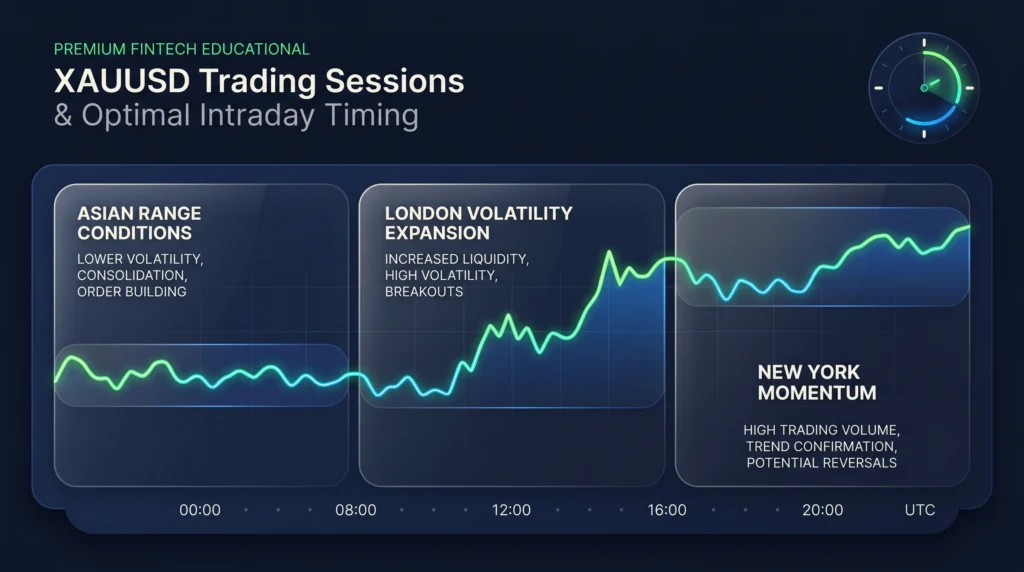
Gold trades for most of the working week, but trading activity is not evenly distributed across all hours. Session choice should match your trading style, available schedule, and risk tolerance and trading objectives. The guide explaining what time does the gold market open can help you compare regional access and typical gold trading hours.
| Session phase | Typical conditions | Suitable approach | Main risk |
| Asian session | Lower activity and tighter ranges | Range trades and selective breakouts | False breaks |
| London open | Volatility expansion | Breakout trading and pullback entries | Sharp reversals |
| New York open | Strong reaction to US order flow | Momentum and news-aware setups | Slippage |
| London-New York overlap | High participation during many periods | Trend continuation and liquidity sweeps | Overtrading |
Asian Session Range Conditions
The Asian session often creates a reference range that later sessions test. Gold may consolidate between visible support and resistance levels when no major catalyst is present. These conditions can suit range-based strategies for day traders, although profit targets should reflect lower intraday volatility and reduced follow-through.
Traders working from South Asia can review the best time to trade gold in India when aligning local hours with international session activity and important economic releases.
Before trading an Asian range, check whether:
- Price is contained between clearly defined boundaries
- No major scheduled release is approaching
- Spread remains stable for the intended target
- Rejection candles appear near range extremes
- Sufficient distance remains before the opposite boundary
London Open Volatility Expansion
London participation can expand the Asian range and establish a new intraday direction. A clean break followed by acceptance may suggest continuation, while a brief move outside the range followed by a fast return may indicate a liquidity sweep.
Do not enter only because price touches or crosses a session boundary. Look for decisive displacement, a candle close beyond the level, continued participation, and a pullback that respects the broken area. Breakout trading becomes less attractive when the initial candle is already unusually extended.
New York Open Momentum
The New York session brings fresh order flow and frequently reacts to US data, bond yields, and currency movement. Momentum can accelerate when the dollar, yields, and gold respond to the same catalyst, but New York can also reverse a trend established earlier in London.
Before entering, reassess:
- Current H1 market structure
- Distance from previous day high or low
- Upcoming US economic announcements
- Spread and average candle size
- Remaining reward before the next major level
This process helps avoid assuming that the earlier direction of gold will automatically continue.
London-New York Overlap Opportunities
The London-New York overlap can provide strong liquidity and volatility, making it attractive for XAUUSD day trading. Trend-following strategies may perform better when price holds important intraday levels, pullbacks remain orderly, and participation supports the existing move.
However, late entries after an extended trend often provide weak entry and exit geometry. The stop may need to be wider, while the remaining target becomes smaller. Waiting for a controlled pullback may be more effective than chasing a fast candle.
Session Transitions and Liquidity Sweeps
Session transitions often attract resting orders above recent highs or below recent lows. Price may briefly move through these levels before reversing as new market participants enter.
Mark session highs, lows, opening prices, and consolidation boundaries before looking for intraday setups. These reference points can reveal whether a move represents genuine continuation or only a temporary search for liquidity.
Intraday Preparation, Directional Bias, and Key Levels
Preparation helps reduce impulsive decisions during active trading. Before each session, identify scheduled news, current volatility, higher-timeframe direction, and the levels where buyers or sellers may respond. A complete plan should define both entry conditions and invalidation.
Daily Bias from H1 Market Structure
The H1 chart helps determine whether the gold market is trending, ranging, or transitioning. Higher highs and higher lows may support a bullish bias, while lower highs and lower lows may suggest bearish control. Mixed structure may call for smaller targets, reduced size, or no trade.
A directional bias should remain flexible. It is a working hypothesis based on current evidence, not a prediction that must be defended when price action changes.
Support, Resistance, Prior Highs, and Prior Lows
Useful reference points for day trading gold include:
- Previous day high and previous day low
- Asian session high and low
- H1 support and resistance levels
- Weekly opening price
- Major round numbers
- Recent impulse origins
- Visible equal highs or equal lows
A level becomes more relevant when several factors align. For example, a prior high located near H1 resistance and a round number may attract more trading activity than an isolated horizontal line.
Multi-Timeframe Alignment from H1 to M15
A practical workflow uses H1 for market context, M30 for session structure, and M15 for execution. This hierarchy helps prevent a low-timeframe signal from overriding a stronger higher-timeframe trend.
Some traders use M5 for precise entries, but faster charts contain more noise and may encourage overtrading. For many strategies for day trading, M15 provides enough detail while preserving meaningful structure.
Gold Day Trader Entry Framework
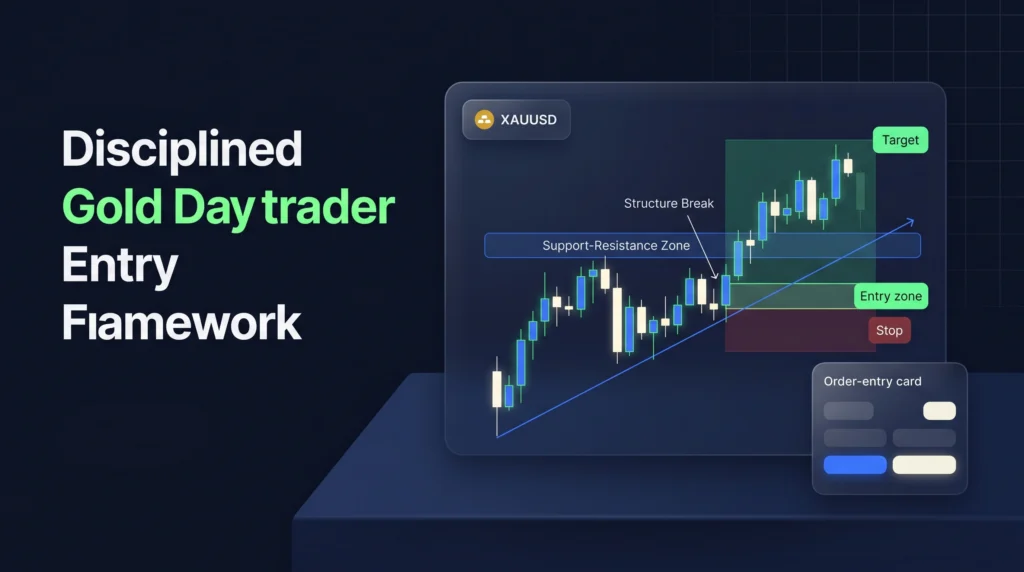
A repeatable entry framework separates valid setups from emotional decisions. Effective entry selection usually requires alignment between location, structure, momentum, session timing, and acceptable risk.
Session Open Confirmation
At the beginning of an active session, wait for evidence such as a range break, rejection from a key level, or strong close beyond prior structure. The first candle after an open can be erratic because orders enter from multiple participants at once.
Allowing the market to reveal direction may reduce premature entries. This delay does not remove risk, but it can help distinguish real participation from temporary volatility.
Break of Structure and Momentum Validation
A break of structure occurs when price closes beyond a meaningful swing point. Stronger confirmation may include a decisive candle body, increased range, limited rejection, and follow-through on the next candle.
A minor wick beyond a level is not sufficient. Price should either show acceptance outside the range or produce a clear retest that confirms the new direction.
Pullback Entry at Key Level
After a confirmed break, wait for price to return toward the broken level. A controlled pullback may provide a smaller stop and clearer invalidation than an immediate market entry.
For example, London may break above the Asian high, close firmly, and then retest the level on M15. A bullish rejection may support a long entry if H1 structure remains constructive and no major resistance sits immediately above.
A pullback checklist may include:
- Break supported by a strong candle close
- Retest occurs at a previously marked level
- Momentum does not collapse during the pullback
- Confirmation appears within the active session
- Planned target offers acceptable reward relative to risk
Candlestick Confirmation for Long and Short Entries
Candlestick signals are most useful when they appear at meaningful locations. A bullish engulfing candle near support after a liquidity sweep carries more context than the same pattern in the middle of a range.
For short positions, traders may look for rejection from resistance, bearish displacement, and failure to reclaim the level. Candles should confirm a broader setup, not operate as independent trading signals.
Stop-Loss Placement Before Execution
Place the stop beyond the point where the setup becomes invalid. For a long pullback, this may be below the rejection low. For a short reversal, it may be above the liquidity-sweep high.
Define technical invalidation first, then reduce position size so monetary risk remains acceptable. Moving the stop farther away after entry may increase loss without improving the original setup.
Profit Targets, Risk-Reward, and Exit Rules
Targets may be based on the next liquidity pool, a prior session extreme, or a predetermined multiple of risk. A trade with limited reward relative to stop distance may not justify execution.
Possible exit methods include:
- Full exit at one predefined target
- Partial profit at first resistance or support
- Trailing stop behind confirmed swing points
- Time-based exit near session close
- Immediate exit when structure invalidates
Choose one method that fits your strategy and evaluate it consistently over a meaningful sample of trades.
High-Probability Intraday Gold Trading Setups
No setup is high probability in every market environment. Its effectiveness depends on session, volatility, structure, location, and execution discipline. Gold trading strategies for XAUUSD should therefore be treated as structured decision models, not guaranteed profit systems.
Session Range Breakout Setup
Mark the Asian high and low, then wait for London participation. Enter only after a decisive close outside the range and a retest that holds. The stop can sit beyond the retest swing, while the target may be the next higher-timeframe level.
Skip the setup when the breakout candle is unusually extended, liquidity is poor, or spreads remain elevated. Chasing a completed move may produce unfavorable risk-to-reward conditions.
False Breakout and Liquidity Sweep Reversal
This setup begins when price moves beyond a visible high or low and then closes back inside the prior range. Confirmation may include a break of short-term structure in the opposite direction.
The entry can occur on a pullback toward the reclaimed level. The stop normally sits beyond the sweep extreme, while the target may be the range midpoint, opposite boundary, or next liquidity zone.
Trend-Following Setup with Moving Averages
Moving averages can help identify gold trends, but they should not be used as isolated signals. A rising average combined with higher highs, higher lows, and pullbacks into support may suggest long opportunities.
During range conditions, repeated moving-average crossovers create noise. Swing trading and trend following may use similar directional tools, but intraday traders require tighter timing and usually close positions before the session ends.
RSI and MACD Momentum Setup
RSI and MACD may help evaluate momentum, divergence, or weakening trend strength. An oversold RSI does not mean price must rise, while an overbought reading does not automatically justify a short trade.
Use indicators to support price action. A momentum shift near a major level is generally more useful than an indicator signal in the middle of an unstructured range. Historical gold charts can help reveal how these tools behave across trending and sideways conditions.
News Volatility and Multi-Session Scalping Setup
News-driven scalping requires strict execution controls. Wait for the initial spike, identify the reaction range, and consider trading only after spreads and candle size begin to normalize. The XAU/USD scalping strategy provides additional context for traders interested in shorter holding periods.
Gold futures, spot gold, and CFDs may react at slightly different speeds because of pricing, liquidity, and execution conditions. Traders attempting to navigate the volatile gold market should avoid excessive leverage during fast releases, since slippage may make the realized loss larger than planned.
Volatility-Based Strategy Adjustments and Indicators
A strategy in gold should adapt when candle size, spread, and price speed change. Fixed stops and targets may behave inconsistently across quiet Asian conditions, an active London open, and a news-driven New York session.
ATR-Based Stop and Target Adjustment
Average True Range can estimate recent movement. A higher ATR may suggest using a wider stop with a smaller position size, while a lower ATR may support tighter parameters.
ATR is descriptive rather than predictive. It does not indicate the future direction of gold and should be combined with structure, session context, and nearby levels.
Trending Conditions vs Range Conditions
Trending markets often favor pullbacks and continuation entries. Range conditions tend to favor rejection trades near established boundaries.
Signs of a trend may include:
- Consistent higher highs or lower lows
- Strong closes near candle extremes
- Shallow, orderly pullbacks
- Moving averages with clear slope
- Breakouts that hold after retesting
The main mistake is applying a trend method inside consolidation or fading a strong directional move without evidence of exhaustion.
High-Impact News Filters and Blackout Windows
Create a personal blackout window around major releases. Some traders stop entering positions before an event and wait for several candles afterward. The appropriate period depends on market conditions, trading platform performance, and strategy rules.
This filter may reduce the number of trading opportunities, but it can also mitigate risk from unpredictable price gaps, spread expansion, and slippage.
Spread, Slippage, and Liquidity Thresholds
Define a maximum acceptable spread before entering. Record whether market orders and stop orders are regularly filled beyond requested prices during volatile periods.
Trading costs can turn a marginal setup into a losing one. Broker comparison should therefore consider execution quality, commissions, margin requirements, platform stability, and access to suitable trading tools, rather than focusing only on advertised spreads.
Risk Management for Intraday Gold Positions
Risk control is central to day trading gold because even a technically sound setup can fail. CFDs and leveraged forex trading products may produce rapid losses, and margin calls can occur when account equity falls below broker requirements.
Position Sizing for XAUUSD Volatility
Calculate position size from the stop distance and maximum monetary risk. A practical process is:
- Set maximum account risk for one position.
- Identify the technical invalidation level.
- Measure stop distance from planned entry.
- Calculate value per price movement.
- Reduce size when volatility increases.
- Confirm required margin before execution.
Do not widen the stop after entry simply to avoid realizing a loss. Position size should adapt to the setup, not the other way around.
Maximum Risk per Trade and Daily Loss Limits
Set a fixed risk cap per trade and a maximum daily loss. Stop trading when that limit is reached. A daily limit protects your account from emotional escalation after several unsuccessful positions.
Also consider a maximum number of attempts for one setup. Repeatedly re-entering the same failed idea may become revenge trading rather than disciplined active trading.
Overnight Exposure and Event Risk
Intraday trading normally aims to close positions within the same trading session. Holding overnight changes the risk profile because spreads, swaps, gaps, and unexpected headlines may affect the position.
Trading sits in the middle between very short scalping and longer swing trading when positions remain open for several hours but are closed before the end of the day. If you choose to hold overnight, treat the position as a separate strategy with revised risk parameters.
Gold Trading Plan, Trade Management, and Common Mistakes
A written plan turns analysis into repeatable behavior. It should include approved sessions, market conditions, entry and exit rules, stop placement, target methods, news filters, and review criteria. Without a plan, fast market volatility can make gold difficult to trade effectively.
Pre-Market Checklist, Trade Journal, and Review Process
Before each session, check:
- Economic calendar and relevant headlines
- H1 direction and current market condition
- Prior highs, lows, and opening range
- Spread, average range, and execution quality
- Maximum risk and daily loss limit
- Approved setup and invalidation point
- Upcoming session transitions
After the session, save gold charts and record entry rationale, execution quality, emotional state, and whether you followed the plan. Review decision quality separately from profit or loss, because a disciplined trade can lose and an undisciplined trade can occasionally make money.
Overtrading, Revenge Trading, and Premature Entries
Common mistakes include entering before confirmation, chasing extended candles, increasing size after a loss, and switching strategies during the same session. These behaviors often appear when traders focus on recovering money rather than following a tested process.
A missed trade is not a financial loss. Waiting for the next valid setup is generally safer than forcing an entry that does not meet your rules.
Intraday Gold Trading FAQ
Which Gold Session Offers Highest Volatility?
The London-New York overlap often produces substantial liquidity and volatility because participants from both regions are active. The New York session may become especially volatile around US economic releases. However, the most active period varies with news, holidays, and market conditions, so traders should monitor current ranges, spreads, and execution instead of relying on a fixed assumption.
Which Timeframe Works Best for Intraday Gold Entries?
Many gold traders use H1 for directional context, M30 for session structure, and M15 for entry confirmation. Faster charts may suit experienced scalpers but contain more noise and higher trading costs relative to target size. The most suitable timeframe depends on your trading style, schedule, experience, and ability to make consistent decisions under pressure.
How Wide Should XAUUSD Stop-Loss Be?
Stop distance should reflect technical invalidation and current gold volatility rather than an arbitrary number of points. A stop may sit beyond a swing high, swing low, or reclaimed session level. ATR can provide context for recent movement. Once the distance is set, position size should be adjusted so the possible loss remains within your predetermined risk limit.
How Can Traders Avoid False Breakouts on Gold?
False breakouts cannot be eliminated, but exposure may be reduced by waiting for a candle close beyond the level, checking whether price holds outside the range, and entering on a controlled retest. Session timing also matters. Breaks during thin liquidity may be less reliable than moves supported by active participation, clear momentum, and stable execution conditions.
Should Gold Trades Remain Open During Major News?
Keeping positions open during major news can expose traders to rapid price changes, wider spreads, slippage, and reduced liquidity. Some experienced traders accept that risk with smaller positions and predefined limits, while others close positions or use a blackout window. The appropriate decision depends on strategy rules, account size, and risk tolerance, and no approach guarantees future results.
Can Technical and Fundamental Analysis Work Together?
Technical and fundamental analysis can complement each other. Fundamental factors may explain why the gold market becomes active, while technical analysis can define entry, invalidation, and target levels. For example, a policy announcement may create directional pressure, but a trader may still wait for a break and retest before entering. Combining both approaches improves context without removing uncertainty.