Gold Options Trading for Beginners: Calls, Puts, Volatility, Risk


Gold options give traders a flexible way to gain exposure to gold price movements without immediately purchasing physical bullion or entering a futures contract. A call may benefit when gold rises, while a put may gain value when gold falls. However, direction alone does not determine success. Volatility, time decay, strike selection, execution costs, and position size can all affect results.
For beginners, the key is to treat options as risk-management instruments rather than simple bets on rising and falling gold prices. This guide explains how gold options work, how calls and puts differ, what drives premiums, and how to approach each trade with defined risk.
Gold Options Trading Basics
Gold options are financial derivatives linked to an underlying gold instrument, which may be a gold futures contract, exchange-traded fund, or another market benchmark. Contract design varies between exchanges and brokers, so traders should examine the product specification before placing an order.
Options can be used for speculation, hedging, or portfolio diversification. They are only one of several ways to invest in gold, alongside physical bullion, exchange-traded products, mining shares, futures, and certain leveraged products.
Gold Option Definition and Core Purpose
A gold-linked derivative is a contract that gives its buyer a right, but generally not an obligation, to buy or sell an underlying gold-related asset at a predetermined price before or on a specified expiration date. The predetermined level is called the strike price.
A call provides the right to buy gold exposure, while a put provides the right to sell it. The buyer pays a premium for that contractual right. For a standard long position, the maximum direct loss is usually limited to the premium paid, plus commissions and other trading costs.
The seller, also called the writer, receives the premium but accepts the obligation created by the contract. Selling options may involve substantial margin requirements and considerably greater risk than purchasing them. Beginners should not assume that every options position has limited risk.
This contract may serve several purposes:
- Speculating on bullish or bearish price movements
- Hedging physical gold or gold-related investments
- Trading an expected increase or decrease in volatility
- Defining maximum risk through long positions
- Building spreads with different strikes or expiration dates
Readers new to spot markets may also benefit from learning how to trade gold for beginners before adding premium pricing and expiration mechanics.
Call and Put Options
Calls and puts respond differently to changes in gold prices. Choosing between them starts with a directional view, but traders should also consider timing, implied volatility, and the amount of movement required to overcome the premium.
| Contract type | Typical outlook | Buyer receives | Main buyer risk |
| Call | Bullish | Right to buy at strike price | Premium paid |
| Put | Bearish or protective | Right to sell at strike price | Premium paid |
This comparison describes long calls and long puts. Short calls and short puts have different payoff profiles and may expose the seller to significant losses.
Gold Call Options for Bullish Price Outlooks
A gold call may suit a trader who expects gold prices to rise before expiration. The holder gains the right to buy gold at the strike price specified in the contract. In practice, many traders close the contract for a profit or loss rather than use the contractual right.
Suppose gold-related futures are trading at 2,400, and a trader buys a call with a 2,450 strike. If the underlying gold price rises sharply, the call may become more valuable. The outcome still depends on how quickly gold moves, how implied volatility changes, and how much time remains.
A higher market price does not automatically produce a profitable trade. The price of gold must often rise enough to cover the premium and transaction costs. If gold does not move as expected, the contract may lose value each day as expiration approaches.
Call buyers should consider:
- How far gold must rise to reach breakeven
- Whether expected movement may occur before expiration
- Whether implied volatility is already unusually high
- Bid-ask spread, commission, and exercise costs
- Potential event risk around economic announcements
Gold Put Options for Bearish Price Outlooks
A put gives its owner the right to sell gold at a set strike price. Traders may purchase put options when they expect gold prices to fall or when they want protection for an existing long position.
For example, an investor holding a gold exchange-traded product may buy a put to reduce downside exposure. If gold price movements turn sharply negative, gains in the put may partially offset losses in the holding. This protection has a cost because the premium may expire worthless if the decline does not occur.
A speculative put position may benefit from falling gold prices without owning physical gold. Yet the trader must still choose a suitable strike price and expiration date. A put that is too far out of the money may be inexpensive but may also require a large decline before it develops meaningful value.
Long puts provide defined direct risk, limited to the premium and trading expenses. Short puts are different: the seller may be required to buy the underlying position after a substantial decline.
Gold Option Pricing and Moneyness
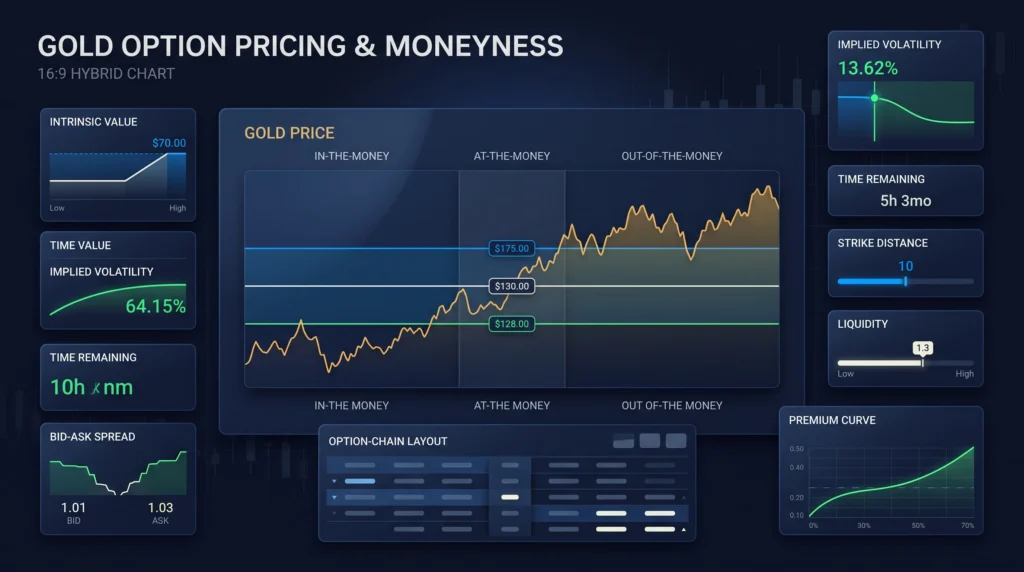
A contract premium reflects more than the current market price of gold. It incorporates the relationship between price and strike, time remaining, expected volatility, interest rates, and contract-specific factors.
For beginners, pricing becomes easier when divided into two components: intrinsic value and time value. Intrinsic value measures whether exercising the contract would currently be favorable. Time value reflects the possibility that conditions may improve before expiration.
Strike Price and Gold Market Price
The strike price is the level at which the contract grants the right to buy or sell the underlying instrument. Its relationship with the current gold price affects its premium and probability of finishing profitably.
A call with a strike below the market price of gold normally has intrinsic value. A put with a strike above the market price normally has intrinsic value. Options with more intrinsic value usually cost more because part of their payoff already exists.
Strike selection changes both cost and risk. A deep in-the-money contract may respond more closely to the underlying market but requires a larger premium. A far out-of-the-money option costs less but depends on a more substantial move.
In-Money, At-Money, and Out-of-Money Options
Moneyness describes the relationship between an option strike and the underlying price.
An in-the-money call has a strike below the market price, while an in-the-money put has a strike above it. These options have intrinsic value.
An at-the-money option has a strike close to the current underlying price. It commonly has significant sensitivity to changes in volatility and time remaining.
An out-of-the-money call has a strike above the market, while an out-of-the-money put has a strike below it. These options have no intrinsic value. Their premiums consist primarily of time value.
Moneyness does not indicate whether a trade is good or bad. A lower-cost option may have a lower probability of finishing in the money, while a more expensive contract may require more capital and still lose value.
Premium Components and Pricing Factors
Several forces can raise or lower a gold option premium:
- Movement in underlying gold
- Implied volatility
- Time remaining until expiration
- Distance between market price and strike
- Interest-rate expectations
- Liquidity and bid-ask spread
- Supply and demand within the gold options chain
Implied volatility represents the market’s pricing of potential future movement. It does not predict direction. High implied volatility may make both calls and puts more expensive because traders anticipate a wider range of outcomes.
Macroeconomic events can influence both gold and option pricing. Inflation expectations, currency movements, geopolitical uncertainty, and central-bank policy may affect demand. Reviewing how Fed rate decisions affect gold can help traders place interest-rate events in a broader market context.
Gold Options Contract Specifications
Contract specifications determine what is being traded and what may happen at expiration. Never rely on a product name alone. Two instruments described as gold options may use different underlyings, quantities, settlement methods, and exercise rules.
Contract Size and Lot Size
Contract size defines the quantity of gold or gold-related exposure controlled by one option. Some exchange contracts represent a large amount of gold, while smaller products may be designed for traders with lower capital requirements.
A trader should confirm:
- Quantity represented by one contract
- Currency used for quotation
- Minimum price movement
- Monetary value of each price increment
- Commission and exchange fees
- Margin rules for short positions
Position size should be based on potential loss, not just the number of contracts. A low-looking premium can still represent a meaningful cash amount after applying the contract multiplier.
Expiration Date and Exercise Style
Every option has an expiration date. After expiration, an option may be exercised, settled, or expire worthless according to its contract rules.
American-style options can generally be exercised before expiration, while European-style options can typically be exercised only on the expiration date. These labels describe exercise mechanics, not geographic availability.
Early exercise is not always economically efficient because an option may retain time value. Selling the contract may produce a better outcome than exercising it, depending on liquidity, fees, and market conditions.
Physical Settlement and Cash Settlement
Settlement rules specify what happens when an option is exercised or remains open at expiration. Physical settlement may result in delivery of the underlying futures position or another deliverable asset. Cash settlement pays the difference according to a defined reference price.
Physical settlement does not always mean that a retail trader receives gold bars. Some commodity options exercise into gold future contracts, which can create new margin obligations and delivery-related exposure.
Before expiration, check the broker’s policies for automatic exercise, position closure, insufficient margin, and delivery restrictions. A broker may close positions before the exchange deadline if the account cannot support the resulting obligation.
Gold Options Versus Gold Futures
Gold options and gold futures both provide exposure to gold, but their obligations differ. A futures contract commits both sides to its terms unless the position is closed. An option buyer purchases a contractual right.
Long options offer limited risk because the buyer can generally lose no more than the premium and transaction expenses. Futures gains and losses move more directly with the underlying market and can exceed the initial margin deposited.
Options also involve time decay and volatility pricing. A futures position does not lose value solely because expiration approaches, although futures prices may differ across contract months.
Beginners comparing these products can review gold futures trading for beginners before deciding which structure better suits their objectives and risk tolerance.
Gold Options Trading Process
A disciplined process begins before order entry. You need a suitable account, a defined market thesis, a maximum acceptable loss, and an exit plan for both favorable and unfavorable outcomes.
Options Broker and Trading Account Selection
To start trading gold options, you need a brokerage account that supports options and provides access to the relevant exchange or product. Availability depends on jurisdiction, account classification, and broker offering.
Compare brokers based on:
- Market access and available gold contracts
- Options approval requirements
- Commissions, platform fees, and exchange charges
- Bid-ask spread and execution quality
- Margin requirements for option sellers
- Educational tools and risk disclosures
- Expiration and settlement procedures
Some platforms offer CFDs alongside futures and options. CFDs may involve leverage, overnight financing, wider spreads during volatile periods, and counterparty exposure. They are not interchangeable with exchange-traded options, so compare contract terms carefully.
Gold Market Condition Analysis
Market analysis should address direction, volatility, and timing. A bullish view is incomplete without considering when the expected rise may occur and whether the option premium already reflects elevated uncertainty.
Review price trends, support and resistance zones, economic events, currency conditions, and changes in real yields. These factors may suggest a market scenario, but they do not guarantee future results.
A practical pre-trade question is: “What must happen, by what date, for this position to work?” If the answer is unclear, the trade may not have a sufficiently defined thesis.
Call or Put Selection
Choose a call when your strategy requires bullish exposure and a put when it requires bearish exposure or downside protection. Then decide whether purchasing or selling the option fits your risk tolerance.
Beginners often find long options easier to control because maximum direct loss is defined at entry. Option selling may produce premium income but can create large losses, margin calls, and forced liquidation.
Direction is not the only decision. A trader expecting a modest rise may choose differently from someone expecting an abrupt volatility spike. The option structure should match both the anticipated move and its expected timing.
Strike Price and Expiration Selection
Strike and expiration determine cost, sensitivity, and probability. Near-the-money contracts tend to react more strongly to changes in the underlying price than distant out-of-the-money options, but they usually require a higher premium.
Expiration should provide enough time for the thesis to develop. Buying too little time may create severe time-decay pressure. Buying excessive time may cost more and reduce capital efficiency.
Consider three questions:
- What price level supports the trade thesis?
- When might the expected move occur?
- How much premium can be lost without disrupting the trading plan?
Order Placement and Position Monitoring
Use a limit order where appropriate rather than automatically accepting the displayed market price. Gold options with limited liquidity may have wide bid-ask spreads, particularly in distant strikes or expiration months.
After placing the order through your trading platform, monitor more than profit and loss. Track underlying price, implied volatility, time remaining, spread width, and upcoming market events.
Decide in advance when to reduce, close, or adjust the trade. Waiting until expiration is not mandatory. Many traders exit earlier to protect remaining value, capture gains, or avoid settlement complications.
Volatility, Strategies, and Risk Management
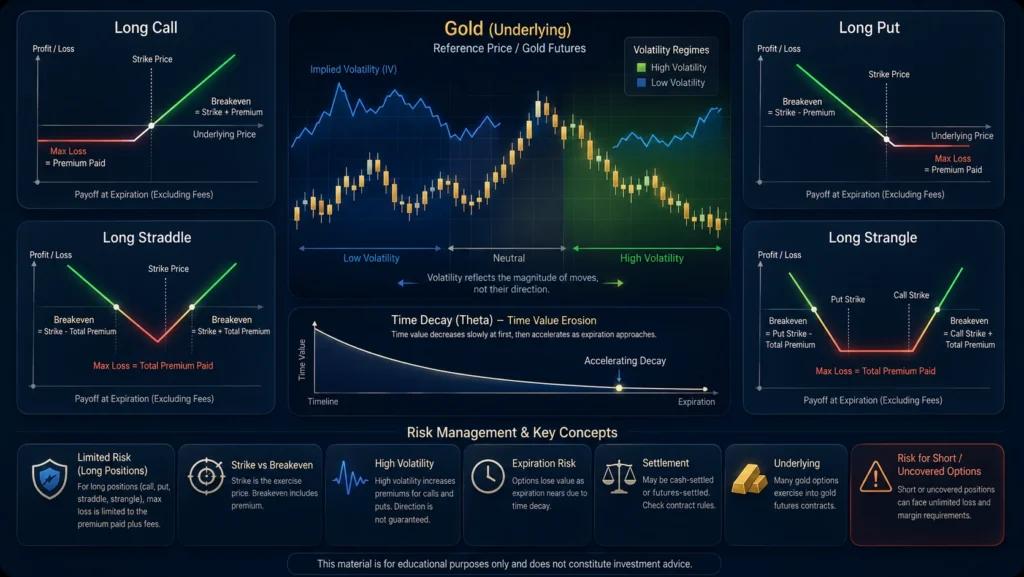
Gold options allow traders to express views on direction and volatility, but flexibility does not remove risk. The same features that create opportunity—leverage, convex payoffs, and time-sensitive pricing—can also produce rapid losses.
Implied Volatility and Gold Option Premiums
Implied volatility measures how much movement the market is pricing into an option. When uncertainty rises, options are typically more expensive, all else being equal.
A trader can correctly predict direction and still lose if the actual move is too small or implied volatility falls sharply. This is sometimes called volatility contraction. It commonly matters after major scheduled events when uncertainty has already been priced into premiums.
Before buying, compare the required move with a realistic market scenario. High volatility may suggest opportunity, but it also increases the price paid for that opportunity.
Time Decay and Expiration Risk
Time decay describes the erosion of an option’s time value as expiration approaches. It generally accelerates near expiration, especially for at-the-money options.
Suppose a trader purchases a call expecting gold prices to rise. Gold moves slightly higher, but not quickly enough. The call may still decline because the favorable price movement does not offset lost time value.
Expiration also creates operational risk. An in-the-money option may be exercised automatically, potentially creating a futures position or settlement obligation. Traders should know the broker’s deadline and account requirements before the final trading day.
Long Call and Long Put Strategies
A long call seeks to benefit from an increase in gold, while a long put seeks to benefit from a decline. Both positions have a defined premium cost.
For a long call:
Maximum loss equals premium paid plus transaction costs.
Breakeven at expiration generally equals strike price plus premium paid.
For a long put:
Maximum loss equals premium paid plus transaction costs.
Breakeven at expiration generally equals strike price minus premium paid.
These calculations apply at expiration and may not reflect the option’s market value before expiration. Volatility and remaining time can produce different interim results.
Straddle and Strangle Volatility Strategies
A long straddle combines a call and put with the same strike and expiration. It may benefit from a large move in either direction, but purchasing two options creates a higher total premium.
A long strangle also combines a call and put with the same expiration, but uses different out-of-the-money strikes. It is often cheaper than a straddle, although it normally requires a larger move to reach profitability.
Both strategies may lose if gold remains within a narrow range or if volatility declines. They should not be treated as automatic profits during uncertain markets. The actual movement must be large enough to overcome two premiums and trading expenses.
Maximum Profit, Maximum Loss, and Breakeven
Risk should be calculated before order entry. For long calls and puts, the premium provides a clear starting point, but traders should include commissions, exchange fees, and spread costs.
Profit potential varies by strategy. A long call may have substantial upside if gold rises significantly, while a long put gains as the underlying falls, subject to the lower boundary of the underlying price.
Option sellers face different risks. An uncovered short call may have theoretically unlimited loss as the underlying rises. A short put can suffer substantial losses during a sharp decline. Margin requirements can increase during market volatility.
Position Sizing, Stop Rules, and Exit Planning
Position size should reflect the amount you can afford to lose, not the margin or premium your broker allows. A practical approach is to define a maximum account risk for each trade and choose the number of contracts accordingly.
Use a written plan covering:
- Maximum acceptable loss
- Profit-taking conditions
- Time-based exit before expiration
- Response to volatility changes
- Events that invalidate the original thesis
- Settlement and exercise procedures
Stops on options require care because premiums can fluctuate sharply and spreads may widen. Some traders use an underlying price level, a percentage loss, or a time-based rule. No method eliminates slippage or guarantees execution at the intended price.
Gold Options Trading FAQ
How Much Money Do Beginners Need for Gold Options Trading?
Required capital depends on the option premium, contract multiplier, broker fees, and whether the position involves buying or selling options. A long option may require payment of the full premium, while a short option can require substantial margin. Beginners should also keep reserve capital for trading costs and avoid committing money needed for essential expenses.
Can Gold Options Be Sold Before Expiration?
Gold options can generally be closed before expiration when sufficient market liquidity is available. A trader who owns an option may sell the same contract rather than exercise it. Closing early can preserve remaining time value or reduce settlement risk, but the execution price depends on the bid-ask spread, market depth, volatility, and current gold price movements.
Can Gold Options Lose More Than Initial Premium?
A buyer of a standard call or put generally has loss limited to the premium paid, plus commissions and fees. Option sellers face different exposure. An uncovered call can produce very large losses if gold rises sharply, while a short put may lose substantially during a decline. Spreads can limit risk, but only when every leg is correctly established and maintained.
How Does Gold Volatility Affect Calls and Puts?
Higher implied volatility generally increases both call and put premiums because the market is pricing a wider range of possible outcomes. Lower volatility may reduce premiums. A buyer can lose even after correctly predicting direction if volatility falls or the price move is insufficient. An option seller may benefit from declining volatility but accepts potentially significant directional and margin risk.
Do Gold Options Require Physical Gold Delivery?
Not all gold options require physical delivery. Some settle in cash, while others exercise into a futures contract or another underlying position. Even physically settled commodity products may not result in retail delivery of gold bars. Traders should verify settlement rules, broker policies, exercise deadlines, and margin requirements for the exact contract before holding it near expiration.
Are Gold Options Riskier Than Gold Futures?
Risk depends on position structure. A long gold option has defined premium risk, while a futures contract can generate losses beyond initial margin. However, options introduce time decay, volatility risk, and more complex pricing. Selling uncovered options may be riskier than buying futures in some conditions. Traders should compare maximum loss, leverage, liquidity, and settlement obligations rather than judging the product name alone.
What Are Pros and Cons of Purchasing Gold Options?
The main pros and cons depend on position structure. Buyers gain defined premium risk, flexible bullish or bearish exposure, and control over a larger underlying value than the cash initially paid. Disadvantages include time decay, volatility-sensitive pricing, trading costs, and expiration pressure. Sellers may collect premiums, but they can face substantial losses and margin demands when gold prices move sharply.
Do You Need a Commodity Trading Account or Physical Gold?
Gold options are traded through a suitable trading account with a broker that provides access to the relevant market. You may need to open a commodity trading account and obtain derivatives approval, depending on local rules and broker policies. Holding physical gold or owning specific ounces of gold is usually unnecessary, although settlement terms must be checked before expiration.