
Pips in Forex: Meaning, Calculation, and Practical Examples

Anyone beginning their forex trading for beginners journey will quickly encounter the term “pip.” Understanding pips in forex is one of the first and most essential concepts a new trader needs to grasp. This standardized measure is how the forex market tracks price movement, expresses spreads, and calculates profit and loss. Without a working knowledge of how this increment functions, it becomes very difficult to evaluate risk, compare trading costs, or make sense of how positions perform over time.
Key Takeaways
- A pip in forex is the standardized measure of the smallest whole price change in a currency pair.
- For most major pairs, one pip equals 0.0001 (the fourth decimal place); for Japanese yen pairs, the equivalent increment is 0.01 (the second decimal place).
- The monetary value of each price increment depends on the currency pair, lot size, and account currency.
- For a standard lot on EUR/USD, each increment of price movement is worth approximately $10.
- Spreads, stop-loss levels, and profit-and-loss calculations are all expressed using this standardized measure.
- Fractional pips — called pipettes — represent one-tenth of the full increment and appear as the fifth decimal digit on most platforms.
What Is a Pip in Forex Trading?
A pip in forex stands for “percentage in point” or “price interest point.” It is the smallest standardized increment used to measure price movement in a currency pair. Traders rely on this measure to express how much an exchange rate has shifted, how wide a spread is, and how much profit or loss a trade has produced.
For most major currency pairs — such as EUR/USD, GBP/USD, and AUD/USD — prices are quoted to four decimal places. One pip sits at the fourth decimal place, meaning a single increment equals 0.0001 of the quote currency.
Example (EUR/USD):
| Price Before | Price After | Change | Movement |
| 1.1050 | 1.1051 | +0.0001 | +1 pip |
| 1.1050 | 1.1080 | +0.0030 | +30 pips |
For currency pairs involving the Japanese yen — such as USD/JPY or EUR/JPY — prices are quoted to two decimal places. Here, the increment sits at the second decimal place, equaling 0.01.
Example (USD/JPY):
| Price Before | Price After | Change | Movement |
| 150.00 | 150.05 | +0.05 | +5 pips |
What Is a Fractional Pip?
Many brokers quote prices with an additional digit beyond the standard four or two decimal places. This extra digit is called a fractional pip, or pipette — one-tenth of the full increment. On most major pairs it appears as the fifth decimal digit; on Japanese yen pairs it appears as the third.
For example, a EUR/USD quote of 1.10501 shows a fractional reading in the last digit. This finer pricing allows brokers to offer tighter spreads and more precise quotes. For beginner traders, the important thing is recognizing this digit without confusing it with the standard increment used in calculations.
Why Are Pips Important in Forex?
This standardized measure is the foundation of almost every calculation in forex trading. The forex bid-ask costs known as spreads are expressed using this figure — a broker might quote 0.8 or 1.2 on EUR/USD. Understanding the spread in these terms helps traders evaluate costs before entering a position.
Profit and loss are first measured in pips, then converted into a monetary figure using the corresponding value for the given position. Risk management tools like stop-loss and take-profit orders are typically set at a specific distance — for example, a 30-increment stop from the entry price. Grasping the concept of pips is therefore fundamental for every forex trader who wants to manage positions with any level of precision.
How to Calculate Pip Value
The monetary value of one pip depends on three factors: the currency pair being traded, the position size (lot size), and the account currency. These calculations differ depending on whether the quote currency in the pair matches the trader’s account currency.
Pip Value for XXX/USD Pairs
For currency pairs where the quote currency is USD — such as EUR/USD or GBP/USD — and the account is denominated in USD, the formula is straightforward.
Formula:
Pip Value = 0.0001 × Position Size (in lots × 100,000)
| Lot Type | Position Size | Value per Increment (USD) |
| Standard lot | 100,000 | ~$10.00 |
| Mini lot | 10,000 | ~$1.00 |
| Micro lot | 1,000 | ~$0.10 |
For a standard lot of 100,000: 0.0001 × 100,000 = $10 per pip. Understanding forex trading lot size is directly tied to this calculation — a larger position means a greater monetary consequence per increment gained or lost.
Pip Value for USD/JPY and Yen Pairs
When the quote currency is not USD — as with USD/JPY — the value must first be calculated in the quote currency, then converted into the account currency.
Example (USD/JPY = 150.00, 1 standard lot = 100,000 USD):
- Increment size = 0.01
- Value in JPY = 0.01 × 100,000 = 1,000 JPY
- Value in USD = 1,000 ÷ 150.00 ≈ $6.67 per pip
This means each price increment on a standard lot USD/JPY position translates to approximately $6.67 of profit or loss. The prevailing exchange rate directly affects this converted figure, which is why these calculations differ from USD-quoted pairs.
How to Calculate Pips in Forex Trading: A Step-by-Step Example
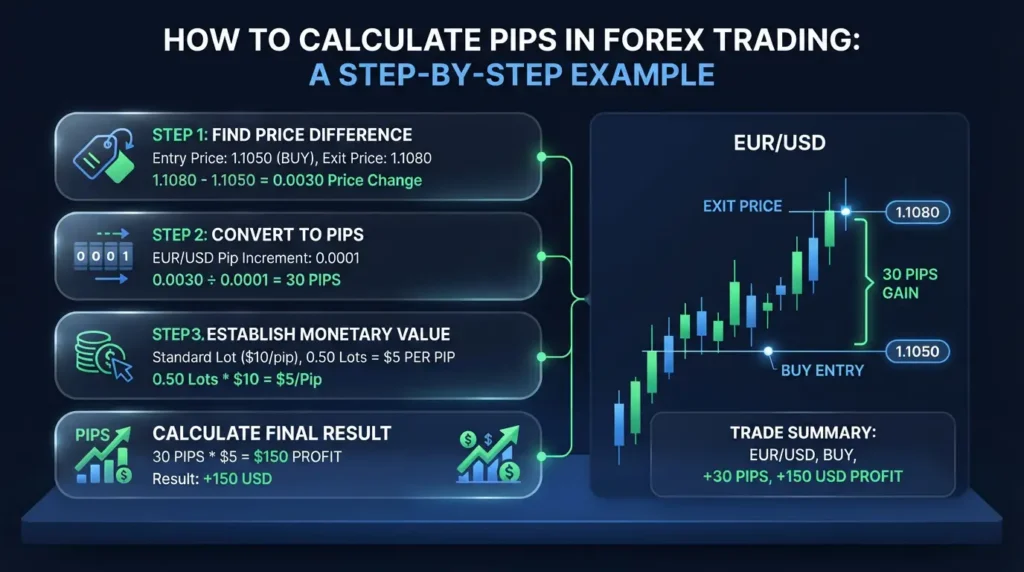
Calculating the outcome of a completed trade involves finding the difference between entry and exit prices and dividing by the increment size. Below is a practical example using EUR/USD.
Trade setup:
- Currency pair: EUR/USD
- Entry price: 1.1050 (buy)
- Exit price: 1.1080
- Position size: 0.50 lots
Step 1 — Find the price difference:
1.1080 − 1.1050 = 0.0030
Step 2 — Convert to pips:
0.0030 ÷ 0.0001 = 30 pips
Step 3 — Establish monetary value:
Full standard lot on EUR/USD = $10 per pip. At 0.50 lots, the figure is $5 per pip.
Step 4 — Calculate the result:
30 × $5 = $150 profit
The same logic applies to a losing trade. If price had moved to 1.1030 instead, the count would be −20, producing a $100 loss at the same position size.
Pips and Lots: How Position Size Affects Profit and Loss
The number of pips gained or lost in a trade only tells part of the story. The actual monetary outcome depends directly on the lot size. A profit of 20 increments on a micro lot (0.01) amounts to approximately $0.20 on EUR/USD, while the same gain on a standard lot amounts to approximately $200.
These two concepts — increment count and lot size — are inseparable. Traders typically define their risk as a specific dollar amount per trade, then work backward to determine how many pips that represents at their chosen position size. A pip value calculator, available on most trading platforms, simplifies this process for less common forex pairs or cross-currency accounts.
Risk Management and Trading Strategies
This measure plays a direct role in how traders structure their approach to risk. A common method is to set a stop loss in forex trading at a defined distance from the entry, capping the maximum loss on any given trade. A trader might decide to risk no more than 20 pips on a EUR/USD trade — at a mini lot that equals $20; at a standard lot, $200.
Trading strategies that target a profit of 50 pips while risking 25 express a 2:1 risk-to-reward ratio — a concept built entirely on this form of measurement. Incorporating distance-based targets into trading decisions is a core element of structured, disciplined trading across all forex pairs.
Risk management also requires understanding that leverage in forex trading amplifies the monetary impact of each increment of price movement. The European Securities and Markets Authority (ESMA) has noted that between 70% and 89% of retail investor accounts lose money when trading CFDs and leveraged forex products, which underscores why understanding exposure in these terms matters before entering any leveraged position.
How Leverage in Forex Trading Affects Each Increment’s Value
Leverage in forex trading allows a trader to control a position much larger than their deposited capital. While leverage does not change the size of a pip or the formula used to calculate its value, it directly increases how much capital is exposed per increment of price movement.
A trader using 1:100 leverage can control a $100,000 position with $1,000 in margin. On EUR/USD, each pip on that standard lot is worth approximately $10. Without leverage, achieving the same exposure would require the full $100,000 in capital. This amplification makes it essential to understand position sizing and increment value before adjusting leverage settings. Past performance does not guarantee future results, and losses may exceed initial expectations when leverage is applied.
Pip, Pipette, Point, and Tick: Key Differences
These four terms are sometimes used interchangeably in trading discussions, but each refers to a distinct concept depending on context and broker conventions.
| Term | Definition |
| Pip | Standard measure of price movement (0.0001 for most pairs, 0.01 for JPY pairs) |
| Pipette / Fractional pip | One-tenth of the full increment (fifth decimal for most pairs, third for JPY pairs) |
| Point | Sometimes a synonym for pip; sometimes refers to the last displayed digit including fractional readings — varies by broker |
| Tick | The minimum price increment a broker allows; often equals one pipette, but can differ |
For beginner traders, the most important distinction is between a pip and a pipette. The former is the standard figure used in all calculations, risk settings, and spread comparisons. The latter is a finer subdivision that appears in quotes but does not typically affect core value calculations.
Practical Examples Across Currency Pairs
Seeing how this measure applies across different forex pairs reinforces the concept in practice.
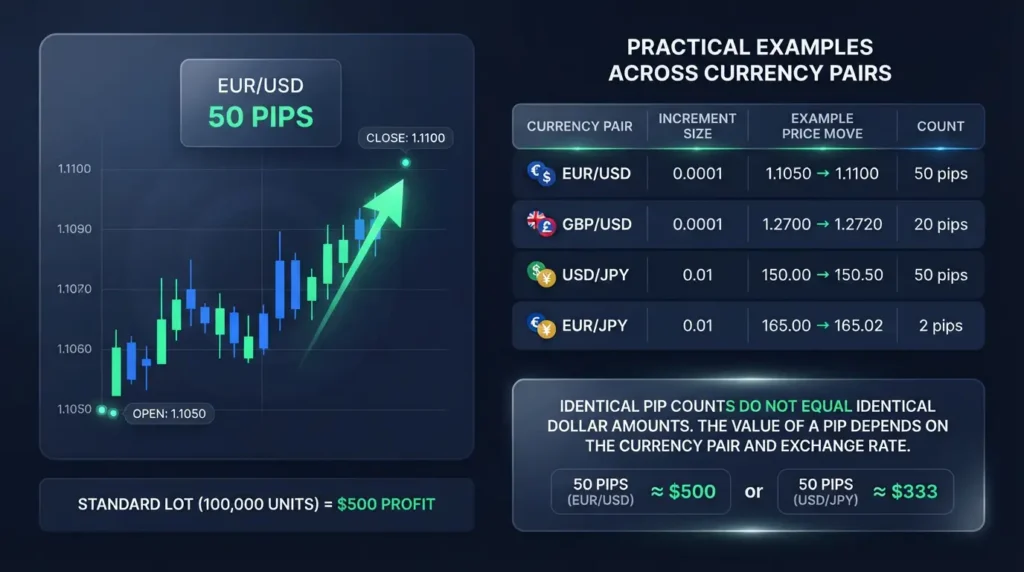
| Currency Pair | Increment Size | Example Price Move | Count |
| EUR/USD | 0.0001 | 1.1050 → 1.1100 | 50 pips |
| GBP/USD | 0.0001 | 1.2700 → 1.2720 | 20 pips |
| USD/JPY | 0.01 | 150.00 → 150.50 | 50 pips |
| EUR/JPY | 0.01 | 165.00 → 165.02 | 2 pips |
A 50-pip move on EUR/USD with a standard lot represents approximately $500 in profit or loss. The same count on USD/JPY with a standard lot represents approximately $333 at an exchange rate of 150.00. Identical counts do not always translate to identical dollar amounts across different currency pairs.
Using a Trading Platform to Monitor Price Movement
Most modern trading platforms display this data directly in the interface. When a position is open, the platform typically shows current profit or loss in both increment count and account currency — allowing traders to monitor results without manually recalculating after every price change.
Trading platforms such as MetaTrader 4 and MetaTrader 5 include built-in pip value calculators and allow stop-loss and take-profit levels to be set in these increments. For beginner traders, using these tools builds an intuitive connection between price movement and real monetary outcomes over time.
The Importance of Pips in Forex
The importance of pips in forex extends well beyond arithmetic. This measure is the shared language of the forex market — how traders communicate price movement, compare costs, define risk, and evaluate performance. Every spread paid is denominated in pips. Every risk management decision anchors to a specific count. Every trade outcome is first expressed in these terms before being converted into a monetary figure.
For anyone at the start of their trading journey, a solid grasp of pip value, pip calculation, and pip-based risk management is not optional. It is the foundation on which every other concept in forex trading is built. The ability to calculate the value of each increment, read spreads accurately, and use distance-based levels to define exposure is what separates reactive trading from structured, informed decision-making.
Frequently Asked Questions
What does pip stand for in forex?
Pip stands for “percentage in point” or “price interest point.” It is the standardized measure of price movement in a currency pair. For most major pairs, one pip equals 0.0001, sitting at the fourth decimal place in the quoted price. For Japanese yen pairs, the same increment equals 0.01, at the second decimal place.
How much is 1 pip worth in USD?
The value of one pip in USD depends on the currency pair and position size. For a standard lot on a USD-quoted pair such as EUR/USD, one pip is worth approximately $10. For a mini lot the figure is approximately $1, and for a micro lot approximately $0.10. For non-USD quote currency pairs like USD/JPY, the value must be converted using the current exchange rate, as shown in the calculation examples above.
What is the difference between a pip and a pipette?
A pip is the standard measure of price movement in forex — 0.0001 for most pairs and 0.01 for Japanese yen pairs. A pipette, also called a fractional pip, equals one-tenth of this full increment. It appears as the fifth decimal digit for most major pairs and the third decimal digit for JPY pairs. Pipettes appear in broker quotes for finer pricing but are not used in standard value calculations.
Can pips be negative?
Price moves in both directions. A trader who buys a currency pair and sees the rate fall will have a negative count on the trade, reflecting a loss. Buying EUR/USD at 1.1050 and closing at 1.1020 represents a move of −30 pips. The increment itself remains a fixed positive measure; the negative sign reflects the direction of price change relative to the open trade.
Do all forex brokers use the same pip size?
For standard major currency pairs, the increment size is consistent across regulated brokers — 0.0001 for most pairs and 0.01 for JPY pairs. The number of decimal places displayed may vary: some brokers show five decimal places, with the fifth being a fractional reading. The core measure remains unchanged regardless of display format. Confirming a broker’s quoting convention early in the trading journey is always advisable.