Forex Trading USD INR: How the Rupee–Dollar Currency Pair Works

Forex trading USD INR is one of the most closely watched currency activities in Asia. The USD INR pair — the US dollar against the Indian rupee — reflects the economic relationship between the world’s largest economy and one of its fastest-growing ones. For beginner traders in India, understanding how this currency pair behaves, what moves its price, and where it can be traded is a practical starting point before exploring broader forex markets. This guide covers the structure of the USD INR pair, the forces that drive it, and the trading concepts most relevant to new market participants.
Key Takeaways
- USD INR shows how many Indian rupees are needed to buy one US dollar; a quote of 85 means 1 USD = 85 INR.
- The Reserve Bank of India manages a “managed float,” intervening to smooth sharp rupee moves.
- Indian retail traders primarily access the USD INR pair through futures and options on the NSE and BSE.
- Key price drivers include oil prices, foreign investment flows, RBI policy, and US Federal Reserve decisions.
- Intraday trading in USD INR is most liquid during the Indian session, roughly 09:00–17:00 IST.
- Risk management tools such as stop loss orders are essential when trading volatile currency pairs.
- Past performance does not guarantee future results; losses may exceed initial expectations in leveraged trading.
What Is the USD INR Currency Pair?
The USD INR pair represents the exchange rate between the US dollar and the Indian rupee. In forex notation, USD is the base currency and INR is the quote currency. A rate of USD/INR = 85 means one US dollar buys 85 Indian rupees. This is the foundational definition that every trader working with this pair needs to understand.
When the USD INR rate rises, the US dollar is strengthening relative to the rupee — meaning the rupee is weakening. When the rate falls, the rupee is gaining value against the dollar. For example, at USD/INR = 83.50, one dollar costs 83.50 rupees. A trader who expects the dollar to strengthen relative to the rupee would consider buying the pair; a trader who expects the rupee to strengthen would consider selling it.
The USD INR pair is part of the broader foreign exchange market, which is the largest and most liquid financial market in the world. For a structured introduction to how this market operates, the complete forex trading guide covers the essential mechanics for new participants.
Where Is USD INR Traded?
International Forex (OTC Market)
USD INR is available through international brokers as spot forex on the over-the-counter (OTC) market. This market operates near 24 hours a day during the trading week, with floating spreads and access across global sessions. Spreads on USD INR through international platforms can be wider than those seen on major pairs such as EUR/USD or USD/JPY, given relatively lower global liquidity compared to those instruments.
Indian Exchanges: NSE and BSE
In India, the primary way retail traders access USD INR is through currency derivatives — specifically futures and options contracts listed on the National Stock Exchange (NSE) and the Bombay Stock Exchange (BSE). Settlement of these contracts is in Indian rupees, and contract expiries typically fall at month-end. This structure means Indian traders do not directly hold foreign currency but instead trade INR-settled instruments that track the USD INR rate.
The tick size for USD INR contracts on Indian exchanges is typically 0.25 paise, or 0.0025 INR. This is the minimum price movement for these instruments — understanding tick size matters for calculating potential gains or losses on a position. For a broader understanding of how Indian traders access the foreign exchange market, the guide to Indian forex market access provides relevant regulatory and structural context.
Trading Hours
For Indian instruments, liquidity in USD INR is highest during the Indian session, roughly 09:00 to 17:00 IST. During these forex market hours in India, bid-ask spreads tend to be tighter and order execution more consistent. Outside this window, particularly after the NSE closes, liquidity drops and price gaps may appear. The guide to forex market hours in India explains how global trading sessions interact with Indian market timings.
What Drives the USD INR Exchange Rate?
Capital Flows and Foreign Investment
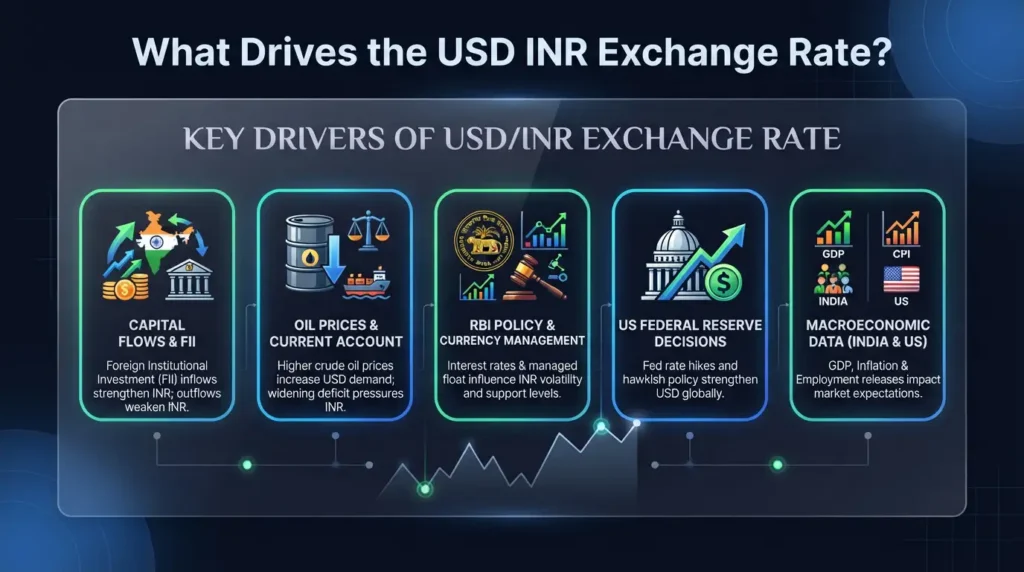
Capital flows are among the most immediate drivers of the USD INR rate. When foreign institutional investors (FIIs) bring capital into Indian equity or debt markets, they convert US dollars into rupees — increasing demand for INR, which strengthens the rupee and pushes the USD INR rate lower. When those investors withdraw capital, they sell rupees and buy dollars, weakening the INR and pushing USD INR higher. Tracking FII flow data is a common element in macroeconomic analysis of the rupee.
Oil Prices and the Current Account
India is one of the world’s largest oil importers. When global crude oil prices rise, India’s import bill increases — meaning more dollars must be spent on oil purchases. This creates additional demand for USD and selling pressure on INR, which generally pushes USD INR higher. A widening current account deficit — when India imports significantly more than it exports — adds structural pressure to the rupee over time. Traders monitoring the USD INR pair often track Brent crude prices as a correlated indicator.
RBI Policy and Currency Management
The Reserve Bank of India does not allow the rupee to float freely. Instead, the RBI operates a “managed float” — intervening in the currency market by buying or selling US dollars to smooth excessive volatility in the INR exchange rate. This intervention creates informal range zones and support or resistance levels where price movement tends to slow. When INR depreciates sharply, the RBI may sell dollars from its foreign exchange reserves to support the rupee.
RBI monetary policy decisions — including interest rate changes, inflation targets, and liquidity measures — also influence the INR rate. Higher interest rates in India relative to the US can attract foreign capital and support the rupee; lower rates relative to the US may have the opposite effect.
US Federal Reserve and Macro Data
Because USD is the base currency in the USD INR pair, decisions by the US Federal Reserve have a direct impact on the pair’s price. When the Fed raises interest rates, the US dollar tends to strengthen globally, which pushes USD INR higher. US macroeconomic data — such as GDP growth figures, inflation reports (CPI), and employment numbers — also drives dollar strength or weakness.
Indian macro data matters equally: India’s own GDP growth rate, inflation readings, fiscal deficit figures, and Union Budget announcements can shift market expectations for the rupee. Understanding how these economic factors influence currency prices is covered in depth in the guide to forex fundamental analysis.
Understanding USD INR Price Behaviour
Volatility and Daily Ranges
The USD INR pair is less volatile than some emerging market currencies but more reactive than major pairs during risk-off episodes in global markets. Typical daily ranges fall between 30 and 60 paise (0.3–0.6% of the rate). During major macro events — US Fed decisions, Indian budget announcements, or global oil shocks — intraday ranges can expand significantly.
Volatility in currency pairs reflects uncertainty in demand and supply for the currencies involved. For beginner traders, higher volatility means larger potential price swings — which increases both the opportunity and the risk on any open position.
Liquidity Conditions
Liquidity in USD INR is strongest during Indian trading hours and around key economic data releases. Thin liquidity — such as during early morning hours or around holidays — can lead to wider spreads and less predictable price movement. Traders using intraday trading strategies typically prefer periods of normal liquidity to manage execution risk.
Trading Strategies for USD INR: Core Concepts
This section explains common approaches that traders use when trading USD INR. These are educational descriptions of market behaviour and trading concepts — not instructions or recommendations.
Range Trading
Range trading involves identifying price levels where USD INR has historically found support (a floor) and resistance (a ceiling). Because the RBI intervenes to limit sharp moves, the USD INR pair often trades within observable bands for extended periods. Some traders use support and resistance levels to guide entry and exit thinking within these ranges. Range trading strategies tend to work differently in trending markets, where price breaks through established zones.
Position Trading
Position trading refers to holding a trade for days, weeks, or even months based on a macro view of the currency pair. A position trader in USD INR might form a view on the direction of the rupee based on India’s current account trends, RBI policy expectations, or the trajectory of US interest rates. This approach requires careful risk management because holding positions longer exposes the trader to more cumulative price movement.
Intraday Trading
Intraday trading in USD INR involves opening and closing positions within the same trading session, with traders required to square off the position before market close. This is common in NSE-listed USD INR futures, where many retail participants take short-term views on price movement during the day. Intraday approaches rely heavily on technical analysis — the use of price charts, indicators, and historical pattern recognition to anticipate near-term moves.
Event-Driven Trading
Some traders focus on high-impact macro events such as RBI policy meetings, US CPI releases, India’s Union Budget, or OPEC oil output decisions. Price movement around these events can be sharp and fast. Understanding how event risk affects the USD INR rate requires knowledge of both Indian markets and global macro drivers.
Risk Management in USD INR Trading
Risk management is a core discipline for any trader working with the USD INR pair or any other currency. Leveraged instruments — including futures and options contracts on the NSE and BSE — amplify both gains and losses relative to the capital committed.
The three foundational risk management tools used in USD INR trading are:
- Stop Loss — an order placed at a defined price level that automatically closes a position if the market moves against the trader beyond a set threshold. Using a stop loss limits the maximum loss on a trade and is a foundational element of any complete trading strategy. Without predefined risk limits, a single adverse price movement can result in losses that exceed the trader’s initial margin.
- Leverage Control — leverage allows a trader to control a larger position with a smaller deposit. For example, if a trader uses leverage of 10:1, a position worth INR 100,000 requires only INR 10,000 in margin. While leverage increases the size of potential returns, it also increases potential losses by the same factor. The European Securities and Markets Authority (ESMA) notes that the majority of retail traders who use leverage in currency markets experience net losses — a finding consistent with data from Indian market regulators as well.
- Hedging — businesses that import or export goods may use USD INR futures and options contracts to hedge against unfavourable exchange rate moves. A company expecting to pay dollars for oil imports, for example, might buy USD INR contracts to lock in a rate, reducing exposure if the rupee depreciates before payment.
Past performance does not guarantee future results. Losses may exceed initial expectations, particularly when trading leveraged instruments in volatile market conditions.
Understanding USD INR Futures and Options
USD INR Futures
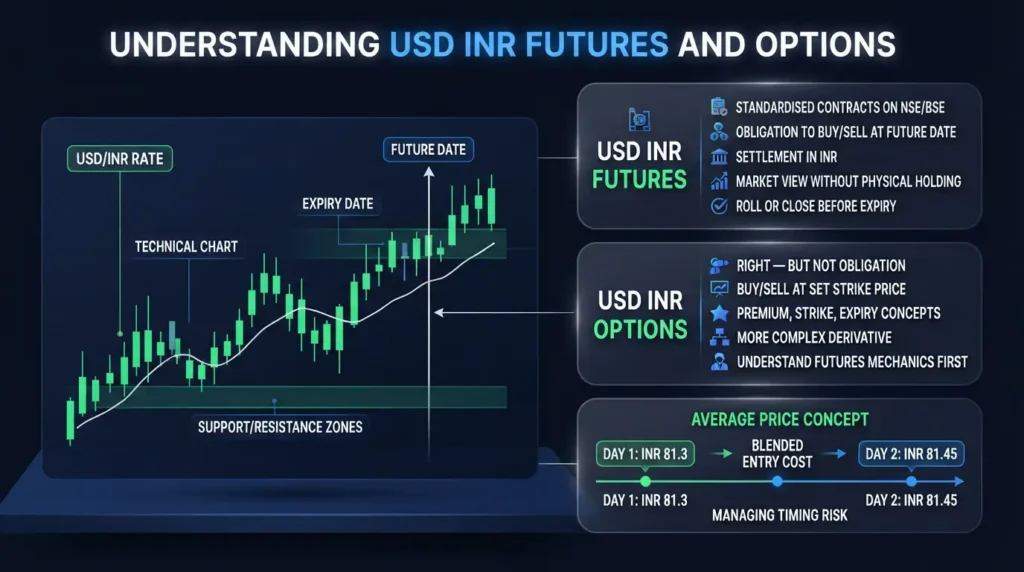
USD INR futures are standardised contracts traded on the NSE and BSE that obligate the buyer and seller to exchange a set amount of US dollars at a specified rate on a future date. Settlement is in Indian rupees. These contracts allow traders to take a view on where the USD INR rate will be at expiry without physically holding foreign currency. Most retail participants in USD INR futures close or roll their positions before expiry rather than holding to settlement.
Options Trading on USD INR
USD INR options give the buyer the right — but not the obligation — to buy or sell the pair at a set price before or at expiry. Options trading in currency derivatives is more complex than futures trading and involves additional concepts such as premium, strike price, and expiry. For beginners, understanding futures mechanics thoroughly before approaching options is generally considered a more structured path.
TWAP and Average Price Concepts
Some strategies involve building a position gradually rather than entering all at once. For example, a trader might buy USD INR contracts on multiple days to achieve an average entry rate. If a trader buys contracts on Day 1 at an average price of INR 81.3 and adds on Day 2 at INR 81.45, the blended entry cost sits between those two levels. This approach — sometimes called averaging — is used to manage timing risk when a trader expects a directional move but is uncertain about short-term price oscillations.
Technical Analysis in USD INR Trading
Technical analysis is the practice of using historical price data, chart patterns, and mathematical indicators to assess potential future price direction. In USD INR trading, technical analysis is widely used by intraday traders and short-term position holders.
The most common technical tools applied to the USD INR market are:
- Moving Averages — smooth price data over a set period to reveal the underlying trend direction
- Relative Strength Index (RSI) — measures momentum and flags whether a pair may be overbought or oversold
- Bollinger Bands — plot volatility ranges around price, widening during high-volatility periods and narrowing during quiet ones
- Support and Resistance Levels — price zones derived from past price action where buying or selling pressure has historically appeared, including levels associated with RBI intervention
Technical analysis does not predict future outcomes with certainty. Indicators may indicate a probable direction but cannot account for sudden macro shocks, unexpected RBI intervention, or abrupt changes in global risk sentiment.
How to Choose Broker for USD INR Trading
The right broker depends on whether a trader is accessing USD INR through Indian exchanges or international forex platforms. The two routes are regulated differently and suit different trading needs.
| Factor | SEBI-Regulated Indian Broker | International Forex Broker |
| Instruments available | USD INR futures and options (NSE/BSE) | USD INR spot forex |
| Regulator | SEBI (India) | FCA (UK), ASIC (Australia), CySEC (Cyprus) |
| Settlement currency | Indian rupee (INR) | Varies by account base currency |
| Typical trading hours | 09:00–17:00 IST | Near 24 hours on weekdays |
| Spreads | Exchange-determined | Broker-determined, often wider for USD INR |
| Best suited for | Indian retail traders, derivatives | Traders wanting spot access |
SEBI-registered brokers are required to follow disclosure norms, margin rules, and investor protection standards set by the regulator. International brokers should be verified against their home regulator’s public register before depositing funds. A reliable trading platform should provide real-time price data, charting tools, and order management features relevant to currency markets.
FAQ
What does USD INR trading refer to?
USD INR trading refers to the buying and selling of contracts or spot positions linked to the exchange rate between the US dollar and the Indian rupee. INR trading is the purchase or sale of instruments priced in Indian rupees relative to another currency — in this case, the dollar. Traders take positions based on expectations of whether the dollar will strengthen or weaken against the rupee.
What is the tick size for USD INR contracts on Indian exchanges?
The tick size for USD INR contracts on the NSE and BSE is typically 0.25 paise, or 0.0025 INR. This is the smallest price increment by which the contract price can move. Understanding tick size helps traders calculate the monetary value of each minimum price move on their position.
How does RBI intervention affect USD INR price movement?
The Reserve Bank of India intervenes in the currency market to prevent excessive rupee depreciation or appreciation. When the rupee falls sharply, the RBI may sell US dollars from its reserves to increase rupee supply and stabilise the rate. This intervention creates informal price zones where the USD INR pair tends to slow or reverse, which some traders incorporate into their range-trading analysis.
Is USD INR more or less volatile than major forex pairs?
The USD INR pair is generally less volatile than some emerging market currencies but more sensitive to global risk events than major pairs such as EUR/USD. Daily price ranges of 30–60 paise are typical under normal conditions. Volatility tends to spike around Indian Union Budget announcements, RBI policy meetings, US Federal Reserve decisions, and sharp moves in global oil prices.
What is the difference between spot forex and USD INR futures?
Spot forex refers to buying or selling a currency pair at the current market rate with immediate settlement (typically T+2). USD INR futures are standardised exchange-traded contracts with a fixed expiry date, and settlement is in Indian rupees. Indian retail traders typically use futures listed on the NSE or BSE, while international spot forex access requires an account with a regulated offshore broker.