Introduction to Forex Currency Pairs – Base Currency, Quote Currency, and Pricing

Forex trading begins with a single concept: two monetary units priced against each other. A currency pair is the instrument through which every transaction in the foreign exchange market takes place — the value of one unit expressed in terms of another. Understanding how these instruments are structured, priced, and traded is the essential first step for anyone exploring the forex market.
This guide explains what a forex pair represents, how exchange rates are quoted, the different categories of traded instruments, and what the pricing mechanics mean in practice for beginner traders.
Key Takeaways
- A currency pair represents the exchange rate between two monetary units, where the first listed is the base currency and the second is the quote currency.
- The exchange rate shows how much of the quote currency is needed to purchase one unit of the base.
- Forex instruments are grouped into major, minor, and exotic categories based on liquidity and trading volume.
- Buying a forex pair means acquiring the base currency while simultaneously selling the quote.
- Major instruments — such as EUR/USD, USD/JPY, and GBP/USD — offer the tightest spreads and the highest liquidity in the market.
- The bid/ask spread represents the cost of entering a trade and reflects the difference between what a broker will pay and what a broker will charge.
What Is a Currency Pair in Forex Trading?
A currency pair is the quotation of one monetary unit’s value relative to another in the foreign exchange market. The instrument represents the exchange rate between two distinct national units and serves as the backbone of forex trading. Every transaction in the forex market involves two assets — one being bought and one being sold simultaneously.
The concept is straightforward: if a trader in India wants to acquire US dollars using Indian rupees, they are interacting with a forex instrument that expresses the relative value of both monetary units. That price updates continuously based on global supply and demand for each unit involved.
These instruments are quoted using three-letter ISO codes assigned to each monetary unit by the International Organization for Standardization. EUR stands for the euro, USD for the US dollar, GBP for the British pound, and JPY for the Japanese yen. These standardized identifiers appear consistently across all trading platforms and financial data providers.
Base Currency and Quote Currency: The Two Components
Every forex instrument consists of exactly two components: the base currency and the quote currency. Understanding the role of each is essential before exploring how forex currency pairs work in practice.
The Base Currency
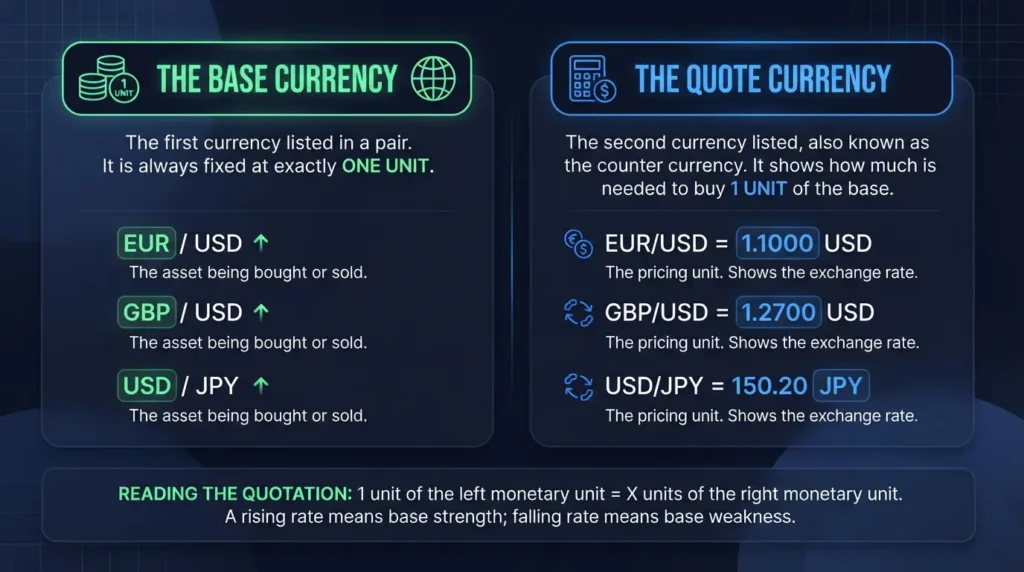
The base currency is always the first listed — positioned to the left of the slash. It is fixed at exactly one unit in every exchange rate quotation. In EUR/USD, EUR is the base currency. In GBP/USD, GBP fills the base position. In USD/JPY, the US dollar is the base.
The base currency functions as the “asset” being priced. When a trader buys a forex instrument, they are acquiring one unit of the base. When a trader sells, they are parting with one unit of the base currency.
The Quote Currency
The quote currency — also called the counter currency or terms currency — is always the second listed, to the right of the slash. The quote currency is the pricing unit: it shows how many units are needed to buy one unit of the base.
In EUR/USD = 1.1000, USD is the quote currency — 1 euro costs 1.1000 US dollars. In GBP/USD = 1.2700, 1 British pound costs 1.2700 US dollars. In USD/JPY = 150.20, JPY is the quote currency — 1 US dollar costs 150.20 Japanese yen.
Reading the Quotation: Left to Right
The simplest rule for reading any forex quotation is left to right: “1 unit of the left monetary unit equals X units of the right.” This applies universally across all instruments. A rising rate means the base has strengthened relative to the quote. A falling rate means the base has weakened.
Types of Currency Pairs in Forex Trading
Not all forex instruments carry equal liquidity, trading volume, or market accessibility. The market broadly divides them into three categories: major, minor, and exotic. Each type has distinct characteristics relevant to beginner traders.
| Type | Definition | Examples | Typical Spread |
| Major | USD + one other major monetary unit | EUR/USD, USD/JPY, GBP/USD | Lowest |
| Minor (Cross) | Two major monetary units, no USD | EUR/GBP, EUR/JPY, GBP/JPY | Moderate |
| Exotic | One major monetary unit + one emerging market unit | USD/INR, EUR/TRY, USD/ZAR | Highest |
Major Currency Pairs
Major currency pairs are the most actively traded instruments in the world. These always include the US dollar on one side — either as the base or the quote — alongside one other major monetary unit. The most widely traded combination globally is EUR/USD, representing the euro against the US dollar.
Major instruments offer the highest liquidity and narrowest spreads, making them a natural starting point for anyone new to the forex market. For a deeper look at the most actively traded instruments, M4Markets offers a full breakdown in its guide to major currency pairs.
Minor Pairs (Cross-Currency Pairs)
Minor pairs — also called cross-currency pairs — involve two major monetary units but exclude the US dollar. EUR/GBP, EUR/JPY, and GBP/JPY are common examples. These instruments tend to carry slightly wider spreads and somewhat lower liquidity than their major counterparts, though they remain actively traded.
Cross-currency instruments are useful when a trader wants exposure to two non-USD economies without routing the trade through the dollar. A view on the British pound relative to the euro, for instance, uses GBP/EUR directly.
Exotic Currency Pairs
Exotic currency pairs combine one major monetary unit — typically the US dollar — with the currency of an emerging or smaller economy. Examples include USD/INR (US dollar vs Indian rupee), USD/ZAR (US dollar vs South African rand), and EUR/TRY (euro vs Turkish lira).
Exotic instruments carry wider spreads, lower liquidity, and higher volatility than major or minor alternatives. This combination can amplify both opportunity and risk. Traders interested in USD/INR forex trading can find a dedicated explanation in M4Markets’ guide to forex trading USD/INR.
How Exchange Rates Work: Pricing in the Forex Market
The exchange rate is the price at which one monetary unit can be exchanged for another. In the forex market, rates update continuously throughout the trading session, reflecting real-time shifts in supply and demand.
A rising EUR/USD rate means the euro is strengthening against the dollar — more dollars are needed to purchase one euro. A falling rate means the euro is weakening. These movements respond to macroeconomic factors including interest rate decisions, inflation data, trade balances, political developments, and broader market sentiment.
The Bid and Ask Price
Every forex instrument is quoted with two prices: the bid and the ask. These two figures reflect the two-sided nature of every transaction.
- Bid price — the price at which the broker buys the base from the trader. This is what a trader receives when selling the instrument.
- Ask price (offer) — the price at which the broker sells the base to the trader. This is what a trader pays when buying.
Example: EUR/USD = 1.0842 / 1.0844
Buying costs 1.0844 USD per euro. Selling returns 1.0842 USD per euro. The difference between these two figures is the spread.
The Spread
The spread equals Ask minus Bid. In the example above: 1.0844 − 1.0842 = 0.0002, or 2 pips. The spread is the immediate cost of entering a trade and is retained by the broker as compensation for facilitating the transaction. Major instruments tend to have tighter spreads due to high volume, while exotic combinations carry wider spreads due to lower participation.
Buying and Selling: How Forex Currency Pairs Work in Practice
Understanding the directional mechanics of trading is fundamental to understanding the forex market itself.
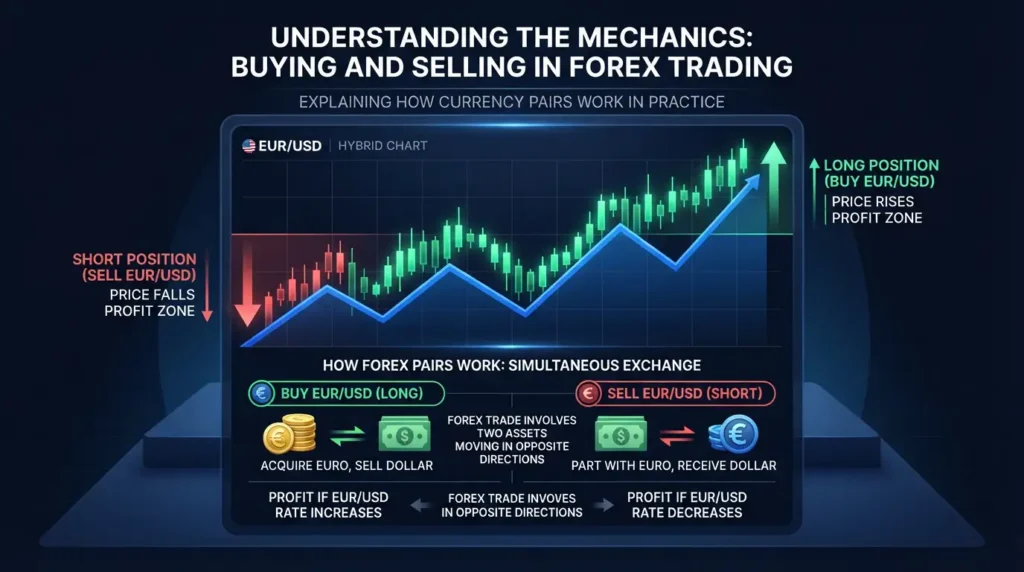
- Buying a forex instrument means acquiring the base monetary unit while simultaneously selling the quote. If a trader buys EUR/USD at 1.1000, they are exchanging US dollars for euros. A profit arises if the rate rises — meaning the euro has strengthened against the dollar.
- Selling a forex instrument means parting with the base monetary unit while simultaneously acquiring the quote. If a trader sells EUR/USD at 1.1000, they are selling euros and receiving dollars. A profit arises if the rate falls — meaning the euro has weakened.
This simultaneous nature — buying one monetary unit and selling another — is what distinguishes forex trading from buying a stock or commodity. The market always involves two assets moving in opposite directions, and the exchange rate reflects the relationship between them rather than the absolute value of either.
Exploring Currency Pair Categories Further
For beginner traders, choosing which instruments to start with can significantly affect the learning experience. Instruments with higher liquidity tend to display more predictable price behavior, attract more available analysis, and cost less to enter through tighter spreads. Lower-liquidity instruments may move more sharply on less news and carry higher entry costs.
A practical overview of this decision is available in M4Markets’ guide to beginner-friendly currency pairs, which covers liquidity, volatility, and spread considerations in depth. For those new to the forex market in general, M4Markets’ forex trading guide provides a complete introduction to how the market functions overall.
Risk Awareness in Forex Trading
Forex instruments are used in leveraged trading environments, which means traders can control positions larger than their initial deposit. While leverage can amplify potential returns, it equally increases the size of potential losses. The European Securities and Markets Authority (ESMA) has noted that a significant majority of retail investor accounts lose money when trading leveraged products such as forex and CFDs.
The forex market is open 24 hours a day, five days a week, and exchange rates can shift rapidly in response to news events, central bank announcements, or geopolitical developments. Past performance does not guarantee future results, and losses may exceed initial expectations in volatile conditions.
Risk management tools such as stop-loss orders and position sizing are commonly used approaches to limiting exposure — though no method eliminates risk entirely when trading with leverage.
FAQ
What does a currency pair represent?
A currency pair represents the exchange rate between two monetary units in the foreign exchange market. The quotation expresses how much of the second listed unit — the quote currency — is required to purchase one unit of the first, known as the base. For example, EUR/USD = 1.1000 means one euro costs 1.10 US dollars at the current market rate.
What is the difference between the base currency and the quote currency?
The base currency is the first listed in any forex quotation and is always priced at one unit. The quote currency is the second listed and shows the cost of buying one unit of the base. In USD/JPY, the US dollar is the base and JPY is the quote — so if USD/JPY = 150.20, one dollar equals 150.20 Japanese yen.
Why do some forex instruments have wider spreads than others?
The spread reflects the liquidity and trading volume of a given instrument. Major combinations like EUR/USD attract the highest number of market participants, which keeps bid/ask differences tight. Exotic instruments — combining a major monetary unit with an emerging market one — see less trading activity, so brokers price in a wider spread to compensate for the higher cost of providing liquidity in those markets.
How does buying a forex instrument differ from selling one?
Buying means acquiring the base monetary unit by spending the quote. Selling means parting with the base in exchange for the quote. Both actions happen simultaneously, since foreign exchange always involves two assets moving in opposite directions at the same moment.
What are cross-currency pairs?
Cross-currency pairs — also called minor pairs — include two major world monetary units but exclude the US dollar. EUR/GBP and GBP/JPY are common examples. These instruments allow traders to express a view on the relative strength of two non-USD economies without routing through a dollar-based trade, and they generally carry moderate liquidity with slightly wider spreads than major instruments.
Are exotic instruments suitable for beginners?
Exotic instruments carry higher volatility and wider spreads than major or minor alternatives, which increases both potential opportunity and potential risk. Most experienced market participants suggest that beginners start with major instruments to develop familiarity with price behavior and market mechanics before moving into less liquid territory. All trading decisions should account for individual risk tolerance and financial circumstances.