Forex Trading Demo Account: How to Practice Without Real-Money Risk


For anyone new to trading, the forex market can feel overwhelming. Currency pairs, leverage, spreads, order types — there is a lot to absorb before placing a single trade. A forex trading demo account gives beginners a structured way to learn all of this without putting real money at risk. Using virtual funds in a live market environment, a practice setup allows traders to build confidence, test ideas, and understand how a trading platform works before ever opening a live account.
This guide explains what a forex demo account is, how simulated practice works in reality, and what beginner traders should know before making the transition to real trading.
Key Takeaways
- A forex trading demo account is a virtual practice environment that uses simulated funds to replicate real market conditions.
- This type of setup allows traders to test strategies and learn a platform without risking real money.
- Most forex brokers offer a free trial profile with no time limit and virtual balances ranging from $10,000 to $100,000.
- Simulated practice does not fully replicate live conditions — emotional pressure, slippage, and execution speed may differ when real funds are involved.
- Beginner traders are encouraged to use a practice environment before going live to build foundational trading skills.
What Is a Forex Trading Demo Account?
For anyone new to trading, the forex market can feel overwhelming. Currency pairs, leverage, spreads, order types — there is a lot to absorb before placing a single trade. A forex demo account gives beginners a structured way to learn all of this without putting real money at risk. Using virtual funds in a live market environment, this practice setup allows traders to build confidence, test ideas, and understand how a platform works before ever opening a live profile. This guide explains what a forex demo account is, how simulated practice works in reality, and what beginner traders should know before making the transition to real trading.
A forex trading demo account is a practice setup that allows traders to buy and sell currency pairs using virtual money instead of real funds. The profile connects to live or near-live market data, meaning the prices displayed reflect actual forex market movements. Beginners can use a forex demo account to explore how the market works, test strategies, and learn the platform — all without any financial risk.
A simulated practice environment is provided by forex brokers as a free tool for both new and experienced traders. This virtual setup is not a simplified simulation — it mirrors real conditions as closely as possible, including live spreads, leverage settings, and the full range of available order types. For a broader understanding of how the forex market operates before opening any profile, the forex trading overview at M4Markets provides a foundational explanation of how currencies are traded globally.
How Does a Forex Demo Account Work?
A forex demo account works by giving the trader access to a platform pre-loaded with virtual funds — typically between $10,000 and $100,000 depending on the broker. The trader registers for the practice profile, receives login credentials, and accesses the platform through MetaTrader 4, MetaTrader 5, cTrader, or a broker’s own web-based interface.
Once logged in, the trader selects a currency pair such as EUR/USD, chooses a position size, and opens a buy or sell order. The virtual balance then changes in real time based on price movements and simulated costs such as spreads and overnight swap fees. If a virtual EUR/USD trade moves in the trader’s favour, the platform shows a virtual profit. If the price moves against the position, the practice profile shows a virtual loss — but no real funds are deposited or withdrawn at any point.
These simulated setups often include the same order types available on a live profile, including market orders, limit orders, and stop orders. Traders can also set stop-loss and take-profit levels, practise managing open positions, and review their trade history — all within the risk-free environment of the practice setup.
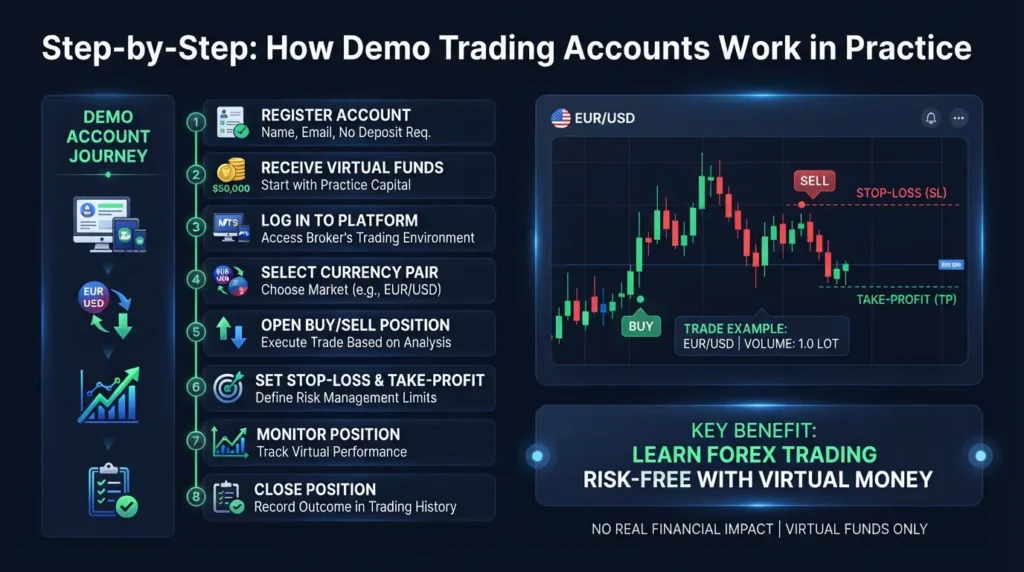
Step-by-Step: How Demo Trading Accounts Work in Practice
The following sequence describes how a beginner trader typically moves through a forex demo account from registration to executing a first trade:
- Register for a demo account with a forex broker — most require only a name and email address with no deposit.
- Receive virtual funds — the broker credits the practice profile with a set amount of virtual money, such as $10,000 or $50,000.
- Log in to the trading platform — typically MetaTrader 4, MetaTrader 5, cTrader, or a browser-based platform provided by the broker.
- Select a currency pair — for example EUR/USD, GBP/USD, or USD/JPY.
- Open a buy or sell position — based on the trader’s analysis of the chart or price movement.
- Set stop-loss and take-profit orders — to define the maximum virtual loss and target virtual profit for the trade.
- Monitor the position — the virtual balance updates in real time as the market moves.
- Close the position — the virtual profit or loss is recorded in the practice profile history with no real financial impact.
What Can Beginners Practise on a Demo Account?
A forex demo account enables beginner traders to develop a broad range of practical skills before committing real capital. The simulated environment allows traders to engage with the market in a structured way, building familiarity with tools and concepts that are essential for going live.
The following areas are commonly practised using virtual funds:
- Chart reading and technical analysis — identifying patterns, trends, and price levels using built-in charting tools and indicators on platforms such as MetaTrader 4.
- Order execution — opening, modifying, and closing market, limit, and stop orders to understand how positions are placed and managed.
- Core market concepts — understanding how pips, lots, spread, leverage, and margin interact within a real market environment.
- Forex trading strategies — testing different approaches such as trend-following or range methods to see how they perform under real market conditions.
- Risk management — applying stop-loss rules, calculating position sizes, and practising how to limit exposure on each trade.
- Platform navigation — learning how to use the broker’s interface, access market data, and manage a profile efficiently.
Simulated practice environments offer a controlled space where beginner traders can make mistakes, observe outcomes, and adjust their approach without any financial consequence. This process of testing and refining is one of the most practical ways to develop genuine skills before moving to a live setup.
Demo Account vs Live Trading Account: Key Differences
Understanding the difference between a demo account and a live profile is important for any beginner who plans to transition from simulated practice to real market activity. While the two environments share many features, there are meaningful distinctions that affect how traders perform and behave.
| Feature | Demo Account | Live Trading Account |
| Funds used | Virtual money | Real money |
| Emotional pressure | Low or absent | High — real profits and losses |
| Order execution | Simulated | Real — subject to slippage and liquidity |
| Spreads | May be tighter than live | Reflects actual market conditions |
| Risk of losing money | None | Real financial risk |
| Withdrawals | Not possible | Possible |
| Purpose | Learning and testing | Active market participation |
The most significant difference between simulated and live market activity is psychological. Due to the absence of real financial stakes, a practice setup does not replicate the emotional pressure that comes with risking real money. Feelings such as greed and fear — which are well-documented influences on trader behaviour — are largely absent in a simulated environment. A trader who performs consistently well on a demo account may respond differently once real funds are involved, because the pressure to win or lose trades carries genuine financial consequences.
According to the European Securities and Markets Authority (ESMA), approximately 70–89% of retail investor accounts lose money when operating with CFDs and leverage. This statistic underlines why practising in a simulated environment and developing a sound plan before going live is considered an important preparatory step.
Important Limitations of a Demo Account
A forex demo account is a valuable learning tool, but it is not a perfect replica of live conditions. Beginner traders should be aware of the following limitations before assuming that simulated performance will translate directly to a live profile.
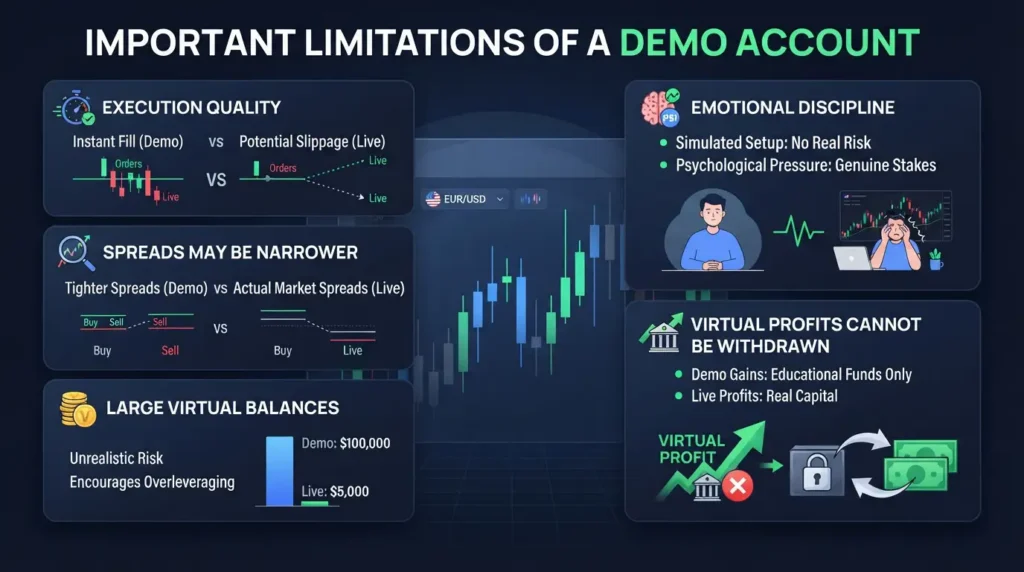
- Execution quality may differ. In a practice environment, orders are filled instantly at the displayed price. In live markets, execution can be affected by slippage — meaning the position fills at a slightly different price than expected, particularly during fast-moving conditions or major news events.
- Spreads may be narrower on demo. Some forex brokers display tighter spreads in the simulated setup than those available when operating with real funds. This can make practice results appear more favourable than they would be under actual market conditions.
- Large virtual balances encourage unrealistic risk. Practice profiles often come pre-loaded with $50,000 or $100,000 in virtual funds. Traders who use the full balance freely may take position sizes and risks they would never take with real money, making the simulated experience less transferable to live activity. A more realistic approach is to set the practice balance to match what would realistically be deposited in a live profile and apply the same risk management rules from the start.
- Emotional discipline cannot be fully developed in a simulated setup. Because no real money is involved, it is difficult to build genuine emotional resilience through virtual practice alone. Risk management habits formed in a simulated environment may not hold under the psychological pressure of a live profile.
- Virtual profits cannot be withdrawn. Any gains made through practice are not real and cannot be converted into real funds. Demo accounts are designed exclusively for learning and education, not for generating income.
How to Use a Demo Account Effectively
Using a demo account effectively requires more than simply placing trades and observing outcomes. Beginner traders who approach simulated practice with structure and discipline are more likely to develop skills that carry over to a live environment.
- Match the practice setup conditions to realistic live profile conditions. Set the virtual balance to the amount that would realistically be deposited in a live setup. Use the same leverage settings and position sizes that would be used with real funds. This makes the simulated experience a more accurate preparation for real market activity.
- Follow a plan from the start. A plan defines the rules a trader follows when entering and exiting positions — including which currency pairs to operate, what conditions trigger a trade, and how much of the balance is risked on each position. Practising with a structured approach on a demo account helps build the discipline needed to follow rules consistently under live conditions. Beginners looking to develop their first approach can explore forex trading strategies as a starting point.
- Keep a trading journal. Recording each position — including the reasoning behind the entry, the outcome, and any observations about what worked or did not — is a practice used by many experienced traders. Maintaining a journal during simulated practice helps identify patterns in decision-making and builds the habit of reviewing performance objectively.
- Set a defined practice period. Rather than using a demo account indefinitely, beginner traders may find it useful to set a specific timeframe — such as four to eight weeks — during which they focus on learning the platform, testing strategies, and building consistency before considering a live profile.
- Treat virtual losses as if they were real. One of the most common mistakes in a simulated environment is continuing to operate after a large virtual loss without reflecting on what went wrong. Treating practice losses with the same seriousness as real losses helps build accountability and better prepares traders for the emotional realities of live market activity.
What to Look for When Choosing a Forex Broker’s Demo Account
Not all practice setups are structured the same way. When a beginner trader selects a forex broker to practise with, the quality and features of the simulated environment are worth considering alongside the broker’s overall offering.
- Platform availability. The practice profile should be accessible through the same platform that will be used for live activity. MetaTrader 4 remains one of the most widely used platforms among retail forex traders and is offered as a simulated environment by many forex brokers. Choosing a broker whose practice platform matches their live setup ensures that skills developed during simulated practice transfer directly to real conditions. For a detailed comparison of platform features and how to evaluate them, the guide on forex platform features covers the key considerations for beginners.
- Virtual balance options. Some brokers allow traders to choose their starting virtual balance, which makes it easier to set up a realistic practice environment that reflects the trader’s intended live deposit size.
- Access to full instrument range. A useful simulated setup should provide access to the same currency pairs, spreads, and order types that are available on the live profile. This ensures that strategy testing in the practice environment is relevant to real conditions.
- No registration barriers. Most reputable forex brokers offer a free demo account with minimal registration requirements — typically just a name and email address, with no deposit required. A free trial that is easy to access allows beginners to start learning immediately without financial commitment.
When Is a Trader Ready to Move from Demo to Live Trading?
Moving from a practice setup to a live profile is a significant step, and there is no universal rule about when a trader is ready. However, several indicators are commonly associated with readiness to begin real market activity.
A trader may be in a better position to consider a live setup when they can execute positions consistently according to a defined plan, apply risk management rules without deviation, understand how leverage, margin, and spread affect each trade, and review their journal and identify both strengths and recurring mistakes. Consistency over time — not a single strong week of practice results — is generally considered a more meaningful signal of readiness.
It is also worth noting that moving to a live profile does not require starting with a large deposit. Many experienced traders and educators suggest beginning with a small live setup to introduce the psychological element of real money gradually, rather than making the jump from a large virtual balance directly to a fully funded live profile.
For beginners who are also considering the regulatory and practical requirements of setting up a live profile in a specific market, the guide on beginner forex setup in India covers the local regulatory framework and account setup process in detail.
FAQs
Is a forex demo account free?
Yes, the vast majority of forex brokers offer a free practice profile with no deposit required. The simulated setup is pre-loaded with virtual funds, typically ranging from $10,000 to $100,000, and can usually be opened with only a name and email address. Some brokers set a time limit on their practice setups, while others allow indefinite access. It is worth checking the specific terms of the broker’s offering before registering.
Can demo account profits be withdrawn?
No. Profits made in a simulated practice environment are virtual and cannot be withdrawn or converted into real money. The practice profile exists solely as a learning environment. Any virtual gains shown in the balance are a reflection of simulated market performance only, not real financial returns.
How long should a beginner use a demo account before trading live?
There is no fixed duration that applies to every trader. The appropriate length of time depends on the individual’s pace of learning, the complexity of the strategies being tested, and the level of consistency achieved. Many traders spend between four weeks and several months in a simulated environment before feeling prepared to move to a live profile. The key measure is not time spent but the quality and consistency of the behaviour developed during that period.
Does a demo account work the same as a live account?
A simulated practice profile replicates many features of a live setup, including real-time pricing, order types, and platform functionality. However, there are differences. Order execution in a practice environment is typically instant, while live activity may involve slippage. Spreads may be tighter in the simulated setup than in live conditions. Most significantly, the absence of real financial risk means that the emotional experience of operating in live markets — including the pressure of real profits and losses — is not fully replicated.
What is the main risk of relying too heavily on demo trading?
The primary risk of extended simulated practice without transitioning to a live profile is that it can create a false sense of readiness. Because no real money is involved, traders may develop habits — such as taking oversized positions or ignoring risk management rules — that would not be sustainable with real funds. Simulated practice is most effective when used with realistic conditions and treated with the same discipline that would be applied in a live setup. Past practice performance does not guarantee equivalent results in live activity, and losses when operating with real funds may exceed initial expectations.