
Lot Size in Forex Trading – How to Calculate Standard, Mini, and Micro Lots

Understanding forex trading lot size is one of the most practical steps a beginner can take before placing a first trade. In the forex market, a lot is a standardized unit of measurement that defines how much of a currency pair is being bought or sold. Choosing the correct trade volume determines how much each pip movement will affect a trading account — and therefore how much can be gained or lost on any single position.
This guide explains what lot size in forex means, how standard, mini, micro, and nano contracts differ, how pip value changes with trade volume, and how to calculate the right position volume based on account balance and planned risk.
Key Takeaways
- A standard lot equals 100,000 units of the base currency; a mini lot equals 10,000; a micro lot equals 1,000; and a nano lot equals 100 units.
- Trade volume determines the pip value of a position — a larger contract produces a greater monetary impact per pip movement.
- Lot size is not the same as margin. A low margin requirement does not reduce the actual market exposure of a position.
- The correct approach is to define the maximum acceptable loss first, then calculate the appropriate trade volume from the stop-loss distance and account risk.
- Micro and mini contracts give beginners more precise control over position exposure and risk per trade.
- Pip value varies across currency pairs and account currencies — the familiar $10-per-pip figure applies only to specific conditions.
What Is a Lot in Forex Trading?
A lot in forex trading is a standardized contract unit used to express the volume of a trade. Instead of specifying an exact number of currency units each time, forex brokers and trading platforms use these increments as a convenient shorthand. This standardized system helps traders, brokers, and systems communicate trade volume consistently across different markets and platforms.
In a forex pair such as EUR/USD, the base currency is EUR. When a trader opens a position of 1.00, the trade represents exposure to 100,000 euros. The chosen contract volume determines how many units of the base currency are involved in the transaction.
Types of Forex Lot Sizes
The forex market uses four main contract types. Each represents a different number of base currency units and produces a different pip value on most standard trading platforms.
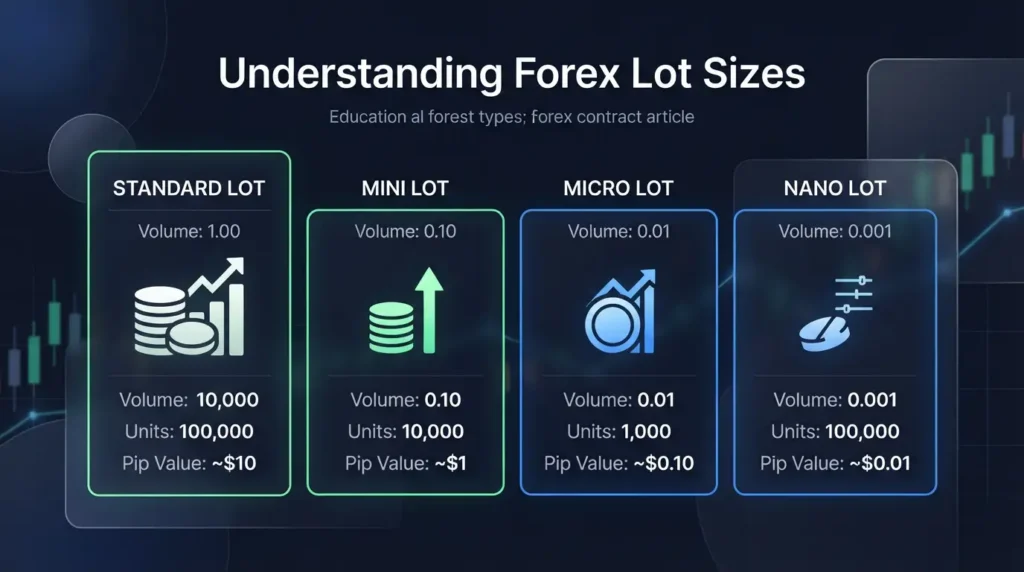
| Lot Type | Platform Volume | Currency Units | Approximate Pip Value (USD-quoted pairs) |
| Standard lot | 1.00 | 100,000 | $10 per pip |
| Mini lot | 0.10 | 10,000 | $1 per pip |
| Micro lot | 0.01 | 1,000 | $0.10 per pip |
| Nano lot | 0.001 | 100 | $0.01 per pip |
The pip values shown above are typical approximations for pairs where USD is the quote currency, such as EUR/USD, GBP/USD, and AUD/USD. Actual values vary depending on the exchange rate, account currency, broker contract specifications, and the specific instrument being traded.
Standard Lot
A standard lot equals 100,000 units of the base currency and is represented on trading platforms as a volume of 1.00. On EUR/USD, this contract means taking exposure to €100,000. For many USD-quoted major pairs, a 1-pip movement at this volume is approximately $10, a 10-pip movement is approximately $100, and a 50-pip movement is approximately $500.
The standard lot is the largest common contract type and creates significant market exposure. This volume is generally unsuitable for a small trading account unless the position carries a very tight stop-loss and the trader has carefully calculated the monetary risk in advance.
Mini Lot
A mini lot equals 10,000 units of the base currency, represented as 0.10 on the trading platform. For a typical USD-quoted pair, one pip at this volume is approximately $1. A 20-pip movement produces approximately $20, and a 50-pip movement produces approximately $50.
Mini contracts in forex are useful when a standard contract would create too much exposure but a micro contract would be unnecessarily small. For example, a volume of 0.30 is equivalent to three mini contracts, or 30,000 units of the base currency. This flexibility makes the mini contract a practical choice for traders who have moved beyond very small account balances but are not yet trading at the standard contract level.
Micro Lot
A micro lot equals 1,000 units of the base currency, represented as 0.01 on the trading platform. For a typical USD-quoted pair, one pip at this volume is approximately $0.10. A 20-pip movement produces approximately $2, and a 50-pip movement produces approximately $5.
Micro contracts allow traders to reduce market exposure significantly and adjust position volume with greater precision. This contract type is also commonly used when testing a strategy under live trading conditions while keeping the monetary risk per trade at a manageable level. For beginner traders opening a first live account, the 0.01 contract often represents the most appropriate starting point.
Nano Lot
A nano lot equals 100 units of the base currency and is represented as 0.001 on platforms that support it. The approximate pip value on USD-quoted pairs is $0.01. Not all forex brokers offer this contract type, and nano-scale trading is less common on standard retail platforms.
Nano-scale trading is primarily used when extremely small exposure is needed — for example, when fine-tuning a position volume calculation or when a very small account balance makes even micro contracts disproportionately large relative to the planned risk. Trading at nano scale allows traders to apply position-sizing discipline from the outset, which can help develop consistent habits before scaling up.
How Lot Size Determines Pip Value and Profit or Loss
Trade volume directly determines the monetary value of every pip movement. When the market moves against an open position, a larger contract produces a greater loss per pip. The same relationship applies in the favorable direction.
Using EUR/USD as an example, the approximate pip values are:
- Volume 1.00: $10 per pip
- Volume 0.10: $1 per pip
- Volume 0.01: $0.10 per pip
If a trade moves 35 pips against the position:
| Position Volume | Approximate Loss |
| 1.00 (standard) | $350 |
| 0.10 (mini) | $35 |
| 0.01 (micro) | $3.50 |
A 35-pip favorable movement would produce approximately the same amounts as profits, before accounting for spread, commission, swap charges, and slippage. Understanding how pips in forex relate to trade volume is fundamental to calculating the real monetary impact of any position.
Lot Size Is Not the Same as Margin
A common misunderstanding among beginner traders is that opening a position at a larger contract volume necessarily requires depositing its full notional value. In leveraged forex trading, the broker typically requires only a fraction of that notional value as margin to open and maintain the trade.
For example, if a EUR/USD position at standard volume has a notional value of $100,000 and the required margin is 1%, the margin requirement would be approximately $1,000. However, margin is only the amount reserved by the broker to keep the position open. The actual risk is determined by the trade volume and by how far the market can move before the stop-loss or margin call is triggered.
Leverage does not reduce the market exposure of the position. A forex leverage explained resource covers this concept in detail, including how leverage amplifies both gains and losses relative to the initial margin deposit. A low margin requirement does not make a large position low-risk. Understanding forex margin explained separately from trade volume helps avoid this common error.
How to Calculate Lot Size in Forex
The correct approach to calculating lot size in forex begins with defining the maximum acceptable loss on a trade, not with selecting the largest position the broker permits. The basic position-sizing formula is:
Lot size = (Account equity x Risk percentage) / (Stop-loss distance in pips x Pip value per standard lot)
This formula expresses the standard position-sizing relationship: the planned risk amount divided by the loss per contract at the stop-loss distance.
Worked Example: EUR/USD
Assume the following:
- Account balance: $5,000
- Maximum risk per trade: 1%
- Risk amount: $50
- Stop-loss distance: 40 pips
- Pip value of 1.00 standard lot: approximately $10
Lot size = 50 / (40 x 10) = 0.125 lots
If the broker accepts only 0.01 increments, rounding down to 0.12 rather than rounding up to 0.13 keeps the planned loss within the intended limit. At a volume of 0.12, the approximate planned loss is:
40 x $10 x 0.12 = $48
This figure excludes commission, spread, and possible slippage.
How Stop-Loss Distance Affects Lot Size
The wider the stop-loss, the smaller the trade volume must be to keep the same monetary risk. With a $50 risk limit on EUR/USD:
- 25-pip stop: 50 / (25 x 10) = 0.20
- 50-pip stop: 50 / (50 x 10) = 0.10
- 100-pip stop: 50 / (100 x 10) = 0.05
The trade setup determines where the stop-loss is placed; that distance then determines the appropriate position volume. Reversing this logic — selecting a trade volume first and adjusting the stop-loss afterward — is a common mistake that can lead to inconsistent risk per trade.
Understanding Platform Volume: What Does 0.25 Lots Mean?
Trading platform volumes are expressed in standard contract units. The conversion between platform volume and currency units follows a simple formula:
Currency units = Lot size x 100,000
Common examples:
| Platform Volume | Currency Units | Description |
| 1.00 | 100,000 | One standard lot |
| 0.50 | 50,000 | Half a standard lot |
| 0.25 | 25,000 | Quarter of a standard lot |
| 0.10 | 10,000 | One mini lot |
| 0.05 | 5,000 | Five micro contracts |
| 0.01 | 1,000 | One micro lot |
A volume of 0.25, for example, represents 25,000 units of the base currency. On EUR/USD, where a standard contract carries a pip value of approximately $10, a position of 0.25 would produce approximately $2.50 per pip.
When Pip Value Is Not $10
The $10-per-pip figure is a useful reference point, but it applies only under specific conditions: the currency pair must be quoted in USD (as in EUR/USD or GBP/USD), and the trading account must be denominated in USD. Pip value can differ in several common situations.
- When USD is the base currency (such as USD/JPY), the calculation differs because the USD is the currency being measured, not the quote currency.
- For cross-currency pairs (such as EUR/GBP, where neither currency is USD), the pip value must be converted using the relevant USD exchange rate at the time of the trade.
- When the account is denominated in a non-USD currency (such as EUR or GBP), all pip values must be converted into the account currency before the position volume can be calculated accurately.
- For non-forex instruments such as gold, silver, indices, or cryptocurrencies, contract specifications and pip values differ from standard forex conventions and vary by broker.
- For precise calculations, a broker’s contract specifications page or a reliable position-volume calculator should be used. Using the $10 approximation for non-USD pairs without verification can lead to meaningful errors in risk calculations.
Common Lot Size Mistakes to Avoid
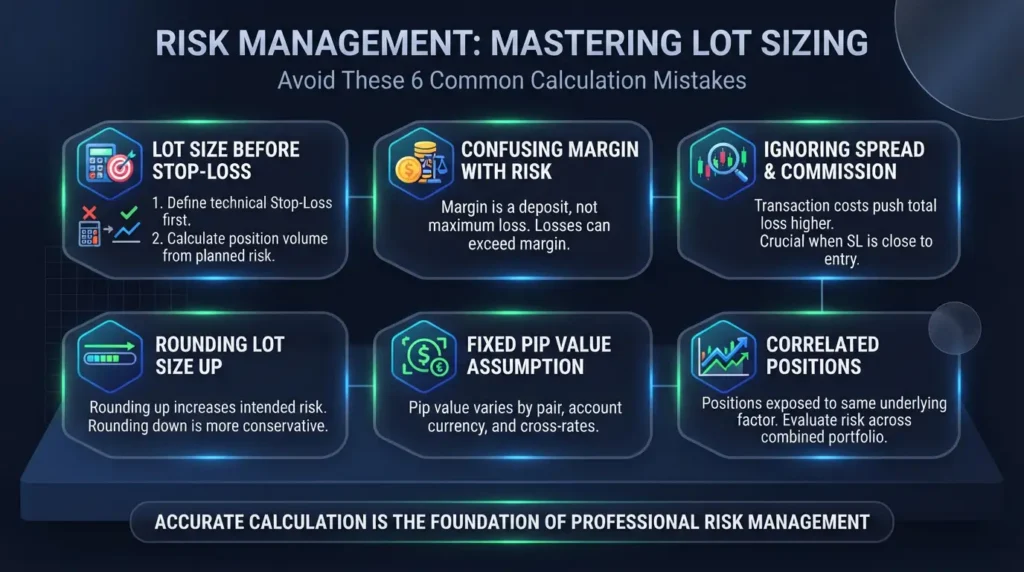
- Choosing lot size before the stop-loss. Some traders select a trade volume first and only then consider where the stop-loss will be placed. The correct process is to define the technical stop-loss first, then calculate the appropriate position volume from the planned risk amount.
- Confusing margin with risk. A position requiring only $200 in margin can still produce a loss substantially greater than $200 if it moves sharply against the trader or if there is a gap in the market. Margin is the deposit required to hold the position open — it is not the maximum possible loss.
- Ignoring spread and commission. If the planned maximum loss is exactly $50, transaction costs including spread and commission will push the total potential loss above that figure. This effect is especially significant when the stop-loss is placed close to the entry price.
- Rounding lot size up. If the calculated volume is 0.126 and the broker accepts 0.01 increments, rounding up to 0.13 increases the planned risk beyond the intended amount. Rounding down is the more conservative approach.
- Assuming $10 per pip for all pairs. This assumption is incorrect for USD-base pairs, cross-currency pairs, and non-USD accounts. Checking the exact pip value before placing a trade avoids systematic errors in position calculations.
- Opening several correlated positions simultaneously. Three separate trades — for example, long EUR/USD, long GBP/USD, and short USD/CHF — may all be exposed to the same underlying factor (USD weakness). Risk should be evaluated across the combined portfolio, not calculated independently for each trade.
Choosing the Right Lot Size for Your Account
Lot size selection should follow from account balance, planned stop-loss distance, and the maximum monetary loss acceptable per trade — not from the maximum position a broker’s leverage allows. For most retail traders, micro and mini contracts provide greater control and more forgiving risk characteristics than standard contracts.
- Micro contracts (0.01) are appropriate when precise, small exposure is needed, or when the account balance is small relative to the planned stop-loss distance.
- Mini contracts (0.10) are useful when the position volume calculation produces results in the 0.10 range and a higher level of exposure per pip is acceptable.
- Standard contracts (1.00) may be suitable only when the account balance and stop-loss distance produce a monetary risk per trade that falls within the trader’s defined risk tolerance.
Developing consistent position-sizing habits before moving to live trading is a core element of a sound trading plan. Starting with smaller contract volumes such as micro-scale positions allows traders to observe how market movements translate into real monetary outcomes without exposing a large portion of the account to any single trade.
Forex Lot Sizes and Risk: The Core Relationship
Lot size and risk per trade are inseparable. Every decision about trade volume is simultaneously a decision about how much monetary exposure the position carries. A standard lot creates significant exposure that can produce substantial gains and losses quickly; a micro lot reduces that exposure by a factor of 100.
Forex and leveraged CFDs carry a high level of risk. According to the European Securities and Markets Authority (ESMA), the majority of retail investor accounts lose money when trading CFDs. Past performance does not guarantee future results, and losses may exceed initial expectations particularly in fast-moving markets or during gaps in price. The appropriate position volume is the one that keeps any single trade’s planned loss within a defined, affordable limit — not the largest contract the account’s leverage would technically permit.
Frequently Asked Questions
What is a lot size in forex trading?
A lot size in forex trading is a standardized unit that defines the volume of a currency trade. One standard lot represents 100,000 units of the base currency. This measure matters because it directly determines the monetary value of each pip movement — a larger contract produces a larger gain or loss for every pip the market moves.
How many units is a 0.01 lot in forex?
A 0.01 lot is a micro lot and equals 1,000 units of the base currency. On USD-quoted pairs such as EUR/USD, the approximate pip value at this volume is $0.10. This is the smallest increment available on most standard retail trading platforms and is commonly used by beginner traders to limit their exposure during early trading experience.
How do I calculate the right lot size for my account?
The right lot size is calculated by dividing the planned risk amount (account equity multiplied by the chosen risk percentage) by the product of the stop-loss distance in pips and the pip value per standard lot. For example, a $5,000 account risking 1% ($50) with a 40-pip stop-loss on EUR/USD would produce a result of 0.125, typically rounded down to 0.12.
Does a larger lot size mean higher profit?
A larger trade volume means a higher pip value, which increases both the potential profit and the potential loss on a trade. Choosing a higher volume than the account balance and stop-loss justify does not improve the probability of success — it only increases the monetary consequences of each pip movement in either direction.
What is a nano lot and who uses it?
A nano lot represents 100 units of the base currency and is shown as a volume of 0.001 on platforms that support it. The pip value on USD-quoted pairs is approximately $0.01. This contract type is not available at all forex brokers and is primarily used by traders who need extremely small exposure — for example, those with very small account balances or those who are testing a strategy while keeping monetary risk at an absolute minimum.
Is lot size the same as leverage?
Lot size and leverage are related but describe different things. Lot size refers to the volume of the trade — the number of base currency units involved. Leverage refers to the ratio between the position’s notional value and the margin required to open it. A trader can open a micro lot with high leverage or a standard lot with lower leverage. Trade volume determines pip value and market exposure; leverage determines the margin required to hold the position open.