Crypto Trading Signals: Sources, Validation, and Scam Warning Signs

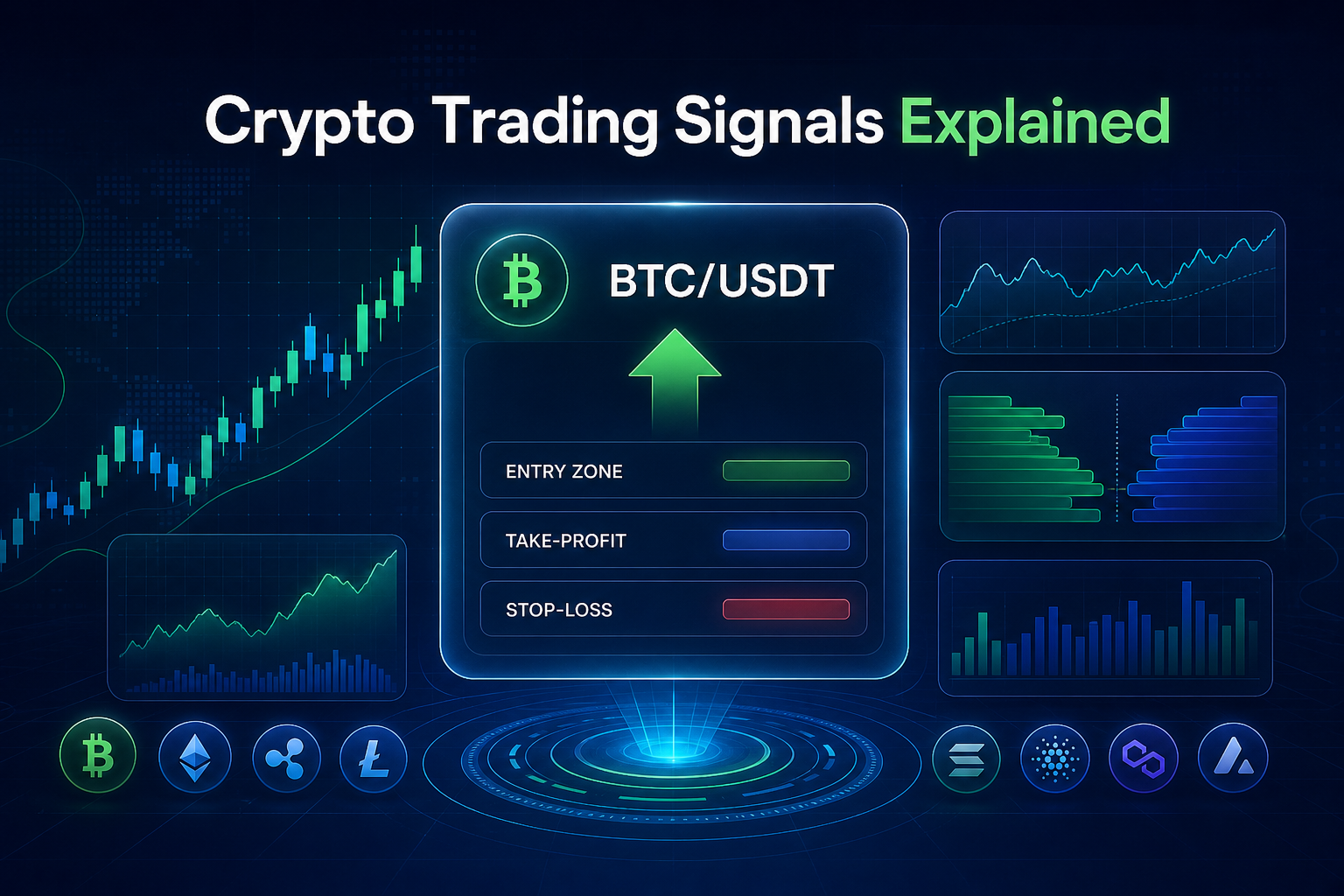
Crypto trading signals are trade suggestions produced by human analysts or automated systems. Crypto signals with entry details typically list an asset name, direction, entry price or zone, take-profit targets, and a stop-loss level. Services that provide signals have grown rapidly across Telegram, Discord, and subscription platforms, reaching participants in crypto trading at every experience level. The industry includes legitimate analytical providers and a large share of fraudulent operations.
This article is an educational overview of where signals come from, how they can be evaluated, and which warning signs are commonly associated with scams. The content is informational only. Nothing here recommends that anyone use crypto signals, and no part of the text constitutes investment advice.
Key Takeaways
- A crypto signal typically contains an asset, direction, entry price or zone, take-profit targets, and a stop-loss level.
- Each signal is an opinion about probability, not a guarantee of profit.
- Validation generally rests on verifiable track records that include every loss, cancellation, and open position.
- Guaranteed returns and screenshot-only proof are widely cited scam markers.
- Regulators describe most unsolicited offers of signals through messaging apps as high-risk.
What Are Crypto Trading Signals
A crypto trading signal is a structured trade idea shared by an analyst, a trading bot, or an algorithmic system. Understanding the format, production method, and delivery channel explains why quality varies so widely across the crypto world. The subsections below define each element in neutral terms.
Core Components of a Signal
A standard crypto signal names the asset and trading pair, such as Bitcoin against USDT, plus the direction, either long or short. Direction indicates whether the idea anticipates a price rise or a fall. The entry price or zone marks the level where the idea is considered valid.
- Take-profit targets: price levels where the idea is considered to have played out.
- Stop-loss level: the price where the idea is considered invalidated.
- Optional extras: leverage guidance and a short written rationale.
Complete formatting is often treated as a basic indicator of provider professionalism, because a missing stop-loss level or entry zone makes an idea impossible to evaluate afterward. Formatting alone does not demonstrate accuracy, though. Even well-formatted crypto signals with entry details can produce losses, since the format describes an idea rather than a result.
Manual vs Automated Signal Generation
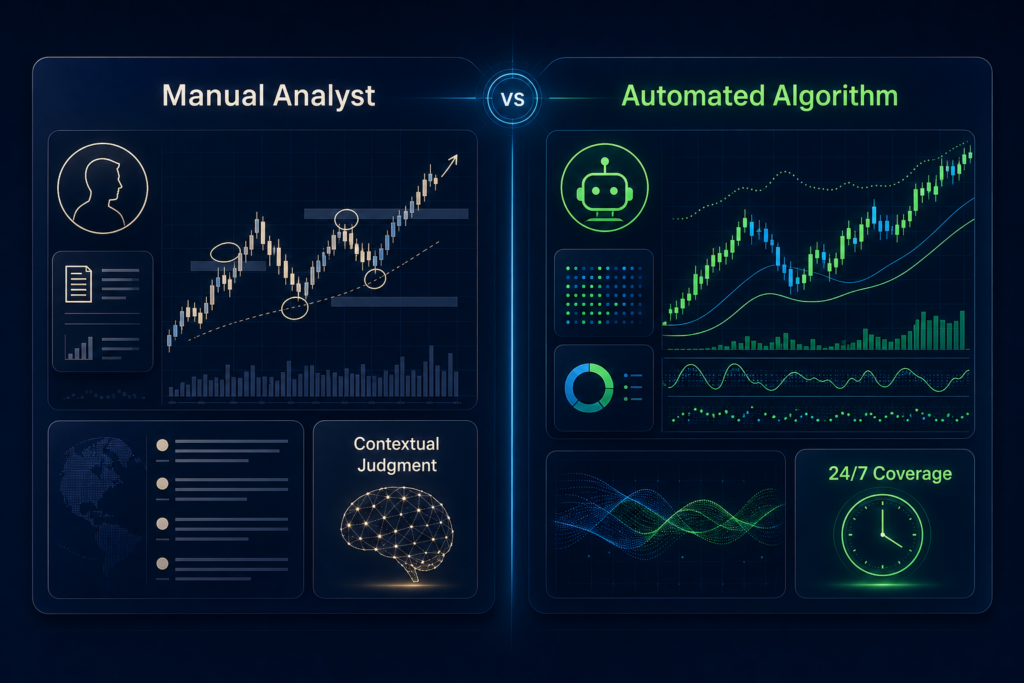
Two production models dominate. Manual signals come from human analysts applying technical and fundamental analysis. Automated trading systems, including algorithmic trading models and bots, scan market data around the clock and generate alerts without human input. Each model has commonly cited strengths and weaknesses.
| Feature | Manual (human analyst) | Automated (algorithm or bot) |
| Production method | Chart reading, research, news judgment | Rule-based or model-based scanning of market data |
| Commonly cited strength | Contextual judgment on events | Consistency and round-the-clock coverage |
| Commonly cited weakness | Subjectivity, fatigue, limited coverage | Susceptibility to unexpected news events |
| Verification angle | Analyst identity and history | Model inputs and backtest transparency |
Neither model removes market risk. Human contextual judgment and algorithmic consistency address different problems, and both approaches can fail when conditions shift abruptly.
Delivery Channels and Formats
Signals typically reach users through a Telegram channel, Discord groups, email, mobile apps, trading dashboards, and copy-trading platforms. Delivery channel affects verification: platforms like Telegram allow messages to be edited or deleted, while database-backed services preserve a timestamped history. Format therefore shapes how checkable a provider’s claims are.
- Messaging groups: fast and informal, but history can be altered.
- Crypto trading signals app products: mobile apps such as CryptoSignalAPP may be listed in an app store, though a listing does not confirm quality.
- Dashboards and copy trading: structured records that are generally easier to audit.
What Signals Can and Cannot Represent
A crypto signal reflects one analysis of probability, not a promise of profit. Past performance does not guarantee future results, and markets may invalidate any setup within minutes. Losses may exceed initial expectations, especially with leverage, which allows traders to control larger positions with a smaller deposit and magnifies both potential gains and potential losses.
Real-world results can also differ from the published idea because of execution quality, latency, fees, slippage, and position sizing. For example, if a published entry is 60,000 and the order fills at 60,150 after a delay, the realized risk-reward changes even though the original idea is unchanged. Claims about trading profits therefore depend heavily on how execution is measured.
Main Sources of Crypto Trading Signals
Understanding how crypto signals work starts with their origins: human analysts, chart-based indicators, algorithmic systems, and blockchain or sentiment data. Each source measures something different and carries different verification challenges. Germany’s financial regulator BaFin has noted that follower counts, likes, and positive feedback are not valid indicators of tip quality.
Human Analysts and Professional Communities
Human analysts are experienced traders who publish chart analysis, often with written reasoning. Some tools and communities pair analyst commentary with different trading styles: scalp signals target very short-term moves, swing signals span days or weeks, and long-term signals reference broader trends. Quality varies widely, so transparency of the analyst’s identity and history is a common evaluation factor.
Technical Indicators and Chart-Based Alerts
Chart-based crypto alerts derive from technical analysis tools, including moving averages, RSI, MACD, Bollinger Bands, Fibonacci retracement levels, support and resistance zones, triangle breakout patterns, and volume changes. These trading tools summarize price, trend, and momentum data into potential entry and exit references. For background on the methodology, see this overview of crypto technical analysis.
Algorithmic Systems and AI Models
AI-powered crypto signals often rely on machine-learning pipelines that combine technical data, on-chain analytics, and sentiment inputs. In general terms, classification models assign probability scores to trade setups based on historical patterns. Claims about “AI bots” appear frequently in marketing, which makes independent verification of model inputs, training data, and reported performance especially relevant in this category.
On-Chain Data and Market Sentiment
Some signals draw on blockchain data, such as exchange inflows and outflows, whale wallet movements, exchange balances, and funding rates on venues like Binance and Bybit. Futures trading signals in particular may reference funding rates and open interest. Sentiment inputs include social media velocity, news flow, and Fear and Greed indexes. These sources measure participant behavior, while chart analysis measures price history alone.
How to Validate Crypto Trading Signals
Validation is the process of testing whether a provider’s claims match verifiable market records. Analysts generally treat checkable, loss-inclusive evidence as more meaningful than marketing claims. The subsections below describe commonly cited validation concepts, presented descriptively rather than as instructions, and they apply equally to free and paid offerings.
Track Record Verification and Loss-Inclusive History
A credible track record includes every signal over a defined period: wins, losses, cancellations, and open positions. Twelve months or more is often considered meaningful, since shorter windows may reflect only one market phase. Self-reported win rates are viewed by analysts as less reliable than third-party verified records or on-chain proof, which is central to judging whether a service is reliable crypto analysis or promotion.
Timestamps and Independent Replay Against Market Data
Timestamp analysis compares published signal times against historical market data. Reviewers ask whether the stated entry price was realistically available after publication, whether old messages were edited or deleted, and whether results survive replay on real exchange candles. Simulated trading against recorded real-time crypto data is one way analysts describe testing such claims.
Transparency of Methodology and Risk Disclosure
Methodological transparency means a provider explains what data triggered the idea, what conditions would invalidate it, how risk is managed, and whether human review is involved. Providers may also describe their approach in terms of established crypto trading strategies. An absence of risk disclaimers is often cited as a warning sign.
Statistical Metrics Beyond Win Rate
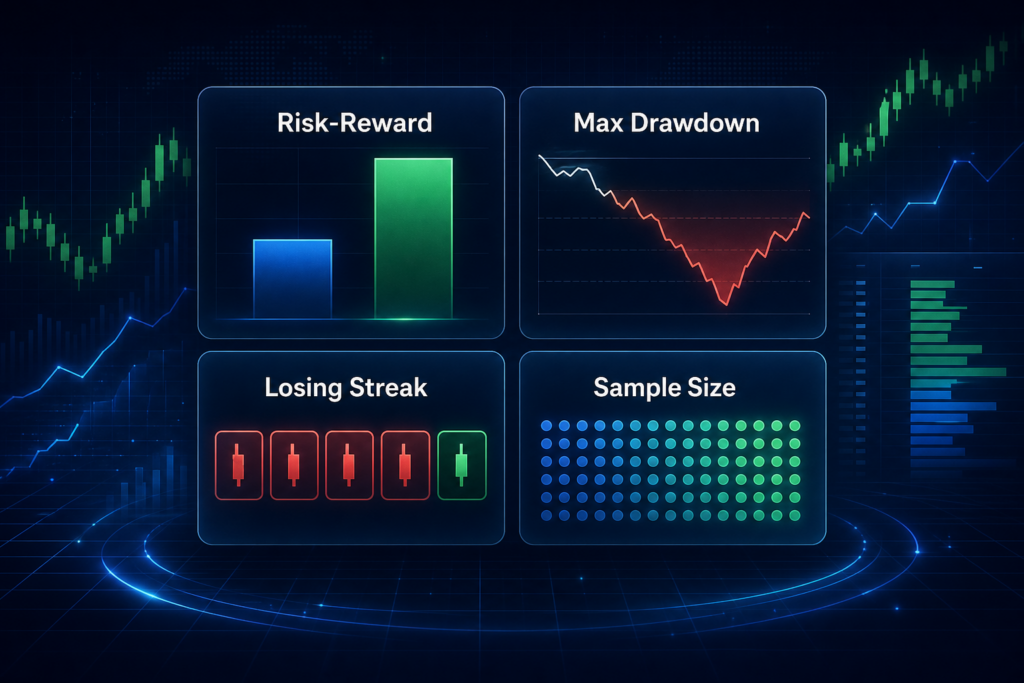
Analysts evaluate signal services with several metrics rather than win rate alone. A high win rate can coexist with overall losses. In a simple example, a service wins 7 of 10 trades with an average win of 1 percent, but its 3 losses average 3 percent each. Net result: 7 minus 9 equals negative 2 percent.
| Metric | Description |
| Realized risk-reward | Average win compared with average loss |
| Maximum drawdown | Largest peak-to-trough decline in the record |
| Longest losing streak | Most consecutive losing trades |
| Sample size | Number of trades behind the statistics |
Expectancy = (Win Rate x Average Win) – (Loss Rate x Average Loss). Cherry-picked entry zones can also distort reported results, since a zone chosen after the fact makes almost any trade appear profitable.
Crypto Signal Scam Warning Signs
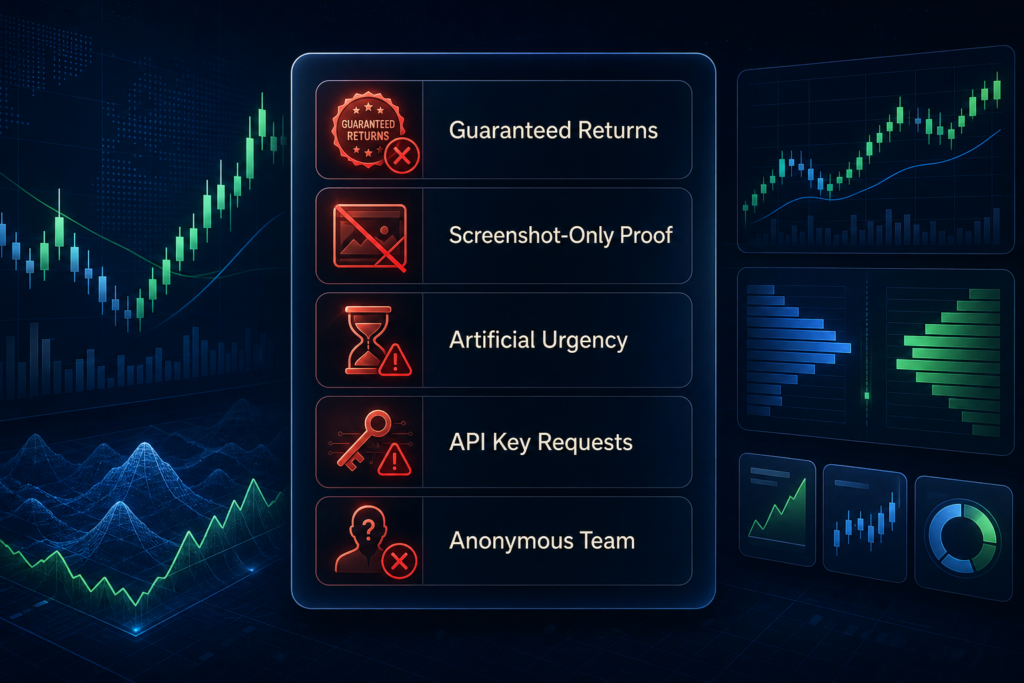
Scam warning signs are patterns that regulators and consumer-protection agencies repeatedly associate with fraud, and they appear across all categories of crypto signals. The CFTC and SEC have observed investment scams touting digital asset advisory and trading businesses, and the markers below recur across many public advisories.
Guaranteed Returns and Fixed Profit Promises
Regulators consistently identify guaranteed or fixed-percentage returns, “risk-free” claims, and implausible win rates as hallmarks of fraud, since no trading method can eliminate market risk. The CFTC and SEC have described fraudsters promising high guaranteed returns with little or no risk. Typical formulations include promised monthly returns in USDT or “zero losing trades,” sometimes attached to a paid signal tier.
Screenshot-Only Track Records
Screenshots of winning trades in private chats are not considered evidence, because images can be fabricated, edited, or selectively chosen. Database-backed, timestamped public trade logs and on-chain verifiable positions offer a contrast. Reverse image search is a common technique for checking whether testimonial photos were copied from unrelated sources.
Pressure Tactics and Artificial Urgency
Manufactured urgency includes countdown timers, “limited spots,” claims that a price will move within an hour, VIP upgrade pressure, and FOMO-driven language aimed at prompting people to act on signals before checking them. Consumer protection materials characterize the purpose of urgency as discouraging verification and independent consultation.
Requests for Funds, API Keys, and Sensitive Data
Technical red flags involve requests for access or funds that a genuine analytical service has no need to hold.
- Requests to send crypto to personal wallets.
- Demands for withdrawal-enabled API keys.
- “Account managers” asking for remote access.
- Any request for seed phrases, private keys, or 2FA codes.
Withdrawal gates and advance “fees” to unlock funds are treated as definitive fraud markers, since legitimate crypto trading platforms do not charge a payment to release existing balances. In the FTC’s published consumer guidance, no cryptocurrency investment is ever guaranteed to make money.
Anonymous Teams and Unverifiable Identities
A crypto signal provider operating under pseudonyms, stock-photo headshots, or vague credentials leaves no accountable individuals. Clone channels and impersonation of well-known analysts are common, and legitimate operators typically warn their audiences about impersonators. An unverifiable identity makes complaints, refunds, and legal recourse difficult to pursue.
Pump-and-Dump Schemes and Fake Social Proof
Pump-and-dump schemes use signal channels to coordinate buying pressure on thinly traded assets. The SEC’s Office of Investor Education and Advocacy has described pump-and-dump promotion of memecoins through social media and cautioned against decisions based solely on social media information.
Coordinated Pump Groups
In a coordinated pump, calls concentrate on low-liquidity coins on obscure exchanges, often accompanied by “insider info” or “next 10x gem” language. Insiders typically exit before followers, leaving later buyers holding a collapsing asset. This structure is generally analyzed as market manipulation rather than analysis, and it affects crypto investors who enter near the peak.
Bot Activity and Manufactured Hype
Automated accounts can flood channels with celebratory replies, fake profit screenshots, and testimonial images within seconds of each post. Referral rewards and affiliate economics can also masquerade as independent community enthusiasm. Apparent crowd agreement may therefore reflect scripted activity rather than genuine results.
Small Wins Followed by Escalating Demands
A documented trust-building pattern begins with small successful trades or better-known assets. Pressure then shifts toward obscure coins, larger deposits, or “recovery trading” offers after losses. Regulators flag this escalation in consumer advisories, and FINRA reported a significant spike in complaints about fraudulent investment groups promoted through social media and encrypted chats in December 2025.
Regulatory Perspective on Signal Services
Regulators in several jurisdictions have addressed signal-related fraud in public advisories and enforcement actions. Descriptions remain general here, because individual cases differ and details change over time. The themes below recur across agencies.
Regulator Warnings and Enforcement Trends
The CFTC, FTC, FINRA, and SEC have characterized signal-related fraud in similar terms: guaranteed returns, unverifiable track records, unsolicited contact through messaging apps, and withdrawal-blocked funds. Canadian regulators issued an investor alert on social media investment groups operating through WhatsApp, Discord, and Telegram.
Checking Providers and Reporting Fraud
Publicly available verification resources are described below in neutral terms.
- Regulator warning lists and registers of authorized firms.
- Domain age lookups.
- Independent review platforms.
- Community reputation threads.
Suspected fraud is generally reported to national financial regulators and consumer-protection agencies, such as the FTC in the United States. Reports typically include screenshots, wallet addresses, and the dates of any payments.
Benefits and Limitations of Signal Services
Signal services present a mixed picture. Commonly described benefits exist alongside costs and conflicts of interest. Balanced coverage includes both, because the same feature can appear as an advantage or a limitation depending on the provider and market conditions, and rankings of the best crypto signals are often promotional rather than independent.
Potential Advantages
Commonly described benefits include time savings in market monitoring, exposure to the reasoning of experienced traders, and structured trade formats. Educational value is also cited. Newer crypto traders who start trading often encounter signals as a way to see how setups are built, and general trading tips from analysts may illustrate how different trading approaches treat risk and timing.
Limitations, Costs, and Conflicts of Interest
Counterpoints include subscription costs and spreads that reduce net results, dependence on another party’s judgment, and affiliate conflicts of interest. Free signals may serve as marketing for paid offerings, and futures trading with leverage can magnify losses on specific trading ideas. Over-reliance overlaps with common crypto trading mistakes. Crypto volatility generally makes signals less reliable than in more established markets, and a published idea may already be outdated.
Role of Independent Judgment
Market participants typically position signals as one input within a broader decision process, alongside personal analysis, risk awareness, and verification. Signals are not usually treated as a substitute for independent evaluation. Because the SEC has cautioned against decisions based solely on social media information, external ideas are commonly cross-checked against other sources when trading cryptocurrencies.
FAQ
What is a crypto trading signal?
A crypto trading signal is a trade suggestion containing an asset, direction, entry price or zone, take-profit targets, and a stop-loss level. A human analyst or an algorithm produces the suggestion. A signal expresses one view of probability and does not represent a guaranteed outcome.
Are crypto trading signals reliable?
Reliability varies widely and cannot be generalized across providers. Verification practices include loss-inclusive histories and independent replay against exchange data. Even a well-documented provider cannot guarantee profit, since market conditions change and past performance does not guarantee future results.
Can crypto signals be free?
Free crypto signals exist, usually through a freemium model. Free channels are sometimes used as marketing funnels for paid VIP tiers, which creates a potential conflict of interest. Free access does not indicate either quality or risk, so the same verification considerations apply.
How can a signal provider be verified?
Verification criteria include a timestamped and complete history, transparent methodology, verifiable identities, third-party tracking, and a check of regulator warning lists. No single criterion is conclusive. Analysts generally view a combination of checkable evidence as more informative than any isolated claim.
What are the most common crypto signal scams?
Commonly reported schemes include guaranteed returns, screenshot-only proof, pump-and-dump groups, unsolicited group invitations, withdrawal gates, and requests for API keys or seed phrases. Scam formats evolve, so listed patterns are illustrative rather than exhaustive.
Are AI-generated crypto signals safer than human ones?
Automation does not inherently reduce risk. AI-generated signals are evaluated through model inputs, training data, and verification of claimed performance. The term “AI” is frequently used as a marketing label in fraudulent schemes, so a claim of AI involvement is not evidence of accuracy.