Arbitrage Trading Crypto: Price Differences, Execution, Costs, and Risks

Arbitrage trading crypto is a practice built around temporary price differences for the same asset across markets, venues, or trading pairs. Within crypto trading, structural fragmentation means each crypto exchange prices cryptocurrencies independently, which can create short-lived gaps.
This article examines why differences exist, how arbitrage works in practice, which costs apply, and which risks are commonly documented. It is an educational overview, not trading instruction.
Key Takeaways
- Cryptocurrency arbitrage is a practice built on temporary price differences for the same digital asset across venues, pairs, or instruments.
- Price differences often arise from market fragmentation, independent order books, regional demand, and latency between venues.
- Commonly described arbitrage strategies include cross-exchange, triangular, decentralized exchange, statistical, and derivatives-based approaches.
- Fees, spreads, slippage, transfer costs, and financing costs may consume a small profit margin entirely.
- Execution, custody, regulatory, and competitive risks exist, so a low-risk label is not the same as risk-free.
- Automated bots are associated with speed, but they add dependencies such as API reliability and software failures.
What Is Crypto Arbitrage Trading?
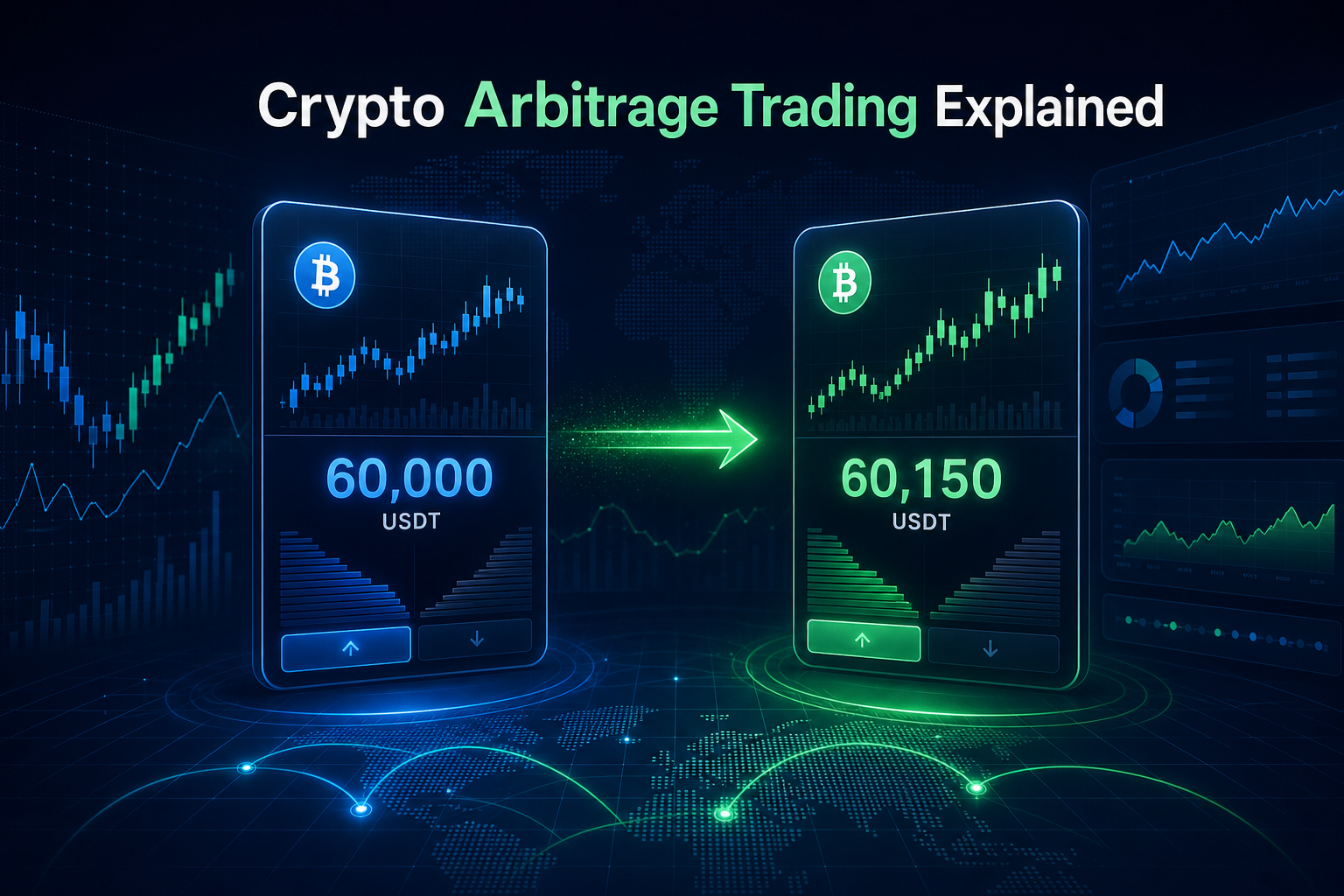
Crypto arbitrage trading is the practice of buying a cryptocurrency on one venue and selling economically equivalent exposure on another when prices diverge. For example, Bitcoin may display 60,000 USDT on one cryptocurrency exchange and 60,150 USDT on another at the same moment. Offsetting transactions are intended to reduce directional exposure, although exceptions and residual risks remain.
A displayed price is not always an achievable price. The last-traded price shows where a previous transaction occurred, while the executable price depends on current order book depth and order size. A quoted gap may shrink or disappear once an actual order meets the available liquidity, so a trader typically interprets displayed differences with caution.
In simple terms, arbitrage works by comparing prices for the same asset in separate places and observing whether the difference exceeds the costs of acting on it. The comparison is the concept, not a method to follow. Whether any gap remains after costs depends on timing, fees, and available depth.
How Arbitrage Differs From Directional Trading
Directional trading and holding depend on whether an asset price rises or falls over time. Arbitrage outcomes depend mainly on price convergence between venues and on execution quality, not on overall market appreciation. This is often characterized as low-risk in terms of market direction, though never risk-free, because operational and execution exposures still apply.
Commentary usually presents the approach in a balanced way, with both potential advantages and limitations:
- Potential advantage: outcomes are intended to be independent of broad market direction.
- Potential advantage: arbitrage activity may contribute to market efficiency by narrowing price gaps.
- Limitation: the profit margin per trade is often small and can be erased by costs.
- Limitation: results depend on infrastructure, speed, and the ability to complete every leg.
Brief History of Crypto Arbitrage
Early crypto markets were highly fragmented, with a small number of venues, limited connectivity, and slow transfers. A study in the Journal of Financial Economics by Makarov and Schoar documented large and persistent price deviations across countries and exchanges. These episodes illustrate how inefficiencies emerge when capital moves slowly between separate markets.
One well-known example is the Kimchi premium, a regional premium on cryptocurrency prices in South Korea reported during periods of intense local demand. Capital controls and currency restrictions limited how quickly foreign capital could close the gap. Over time, growing participation and better infrastructure have generally compressed such persistent gaps.
Why Crypto Price Differences Exist
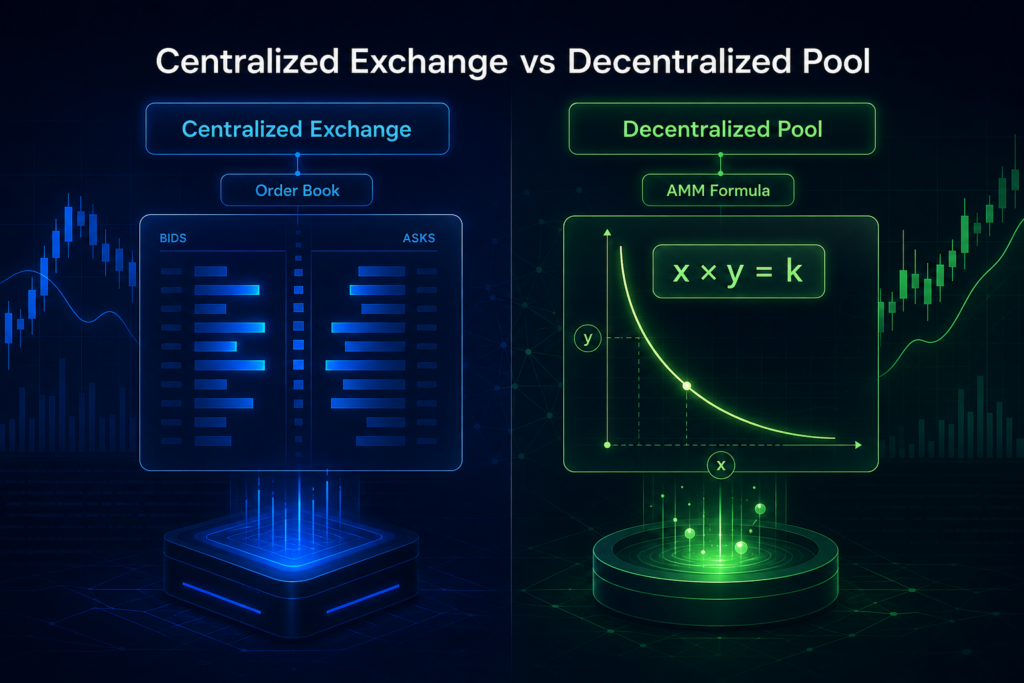
The same cryptocurrency can trade at different prices because each venue runs its own pricing mechanism. A centralized crypto exchange uses an order book, while decentralized venues use liquidity pools governed by formulas. No single universally executable quote exists, so a price difference is better understood as a structural feature of the crypto market than as an anomaly.
Market Fragmentation and Regional Demand
Hundreds of centralized and decentralized venues operate independently, each with its own users, listings, and liquidity. Supply and demand on one cryptocurrency exchange may differ from another, particularly when local audiences, fee schedules, or listing timing differ. In simple terms, separate markets can reach separate prices for the same coin at the same time.
Regional factors can make such gaps more persistent. Local demand, capital controls, currency restrictions, and regulatory environments may limit how freely capital moves across borders. Moving cryptocurrencies internationally may also involve restrictions, reporting requirements, and extra costs, which helps explain why some regional price differences have lasted longer than purely technical mismatches.
Liquidity, Order Books, and Latency
Order book depth determines how much of an asset can be bought or sold near a quoted price. A headline price may be achievable for a small size on one venue but not on another. Liquidity also differs across crypto trading pairs, so the same asset may have deep books in one pair and thin books in another.
Latency adds a timing dimension. Price updates travel between venues with small delays, so one venue may briefly lag another after a sharp move. These transitory mismatches are separate from the bid-ask spread within a single venue, which is the gap between the best buy and sell quotes and is treated as its own cost.
Common Types of Crypto Arbitrage
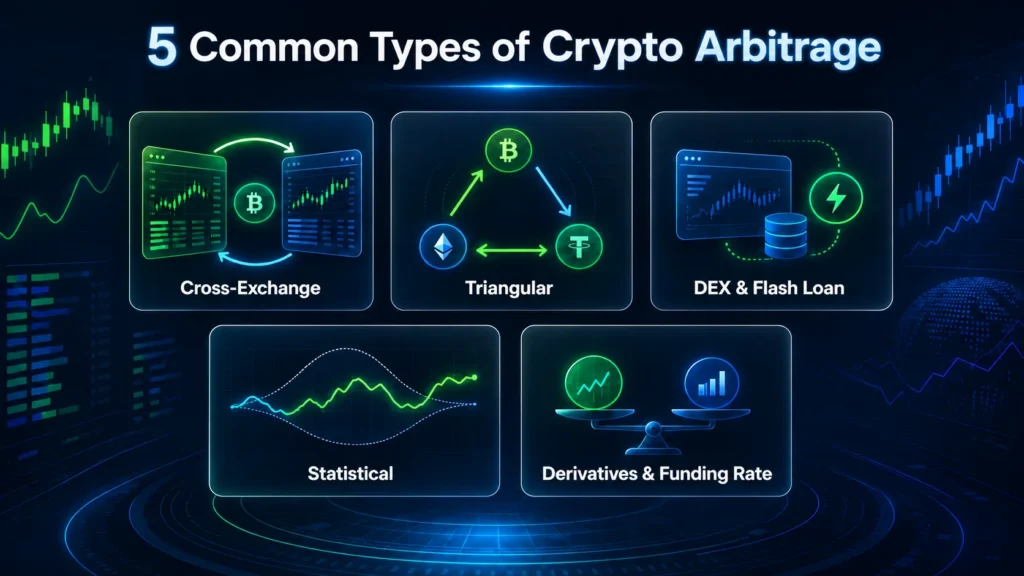
Market commentary describes several classifications of arbitrage strategies. Each is presented below as an approach some market participants use, without judging which is preferable. The table summarizes the main differences before each type is described in more detail.
| Type | Typical venues | Core idea | Main dependency |
| Cross-exchange (spatial) | Multiple exchanges | Same asset, different prices | Transfers or pre-funded balances |
| Triangular | Single exchange | Three related exchange rates | Speed and fee levels |
| DEX and flash loan | Decentralized pools | Pool price versus other venues | Network fees and smart contracts |
| Statistical | Multiple markets | Expected reversion of relative prices | Model validity |
| Derivatives and funding rate | Spot and derivatives venues | Spot versus derivatives pricing | Margin and financing costs |
Cross-Exchange (Spatial) Arbitrage
Cross-exchange arbitrage, also called spatial arbitrage, is the most commonly cited form. A participant buys an asset on one exchange and sells it on another when prices diverge, and each leg relates directly to the other. This form requires access to multiple exchanges, and structural variants exist for handling the movement of funds, each with different timing and cost profiles.
Triangular Arbitrage
Triangular arbitrage concerns potential discrepancies among three related exchange rates, typically on a single venue. The cycle converts one asset into a second, then a third, and returns to the original asset. Such inconsistencies are typically fleeting and quickly compressed by arbitrage bots, and no favorable result is assured.
Decentralized Exchange and Flash Loan Arbitrage
On-chain activity takes place between decentralized venues, where automated market maker pools set prices that may diverge from centralized platforms. This belongs to the broader field of decentralized finance. Decentralization removes a central operator but introduces network fees and smart-contract exposure.
Flash loans are a separate concept. A flash loan is a financing mechanism that allows borrowed capital within a single transaction, and the loan must be repaid in that same transaction or the transaction reverses. Flash loans may feature in on-chain arbitrage, but they are not synonymous with decentralized exchange arbitrage.
Statistical Arbitrage
Statistical arbitrage is a quantitative, model-based approach that identifies statistical relationships between assets and positions for an anticipated reversion of relative prices. Convergence is anticipated rather than guaranteed, and models can misfire when relationships break down. Among trading strategies, this one differs fundamentally from capturing an already observable price gap.
Derivatives and Funding Rate Arbitrage
Derivatives-based approaches focus on the relationship between spot prices and derivatives prices. The spot-derivatives basis is the difference between a futures price and the spot price, while perpetual funding is a periodic payment between long and short holders. These are related but distinct phenomena, and both typically involve margin requirements and financing costs. The approaches are commonly described as delta-neutral in intent.
How Arbitrage Trades Are Executed
Execution describes how an arbitrage opportunity moves from detection to completed orders. The sequence below is conceptual, not instructional, and shows why timing and the ability to complete both legs are commonly described as central to outcomes:
- Price data from several venues is monitored.
- Quoted prices are compared against order book depth.
- Orders are placed on each leg.
- Settlement or balance adjustments follow.
Manual Versus Automated Execution
Manual monitoring relies on a trader watching prices and placing orders on a crypto trading platform. Automated approaches use software tools connected through exchange APIs. Automated bots are commonly associated with speed advantages, but they also depend on API reliability, rate limits, and software stability. Common tools include:
- Price scanners that compare quotes across venues.
- Alert systems that flag a price difference.
- A trading bot that places orders through an API.
- Platforms such as Coinrule, which describe rule-based automated trading.
Order types also shape results. A market order executes immediately at the best available price, while a limit order executes only at a specified price or better and may remain unfilled. Latency affects the prices actually achieved, since a quote can change between detection and fill.
Transfer-Based Versus Pre-Funded Execution
Transfer-based execution moves assets between venues. Blockchain confirmation times and network fees apply, and prices can move while the transfer is pending. Some bot designs reduce this by keeping balances on multiple exchanges in advance, which limits transfer timing exposure but ties up capital and spreads it across platforms. Each structure involves trade-offs, and neither is recommended here.
Costs That Affect Arbitrage Profitability
A price gap becomes a result only after all costs are accounted for, and a small profit margin can be consumed entirely by expenses. Some costs are charged separately, such as fees, while others, such as slippage, are already reflected in executed prices. Distinguishing the two helps avoid double-counting when costs are discussed in analysis.
| Cost type | Where it arises | Why it varies |
| Maker and taker fees | Each exchange leg | Venue fee tiers and volume |
| Bid-ask spread | Within each venue | Liquidity and volatility |
| Slippage | Order execution | Order size versus depth |
| Withdrawal fees | Moving assets off a venue | Venue policy and asset |
| Network fees | On-chain transfers | Blockchain congestion |
| Financing costs | Margin or distributed capital | Funding rates and opportunity cost |
Trading Fees, Spreads, and Slippage
Exchanges charge trading fees, often split into maker fees for resting orders and taker fees for orders that remove liquidity. Each leg of a trade carries its own fee on a large cryptocurrency exchange such as Binance and on comparable platforms. Crypto trading spreads add a further cost within each venue.
Slippage occurs when the executed price differs from the quoted price, particularly when order size exceeds available depth. Market impact can reduce realized prices for larger orders. Because each leg faces its own fee, spread, and slippage, these costs compound across a single arbitrage trade.
Withdrawal, Network, and Financing Costs
Venues may charge withdrawal fees, and blockchain network fees rise and fall with congestion. Financing-related costs include margin funding for derivatives-based approaches and the opportunity cost of capital distributed across platforms. These costs vary over time and across venues, so a cost level seen on one day may not apply on another.
Net Returns After Costs
The net result of an arbitrage trade is what remains after trading, transfer, and financing costs are deducted from the gross price gap. Documented outcomes in this activity are often characterized as thin and variable. Uncertainty depends on costs, infrastructure, and market conditions, so a visible gap does not imply net income.
Key Risks of Crypto Arbitrage
Market commentary groups the risks of crypto arbitrage into several categories. A low-risk description refers to market direction only and does not mean an absence of risk. Past performance does not guarantee future results, and losses may exceed initial expectations, particularly when leverage, fast markets, or platform failures are involved.
- Incomplete execution across legs.
- Venue, custody, and counterparty exposure.
- Regulatory and tax uncertainty.
- Rising competition and shrinking margins.
Execution Risk and Incomplete Fills
Execution risk arises when one leg of a trade completes while the other fails or fills only partially. The result can be residual exposure to market movement, so an apparently balanced trade becomes an unhedged position. Volatility can widen price discrepancies while also increasing execution uncertainty, since quotes may change before orders are filled.
Exchange, Custody, and Counterparty Risk
Funds held on trading venues face withdrawal freezes, delays, security incidents, platform outages, and insolvency. Historical failures such as Mt. Gox and FTX illustrate these exposures. Capital spread across multiple exchanges is exposed to each venue’s condition, and insurance protections vary and may not cover all losses.
On-chain approaches carry additional smart-contract and protocol risks, such as coding flaws or failed transactions. Each digital asset held in a pool or wallet adds another potential point of failure. Risk management in this context is commonly described in terms of counterparty selection and diversification across operational dependencies.
Regulatory and Tax Considerations
The legal treatment of arbitrage activity varies by jurisdiction, and cross-border asset movement may encounter restrictions or reporting obligations. In the European Union, for example, the Markets in Crypto-Assets framework described by ESMA shows how regulation continues to evolve.
Frequent trading may also carry tax implications, including taxable events on each conversion. Authorities such as the Internal Revenue Service in the United States publish guidance on digital asset reporting. Frameworks change over time, so jurisdiction-specific sources remain the reference point.
Competition and Market Efficiency
Arbitrage activity reduces the inefficiencies it relies on, because arbitrage bots compress spreads within moments. As markets mature and infrastructure professionalizes, opportunities tend to become smaller, faster, and concentrated among well-resourced participants. Under this view, arbitrage serves as a mechanism that contributes to price efficiency across markets, as discussed in general terms in arbitrage theory.
Frequently Asked Questions
Is crypto arbitrage legal?
Legal treatment depends on jurisdiction, venue rules, and applicable regulations, so no blanket statement applies. Cross-border fund movement may encounter restrictions or reporting requirements. Readers seeking certainty are generally directed to official, jurisdiction-specific sources or qualified legal professionals, as this article does not provide legal advice.
Is crypto arbitrage risk-free?
No. Although often characterized as low-risk in terms of market direction, the approach carries execution, custody, regulatory, and operational risks. Costs can also eliminate an apparent price gap before any result is realized. No trading approach is accurately described as risk-free, and losses remain possible.
How much capital does crypto arbitrage require?
Capital commitments vary widely depending on the approach, the venues, and whether balances must be distributed across several platforms, which involves capital lock-up. Commentary often associates a small profit margin per trade with particular capital considerations. No specific scale is implied or recommended here.
How does crypto arbitrage compare to traditional arbitrage?
Both share the same conceptual foundation and similar cost and risk considerations. They differ in trading hours, market fragmentation, infrastructure maturity, and settlement mechanics, since crypto markets operate continuously across many venues. Neither is asserted to offer more frequent opportunities.