Crypto Trading Spreads: Bid-Ask Costs, Liquidity, and Volatility


Crypto trading spreads describe the gap between the highest bid and the lowest ask shown on a cryptocurrency exchange. Every order-book market with two-sided quotes displays these two live prices, which update as orders arrive, fill, or are cancelled. Understanding this mechanic is a common starting point for beginners in crypto trading.
This educational overview covers three connected dimensions: the bid-ask gap as a built-in cost of trading, its close relationship with market liquidity, and its documented tendency to widen when volatility rises. Each section explains how the concepts work and relate to one another, using simple numerical examples and cautious language. Every example is illustrative only.
Key Takeaways
- The bid-ask spread is the gap between the best ask price and the best bid price visible in an exchange order book.
- Every order-book market with two-sided quotes shows this gap, and it changes as orders arrive, fill, and cancel.
- The gap is an implicit execution cost, separate from explicit exchange fees.
- Tighter bid-ask spreads are historically associated with deeper market liquidity and stronger competition among liquidity providers.
- Quotes often widen when volatility rises, order books thin, or uncertainty increases.
- The gap is a descriptive characteristic of trading conditions, not a directional price signal.
- Slippage and the quoted gap are distinct measurements and are not synonyms.
Crypto Spread Fundamentals: Bid, Ask, and Order Book
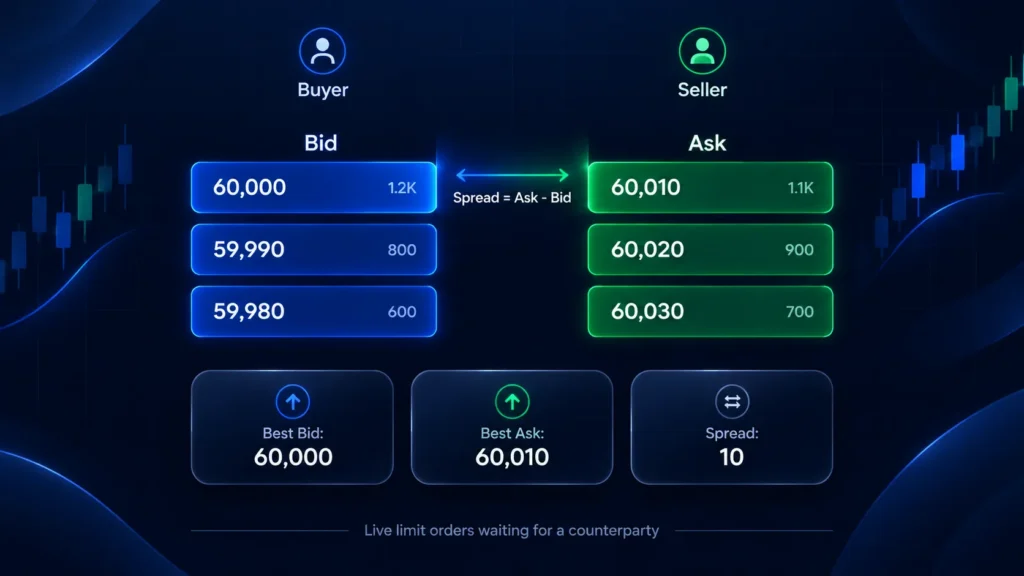
Three building blocks explain how the quoted gap appears on screen: the bid price, the ask price, and the order book that holds both. Each concept is defined below in simple terms, followed by a worked calculation and a description of the participants who shape the quotes in cryptocurrency trading.
Bid Price and Ask Price Explained
The highest bid price is the top price a buyer is willing to pay, and the lowest ask price is the minimum a seller is willing to accept. According to the U.S. SEC’s investor education site, the bid is almost always lower than the ask, and the difference between them is called the spread.
These quotes are live limit orders sitting in the order book and waiting for a counterparty, not theoretical values. In a market buy, a participant generally pays the lowest ask, while a participant who decides to sell an asset with a market order generally receives the highest bid.
How Bid-Ask Spread Is Calculated
To calculate the spread, analysts take the difference between the highest bid and the lowest ask shown in the book. If Bitcoin shows a best bid of 60,000 and a best ask of 60,010, the absolute figure is 10 units of the quote currency, written as: Spread = Ask – Bid.
The percentage form expresses the gap relative to a reference price. This article uses the mid price: Mid Price = (Ask + Bid) / 2, so Percentage Spread = (Ask – Bid) / Mid Price x 100. In the example, 10 / 60,005 x 100 gives roughly 0.017%, which allows comparison between assets with very different price levels.
Order Book Mechanics Behind Spread
An order book is built from limit orders. Buyers place bids below the market and sellers place asks above it, creating visible levels of quantity on each side. The gap between the top bid level and the top ask level forms the quoted spread.
Market makers place limit orders that provide liquidity and define the quotes. Market takers submit market orders that consume the best available prices, a behavior often described as “crossing the spread”. Different crypto order types therefore interact with the quoted prices in different ways, either adding to the book or removing from it.
Bid-Ask Spread as Trading Cost
The quoted gap is one of several transaction costs on a crypto exchange, and it is frequently overlooked because it never appears as a separate line item. This section describes how it acts as a cost of immediacy, how it shapes trade execution, and how it differs from published fees.
Cost of Immediate Execution
The gap is commonly described as an implicit cost of immediacy. A participant who captures the spread by buying at the ask and selling at the bid at the same moment records a loss on the round trip. With a bid of 60,000 and an ask of 60,010, a round trip on one crypto such as Bitcoin shows a price difference of 10 units.
This illustration assumes unchanged quotes, sufficient displayed quantity at the top of the book, and zero fees. The one-way execution cost is roughly half of the round-trip figure when measured against the mid price. The width of the gap varies widely across assets and market conditions, so the example is illustrative only.
Spread vs Exchange Fees
Exchange fees are explicit, published charges for executing an order, while the quoted gap is an implicit cost embedded in prices. On typical order-book exchanges, the platform generally earns crypto trading fees rather than the gap itself. Some broker or dealer pricing models build costs into quoted prices instead of charging a separate fee.
Maker fees are often lower than taker fees because makers add liquidity to the book. A trading platform may also publish tiered schedules based on monthly volume, so total transaction costs can differ between participants even on the same pair. Both cost dimensions coexist and are reported separately, as the comparison below shows.
| Feature | Bid-Ask Spread | Exchange Fees |
| Visibility | Implicit, derived from quoted prices | Explicit, published in a fee schedule |
| Who receives it | Not paid to the exchange on most order-book venues | Collected by the exchange or broker |
| Variability | Changes with order-book conditions | Often tiered by volume or order role |
| Where it appears | Gap between best bid and best ask | Charged as a separate line on execution |
Fixed and Variable Spreads
Two pricing behaviors appear across venues. Certain brokers offering a contract for difference on crypto assets quote fixed spreads, while most crypto exchanges show variable quotes determined by the live order book. Brokers such as Exness are sometimes cited as examples of dealer-style pricing, and the type of spread offered often depends on the pricing model of the venue.
The two approaches are generally described with the following characteristics:
- Fixed spreads offer predictability in quoted pricing, though they may be set wider to account for unpredictable conditions.
- Variable quotes reflect real-time supply and demand and may be very narrow in calm periods.
- A higher spread in fast markets increases the implicit cost of execution.
- Neither model is inherently superior, since each reflects a different pricing and risk-sharing structure.
Liquidity and Spread Relationship
Market liquidity describes how easily an asset can be traded without moving the price, and the quoted gap is one visible measurement of that ease. This section covers the historical association, the role of order book depth, and differences across assets and venues.
Tight Spreads as Liquidity Signal
Assets with high liquidity and active order books historically tend to show narrower quotes, while thinly traded assets tend to show wider ones. This is typically attributed to competition among liquidity providers and to the balance of supply and demand. Many market makers quoting the same asset often compress the quoted gap.
The relationship is a general tendency rather than a fixed rule. In some market conditions, a narrow gap may sit on top of a thin book, and a wide gap may appear in an otherwise active market. Narrow quotes are therefore associated with strong liquidity, but they do not guarantee it.
Order Book Depth and Slippage
The top-of-book quote describes only the first price level, while depth describes the quantity available at each level. Three related concepts are often separated: the quoted spread, slippage, and price impact. Slippage means an order is filled at a different price than expected, such as a fill away from the requested price.
Slippage can arise when an order consumes multiple book levels, or when quotes change while the order is being filled. For example, a market order for 2 Bitcoin might fill 1 at 60,010 and 1 at 60,030, producing an average price of 60,020. Slippage can be negative or positive, and it is a distinct measurement from the quoted gap.
Liquidity Differences Across Assets and Venues
Major assets such as Bitcoin and Ethereum typically show tighter bid-ask spreads than low-cap altcoins, and the same asset can trade at different quotes on different venues. A single crypto trading pairs listing, such as BTC against a dollar stablecoin, can look very different from a thinly traded pair of two smaller tokens.
Fragmentation, meaning one coin trading on many separate exchanges, also shapes local market spreads. Trading volume, market-maker participation, and venue-specific order flow all influence visible quotes. Regional pairs, such as crypto INR pairs, may reflect local participation rather than global activity, so the exchange of choice can influence observed conditions.
Volatility and Spread Widening
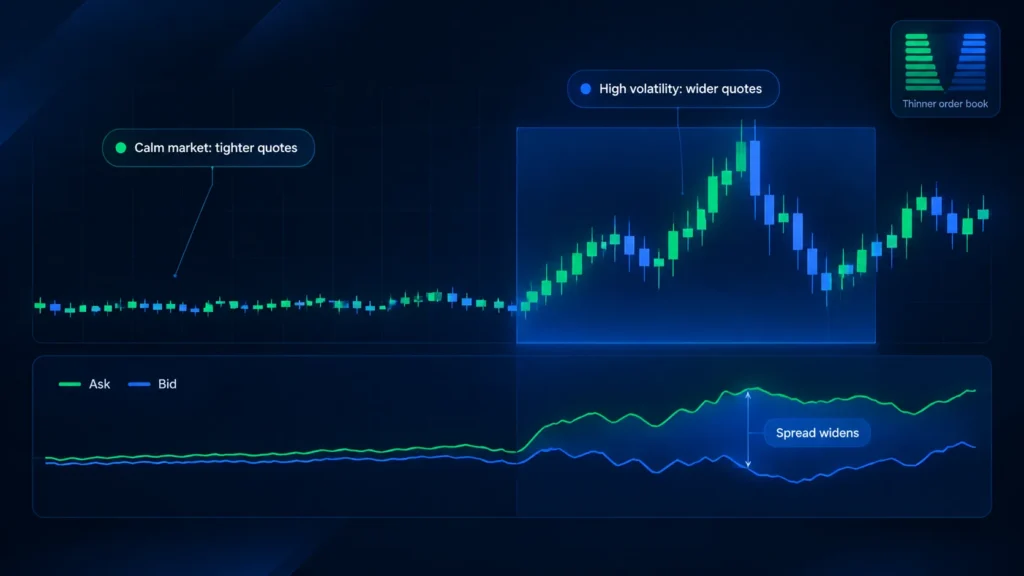
Quoted gaps are not static. They tend to react to changes in price volatility, order flow, and participation. Volatility is a measure of how much a price moves over time. The following sections describe this reaction from the perspective of liquidity providers, during stress events, and around news and time-of-day changes.
Why Volatility Widens Spreads
During fast price moves, market makers face elevated inventory risk and execution risk. Quotes can become stale in milliseconds, so liquidity providers are often described as widening quotes, reducing displayed order sizes, or temporarily withdrawing liquidity. A wider gap can be interpreted as compensation for that added risk.
A potential feedback loop is sometimes described: thinner books may let smaller orders move prices further, which raises volatility and encourages more quote withdrawal. Because spreads affect trade execution costs, wider quotes can raise the overall cost of participation. Outcomes are not guaranteed and vary across venues and assets.
Market Stress, Liquidations, and Spread Behavior
Periods of market stress, including sharp directional moves, forced liquidations of leveraged crypto derivatives positions, and one-sided order flow, have historically coincided with visibly wider quotes and thinner order books. Margin requirements determine when leveraged positions are closed, so liquidation cascades can add concentrated order flow to an already fragile book.
Market commentary frequently uses the March 2020 Bitcoin sell-off as a descriptive example of depth deteriorating under stress, and such episodes are not predictions. According to the European Securities and Markets Authority, a large share of retail CFD accounts lose money, which underlines the risk of leveraged products.
News, Events, and Participation Changes
Event-driven uncertainty, such as major announcements, regulatory developments, or macroeconomic data releases, can alter both volatility and participation. Market makers may reduce quote sizes before scheduled events, and the price of an asset may gap quickly until new information is absorbed.
Crypto markets trade around the clock, and order books are sometimes described as thinner during off-peak hours or weekends. Crypto traders in different time zones contribute to shifting participation. Conditions vary by venue and asset, so these time-related patterns are described only as observed market characteristics, and no timing recommendation is implied.
Interpreting Spreads in Market Analysis
Analysts and academics measure quoted gaps in several ways in cryptocurrency trading research and commentary. This section explains the main measurement concepts, how the gap is commonly read alongside other metrics, and why such assessment has limits that deserve attention.
Quoted vs Effective Spread
The quoted spread is the visible gap at the top of the book at a given moment. The effective version is measured from the difference between an execution price and the contemporaneous midpoint, often doubled: Effective Spread = 2 x |Execution Price – Mid Price|. The two can differ, especially for larger orders or fast markets.
| Measure | Definition | Example (Mid Price 60,005) |
| Quoted | Best ask minus best bid at a given moment | 60,010 – 60,000 = 10 |
| Effective | Twice the gap between execution price and mid price | 2 x |60,020 – 60,005| = 30 |
Both are analytical concepts used in market microstructure discussions. The effective measure should not be equated with total trading costs, because fees and later price movements are excluded. Neither measure describes the profit or loss of any specific trade.
Spread as Market Health Indicator
In market commentary, the quoted gap is commonly treated as one indicator of market conditions. It is typically read alongside order-book depth, trading volume, and observed slippage to form a broader picture of liquidity. Analysts generally describe the combination as a way to separate calm, well-supplied markets from fragile ones.
Typical observations in this combined reading include:
- A narrow gap with deep order-book levels is often described as consistent with healthy market liquidity.
- A narrow gap with thin depth may indicate that displayed liquidity is limited.
- A widening gap alongside rising volatility is commonly interpreted as increased uncertainty among liquidity providers.
- Persistent slippage on modest orders may indicate that visible quotes do not fully represent available size.
- The spread impact on a small order is typically modest, while larger orders may experience more slippage.
Limitations of Spread-Based Assessment
The quoted gap alone is an incomplete measure. It can be momentary, venue-specific, and, in thin books, potentially unrepresentative or distorted by a single small order. A tight reading at one instant may not persist, and a wide reading may reflect a temporary quote withdrawal rather than lasting conditions.
The word “spread” also has other meanings in finance, such as an intermarket spread between related futures contracts on a futures exchange, an options strategy built from several legs, or the swap cost of holding a leveraged derivative overnight. Spread trading refers to strategies built around price differences between related instruments, and it is distinct from the spread in crypto trading discussed here.
Bid-ask gaps are best considered as one descriptive window into market structure, read in context rather than in isolation.
FAQ
What Does Bid-Ask Spread Mean in Crypto Trading?
The bid-ask spread is the gap between the best ask and the best bid in an order book. For example, a bid of 3,000 and an ask of 3,002 for Ethereum gives a gap of 2. It describes the cost of immediacy at that moment and changes as orders arrive and fill.
How Is Bid-Ask Spread Calculated?
The absolute figure is Ask – Bid. The percentage variant divides that result by a stated reference price, such as the mid price, and multiplies by 100. With a bid of 3,000 and an ask of 3,002, the mid price is 3,001, so the percentage form is 2 / 3,001 x 100, or about 0.067%.
Why Do Crypto Spreads Widen During High Volatility?
Liquidity providers face greater inventory and execution risk when prices move quickly, so they often widen quotes, reduce sizes, or step back. Fewer resting orders mean thinner books. The pattern is a general tendency, and venues with strong market-maker participation may show less widening than others.
How Do Crypto Spreads Differ From Trading Fees?
The quoted gap is an implicit cost embedded in prices, while trading fees are explicit, published charges applied when an order executes. Both can affect total transaction costs, and they are reported separately. A wider gap does not change the published fee rate, and some dealer pricing models blend both into a single quoted price.
Do Wider Spreads Predict Crypto Price Direction?
No. Quoted gaps reflect trading conditions and liquidity, not the direction of future prices. A wider spread can appear during rises, declines, or sideways markets. It is better understood as a description of current market structure than as a directional price signal.
How Do Spreads Differ From Slippage?
The quoted gap is the difference between the best bid and best ask at the moment of observation. Slippage is the difference between the expected price and the actual price on a filled order. A market can show a narrow gap yet still produce slippage if a large order consumes several book levels.