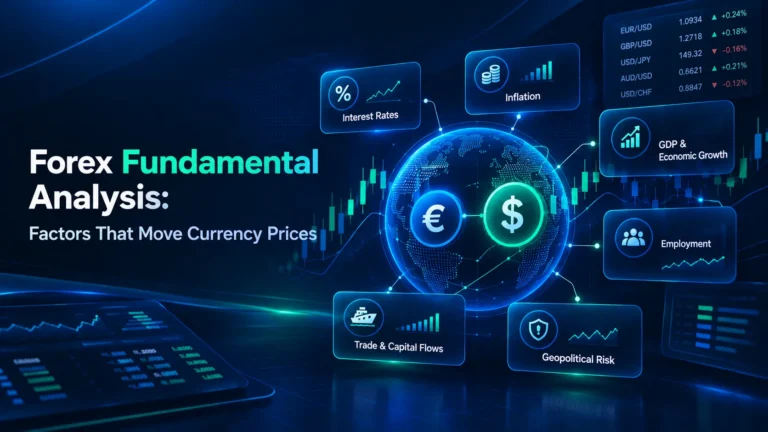
Forex Trading in India – What New Traders Need to Know About the Foreign Exchange Market


Forex trading in India attracts growing interest from individuals curious about the global foreign exchange market, yet many beginners are unsure where to start or what the rules actually are. The foreign exchange market is the largest and most liquid financial market in the world. According to the 2025 BIS Triennial Survey, daily global forex turnover reached USD 9.6 trillion in April 2025 — a record result and a 28% increase since 2022. For traders in India, accessing this market is possible, but only through specific legal channels defined by national regulators. This guide explains what forex trading is, how the forex market works, and what beginners need to understand before they consider participating.
Key Takeaways
- The foreign exchange market is the world’s largest financial market, operating 24 hours a day across global sessions.
- Forex trading in India is legal only when conducted through SEBI-registered brokers on recognized exchanges such as the NSE or BSE.
- Indian residents may trade currency derivatives on approved INR pairs and select cross-currency pairs; spot forex and offshore CFD platforms are prohibited under FEMA.
- Core forex concepts every new trader should understand include currency pairs, exchange rates, leverage, margin, pip, spread, bid and ask prices, and volatility.
- Risk management — including the use of stop-loss orders and position sizing — is a fundamental discipline for any trader entering financial markets.
- According to the European Securities and Markets Authority (ESMA), 74–89% of retail CFD accounts lose money, a figure that underlines why understanding risk before trading is essential.
- Past performance does not guarantee future results, and losses in forex trading may exceed initial expectations.
What Is the Forex Market and How Does Forex Trading Work?
The foreign exchange market — commonly called the forex market or FX market — is a global network where currencies are bought and sold against one another. Unlike a stock exchange such as the NSE or BSE, the global forex market does not operate from a single centralized location. Instead, most forex trading is done over-the-counter (OTC), meaning transactions take place directly between participants through electronic networks.
The forex market operates 24 hours a day, five days a week, across overlapping global sessions in Sydney, Tokyo, London, and New York. This continuous operation means that currency values can fluctuate at any hour in response to economic data releases, central bank decisions, geopolitical events, and shifts in supply and demand.
Currency trading involves the simultaneous buying of one currency and selling of another. Currencies are always quoted in pairs — for example, USD/INR represents the US dollar priced against the Indian rupee. The first currency listed is called the base currency, and the second is the quote currency. When a trader buys a currency pair, the base currency is purchased while the quote currency is sold, and vice versa.
Types of Forex Instruments: Spot, Forwards, Futures, and Derivatives
The forex market encompasses several types of instruments, each with distinct characteristics. Understanding these types of forex products is important for new traders evaluating which markets they can access legally in India.
Spot Market: The spot market is where currencies are exchanged at the current exchange rate, with settlement typically occurring within two business days. The spot market represents the largest segment of daily forex trading volume globally, though Indian retail traders cannot access offshore spot forex directly under current regulations.
Forward Contracts: A forward contract is a private agreement between two parties to exchange a currency at a specified exchange rate on a future date. Forward contracts are used by businesses and institutions primarily for currency risk management and hedging rather than speculative trading.
Currency Futures: Currency futures are standardized derivative contracts traded on recognized exchanges. A futures contract obligates the buyer to purchase — and the seller to deliver — a set amount of a currency on a specified future date at an agreed price. In India, currency futures are the primary instrument available to retail traders on regulated exchanges.
Currency Options: Currency options are derivative contracts that give the holder the right, but not the obligation, to buy or sell a currency pair at a specific price before or on a set expiration date. Options can be used for hedging currency risk or for speculative trading, depending on the trader’s objective.
| Instrument | How It Works | Typical Use |
| Spot Forex | Exchange at current rate, settled in ~2 days | Banks, institutions; restricted for Indian retail |
| Forward Contract | Fixed rate agreed for a future date | Hedging currency risk |
| Currency Futures | Standardized contract on exchange, cash-settled | Legal for Indian retail on NSE/BSE/MSE |
| Currency Options | Right to buy/sell at a set price by expiration | Hedging and speculative trading |
Is Forex Trading Legal in India? The Regulatory Framework Explained
A common question among new traders in India is whether forex trading legality in India permits retail participation. The answer requires understanding the three regulatory bodies that govern the Indian forex market.
Foreign exchange trading in India is regulated by three entities: the Reserve Bank of India (RBI), the Securities and Exchange Board of India (SEBI), and the Foreign Exchange Management Act (FEMA) 1999. The RBI manages currency reserves, SEBI requires brokers providing currency trading services to be registered, and FEMA defines permitted and prohibited transactions.
In practice, Indian residents must use a forex broker regulated by SEBI to trade forex legally. SEBI-registered brokers must meet specific compliance standards, including keeping client money in separate accounts and maintaining a physical presence in India. SEBI-registered brokers will only execute currency trades through recognized Indian exchanges.
India’s foreign exchange market has grown to approximately $60 billion in daily turnover, according to an RBI Governor statement from 2024, making it a significant market. Despite this size, the RBI and SEBI maintain strict controls over who can participate and how.
Penalties for Non-Compliance
The consequences of trading outside approved channels are significant. Under FEMA Section 13, penalties for unauthorized forex trading can reach three times the transaction amount or Rs 2 lakh, whichever is higher, with an additional Rs 5,000 per day for continuing violations. The RBI’s alert list includes 95 unauthorized forex trading platforms as of its November 2025 update. Beginners should verify any platform against this publicly available list before depositing funds.
What Currency Pairs Can Indian Traders Legally Trade?
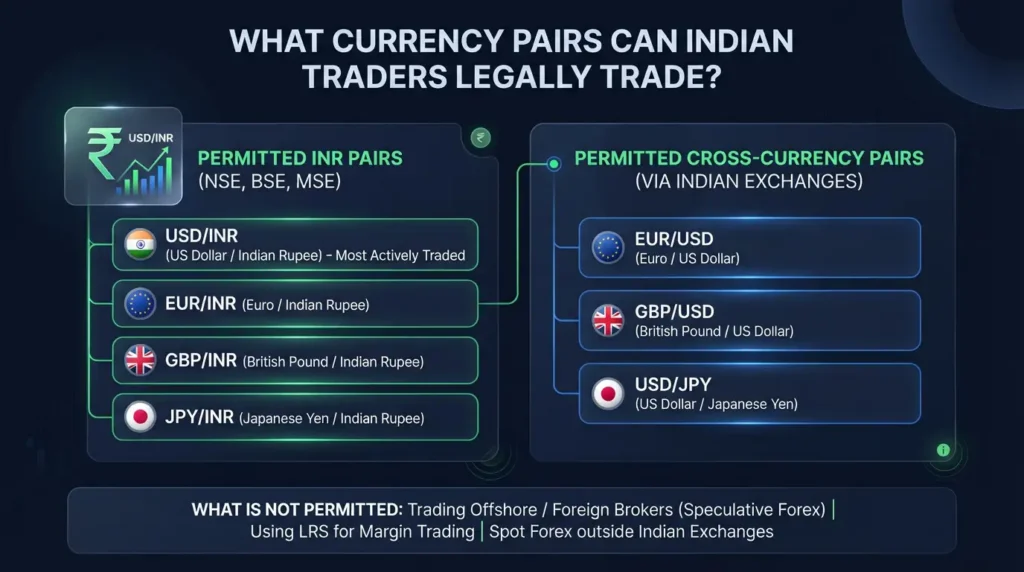
Indian residents are permitted to trade a defined set of currency pairs as derivatives on recognized exchanges. Understanding USD/INR forex trading is a natural starting point, as the US dollar–Indian rupee pair is the most actively traded INR pair on domestic exchanges.
Permitted INR Pairs:
- USD/INR (US dollar / Indian rupee)
- EUR/INR (euro / Indian rupee)
- GBP/INR (British pound / Indian rupee)
- JPY/INR (Japanese yen / Indian rupee)
Permitted Cross-Currency Pairs (via Indian exchanges):
- EUR/USD
- GBP/USD
- USD/JPY
These contracts are traded on the National Stock Exchange (NSE), the Bombay Stock Exchange (BSE), and the Metropolitan Stock Exchange (MSE). All contracts are cash-settled in Indian rupees, meaning no physical delivery of foreign currency occurs for retail derivative positions.
What Is Not Permitted:
- Using offshore or foreign brokers for speculative forex trading
- Trading spot forex or CFDs on non-INR pairs outside Indian exchanges
- Sending money abroad under the Liberalised Remittance Scheme (LRS) specifically for margin trading or speculative forex, which the RBI has explicitly stated is not permitted
Core Forex Concepts Every New Trader Should Understand
Before a new trader considers entering the foreign exchange market, several foundational concepts require a clear understanding. These are not optional extras — they directly affect how positions behave and how risk accumulates.
Currency Pairs and Exchange Rates
A currency pair represents the relative value of one currency against another. The exchange rate shows how much of the quote currency is needed to buy one unit of the base currency. Exchange rates fluctuate continuously based on economic data, interest rate decisions by central banks, political developments, and overall market sentiment.
Example: If the USD/INR exchange rate is 83.50, one US dollar costs 83.50 Indian rupees. If the rate rises to 84.00, the rupee has weakened against the dollar — meaning a dollar buys more rupees than before.
Bid and Ask Prices
Every currency pair is quoted with two prices: the bid price and the ask price. The bid price is the rate at which a trader can sell the base currency; the ask price is the rate at which a trader can buy it. The difference between these two prices is called the spread. The spread represents a cost that the broker typically earns on each transaction.
Pip: The Basic Unit of Movement
A pip (percentage in point) is the smallest standard price movement in a currency pair. For most major currency pairs, a pip is equal to 0.0001 of the exchange rate. Pip values matter because they determine the monetary value of price fluctuations relative to position size.
Example: In the EUR/USD pair, a move from 1.0850 to 1.0851 is a movement of one pip.
Leverage and Margin
Leverage allows a trader to control a position larger than the capital actually deposited. Margin is the amount of funds required to open and maintain a leveraged position.
Example: With 10:1 leverage, a trader with ₹10,000 in margin could control a position worth ₹1,00,000. A 1% movement in the market would produce a gain or loss of ₹1,000 — equal to 10% of the deposited margin.
Leverage amplifies both potential gains and potential losses equally. Analysing retail trading accounts, ESMA concluded that 74–89% of clients lose on their investments, with average loss amounts per client ranging from €1,600 to €29,000. High leverage leads to oversized positions, especially among novice traders who have limited discipline in following risk management rules. Losses may exceed initial capital in leveraged environments.
Volatility
Volatility describes the rate and magnitude of price fluctuations in a currency pair. High volatility means prices are moving rapidly and unpredictably; low volatility means prices are relatively stable. Volatility tends to increase around major economic announcements, central bank decisions, and geopolitical events. For new traders, high volatility environments may increase both the speed and size of potential losses.
Forex Market Hours in India and Global Trading Sessions
The global forex market runs continuously from Monday morning in Sydney to Friday evening in New York. However, different sessions have different levels of liquidity and volatility, which affects how currency price movements behave.
Understanding forex market hours in India is particularly relevant for traders using the NSE and BSE currency derivatives segments, which operate during fixed hours (approximately 9:00 AM to 5:00 PM IST on working days), unlike the 24-hour OTC global market.
| Global Session | IST Approximate Hours | Major Pairs Active |
| Sydney | 5:30 AM – 2:00 PM | AUD, NZD pairs |
| Tokyo | 5:30 AM – 2:30 PM | JPY pairs |
| London | 12:30 PM – 9:30 PM | EUR, GBP, CHF pairs |
| New York | 6:30 PM – 1:00 AM | USD pairs |
The London–New York overlap (approximately 6:30 PM to 9:30 PM IST) is historically the highest-liquidity window for major currency pairs globally.
How to Start Trading Forex Legally in India
For individuals who decide to explore forex trading after understanding the regulatory context and core concepts, the legal pathway involves several structured steps. This is a description of the typical process — not a personal recommendation to trade.
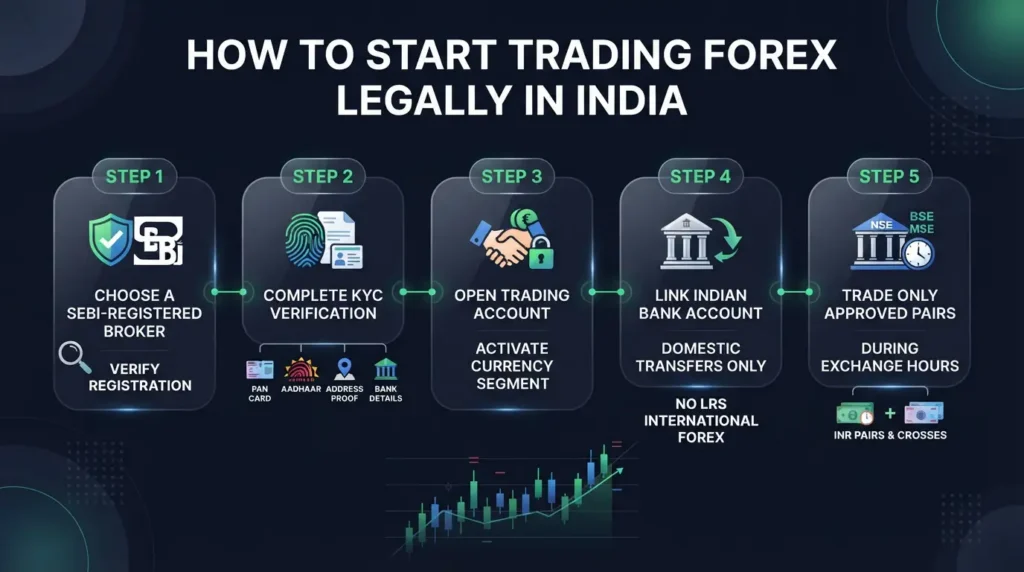
Step 1 — Choose a SEBI-Registered Broker: Select a broker that is registered with SEBI and authorized to offer the currency derivatives segment. SEBI registration can be verified directly on the SEBI website.
Step 2 — Complete KYC Verification All SEBI-registered brokers require Know Your Customer (KYC) documentation, typically including a PAN card, Aadhaar, address proof, and bank details, with in-person or video verification as required.
Step 3 — Open a Trading Account with the Currency Segment Activated A trading account (and in some cases a demat account) is required. The broker must specifically activate access to the currency derivatives segment.
Step 4 — Link an Indian Bank Account All funds must move through the Indian banking system. International transfers specifically for forex speculation are not permitted under LRS.
Step 5 — Trade Only Approved Pairs During Exchange Hours Transactions must be limited to the permitted INR and cross-currency pairs on NSE, BSE, or MSE, during the exchange’s operating hours.
Forex Trading Strategies: What New Traders Should Understand
Many participants in the foreign exchange market develop trading strategies to guide their buying and selling decisions. A trading strategy is a structured approach to identifying and acting on potential currency price movements. Different trading styles suit different time commitments, risk tolerances, and market conditions.
New traders should approach forex trading strategies as a topic of study and research rather than immediate implementation. Understanding various approaches is part of building foundational knowledge.
Scalping is a trading style where positions are held for very short periods — often seconds to minutes — with the goal of capturing small pip movements repeatedly throughout the day. Scalping requires fast execution and discipline, and is generally considered a higher-risk approach for new traders.
Day Trading involves opening and closing all positions within a single trading session, avoiding overnight exposure. Day traders analyze intraday price movements and make trading decisions based on short-term technical patterns and market conditions.
Swing Trading is a trading style where positions are held for several days to weeks, aiming to capture medium-term currency price movements. Swing trading is often used by traders who cannot monitor markets continuously throughout the day.
Position Trading involves holding positions for weeks, months, or longer, based on fundamental analysis of economic trends, interest rate differences between countries, and macroeconomic factors. Position trading requires a strong understanding of how central bank policy and economic data affect currency values over time.
| Trading Style | Typical Hold Period | Primary Analysis Type |
| Scalping | Seconds to minutes | Technical |
| Day Trading | Hours (within one session) | Technical |
| Swing Trading | Days to weeks | Technical and fundamental |
| Position Trading | Weeks to months | Fundamental |
Risk Management in Forex Trading: Concepts Every Trader Should Know
Risk management is not a supplementary topic — it is the foundation of any sustainable approach to trading in financial markets. New traders who overlook risk management are more likely to experience significant capital loss.
Stop-Loss Orders: A stop-loss order is an instruction to automatically close a position if the price moves against the trader by a specified amount. Stop-loss orders help limit potential losses on any individual trade by removing the need for manual intervention in fast-moving markets. Many experienced traders consider the disciplined use of stop-loss orders a standard element of risk management rather than an optional feature.
Position Sizing: Position sizing refers to the amount of a currency pair that a trader buys or sells in a single transaction. Controlling position size relative to overall account capital is a key method of managing exposure. Larger positions amplify both potential gains and losses in proportion to capital.
Risk-Reward Ratio: The risk-reward ratio compares the potential loss on a trade to the potential gain. A ratio of 1:2, for example, means a trader risks one unit of capital to potentially gain two units. Some traders use this concept when evaluating whether a potential trade aligns with their broader strategy.
Interest Rate Risk: Currency values are significantly influenced by interest rate decisions made by central banks. When a country’s central bank raises interest rates, the currency may attract demand from investors seeking higher returns. Interest rate differences between countries can drive sustained directional movements in currency pairs over time.
Forex Trading and Commodities: Understanding Related Markets
The foreign exchange market does not exist in isolation. Currency values are often connected to commodity prices through trade flows and economic dependencies. Countries that are major exporters of commodities such as oil, gold, or agricultural products may see their currency values influenced by changes in commodity prices on global markets.
For example, the Indian rupee is affected by crude oil prices because India is a significant importer of oil. When oil prices rise, India’s import costs increase, which can put downward pressure on the rupee relative to the US dollar. Understanding these linkages is part of developing broader market awareness, which may inform trading decisions over time.
Summary: What to Know Before Entering the Forex Market
The global foreign exchange market offers significant opportunity alongside significant risk, particularly for new traders who may not yet fully understand the instruments, mechanics, and regulatory framework involved. For a structured introduction to the fundamentals, a beginner forex trading guide provides a useful starting framework.
Forex trading in India operates under a clear and enforceable legal structure governed by the RBI, SEBI, and FEMA. Participants who trade outside the permitted channels face meaningful legal consequences, and the financial risks of leveraged currency trading are documented extensively by regulators worldwide. ESMA’s analysis of broker disclosures showed that between 74% and 89% of retail traders lose money on CFDs and forex — a statistic that reflects how challenging consistent profitability in these markets can be for retail participants.
Understanding what the forex market is, how currency pairs and exchange rates work, and what regulatory conditions apply in India is the minimum foundation for approaching this market responsibly. Past performance does not guarantee future results, and losses in forex trading may exceed initial expectations.
Frequently Asked Questions About Forex Trading in India
What is the difference between the forex market and the stock exchange?
The foreign exchange market is a global, primarily over-the-counter market where currencies are bought and sold continuously. A stock exchange such as the NSE or BSE is a centralized marketplace where shares of listed companies are traded during fixed hours. The forex market is significantly larger by daily trading volume and operates across global time zones without a physical central location.
Can new traders in India trade forex without a broker?
No. Indian residents must use a SEBI-registered broker that offers the currency derivatives segment on recognized exchanges. Trading directly on global OTC forex platforms or through offshore brokers is prohibited under FEMA regulations and may carry significant legal and financial penalties.
What does leverage actually mean in practice for a new trader?
Leverage allows a trader to control a position larger than the capital deposited. While this can amplify gains when a trade moves in the expected direction, it equally amplifies losses when the market moves against the position. New traders frequently underestimate how quickly leveraged losses can exceed the initial margin deposited, which is why understanding margin requirements before trading is considered essential.
Are forex trading strategies the same as investment strategies?
Forex trading strategies and investment strategies are distinct approaches. Forex trading is generally considered speculative in nature, involving short- to medium-term positions on currency price movements. Investment strategies typically involve longer time horizons with an expectation of value appreciation. In the Indian regulatory context, retail forex trading is specifically categorized as derivative trading on recognized exchanges, not investment activity.
How is the exchange rate for a currency pair determined?
Exchange rates in the forex market are primarily determined by supply and demand. When demand for a currency rises — due to economic growth, higher interest rates, or increased foreign investment — the currency typically appreciates. When demand falls, the currency may weaken. Central bank intervention, geopolitical events, and macroeconomic data releases all contribute to short-term and long-term exchange rate fluctuations.