Crypto Trading Risk Management: Position Sizing, Stop Losses, and Exposure

Crypto trading risk management is a set of practices that help traders control potential losses in cryptocurrency markets. Position sizing, stop losses, and exposure management form the three pillars covered here.
Because crypto trading combines market volatility, round-the-clock sessions, and widespread leverage, these concepts receive particular attention in educational material. Results are never guaranteed.
Key Takeaways
- A guideline of risking roughly 1–2% of account value on every trade is widely referenced.
- Position size is often derived from the distance to a stop level rather than from a fixed lot size.
- Stop levels are frequently discussed at technical invalidation points or at multiples of Average True Range (ATR).
- Total open risk and correlation between holdings are typically capped or monitored.
- Leverage magnifies both gains and losses.
- Risk management strategies limit and shape risk but do not eliminate losses.
What Is Risk Management in Crypto Trading
Risk management in crypto refers to the policies and calculations a trader uses to define how much loss is acceptable before a position is opened. In the cryptocurrency market, proper risk management is generally treated as a foundation of trading rather than an optional add-on, because price swings can be sudden and large.
Why Crypto Markets Carry Elevated Risk
Cryptocurrency trading involves structural features that differ from traditional financial markets. Volatility is typically higher than in stocks or currencies, trading continues 24/7 without a closing pause, and liquidity can thin out over weekends. Leveraged derivatives can produce liquidation cascades, and regulatory uncertainty adds unpredictability. These traits are often described as amplifying both potential gains and potential losses.
Core Principles of Risk Management
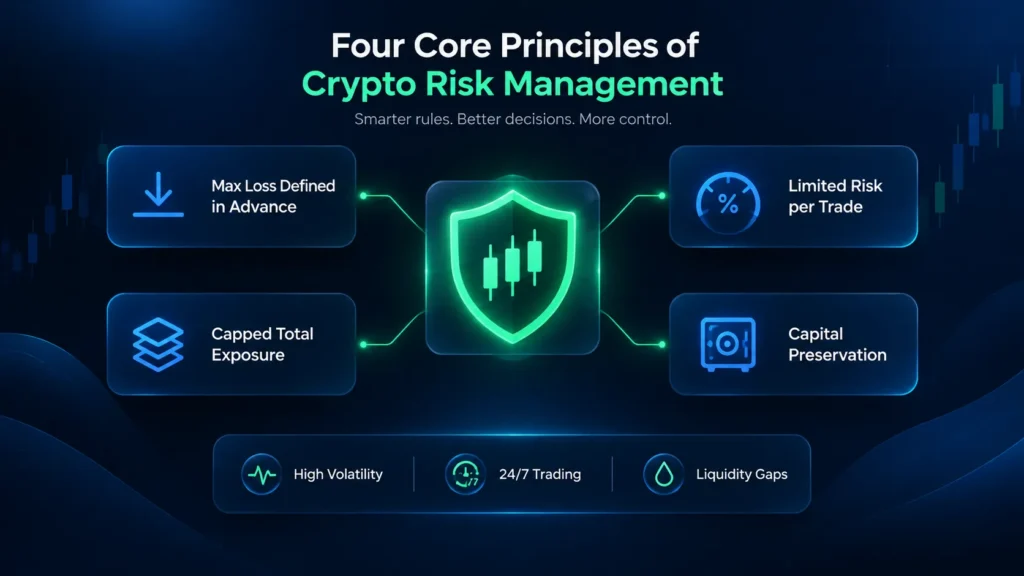
Educational sources commonly describe four risk management practices, presented here as widely cited ideas rather than instructions:
- Defining a maximum acceptable loss in advance
- Limiting the amount risked on each trade
- Capping total exposure across open positions
- Treating capital preservation as a priority
Preservation of Capital vs. Return Targets
A conceptual trade-off exists between aggressive growth and account survivability. Drawdowns require progressively larger gains to recover: a 50% loss needs a 100% gain to return to the starting balance. This arithmetic is often cited as the reason many traders discuss limiting losses first. According to the European Securities and Markets Authority, a large majority of retail accounts lose money trading leveraged products such as CFDs.
Position Sizing Fundamentals
Position sizing describes how much capital is allocated to a single trade. In crypto trading, position size determines how strongly a given price move affects the account, which makes sizing one of the most frequently discussed ways to manage risks.
Risk-Per-Trade Rule
The widely referenced 1–2% guideline concerns the amount lost if a stop level is reached, not the full value of the position. For example, on a $10,000 account, 1% risk implies a maximum planned loss of $100. Some experienced traders reportedly use narrower or wider ranges, up to around 5% of total capital, depending on trading style and market conditions.
Position Size Calculation
Position size is commonly described as the risk amount divided by the stop distance. In a worked example, a $100 risk with a stop 5% from the entry price implies a $2,000 position, because a 5% move on $2,000 equals $100. Wider stops generally correspond to smaller positions, and tighter stops to larger ones, keeping dollar risk constant.
Volatility-Adjusted Sizing
Position size may also be adapted to volatility. Highly volatile altcoins that show higher volatility are often associated with smaller positions, while more established assets such as Bitcoin may be discussed with larger ones. The Average True Range (ATR) is an indicator commonly used to measure recent price action and to inform both stop distance and size.
Common Position Sizing Errors
Trading education frequently describes several recurring patterns in position sizing:
- Sizing by gut feeling rather than a predefined risk budget
- Taking maximal positions after winning streaks
- Using full leverage on a single trade
- Letting conviction, rather than a risk budget, determine size
These patterns are generally associated with outsized losses when markets move unexpectedly.
Stop-Loss Orders Explained
A stop-loss order is an instruction placed with a cryptocurrency exchange to close a position when price reaches a specified level. Stop-loss orders are generally described as a tool for limiting downside risk, though their behavior depends on the order type and on market liquidity at the time.
Types of Stop-Loss Orders
Exchanges typically offer several stop mechanisms, and understanding crypto order types helps clarify how each functions. The comparison below summarizes general advantages and limitations.
| Stop Type | How It Functions | General Limitation |
| Stop-market | Becomes a market order once the trigger price is reached | Fill price may differ during fast moves (slippage) |
| Stop-limit | Becomes a limit order at the trigger price | May not execute if price gaps past the limit |
| Trailing stop | Trigger level follows price at a set distance | Tight trails may exit during normal noise |
| Mental stop | Exit level held by the trader, not placed on the exchange | Depends on discipline and constant attention |
Placement Approaches: Structure and Volatility
Two approaches to stop placement are commonly discussed. Structural placement positions the exit point beyond swing lows or highs, or beyond support and resistance, where the trade idea is considered invalidated. Volatility-based placement uses multiples of ATR, often 1.5–2.5 times for major coins and wider for volatile altcoins. Arbitrary round percentages are sometimes criticized for being triggered by normal market noise.
Stop Hunting and Liquidity Considerations
A stop hunt describes price briefly pushing through visible clusters of stop orders to collect liquidity before reversing. Stops clustered just beyond obvious round numbers, or exactly at widely watched support levels, are often associated with this risk. During extreme volatility or low liquidity, such moves may appear more pronounced, though attributing a specific move to deliberate hunting is difficult.
Trailing Stops and Break-Even Moves
Trailing stops are generally used in trending markets to allow winning trades to continue while protecting accumulated gains. Some traders also move a stop to the entry price, known as break-even, after price advances a certain distance. Trade-offs are commonly noted: tighter trails protect more profit but may close trades earlier than the trend would otherwise allow.
Managing Market Exposure
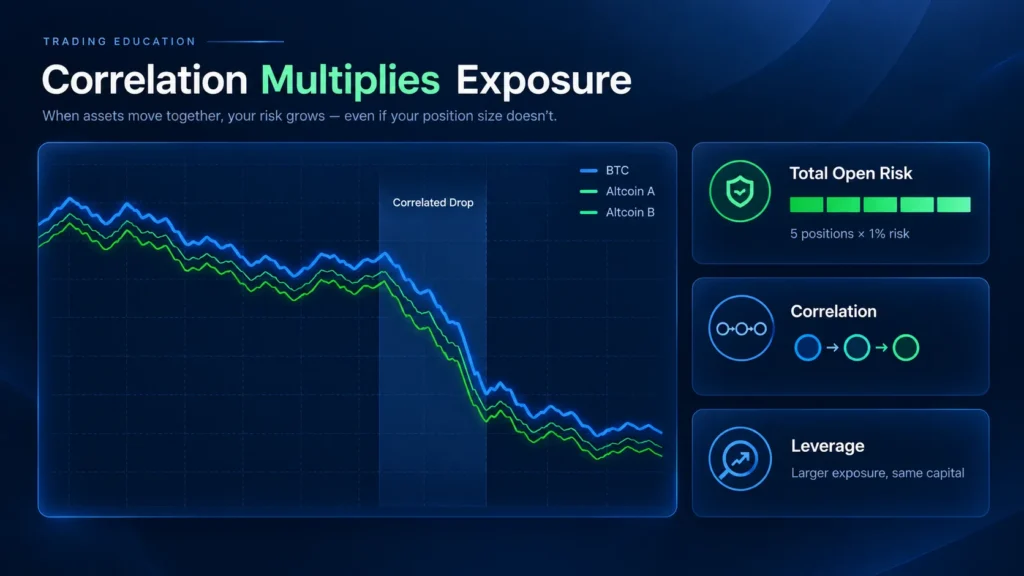
Exposure describes the total amount of capital at risk across all open positions, rather than the risk in any single trade. Because risk comes from how holdings interact, exposure management in the crypto market also considers how different crypto assets relate to each other during sharp price movements.
Total Open Risk and Correlation
Total open risk is the combined planned loss across every open position. Correlated holdings, such as multiple altcoins that tend to move with Bitcoin, can effectively multiply that risk because they may decline together. Some traders reportedly cap total open risk at around 20% of total capital or limit the number of concurrent positions.
Diversification vs. Concentration
Two views coexist in trading discussions. Traders who diversify across asset classes and individual coins may reduce single-asset risk, but diversification can dilute any analytical edge and still leave correlation risk. Concentration in a few assets increases both potential upside and vulnerability. The 2022 collapse of the FTX exchange is often cited as an example of concentrated counterparty exposure.
Leverage and Effective Exposure
Leverage increases effective exposure without adding capital, magnifying outcomes in both directions. Leverage changes margin requirements, not necessarily the amount risked when sizing is derived from stop distance. Liquidation risk, however, tends to grow with leverage, especially in volatile markets. A deeper explanation of leverage trading crypto covers margin and liquidation mechanics. Losses may exceed initial expectations.
Drawdown Limits and Cash Reserves
Some traders define a maximum drawdown threshold that triggers a pause and review of results. Others hold a portion of capital in cash or stablecoins. Maintaining reserves is often described as providing flexibility during sharp corrections, although stablecoins carry their own issuer and counterparty risks, which regulators such as the Financial Conduct Authority have repeatedly highlighted.
Risk-Reward Ratio in Trade Planning
The risk-reward ratio compares the potential gain of a trade with its potential loss. In crypto trading, the ratio is a conceptual tool used to describe how a strategy’s winning and losing trades relate to each other across many outcomes, rather than a way to predict any single result.
How Risk-Reward Is Calculated
The ratio is defined as potential profit divided by potential loss. Benchmarks such as 2:1 or 3:1 are commonly cited in trading education. The underlying logic is that a favorable ratio may allow a strategy to remain viable even with a lower win rate, since occasional larger gains can offset more frequent small losses.
Win Rate and Expectancy
Win rate and risk-reward interact. Theoretically, a 2:1 ratio can remain profitable at win rates above roughly 33%, while a 1:1 ratio would require more than 50%. The table below illustrates this relationship. Historical patterns do not guarantee future outcomes, and real results are affected by fees and slippage.
| Risk-Reward Ratio | Approximate Break-Even Win Rate |
| 1:1 | 50% |
| 2:1 | 33% |
| 3:1 | 25% |
Limitations of Ratio-Based Thinking
Ratios depend on accurate targets and stops, and market conditions can shift quickly. A planned 3:1 trade may never reach its target, and fast price moves can lead to fills that differ from planned levels. For these reasons, the ratio is best understood as conceptual context rather than a prescription or a predictor of results.
Common Risk Management Mistakes
Behavioral patterns often explain why risk plans fail in practice. Many common crypto trading mistakes involve emotion, such as fear of missing out, rather than flawed calculations. Knowing how to manage these behavioral tendencies is often treated as a skill separate from technical analysis.
Moving or Removing Stops
Widening stops on losing positions, or canceling them in the hope of recovery, is a well-documented behavioral pattern. It is generally characterized as one of the most frequent contributors to outsized losses, because the original maximum acceptable loss is effectively abandoned once the stop level is changed after entry.
Overtrading and Revenge Trading
Revenge trading describes attempting to win back losses quickly through larger or more frequent trades, often driven by fear or frustration. Overtrading can also increase fees and total exposure. Predefined rules and session limits are often discussed as structural countermeasures, because they reduce the influence of emotion on trading decisions.
Absence of a Written Plan
Trading without documented rules for risk, entries, exits, and exposure is often associated with inconsistent outcomes. A written trading plan is generally framed as a best practice in trading education, since written criteria allow decisions to be reviewed objectively afterward instead of being reconstructed from memory.
FAQ
What is the 1–2% rule in crypto trading?
The 1–2% rule is a guideline describing a maximum loss of roughly 1–2% of account value on a single trade, measured at the stop level. On a $5,000 account, 2% equals $100. The guideline concerns potential loss, not position value, and some traders use different percentages.
How is position size calculated with a stop loss?
Position size is commonly described as the risk amount divided by the stop distance. A $200 risk with a 4% stop distance implies a $5,000 position. Wider stops generally correspond to smaller positions, while tighter stops correspond to larger ones, keeping the planned dollar loss constant.
Where are stop losses commonly placed in crypto?
Stop losses are commonly discussed at two kinds of locations. Structural approaches use levels beyond swing highs or lows where a trade idea is considered invalidated, while volatility-based approaches use multiples of ATR. Appropriate distances vary by asset, timeframe, and market conditions.
How does leverage affect risk?
Leverage magnifies effective exposure and liquidation risk because a smaller deposit controls a larger position. When position size is derived from stop distance, planned dollar risk may remain unchanged. However, higher leverage brings the liquidation price closer, so rapid price swings may close positions before a stop is reached.
What is total exposure in crypto trading?
Total exposure is the aggregate risk across all open positions. Correlation can amplify it, since many altcoins tend to move alongside Bitcoin. Five positions that each risk 1% may behave like one larger position if the assets decline together, so exposure is generally assessed at the portfolio level.
Can risk management eliminate losses?
No. Risk management techniques are generally described as limiting and shaping risk, not removing it. Losses remain an inherent part of trading, and factors such as slippage, exchange outages, and liquidity gaps can cause outcomes to differ from plans. Past performance does not guarantee future results.