Crypto INR Pairs: Rupee-Quoted Markets, Liquidity, and Pricing

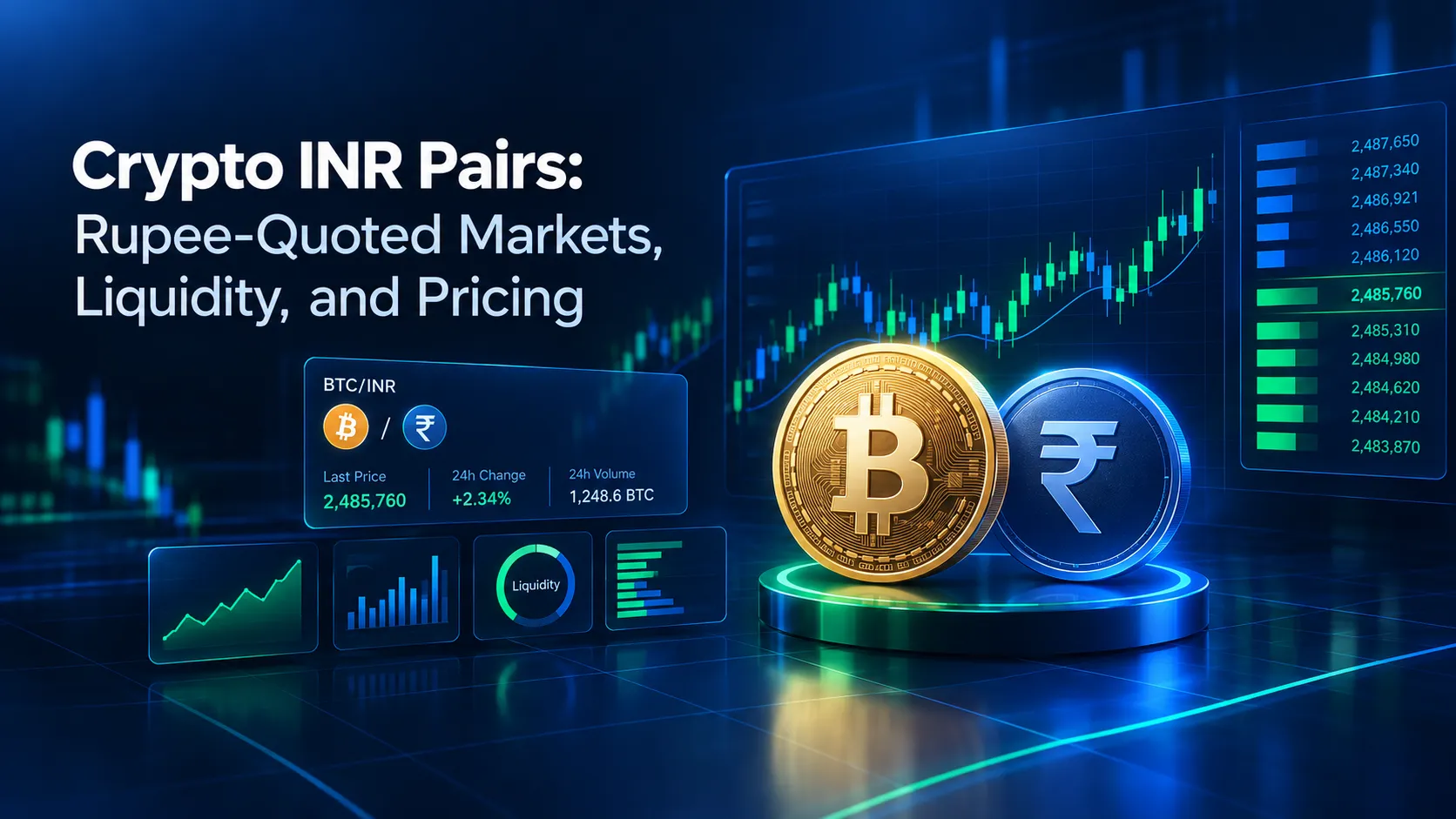
Crypto INR pairs are cryptocurrency markets in which prices are quoted in Indian rupees rather than US dollars or stablecoins. Such quotations matter for crypto trading in India because a rupee price removes one currency conversion from the reading of a quote.
This article explains market structure, price formation, liquidity, costs, and regulatory context in neutral, educational terms. All content is informational market commentary and does not constitute investment advice.
Key Takeaways
- Definition: A crypto INR pair quotes the price of one unit of a cryptocurrency, such as Bitcoin, in Indian rupees.
- Comparison: INR pairs differ from USDT and USD markets in pricing reference, conversion steps, and market structure.
- Liquidity: Trading volume, order-book depth, and bid-ask spreads shape how a rupee market absorbs orders.
- Pricing: Global cryptocurrency prices and the USD/INR exchange rate both influence local quotations.
- Costs and rules: Exchange fees, settlement mechanisms, taxation, and regulation affect the broader market.
What Are Crypto INR Pairs?
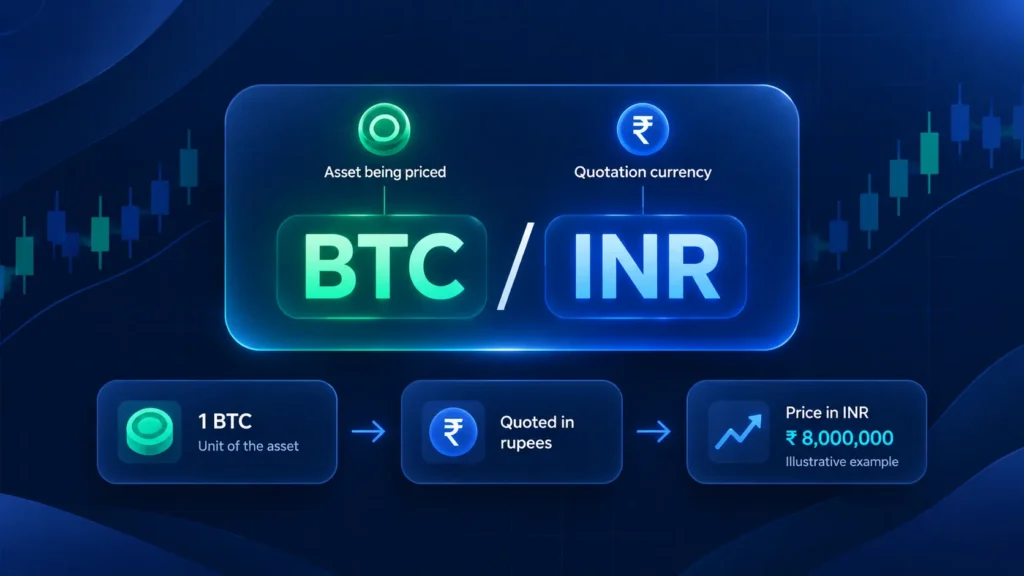
A crypto INR pair is a market quotation that expresses the value of a cryptocurrency in Indian rupees. Two currencies are always involved: the asset being priced and the currency used for pricing. Separating these two roles helps beginners read any quote on a cryptocurrency exchange.
How INR Trading Pairs Work
A trading pair such as BTC/INR lists the priced asset first and the quotation currency second. In BTC/INR, Bitcoin is the asset and the Indian rupee is the quotation currency. If BTC/INR displays 8,000,000, one Bitcoin is quoted at 8,000,000 rupees. These figures are illustrative only.
INR Pairs vs USD and USDT Markets
Direct rupee quotations differ from USD and USDT markets in the pricing reference. USD is a fiat currency issued by the United States. Tether (USDT) is a stablecoin designed to track the US dollar, so USDT pairs usually carry a dollar-linked reference. INR pairs carry a rupee reference, which may require no extra currency conversion for Indian participants.
Common Cryptocurrencies Available in INR Markets
Availability depends on each exchange’s listing policy, market demand, and trading activity. Pairs commonly encountered include:
- BTC/INR: Bitcoin priced in rupees, usually the most widely listed pair.
- ETH/INR: Ethereum priced in rupees.
- USDT/INR: a stablecoin priced in rupees, often used as a reference rate.
- XRP/INR and DOGE/INR: selected major altcoins, listed on some platforms only.
How Crypto INR Prices Are Determined
Rupee-denominated cryptocurrency prices emerge from several overlapping mechanisms. Local order books, global valuations, and currency movements all contribute. Because each platform operates independently, the same asset can display slightly different INR quotations at the same moment.
Supply, Demand, and Order Book Activity
Prices form where buy orders and sell orders meet. A buy order states the highest price a participant will pay, and a sell order states the lowest price a participant will accept. When executed transactions occur at higher prices, the last traded price rises. Short-term movements often reflect shifts in the balance of outstanding orders.
Global Crypto Prices and INR Exchange Rates
An INR quotation reflects two layers: the global value of the cryptocurrency, commonly referenced in USD, and the USD/INR exchange rate. In simple terms, INR price is approximately USD price multiplied by the exchange rate. If Bitcoin stays flat in USD while the rupee weakens, the INR quotation may rise without any change in Bitcoin’s global valuation.
Price Differences Across Crypto Exchanges
Different exchanges may display different INR quotations for the same asset. Contributing factors include order-book depth, trading activity, platform fees, and local conditions. Such differences do not necessarily represent directly comparable markets, since each platform has its own participants.
Market data providers publish live price figures, price charts, last 24 hours changes, and market cap rankings for reference. Online forum threads and social media discourse are generally not considered reliable market data, and any forecast or prediction found there may be inaccurate.
Liquidity in Crypto INR Markets
Market liquidity describes how easily an asset can be exchanged without a large change in its price. In rupee markets, liquidity influences price stability, trading costs, and the capacity of an order book to absorb orders. The sections below describe the main indicators used to observe it.
Trading Volume and Market Depth
Trading volume measures completed transactions over a period, while order-book depth measures outstanding buy and sell orders waiting at various price levels. The two indicators offer different perspectives. High volume may reflect active participation, whereas depth indicates how much capacity exists near the current price. Volume concentrated in a few large transactions can be misleading.
Bid-Ask Spreads and Slippage
The bid-ask spread is the difference between the highest bid and the lowest ask, written as Spread = Ask Price – Bid Price. Slippage is the difference between an expected price and the price obtained at execution. Thinner INR markets may show wider spreads and greater price impact. Crypto trading spreads are described in more detail in a separate guide.
Liquidity Differences Between Major Coins and Altcoins
Major cryptocurrencies such as Bitcoin and Ethereum typically attract broader participation and deeper order books than less frequently traded tokens. Altcoins listed in INR may have fewer participants, with orders concentrated near a handful of price levels. In some market conditions, a smaller pair can therefore display noticeably wider spreads.
| Characteristic | Major Coins (BTC, ETH) | Smaller Altcoins |
| Market participation | Typically broad | Often limited |
| Order-book depth | Often deeper | Often thinner |
| Typical spreads | Often narrower | Often wider |
| Price impact of large orders | Generally lower | Generally higher |
INR Pairs vs USDT Pairs
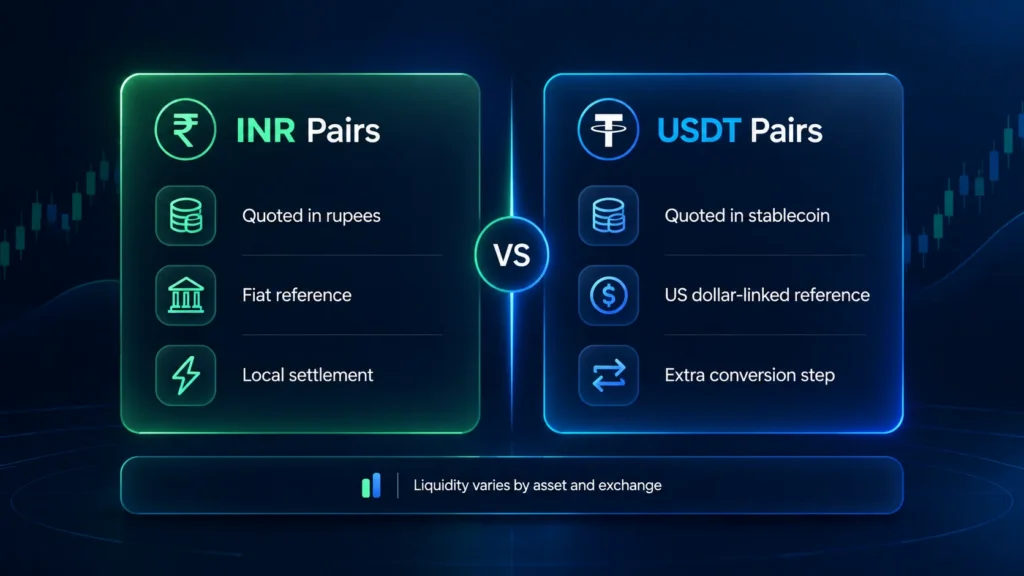
INR pairs and USDT pairs both describe cryptocurrency prices, but each uses a different quotation currency. One references a national fiat currency, and the other references a stablecoin. The sections below compare pricing references, liquidity distribution, and the role of currency conversion.
Direct INR Pricing and Stablecoin Conversion
INR pairs express prices directly in rupees. USDT pairs express prices in a stablecoin designed to track the US dollar, so rupee value depends on a further conversion between USDT and INR. Stablecoins also carry issuer-specific risks, including reserve transparency and temporary departures from the intended peg.
Liquidity Distribution Across INR and USDT Markets
Liquidity can be distributed unevenly between INR and USDT order books. Some assets may have more active global stablecoin markets, while others show relatively active local rupee markets. Neither quotation currency guarantees deeper liquidity. Market makers and peer-to-peer venues may also split activity across several order books.
Price Differences Between INR and USDT Quotations
Differences between INR and USDT quotations can arise from conversion rates, trading fees, liquidity conditions, and temporary imbalances. USDT’s intended dollar peg does not guarantee an identical price relationship across platforms. Derivatives such as perpetual futures contracts on a futures exchange are usually denominated in USDT, and leverage in futures trading may magnify losses, including on short positions.
| Feature | INR Pairs | USDT Pairs |
| Quotation currency | Indian rupee (fiat) | Tether (stablecoin) |
| Pricing reference | Rupee value | US dollar-linked value |
| Conversion required | Often none for rupee holders | USDT to INR step may be needed |
| Specific risks | Local settlement and banking | Stablecoin peg and issuer risk |
Factors Affecting Crypto INR Market Liquidity
Liquidity in rupee markets is shaped by structural and external forces rather than by the pair alone. Participation, payment infrastructure, and market sentiment each contribute. Understanding these factors explains why one INR pair can behave differently from another over time.
Exchange Participation and Market Fragmentation
Buyers, sellers, and trading activity are distributed across many platforms, such as KuCoin, Cofinex, and local exchanges. Each platform maintains a separate order book. Fragmentation can therefore produce different spreads, volumes, and prices for the same cryptocurrency, since no single order book captures total market interest.
INR Deposits, Withdrawals, and Settlement Infrastructure
Rupee markets depend on fiat payment systems, bank transfers, and banking relationships. Deposit availability, withdrawal processing, 2FA protections, and identity verification all influence participation. Interruptions or settlement restrictions at a third party payment provider may reduce activity, and thinner participation can in turn affect depth and spreads.
Volatility, Market Demand, and Liquidity Changes
Sharp price movements, shifting demand, and uncertainty can reduce order-book depth and widen spreads. Liquidity is therefore variable rather than a fixed property of a pair. Descriptive tools such as moving averages and RSI are sometimes used to characterize bullish or bearish phases, though such readings carry no certainty about future behavior.
Trading Costs and Pricing Differences in INR Markets
The total cost of exchanging cryptocurrency in rupees extends beyond a visible fee. Explicit charges and embedded costs both contribute. The following sections describe cost components descriptively and do not present any strategy or execution framework.
Exchange Fees and Transaction Charges
Explicit costs may include trading fees, deposit and withdrawal charges, and other platform-specific transaction charges. Embedded costs, such as the spread, appear within the quoted price rather than as a separate line item. Common cost components include:
- Trading fees: charged as a percentage of transaction value.
- Deposit and withdrawal charges: applied by the platform or payment provider.
- Spread: embedded in the difference between bid and ask.
- Slippage: arising during execution of larger orders.
Spread Costs and Market Impact
Spread and order size relative to available liquidity both affect transaction prices. Market impact is the price movement associated with an order interacting with available liquidity. For example, an order larger than the visible depth near the best price may be filled across several price levels, producing an average price different from the first quote.
Taxation and Regulatory Costs in India
According to the Income Tax Department’s guidance on virtual digital assets, income from transferring virtual digital assets is taxed at a flat 30 percent plus surcharge and cess under Section 115BBH. Section 194S provides for 1 percent tax deducted at source on specified transfers. Treatment depends on current legislation and individual circumstances, and this article is not tax advice.
Regulatory Environment for Crypto INR Pairs in India
India’s regulatory and financial environment shapes how rupee-denominated cryptocurrency markets operate. Taxation, anti-money-laundering rules, and banking infrastructure all play roles. Rules continue to evolve, so readers may wish to consult official sources for current requirements.
Cryptocurrency Trading and Legal Status
Cryptocurrency is not legal tender in India, and the existence of trading markets differs from regulatory endorsement. In March 2020, the Supreme Court set aside an RBI circular restricting banks from serving crypto businesses. Platforms do not all share the same regulatory status, and the Reserve Bank of India has publicly expressed caution about the asset class.
Exchange Compliance and FIU-IND Registration
The Financial Intelligence Unit-India oversees the anti-money-laundering framework, and relevant virtual digital asset service providers have reporting obligations under it. Registration indicates participation in this compliance framework. It is not a government guarantee or endorsement of a platform, its products, or its financial soundness.
Tax Reporting and Banking Infrastructure
Tax reporting obligations, transaction records, banking access, and payment-processing arrangements influence the link between rupees and cryptocurrency markets. Specified reporting entities must report certain crypto-asset transactions in prescribed forms. Requirements and operational arrangements may change, so readers interested in crypto trading in India may find broader context in that guide.
Advantages and Limitations of Crypto INR Markets
Rupee-denominated markets have characteristics that are relevant to Indian participants, along with limitations that may affect operation. A balanced view considers both. Direct INR pricing simplifies some aspects of reading quotes but does not remove the risks of cryptocurrency markets.
Benefits of Direct Rupee-Denominated Pricing
INR quotations provide a familiar currency reference and reduce the need for an intermediate conversion when a direct INR market exists. Price comparisons and transaction accounting may be simpler because values are already denominated in rupees. A calculator or INR converter may still be used to compare quotes with global USD figures.
Liquidity Constraints and Price Fragmentation
Uneven participation, differences between exchanges, and limited depth in some pairs can affect pricing consistency. The availability of an INR quotation does not necessarily indicate high liquidity. Smaller pairs may display deep liquidity only intermittently, and crypto trading pairs vary considerably in activity.
Currency, Platform, and Regulatory Risks
Direct INR pricing does not eliminate cryptocurrency risks. Notable risks include:
- Price volatility: values may change sharply within short periods.
- Platform operations: outages, security incidents, or insolvency may occur.
- Settlement restrictions: deposits and withdrawals may be interrupted.
- Regulatory change: taxation and compliance requirements may be revised.
Individual risk tolerance varies, and losses may exceed initial expectations. Past performance does not guarantee future results. According to the European Securities and Markets Authority, roughly 70-89% of retail investor accounts lose money when trading CFDs, which illustrates the risks of leveraged products.
Future Outlook for Crypto INR Markets
The development of rupee-denominated markets depends on infrastructure, participation, and regulation. The sections below describe possibilities rather than forecasts. No definitive prediction about future prices, adoption, or regulation is made or implied.
Growth of INR Market Infrastructure
Improvements in payment connectivity, exchange infrastructure, and market access may influence the availability and operation of INR pairs. Analytics providers such as Chainbase supply on-chain information that market participants sometimes use to study activity. These developments are possibilities, not guaranteed outcomes, and real-time data quality may vary.
Institutional Participation and Market Liquidity
Broader participation from market makers and other institutional participants could affect order-book depth, spreads, and price discovery. Traditional venues such as Nasdaq illustrate how institutional-grade market structure can support deep liquidity, although crypto markets differ. Actual outcomes depend on regulation, demand, and operating conditions.
Regulatory Developments and Market Evolution
Changes in taxation, compliance requirements, and financial infrastructure could alter the structure of INR-denominated markets. Established developments, such as the current tax framework, differ from uncertain future scenarios. Central bank positions, including those of the Reserve Bank of India, may also shape the environment over time.
Frequently Asked Questions About Crypto INR Pairs
What Are Crypto INR Pairs?
Crypto INR pairs are market quotations that express a cryptocurrency’s price in Indian rupees. BTC/INR is a straightforward example, showing how many rupees one Bitcoin is quoted at. The quotation currency is the rupee, while the priced asset is the cryptocurrency.
Which Crypto INR Pairs Are Commonly Available?
Availability depends on each exchange and its supported markets. BTC/INR and ETH/INR are common examples, while other pairs may be listed according to platform policies and market demand. Listings can change over time, so supported pairs may differ between platforms.
Why Can Crypto INR Prices Differ Between Exchanges?
Each exchange maintains an independent order book, so prices reflect that platform’s own trading activity. Liquidity, fees, currency conversion, and temporary differences in supply and demand all contribute. Such gaps are usually small for major coins but may widen in thinner markets.
Are INR Pairs More Liquid Than USDT Pairs?
Liquidity varies by cryptocurrency, exchange, and market conditions. Neither quotation currency guarantees deeper liquidity or narrower spreads. Some assets show more active USDT markets, while others have relatively active rupee markets, and the pattern may change over time.
How Does the INR Exchange Rate Affect Cryptocurrency Prices?
Changes in the rupee’s value against the US dollar can influence INR quotations for cryptocurrencies whose global prices are commonly referenced in USD. A weaker rupee may raise the rupee quotation even when the dollar price is unchanged. Local supply and demand can add further effects.
What Is the Difference Between BTC/INR and BTC/USDT?
BTC/INR quotes Bitcoin in rupees, while BTC/USDT quotes Bitcoin in Tether. The first uses a fiat currency as the quotation reference, and the second uses a stablecoin designed to track the US dollar. The USDT quotation may therefore require a further conversion into rupees.
Are Crypto INR Pairs Subject to Tax in India?
Transactions involving virtual digital assets may fall under India’s applicable tax and tax-deduction-at-source rules, regardless of the quotation currency. The specific treatment depends on current law and the circumstances of each transaction. Official sources or a qualified tax professional can provide individual clarification