Crypto Trading Pairs: Base Assets, Quote Assets, and Pair Pricing


Crypto trading pairs are the basic units of price quotation on cryptocurrency exchanges. Each pair names two instruments, such as BTC/USDT, and shows how much of the second corresponds to one unit of the first. Beginners exploring crypto trading usually meet these tickers before any other concept.
This article offers educational market commentary on terminology, pricing mechanics, and general market characteristics. It covers base and quote assets, price notation, pair types, and exchange structures without giving investment guidance. Digital tokens can be highly volatile, past performance does not guarantee future results, and losses may exceed initial expectations.
Key Takeaways
- A crypto trading pair represents the exchange rate between two assets.
- The base asset is the first symbol in a pair, while the quote asset is the second.
- Pair pricing expresses the value of one unit of the base in units of the quote.
- Trading pairs may combine cryptocurrencies, stablecoins, and fiat currencies.
- Liquidity, trading volume, and quote currency differences can affect how pair prices are displayed and interpreted.
What Are Crypto Trading Pairs?
A crypto trading pair is a market that links two cryptocurrencies, or a cryptocurrency and a traditional currency, on an exchange. Platforms such as Binance, Coinbase, Kraken, and CEX.IO list many pairs, each with its own price, order book, and trading volume. The sections below cover how a pair is structured, displayed, and organized.
How Crypto Trading Pairs Work
A trading pair represents a market where one currency or token is exchanged for another. In BTC/USDT, Bitcoin is exchanged against Tether, a stablecoin designed to track the United States dollar. The quoted price states how many USDT correspond to one bitcoin, which expresses the relative value of the two at that moment.
Educational resources such as the Spark trading pair glossary describe the same convention: the first symbol is the one being priced, and the second symbol is the unit of measurement. In simple terms, a pair works like a price tag, with the second symbol acting as the currency printed on the tag.
How Trading Pairs Are Displayed on Exchanges
Exchanges identify each market with a ticker that joins two symbols. The separator and format vary between platforms, but the order of the symbols usually carries the same meaning. Common formats include:
- BTC/USDT: a slash separates Bitcoin (base) from Tether (quote).
- BTC-USDT: a dash performs the same role on some platforms.
- BTCUSDT: a combined symbol appears in many trading interfaces and data feeds.
- ETH/BTC: Ethereum is priced in Bitcoin rather than in a fiat currency.
- BTC/USD: Bitcoin is priced in the US dollar, a fiat currency.
Reading the order correctly matters because ETH/BTC and BTC/ETH describe opposite price directions. The first symbol identifies the base and the second identifies the quote. Exchange terminology often treats the words asset and currency as interchangeable.
Why Cryptocurrency Markets Use Trading Pairs
Cryptocurrency markets use trading pairs because no single instrument serves as a universal pricing unit. Each pair creates a separate market with its own exchange rate, which lets one cryptocurrency be valued against another digital currency or a traditional currency. This organizes thousands of tokens into comparable markets.
The convention resembles the foreign exchange market, where major currency pairs such as EUR/USD express the euro in US dollars. Crypto markets apply the same logic to digital tokens. Publishers such as DailyForex, where analyst Christopher Lewis has written on forex and cryptocurrency topics, often discuss both markets using this shared pair notation.
Base Assets vs. Quote Assets
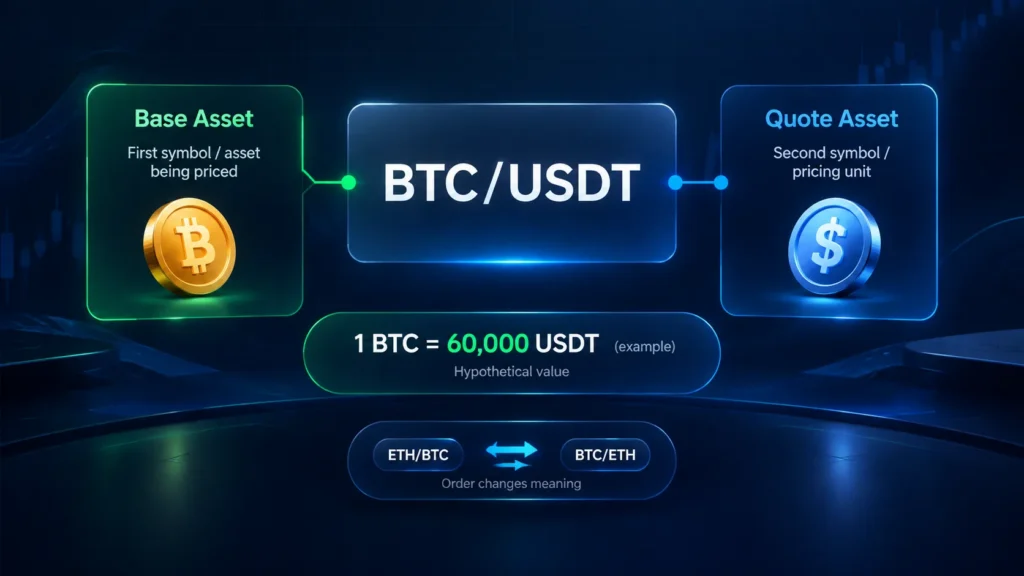
Every pair has two components with different roles. The base asset is the item being priced, and the quote asset is the unit that expresses the price. The order of the symbols determines the meaning of the displayed exchange rate, so reversing it changes the question the price answers.
What Is a Base Asset in Crypto Trading?
The base asset is the first symbol in a trading pair and the item whose value is being expressed. In BTC/USDT, Bitcoin is the base asset, so the displayed price describes the cost of one bitcoin. On many exchanges, order sizes are also measured in the base currency.
What Is a Quote Asset in Crypto Trading?
The quote asset is the second symbol in a pair and the unit used to state the base’s price. In BTC/USDT, USDT is the quote asset, so the price appears in Tether units. Quote currencies commonly include stablecoins, fiat currencies, Bitcoin, and Ethereum.
The LCX guide to crypto pairs notes that the quote currency also measures the price and settles the exchange. A holder of that currency is therefore the party able to obtain the base in that market.
How Base and Quote Assets Work Together
Base and quote together establish one relative exchange rate. In BTC/USDT, Bitcoin is valued in Tether. In ETH/BTC, Ethereum is valued in Bitcoin. Because Bitcoin is a base in one market and a quote in another, the same coin can be measured in different quote currencies.
This flexibility means the displayed number depends on the pricing unit. A figure of 3,000 in an ETH/USDT market and a figure of 0.05 in an ETH/BTC market can describe similar Ethereum value, since each figure is expressed in a different unit.
Base Currency vs. Quote Currency: Key Differences
The table below compares the two roles. The terms base currency and quote currency are used in forex and crypto alike, and exchanges frequently apply them to tokens that are not government-issued currencies.
| Feature | Base Asset | Quote Asset |
| Position in pair | First symbol | Second symbol |
| Role in pricing | The item being priced | The unit used for pricing |
| Meaning of the price | One unit of the base | Amount of the quote required |
| Example in BTC/USDT | Bitcoin (BTC) | Tether (USDT) |
| Example in ETH/BTC | Ethereum (ETH) | Bitcoin (BTC) |
How Crypto Trading Pair Pricing Works
Pair pricing communicates the relative value of two instruments through a single number. The sections below cover price notation, the factors that shape displayed prices, and the reasons the same cryptocurrency can show different figures across markets.
How to Read Crypto Trading Pair Prices
A quoted price represents the amount of the quote asset that corresponds to one unit of the base. If a hypothetical BTC/USDT market displays 60,000, one bitcoin is priced at 60,000 USDT. The relationship can be written in plain text as Quote amount = Base amount x Price.
Using the same hypothetical figure, 0.5 BTC would correspond to 30,000 USDT. The number describes only the market where it appears and reflects the latest quoted price. Price changes in the market alter the quote amount linked to each unit of the base asset.
What Determines the Price of a Trading Pair?
Price formation within a pair results from interaction among market participants. Orders placed on the exchange, available liquidity, and executed transactions all contribute to the displayed price. Factors commonly associated with price formation include:
- Buy and sell orders: resting bids and asks form the order book.
- Market demand: the balance between participants seeking each side of the pair.
- Available liquidity: the volume of orders near the current price.
- Executed transactions: the most recent matched trade often sets the displayed price.
- Market trends and news: developments that may shift participant expectations.
Why the Same Cryptocurrency Has Different Pair Prices
The same cryptocurrency can display different prices because each pair uses a different pricing unit and a different market. BTC/USDT, BTC/USD, and BTC/USDC express Bitcoin in Tether, US dollars, and USD Coin respectively. Each market has its own order book and its own participants.
Small gaps between these figures may appear when the quote currencies trade slightly away from their intended values. Exchange-specific liquidity and temporary imbalances in supply and demand may also contribute. For this reason, a BTC/USDT figure and a BTC/USD figure are related but not necessarily identical.
Relative Pricing Between Two Cryptocurrencies
ETH/BTC shows how a cryptocurrency’s value can be measured against another cryptocurrency instead of a fiat currency. If a hypothetical ETH/BTC market displays 0.05, one ether is priced at 0.05 bitcoin. The figure describes the relative market prices of the two coins.
With a hypothetical BTC/USDT price of 60,000, an ETH/BTC price of 0.05 would imply roughly 3,000 USDT for one ether. This illustrates that the value of Ethereum can be expressed in several units, and each unit offers a different perspective.
Common Types of Crypto Trading Pairs
Crypto trading pairs fall into several categories according to the quote currency. The composition of each pair determines its pricing unit and several market characteristics, including how directly the price relates to a government-issued currency and how sensitive the quote is to volatility.
Crypto-to-Stablecoin Pairs
Pairs such as BTC/USDT and ETH/USDC use a stablecoin as the quote asset. A stablecoin is a digital currency designed to track a reference such as the US dollar. This gives many cryptocurrencies a widely used denomination, as described in the Binance Square overview of stablecoin pairs.
Stablecoins do not always hold their intended value. A peg can weaken under market stress, and the market price of the stablecoin may deviate from its reference. This risk is one reason a USDT-quoted price and a fiat-quoted price may not match exactly.
Crypto-to-Fiat Pairs
Crypto-to-fiat pairs such as BTC/USD, BTC/EUR, and ETH/GBP express cryptocurrency prices in government-issued currencies. A fiat balance is held in a regulated currency system, whereas a stablecoin balance is a tokenized representation of fiat value issued on a blockchain.
Regional markets add further variety, such as crypto INR pairs, which price digital currencies in Indian rupees. Availability of fiat quote currencies depends on each exchange, its banking relationships, and the regulatory framework where it operates.
Crypto-to-Crypto Pairs
Crypto-to-crypto pairs such as ETH/BTC and LTC/BTC price one digital currency in another. Litecoin quoted in Bitcoin, for example, shows how many bitcoin correspond to one litecoin. These markets establish relative prices without requiring either coin to be quoted directly in a fiat currency.
Such pairs can display price movement that differs from fiat-quoted markets. When both coins rise or fall against the US dollar, the crypto-to-crypto price reflects only their relative change.
Bitcoin and Ethereum as Quote Assets
Bitcoin and Ethereum often serve as quote currencies for other cryptocurrencies, particularly smaller tokens. A pair such as a token against BTC expresses that token’s value in bitcoin, which has historically been a widely used reference within the crypto market.
Crypto-denominated prices differ from fiat-denominated prices because the quote asset itself changes in value. A token may appear to gain value in a BTC-quoted market while remaining flat in a USD-quoted market, if Bitcoin weakens against the dollar.
Factors That Affect Trading Pair Prices and Market Conditions
Pairs involving the same underlying cryptocurrency can exhibit different pricing behavior. The differences generally stem from market structure and participation rather than from the token alone. The sections below describe general characteristics, not predictions or recommendations.
Liquidity and Trading Volume
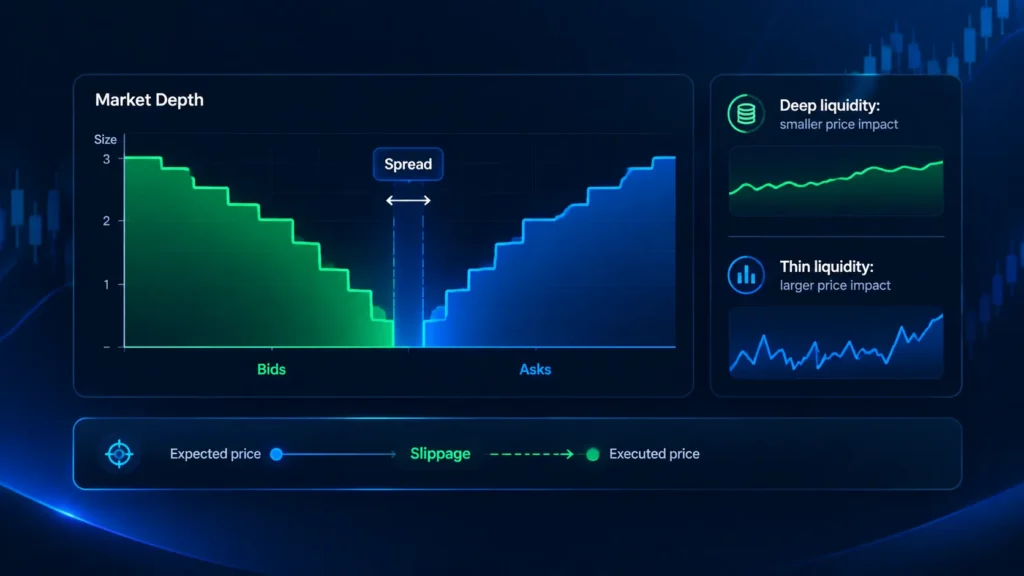
Liquidity describes how easily a holding can be exchanged without a large effect on its price, while trading volume measures the total quantity exchanged during a period. The two describe different aspects of market activity. Highly liquid markets may support smoother execution, whereas low-volume markets can experience larger price fluctuation.
For example, a major pair such as BTC/USDT typically has deep order books on large exchanges. A smaller token paired with an obscure quote currency may have only a few resting orders, so a single order can move the displayed price noticeably.
Bid-Ask Spread and Slippage
The bid is the highest price a participant is willing to pay, and the ask is the lowest price a participant is willing to accept. The spread is the gap between them. A hypothetical bid of 59,990 and ask of 60,010 would show a spread of 20 USDT. Further background appears in this overview of crypto trading spreads.
Slippage is the difference between an expected price and the executed price, and it tends to be more noticeable in markets with limited liquidity. If an order expected near 60,000 fills at 60,050, the difference is 50 USDT per bitcoin. Wider spreads and larger order sizes are often associated with greater slippage.
Exchange Differences and Price Discrepancies
Each exchange maintains an independent order book, so the same pair can show different prices across platforms. Temporary discrepancies are commonly linked to several factors:
- Independent order books: each platform matches only its own participants.
- Market participation: different user bases create different supply and demand.
- Trading fees: fee schedules affect the effective cost of transactions.
- Liquidity conditions: depth varies between platforms and time periods.
- Transfer constraints: moving funds between exchanges takes time and may incur costs.
Quote Asset Stability and Valuation
The quote asset shapes how a displayed price is interpreted. Fiat currencies are government-issued, stablecoins aim to track a reference, and cryptocurrencies such as Bitcoin can show high price volatility. A change in the quote’s value alters the pair price even if the base is unchanged.
The European Supervisory Authorities have described many crypto assets as highly risky and speculative, with a real possibility of losing all invested money. This context helps explain why quote stability is a relevant consideration when interpreting pair prices.
Crypto Trading Pairs on Centralized and Decentralized Exchanges
Centralized exchanges (CEXs) and decentralized exchanges (DEXs) both facilitate exchanges between two currencies or tokens, but they use different mechanisms. One relies on order books operated by a company, and the other relies on smart contracts and liquidity pools within decentralized finance.
Trading Pairs on Centralized Exchanges
Centralized exchanges typically organize spot markets around individual pairs, and each market has its own order book. Bids and asks are collected, and a matching system pairs compatible orders. The most recent matched price becomes the displayed price for that pair.
Under the EU’s MiCA framework, the European Supervisory Authorities note that only authorised providers may offer crypto-asset services in the EU, and that legal protection can be limited depending on the token. A listed pair does not imply regulatory approval of the token.
Trading Pairs on Decentralized Exchanges
Decentralized exchanges commonly facilitate swaps through automated market makers and liquidity pools. A pool holds two tokens, such as ETH and USDC, contributed by liquidity providers. The pool’s relative quantities of each token influence the quoted price, and each swap changes those quantities.
In many designs, a formula keeps the product of the two pool balances roughly constant. When a participant removes one token, the pool holds less of it, and its quoted price rises. Large swaps relative to pool size can therefore produce notable price impact.
Key Differences Between CEX and DEX Pair Pricing
Order-book pricing and liquidity-pool pricing differ in structure, though neither model is universally superior. The table below summarizes general characteristics, which may vary by platform and protocol.
| Feature | Centralized Exchange (CEX) | Decentralized Exchange (DEX) |
| Pricing mechanism | Order book with matching engine | Liquidity pool with formula |
| Liquidity source | Market makers and participants placing orders | Liquidity providers depositing tokens |
| Price impact | Depends on order book depth | Depends on pool size relative to swap |
| Pair availability | Selected by the exchange | Often permissionless listing |
| Typical discrepancy source | Separate order books | Pool imbalances and transaction costs |
Why Crypto Trading Pairs Matter for Market Analysis
Pairs provide context for interpreting cryptocurrency prices and relationships between markets. An isolated price in one quote currency shows only part of the picture, while multiple pairs together can describe relative value, market structure, and the effect of the pricing unit.
Measuring Relative Cryptocurrency Performance
ETH/BTC expresses the relative value of Ethereum against Bitcoin. A rising ETH/BTC price can indicate that Ethereum is gaining value relative to Bitcoin, while a falling price can indicate the opposite. This holds regardless of the direction of either coin against fiat currencies.
For instance, both coins may fall against the US dollar while ETH/BTC rises, if Ethereum falls by less than Bitcoin. Analysts sometimes review such ratios when discussing market trends, portfolio management, or hedge-related questions, although a ratio alone does not predict future results.
Comparing Prices Across Trading Pairs
Prices quoted in USDT, USD, BTC, or ETH are not directly interchangeable. A figure of 3,000 in USDT and a figure of 0.05 in BTC use different units, so comparison requires the exchange rate between those quote currencies. Without that conversion, the numbers describe different quantities.
Similar caution applies when comparing a crypto price with prices in the forex market. A euro-quoted price and a dollar-quoted price describe the same token in different currencies, and the relevant exchange rate affects how the two figures relate.
Cross-Pair Pricing and Market Relationships
Related pairs can reflect interconnected exchange rates. When no direct market exists between two coins, a cross rate can be derived through a shared quote currency, as the LCX overview explains. In plain text: ETH/USDT = ETH/BTC x BTC/USDT.
Differences between calculated and displayed prices may arise from liquidity constraints, transaction costs, and timing. Market participants sometimes describe these differences as inefficiencies, though they can narrow or widen depending on conditions. Such relationships illustrate that each pair belongs to a broader network of markets.
FAQ About Crypto Trading Pairs
What Is a Crypto Trading Pair?
A crypto trading pair is a market that expresses the exchange rate between two assets, such as BTC/USDT. The first symbol, Bitcoin, is the base, and the second, USDT, is the quote. The displayed price shows how many units of USDT correspond to one bitcoin on that exchange.
What Is the Difference Between a Base Asset and a Quote Asset?
The base appears first and is the item being priced, while the quote appears second and supplies the unit of measurement. In ETH/BTC, Ethereum is priced in Bitcoin. The roles depend on position within the ticker rather than on the type of token involved.
How Do You Read a Crypto Trading Pair Price?
A BTC/USDT price of 60,000 means one BTC is priced at 60,000 USDT, based on the market’s current quoted price. The figure changes as orders are matched. The number applies only to that specific market, so a BTC/USD or BTC/EUR quote may display a different value.
Why Do Cryptocurrencies Have Multiple Trading Pairs?
A cryptocurrency may be listed against several quote currencies, which creates separate markets with different denominations, liquidity conditions, and exchange rates. Bitcoin, for example, may appear against USDT, USD, and EUR. Each market has its own order book, so the available depth and price can differ.
What Is the Difference Between BTC/USD and BTC/USDT?
USD refers to the US dollar, a government-issued fiat currency, whereas USDT is Tether, a stablecoin designed to track the dollar’s value. Their prices may differ slightly because USDT trades in its own market and can move away from its intended peg. Exchange-specific liquidity may also contribute.
Can Two Exchanges Show Different Prices for the Same Trading Pair?
Yes, two exchanges can display different prices for the same pair. Each platform maintains an independent order book, with its own participants, liquidity, trading activity, and fee structure. These factors can produce temporary discrepancies, which often narrow as participants and market makers respond, though gaps can persist during volatile periods.
What Does ETH/BTC Mean?
ETH/BTC means Ethereum is the base and Bitcoin is the quote. The pair expresses the price of one Ether in Bitcoin. A displayed value of 0.05, for example, indicates that one ETH is priced at 0.05 BTC in that market.
Are Crypto Trading Pairs the Same on Every Exchange?
No, exchanges decide which markets they list. Token availability, supported quote currencies, and market conditions therefore vary between platforms. A pair that exists on one exchange may be absent on another, and liquidity for the same pair can differ considerably across venues.