Crypto Order Types: Market, Limit, Stop, and Conditional Orders


Crypto order types are instructions that tell a cryptocurrency exchange how and when to execute a trade. In crypto trading, the selected order type influences execution speed, cost control, and exposure to risk. Four main categories exist: market, limit, stop, and conditional, each carrying different execution conditions and trade-offs in practice.
Each category has distinct advantages and limitations, particularly in volatile crypto markets where market liquidity, rapid swings, and slippage can change the final fill. This article explains how different order types work, compares their characteristics, and describes situations in which market participants commonly use each one. It is educational commentary rather than trading guidance.
Key Takeaways
- Market orders prioritize execution speed over cost certainty.
- Limit orders provide control over the entry or exit level but do not guarantee a fill.
- Stop orders activate when a predefined trigger condition is met.
- Conditional instructions automate trading actions based on specified criteria.
- Advanced tools, including trailing stops and OCO orders, support more structured trading strategies.
- Liquidity, volatility, fees, and trading objectives commonly influence the choice.
What Are Crypto Order Types?
A trading instruction submitted to a cryptocurrency exchange defines the asset, quantity, direction, and execution conditions of a trade. The exchange’s matching engine reads these details and pairs them with opposing offers stored in the order book. The sections below explain each step of that process in simple terms.
How Crypto Orders Work
A market participant submits a buy or sell instruction through an exchange interface or application programming interface. A market order interacts immediately with existing offers, while a limit order enters the order book and waits for a counterparty. Conditional instructions remain dormant until a specified trigger, such as a particular level, is reached.
Exchange rules determine how each instruction is processed. Platforms such as Backpack Exchange publish their own documentation describing supported order types, minimum sizes, and trigger references. Because these details vary, an identical name can behave differently across a cryptocurrency exchange, which is why platform documentation is commonly treated as the reference point.
Role of Order Books, Liquidity, and Price Execution
The order book lists bids, which are buy requests, and asks, which are sell requests, sorted by price. The bid-ask spread is the gap between the highest bid and the lowest ask. Depth describes how much quantity rests at each level, and crypto trading spreads are one visible measure of it.
Market liquidity influences how far a large trade moves through the book. When resting quantity is thin, a single request can consume several levels, so the displayed market price may differ from the final fill. According to the SEC’s Investor.gov guidance, the last-traded price is not necessarily the one at which a market order executes.
Main Categories of Cryptocurrency Trading Orders
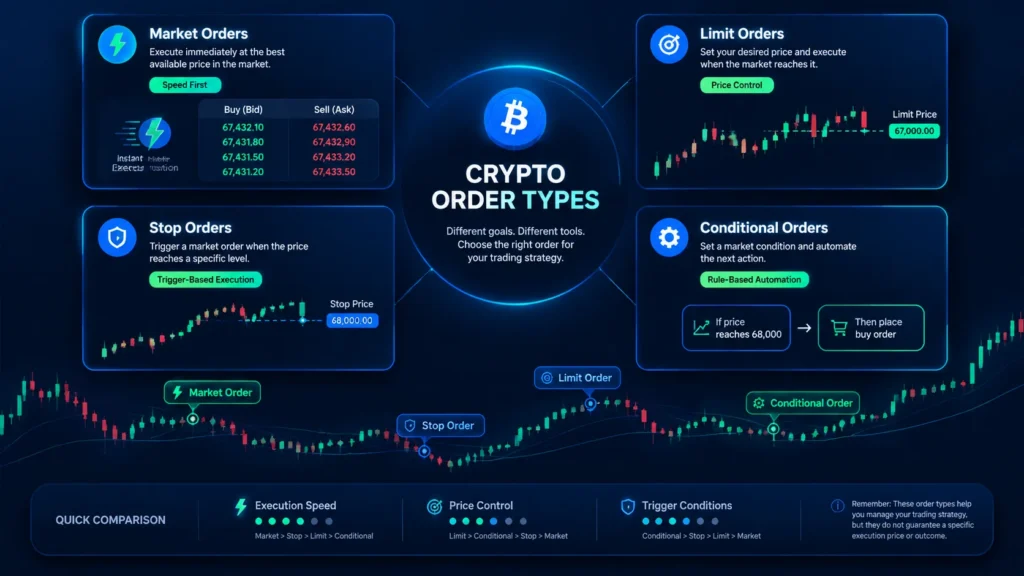
Four categories are commonly used to describe cryptocurrency trading instructions. Stop orders generally work through trigger conditions, and conditional types may activate market or limit orders depending on exchange functionality, so the categories can overlap in practice. The list below summarizes each category in simple terms.
- Market: executes immediately against available liquidity.
- Limit: executes only at a specified limit price or better.
- Stop: activates when a stop price is reached.
- Conditional: activates, executes, or cancels when set criteria are met.
Market Orders: Fast Execution at Available Prices
A market order is an instruction to buy or sell a cryptocurrency immediately at the best available price. Its main characteristic is execution priority, since the trade consumes resting liquidity instead of waiting. The trade-off is uncertainty about the fill, because the result depends on the book at the moment of execution.
How Market Orders Work
A market buy matches the lowest available sell offers, while a market sell matches the highest available bids. If the first level lacks enough quantity, the trade continues to the next one. The result is a fill across multiple levels rather than at one exact price.
Immediate execution does not guarantee a specific fill or complete fulfillment in every market condition. In fast markets, the book can change between submission and matching. For this reason, the best available price at submission may differ from the average actually received during volatile periods.
Advantages and Disadvantages of Market Orders
Market orders are often described as simple and convenient. Execution speed is the central feature, and no limit needs to be specified. In liquid pairs, the fill typically stays close to the current market price, which makes this type familiar for beginners learning how a basic trade works.
The disadvantages relate to cost control. Slippage, spread costs, and unfavorable fills can occur, particularly in thinly traded markets or during sudden volatility. Unlike market orders, a limit instruction sets a boundary, whereas a market request offers no ceiling or floor, so the final cost can exceed what the screen displayed.
When Market Orders Are Commonly Used in Crypto Trading
Market orders are commonly associated with situations where speed matters more than precision, such as entering or exiting a liquid market quickly. Highly traded pairs such as Bitcoin against a major stablecoin usually have deep books, which can reduce the gap between the quote and the fill.
Size, market depth, and current volatility are factors commonly considered before this type is used. A large request in a low-liquidity altcoin can move the market noticeably. Participants sometimes split large trades into smaller parts to reduce this effect, although outcomes vary with conditions and are never certain.
Market Order Example
Assume BTC last traded at $60,000 and a market buy for $120,000 is submitted. The sell side holds limited quantity at the displayed level, so the trade fills across three levels, as shown below. The figures are hypothetical and rounded for illustration.
| Level | BTC Filled | Cost (USD) |
| $60,000 | 0.5000 | $30,000 |
| $60,050 | 0.8000 | $48,040 |
| $60,120 | 0.6979 | $41,960 |
| Total | 1.9979 | $120,000 |
The weighted average execution price equals total cost divided by total quantity, or roughly $60,062. That is about $62 above the last traded price of $60,000, or roughly 0.10%. The difference illustrates slippage, which can be smaller or larger depending on liquidity and volatility.
Limit Orders: Price Control and Execution Conditions
A limit order allows a trader to specify the maximum amount to pay when buying or the minimum to accept when selling. This control comes with a trade-off, because the trade may be delayed, partially filled, or never executed. The sections below describe how this type behaves in practice.
How Limit Orders Work
A limit order allows participants to define a limit price, and the instruction then rests in the order book until a counterparty accepts it. A buy limit executes at the specified price or lower, while a sell limit executes at the specified price or higher, subject to liquidity and exchange rules.
When the chosen level crosses the spread, part of the trade may execute immediately against resting offers. The remainder, if any, joins the book. If the market never reaches the specified level, the order will remain open until it is canceled or expires under the platform’s time-in-force rules.
Advantages and Disadvantages of Limit Orders
Limit orders are commonly associated with discipline. Because the limit acts as a boundary, exposure to unexpected fills is reduced. A limit order also allows entries or exits to be planned in advance, without constant screen monitoring, which some participants find useful in volatile markets.
The limitations involve certainty of execution. Missed opportunities occur if the market moves away, and partial fills can leave a position smaller than intended. During rapid movements, the order remains unfilled while the market passes through the level, so control and fill certainty tend to pull in opposite directions.
Buy Limit vs. Sell Limit Orders
A buy limit is an order to buy at a specified level or lower, placed below the current market price. A trader seeking to accumulate Bitcoin at a lower level might submit a request at $58,000 while the market trades at $60,000. It executes only if sellers accept $58,000 or less.
A sell limit is placed above the current market price. A holder aiming to exit at a predefined target might submit a sell order at $63,000 while BTC trades at $60,000. It executes only if buyers reach that level, and proceeds depend on fees and available depth.
When Limit Orders Are Commonly Used
Limit orders are often associated with planned entries, target exits, and trading less liquid cryptocurrency pairs, where market orders may produce wide slippage. In such pairs, a specified limit can prevent a fill far from the intended level, although the trade may take longer to execute.
Depth, spread width, and the likelihood of the market reaching the selected level are commonly evaluated alongside this type. A limit placed far from the current price may remain open for a long period. A limit order allows precise targets, but it does not predict whether those targets will be reached.
Stop Orders: Trigger-Based Trading and Risk Management
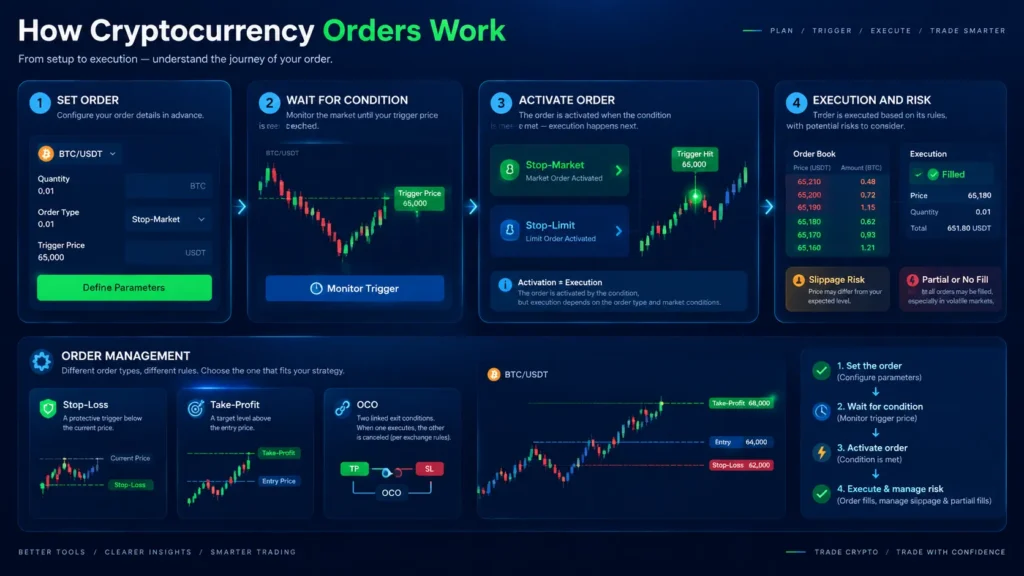
A stop order is an instruction that activates when a specified trigger or condition is reached. Stop orders are commonly described as tools for automating entries and exits and responding to adverse moves, which connects them to crypto trading risk management. A stop price is a trigger, not a guaranteed execution price.
How Stop Orders Work
The exchange monitors a selected reference and activates the corresponding instruction when the condition is satisfied. Trigger references may use the last traded price, mark price, or index price, depending on the platform and trading product. The choice of reference can change when activation occurs during volatile moves.
Before activation, a stop order generally does not rest in the public book. After the trigger, it becomes either a market order or a limit order. The SEC’s investor bulletin on stop orders notes that the stop price is a trigger that converts the instruction into a market order.
Stop-Market Orders
A stop-market order becomes a market order once the stop price is reached. Its potential benefit is execution priority, since the trade is intended to fill after activation. Its main exposure is slippage, because fast movements can push the fill well away from the trigger level.
Consider a hypothetical holder of BTC trading at $60,000 with a sell trigger at $58,000. If the market falls rapidly through that level, the resulting market request might fill near $57,700 instead. The difference reflects available liquidity at the time, not an error in the instruction.
Stop-Limit Orders
A stop-limit order combines a trigger with a separate limit. When the stop price is reached, a limit order is placed at the specified level. This structure offers protection after activation, but the trade may remain unfilled if the market moves beyond the acceptable limit.
In a hypothetical example, a stop price of $58,000 and a limit price of $57,800 are selected on a sell stop limit order. The stop price and the limit price differ by $200 here. If BTC falls to $58,000, the limit instruction activates, but a gap to $57,500 may leave it unfilled.
Stop-Loss Orders vs. Stop Orders
A stop-loss is a stop order used for a specific purpose: exiting a position after an adverse move. In this sense, every stop-loss is a stop order, but not every stop order is a stop-loss. The terms are sometimes used interchangeably, which can create confusion.
Stop orders can also support conditional entries, such as a buy stop placed above the current level to participate in a breakout. This broader use is why stop instructions appear in several strategy descriptions. The label matters less than the underlying trigger, reference, and resulting action.
Common Stop Order Mistakes
Educational sources often describe several recurring misunderstandings about stop instructions. These are summarized below as general observations, not guidance.
- Triggers placed very close to volatile levels may activate during short-term fluctuations.
- Slippage after activation is sometimes overlooked.
- The trigger is sometimes confused with the execution price.
- Stop-limit orders are sometimes assumed to always fill.
Exchange trigger rules and settings differ, which is why reviewing platform documentation is commonly considered part of understanding these instructions.
Conditional Orders: Automated Trading Based on Predefined Rules
Conditional orders are instructions that activate, execute, or cancel when specified criteria are met. They reduce the need for constant market monitoring and support more systematic trading decisions. The category is broad, and it includes individual types such as stop-market, stop-limit, and take-profit. The sections below explain the mechanics.
How Conditional Orders Work
The process generally has three parts: a trigger is defined, a subsequent action is specified, and the instruction is submitted to the exchange. The exchange then evaluates the condition continuously. When the condition is satisfied, the corresponding market or limit instruction is activated and routed to the matching engine.
Available triggers, balance requirements, and activation rules vary across platforms. Some exchanges require the full balance to be reserved when the instruction is created, while others check it at activation. This is one reason the same setup can behave differently from one trading venue to another.
Conditional Buy and Sell Orders
A conditional buy order can activate when the market rises above a selected level, as in a breakout entry, or when it falls to a target level, as in a planned purchase. The condition is defined in advance, and the exchange applies it without manual input.
A conditional sell can automate exits when the market reaches predefined thresholds. For example, a holder of Ether may define a sell condition above the current level. Whether the exit works as intended depends on liquidity at activation and on the resulting action being a market or limit instruction.
Stop-Loss and Take-Profit Orders
Stop-loss instructions are intended to limit potential losses, while take-profit instructions are designed to exit positions at predefined profit targets. Both may be implemented as conditional orders. They represent opposite sides of an exit: one responds to adverse movement, and the other responds to favorable movement.
Execution depends on whether the triggered action is market-based or limit-based. Market-triggered versions prioritize execution but may suffer slippage. Limit-triggered versions control the fill level but may not execute. In either case, activation does not guarantee a result, and fees apply to the final execution.
Benefits and Limitations of Conditional Orders
Conditional instructions are commonly associated with automation, consistent execution rules, and reduced dependence on manual monitoring. They allow participants to define responses before movements occur, which some find helpful when markets operate around the clock, as cryptocurrency markets do.
The limitations include trigger failures, changing market conditions, insufficient balances, and exchange-specific restrictions. A condition defined in advance cannot account for every later development, such as a sudden liquidity gap. Automation therefore reduces manual steps, but it does not remove market risk.
Advanced Crypto Order Types
Advanced instructions are used to manage exits, automate strategies, and control execution behavior. Their availability differs between spot trading, margin trading, futures, option products, and individual cryptocurrency exchanges. Some platforms also offer bracket orders, which pair an entry with both a profit target and a protective exit.
Take-Profit Orders
A take-profit instruction activates an exit when the market reaches a predefined target. It is commonly described as part of profit-taking approaches within a broader trading strategy. The final result depends on the execution method, available liquidity, and applicable fees, so the target and the realized fill can differ.
Some platforms offer take-profit instructions in both market and limit versions. A market version prioritizes execution after activation, whereas a limit version defines the lowest acceptable level. As with other conditional tools, the trigger reference and balance rules are set by the exchange, not by the name.
Trailing Stop Orders
A trailing stop adjusts its trigger as the market moves favorably, using a specified percentage or distance. In simple terms, the trigger follows an upward trend while keeping a fixed gap, and it stays in place if the market reverses. This defines an exit condition without a manual update.
Trailing stops may behave differently across exchanges. Some update continuously, while others update at intervals, and the reference may differ. After activation, the instruction becomes a market or limit action, so slippage and non-execution risks remain relevant. Rapid reversals in volatile periods can trigger the exit sooner than anticipated.
One-Cancels-the-Other (OCO) Orders
An OCO order links two instructions so that execution or activation of one causes the other to be canceled, according to the platform’s rules. The structure allows alternative exit scenarios to be defined in advance. OCO therefore functions as a pair, not as two independent instructions.
A common illustration combines a take-profit target with a protective stop. If BTC rises to the target and the limit instruction fills, the stop is canceled. If BTC falls to the trigger first, the stop activates and the target is canceled. This is one example of a conditional structure.
Time-in-Force Instructions: GTC, IOC, and FOK
Time-in-force instructions define how long a request stays active and how partial fills are handled. They are particularly relevant to limit orders, whose execution may take time. The three main options are described below.
- Good-Til-Canceled (GTC): remains active until filled, canceled, or otherwise terminated under exchange rules.
- Immediate-or-Cancel (IOC): available quantities execute immediately, and any unfilled remainder is canceled.
- Fill-or-Kill (FOK): the entire quantity must execute immediately; otherwise, it is canceled.
These instructions influence duration and partial-fill behavior. A GTC limit order can remain open for long periods, while an IOC limit order may produce a partial fill. FOK avoids partial fills entirely, but it cancels whenever full quantity is unavailable.
Market vs. Limit vs. Stop vs. Conditional Orders
The main categories differ in execution speed, control over the fill, trigger requirements, and common applications. Treating them as interchangeable can lead to misunderstandings, because each serves a distinct purpose. The comparison below summarizes how they differ, followed by a neutral description of the objectives commonly associated with each type.
Crypto Order Types Comparison Table
| Order Type | Execution Condition | Price Control | Main Advantage | Main Limitation |
| Market | Immediate execution against available liquidity | Low | Speed | Slippage |
| Limit | Specified price or better | High | Price control | May not fill |
| Stop-Market | Trigger activates a market order | Low after activation | Execution priority | Slippage after triggering |
| Stop-Limit | Trigger activates a limit order | High after activation | Price protection | May not fill |
| Conditional | Predefined condition is satisfied | Depends on resulting order | Automation | Trigger and execution risks |
| Trailing Stop | Dynamic trigger follows favorable movement | Depends on execution method | Automated exit management | Reversal and execution risk |
| OCO | Linked conditions determine the action | Depends on component orders | Alternative exit scenarios | More complex setup |
Conditional instructions can overlap with stop orders and other advanced types. For example, a stop-limit is also conditional, because it activates only after a trigger. The table therefore shows how terminology is commonly organized, though exchanges may classify the same instruction under different names.
Which Crypto Order Type Fits Which Objective?
Market participants commonly associate each type with a distinct objective. These associations are descriptive and vary by platform, asset, and conditions.
- Speed is generally associated with market orders when immediate execution matters.
- Cost control is generally associated with limit orders.
- Stop-market instructions are associated with triggering an exit while prioritizing execution.
- Stop-limit instructions are associated with cases where constraints matter more than guaranteed execution.
- Conditional and linked instructions are associated with automating predefined rules.
No instruction eliminates market risk. Markets can gap, liquidity can disappear, and exchanges can change rules. Past performance does not guarantee future results, and losses may exceed initial expectations, particularly in leveraged products.
How Traders Choose the Right Crypto Order Type
Selection is commonly described as a function of execution priorities, market conditions, and risk-management objectives. Participants often weigh how much they value speed against certainty of the fill. The following sections outline the factors that educational sources typically highlight, without implying that one approach suits every situation.
Match Order Types to Trading Goals
Different objectives are associated with different tools. Short-term trading may involve market orders for speed, planned entries may involve limits, longer-term accumulation may use staged limits, and automated exits may rely on conditional instructions. No single type is universally superior.
Choices also depend on experience. A beginner learning execution mechanics may find that simple instructions are easier to interpret than linked or trailing ones. Understanding how each is processed before using advanced options is commonly viewed as a prudent learning sequence, as complexity can add operational risk.
Evaluate Liquidity, Volatility, and Slippage
Market depth, spread, trade size, and rapid swings all affect execution. A deep book can absorb a large market request with limited slippage, while a thin book may not. Volatility can also widen spreads and cause triggers to activate sooner than expected.
Low-liquidity altcoins add further challenges, since few participants may be available on the other side of a trade. Volatile periods, such as major news events, can amplify these effects. Slippage, in simple terms, is the difference between the expected and the executed level.
Review Fees and Exchange-Specific Rules
Exchanges usually distinguish between maker and taker fees. A maker instruction adds liquidity by resting in the book, while a taker instruction removes liquidity by executing immediately. Fee treatment depends on how a trade executes and on the exchange’s fee schedule, so identical trades can cost different amounts.
Other factors commonly checked include trigger references, supported types, minimum sizes, and available time-in-force options. These details vary by crypto trading platform, and an unfamiliar rule can change how an instruction behaves. Platform documentation is generally the authoritative source for these specifications.
Frequently Asked Questions About Crypto Order Types
What Are the Main Types of Crypto Orders?
The core categories are market, limit, and stop orders. Conditional instructions extend these by activating, executing, or canceling a trade when set criteria are met. Advanced tools, such as trailing stops and OCO orders, build on the same foundations. Availability depends on the exchange and on whether the product is spot, margin, or futures.
What Is the Difference Between Market and Limit Orders?
A market order prioritizes execution at available prices, so it typically fills quickly but at an uncertain level. A limit order specifies an acceptable execution level, giving more control but no guarantee of a fill. The difference reflects a trade-off between speed and certainty, not a ranking of quality.
What Is the Difference Between Stop-Market and Stop-Limit Orders?
A stop-market order activates a market order, while a stop-limit order activates a limit order. The first prioritizes execution and accepts slippage. The second prioritizes the fill level and accepts the possibility of no execution. The trade-off is between execution priority and control after activation.
Are Conditional Orders the Same as Stop Orders?
Not exactly. Stop orders commonly use triggers and may form part of a conditional system. Conditional instructions, however, can include other automated actions, such as take-profit, linked strategies, or time-based conditions. Terminology differs by exchange, so a stop order on one platform may be labeled conditional on another.
Which Crypto Order Type Is Best for Beginners?
No type is universally best, since the appropriate choice depends on the objective, knowledge of execution mechanics, and tolerance for uncertainty. Educational sources generally encourage learning how basic instructions work before using advanced ones. Practicing in demo environments, where available, is often described as a way to observe behavior without risking capital.
Can Crypto Orders Fail to Execute?
Yes. Limit and stop-limit instructions may remain unfilled if the market never reaches, or moves past, the specified level. Market orders can experience partial fills or unfavorable results in thin books. Conditional instructions may also fail to activate or execute as expected because of trigger rules, liquidity constraints, insufficient balances, or exchange restrictions.