Crypto Trading Platform: Execution, Charts, Orders, and Risk Tools

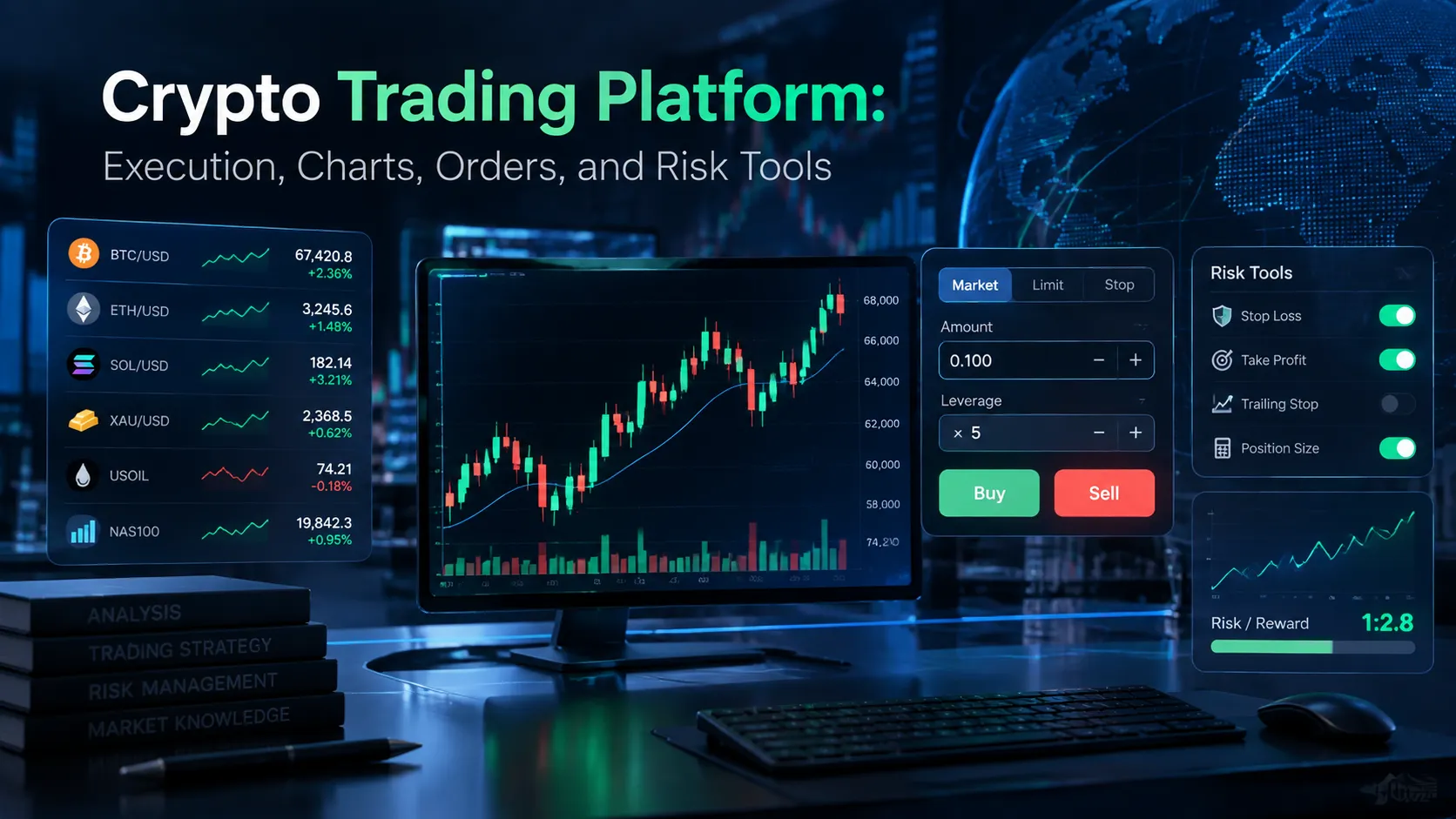
A crypto trading platform is the interface that connects market data, charting, order management, execution, and risk-control functions in one place. Anyone exploring crypto trading will typically use this kind of interface to trade crypto, view a wide range of cryptocurrencies, and monitor positions across the crypto space.
Platforms generally support trading in crypto across major tokens such as bitcoin (BTC) and ethereum (ETH), as well as a broader set of altcoins built on various blockchain networks. This article introduces four core areas — execution, charts, orders, and risk tools — from a purely educational, non-directive perspective focused on platform mechanics rather than trading recommendations.
Key Takeaways
- A crypto trading platform typically combines a market dashboard, order book, charting suite, and risk-monitoring tools.
- Many platforms support both spot crypto trading and derivatives, including futures and options, sometimes described together as spot and derivatives trading.
- Real-time data, chart analysis, order types, execution quality, and risk controls are interconnected rather than separate features.
- Available functionality — including deposit methods, fee structures, and supported tokens — can differ across platforms, markets, jurisdictions, and account types.
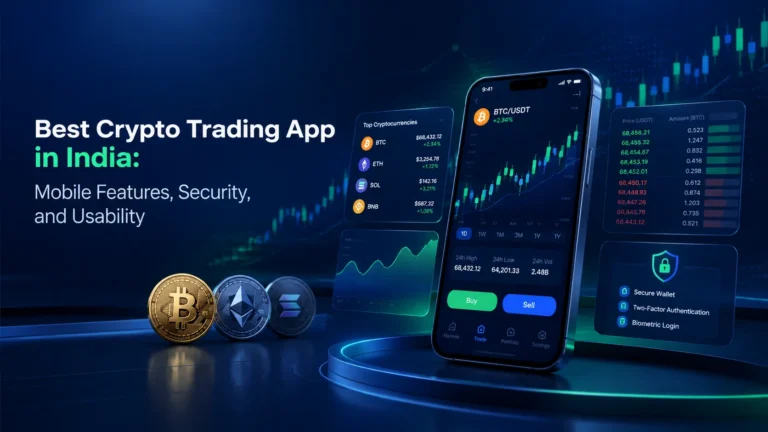
- Mobile platform access, via a crypto trading app, is now standard alongside desktop interfaces on most exchanges.
Crypto Trading Platform Features and Core Interface
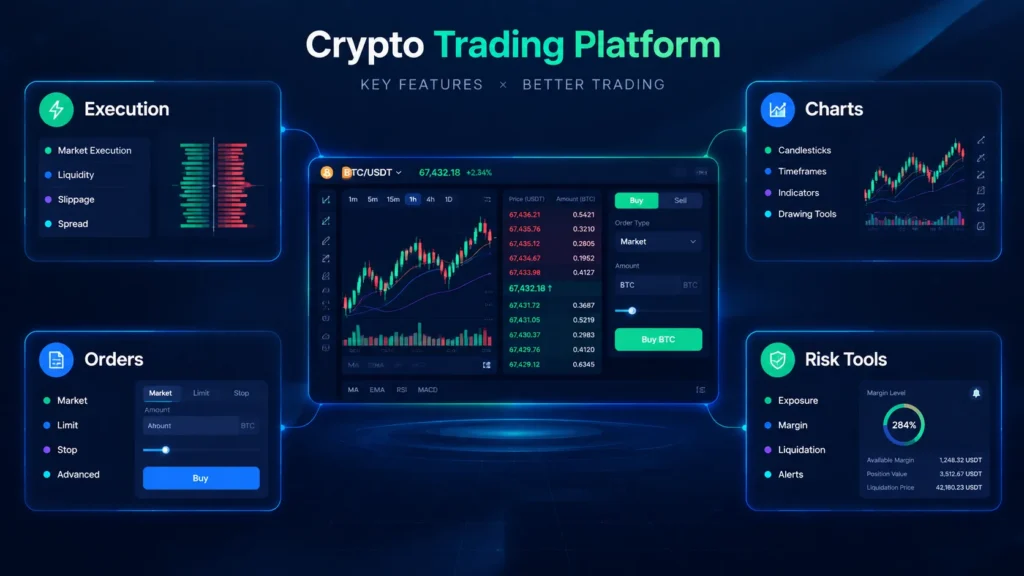
Most crypto trading platforms are built around a central dashboard that organizes market data, account information, and trading controls. Familiarity with this layout is often the first step for someone new to digital-asset markets.
Trading Dashboard and Market Overview
A typical dashboard displays asset prices, available trading pairs, account balances, open positions, order status, and general market statistics. This overview is generally the first screen a trader sees before they start trading or begin to explore how to start crypto trading in more depth. Layouts vary between platforms, but the underlying categories of information tend to remain consistent, whether a user holds bitcoin, ethereum, or other cryptocurrencies.
Order Book and Market Depth
The order book lists pending bids (buy orders) and asks (sell orders) for a given trading pair on the spot market. The gap between the best bid and best ask is known as the spread, and the volume of orders at different price levels reflects available liquidity. Many exchanges apply separate maker and taker fees, where a “taker” order removes liquidity from the book and a “maker” order adds it — a structure that can influence the overall cost of a trade.
| Order Book Element | What It Shows |
| Bid | Highest price a buyer is currently willing to pay |
| Ask | Lowest price a seller is currently willing to accept |
| Spread | Difference between best bid and best ask |
| Depth | Volume of orders sitting at each price level |
Trade History and Account Information
Platforms generally maintain records of executed trades, associated fees, historical orders, balances, and open positions across tokens such as BTC, ETH, and other supported cryptocurrencies. Some interfaces also display holdings related to NFTs alongside standard trading assets, depending on the platform. Access to detailed trade history is a common expectation across most cryptocurrency exchanges.
Real-Time Market Data
Live price feeds, volume statistics, and streaming trade data are core components of a functioning platform, supporting what is sometimes referred to as live trading. Data latency — the delay between an event occurring and it appearing on-screen — can matter, since outdated information may not reflect current market conditions. This is one reason data speed is often discussed alongside execution quality.
Order Execution and Trading Mechanics
Execution refers to how a submitted order interacts with the market and becomes a completed trade. The mechanics behind this process vary depending on order type and on whether it relates to spot trade activity or to crypto derivatives.
Market Orders and Immediate Execution
A market order is generally designed to execute immediately against available liquidity when someone wants to trade bitcoin, trade BTC, or trade cryptocurrencies more broadly. Because it fills against whatever prices are currently on the order book, the final execution price may differ from the price last displayed on the screen, particularly in fast-moving conditions.
Limit Orders and Price Control
A limit order specifies a particular execution price, and it remains open until a matching counterparty is available or the order is cancelled. This approach offers price control but does not guarantee that the order will be filled, since market conditions may never reach the specified level.
Stop and Trigger-Based Orders
Stop and stop-limit orders activate once a defined price condition is reached, after which they behave like a market or limit order. These mechanisms are also common in crypto futures and perpetual futures markets, where positions can be monitored continuously. It’s worth noting conceptually that the trigger condition and the final execution condition are not the same thing — activation does not guarantee a specific fill price.
Advanced Execution Methods
Some platforms support additional mechanisms, including:
- Post-only — intended to avoid taking liquidity from the order book
- Reduce-only — limited to decreasing an existing position
- Immediate-or-cancel (IOC) — fills what it can immediately, cancels the remainder
- Fill-or-kill (FOK) — must be filled completely and immediately or is cancelled entirely
- Time-weighted execution — spreads an order across a defined period
A number of exchanges also offer free APIs that allow connections to third-party systems, including an algo marketplace where algorithmic crypto strategies or a trading bot can be deployed. These features generally serve specific structural purposes and involve trade-offs between speed, price control, and market impact.
Slippage, Spread, and Liquidity
Price slippage describes the difference between an order’s expected price and its actual execution price. It tends to increase with larger sizes, thinner order books, wider spreads, or heightened volatility. Understanding this relationship is often considered part of general market literacy rather than a specific trading technique.
Charting Tools for Crypto Markets
Charting tools help translate raw price data into a visual format that can be observed over time, supporting broader trading strategies and general market observation.
Candlestick Charts and Timeframes
Candlestick charts display open, high, low, and close (OHLC) price data for a given period. Shorter timeframes show granular price activity, while longer timeframes summarize broader trends in bitcoin trading and other markets. Platforms such as TradingView are widely used for this type of visual analysis and are often integrated into a platform’s trading tools.
Technical Indicators
Common indicators include moving averages, the Relative Strength Index (RSI), MACD, Bollinger Bands, and various volume-based tools. These are generally presented as analytical aids that summarize price or volume behavior, rather than as instructions for specific actions.
Drawing and Annotation Tools
Trend lines, horizontal support and resistance levels, channels, and Fibonacci retracement tools are commonly available for visually marking chart observations. These tools support broader crypto technical analysis without prescribing any particular interpretation.
Multi-Chart and Multi-Timeframe Analysis
Some platforms allow several markets or timeframes to be displayed simultaneously. This layout can support a broader view of market activity across different assets or periods at the same time, including comparisons between spot and derivatives trading.
Order Book and Chart Integration
Certain interfaces combine chart data with order-book depth, recent trade history, and order-entry panels in a single unified screen, reducing the need to switch between separate tools.
Order Management and Position Monitoring
Beyond execution itself, platforms typically provide tools for tracking orders and positions after they are placed.
Open Orders and Pending Orders
Unfilled orders are usually listed with their current status, remaining quantity, price parameters, and time-in-force conditions, which determine how long it stays active.
Positions, Fills, and Execution History
Individual filled orders are recorded separately from overall position data, since a single position may be built from multiple partial fills over time, whether in spot markets or in futures trading.
Order Modification and Cancellation
Many platforms allow eligible orders to be modified or cancelled before execution, though rules around this can vary depending on the type, market conditions, or platform policy.
Alerts and Notifications
Price alerts, order-status updates, and margin notifications are commonly integrated into trading interfaces to keep users informed of account or market events.
Risk Management Tools on Crypto Platforms
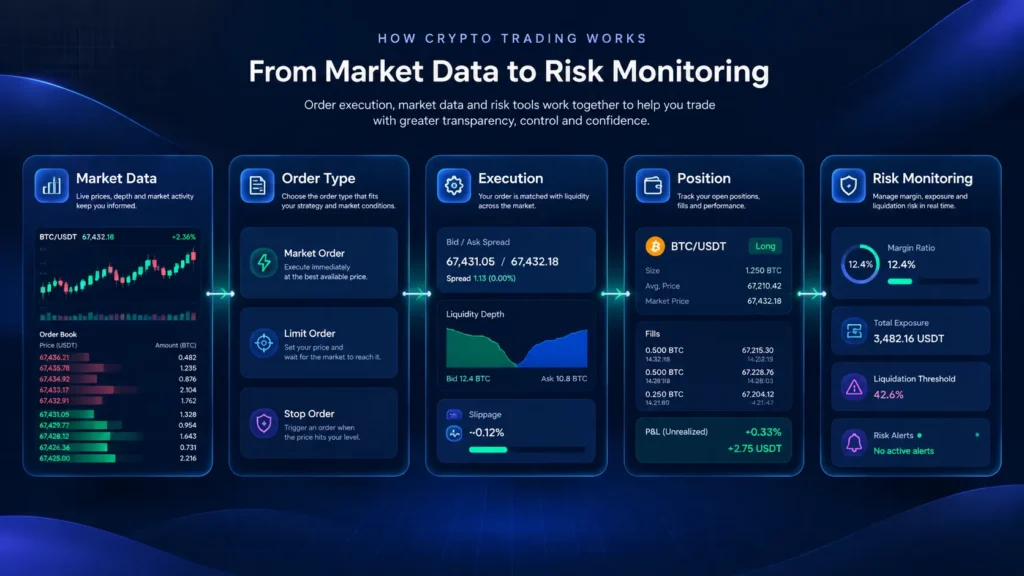
Risk-management features are generally designed to help monitor exposure rather than eliminate market risk.
Stop-Loss and Take-Profit Functions
These are automated order mechanisms that activate once a specified price condition is reached. It’s worth noting that, like other trigger-based orders, execution still depends on available liquidity and prevailing market conditions at the time of activation.
Position and Exposure Monitoring
Tools in this category typically display position size, unrealised and realised profit and loss, margin usage, leverage (where applicable), and overall account exposure across both spot and derivative holdings.
Margin and Liquidation Information
In leveraged crypto markets, platforms often display available margin, maintenance requirements, and liquidation thresholds, along with related notifications as these levels are approached. This applies to instruments such as crypto futures, perpetual futures, and trading options on bitcoin, where offered.
Risk Limits and Account Controls
- Maximum order size limits
- Trading permission settings
- Leverage restrictions
- API permission scopes
- Account-level withdrawal or access controls
Portfolio and Drawdown Monitoring
Some platforms provide aggregate statistics such as historical performance, drawdown measurements, and exposure breakdowns across an entire portfolio rather than individual positions alone.
Platform Security and Reliability
Security and reliability features are a standard part of evaluating any trading environment.
Account Authentication and Access Controls
Passwords, multi-factor authentication, withdrawal whitelists, session management, and device verification are common mechanisms used to protect account access and crypto wallet balances.
API Permissions and Connected Accounts
An API can connect external applications — such as a trading bot or portfolio tracker — to an account. Permission scopes typically determine what actions, such as trading or withdrawals, a connected application is allowed to perform.
System Availability and Execution Reliability
Technical factors such as outages, network latency, rejected orders, and delayed market data can all affect how reliably a platform functions during periods of high activity.
Data Protection and Transaction Records
Account records, trade history, and audit trails are typically maintained for transparency, alongside general security measures associated with digital trading platforms.
Comparing Crypto Trading Platform Functionality
Platforms can differ meaningfully across several dimensions, which is often useful context before comparing top crypto trading brokers in India or elsewhere. India’s crypto market has grown alongside a wider set of INR-settled crypto options, and some platforms also advertise deposits and withdrawals in Indian rupees, with certain providers reportedly allowing users to start crypto trading with amounts as low as ₹100.
| Comparison Area | What to Consider |
| Execution and order types | Range of supported orders, execution mechanisms, order-status visibility |
| Charting and analysis | Indicator variety, drawing tools, multi-chart layouts, data speed |
| Risk and position controls | Stop mechanisms, exposure data, margin monitoring, alerts |
| Interface and usability | Navigation, dashboard customization, mobile platform vs desktop design |
| Fee and execution transparency | Trading fees, spreads, liquidity, and disclosed execution practices |
Execution and Order Types
Platforms vary in the breadth of crypto order types supported, along with how clearly order status and available markets are presented.
Charting and Market Analysis
Differences here include the depth of chart customization, indicator libraries, drawing tools, and how real-time data is integrated into the charting experience.
Risk and Position Controls
Availability of stop and trigger mechanisms, exposure summaries, margin monitoring, and account-level restrictions can vary noticeably between platforms.
Interface and Usability
Navigation design, dashboard layout, order-entry clarity, and consistency between mobile platform and desktop versions all influence day-to-day usability.
Transparency of Fees and Execution
Trading fees, spreads, available liquidity, and any disclosed execution practices are commonly examined when comparing platforms, since these factors can affect the overall cost of trading over time. Some exchanges, including well-known names such as Binance, market themselves around low fees or promotional zero trading fees periods, while others rank platforms by exchange by trading volume as a general indicator of scale rather than quality. Terms like “best crypto exchanges,” “best cryptocurrency exchange,” or “top crypto exchange” are often used in marketing contexts and are worth evaluating independently rather than taken at face value.
Crypto Trading Platform Limitations and Common Trade-Offs
No platform design is free of trade-offs, and several recurring patterns are worth understanding conceptually.
- Speed vs price control — immediate execution and price-specific execution generally involve different compromises between certainty of fill and certainty of price.
- Advanced features vs interface complexity — additional order types, indicators, and risk tools can expand functionality while making an interface harder to navigate.
- Automation vs user control — automated orders and alerts, including those used with a trading bot, remain dependent on platform infrastructure and prevailing market conditions rather than operating independently of them.
- Centralised vs multi-platform access — using a single exchange interface differs structurally from third-party terminals or decentralized venues, such as automated market makers like Uniswap, that aggregate multiple accounts or liquidity pools.
FAQ
What Is a Crypto Trading Platform?
A crypto trading platform is a software interface that allows users to view market data, place orders, and monitor positions across one or more cryptocurrency markets. It typically combines charting, order management, deposit and withdrawal functions, and account-tracking tools in a single environment. The exact feature set, including which tokens and INR-settled options are supported, can vary between exchanges and third-party terminals.
What Features Matter Most on Crypto Trading Platforms?
Execution reliability, charting tools, order-management functionality, real-time market data, and risk-control features are generally considered the core areas of platform functionality. No single feature determines overall usability on its own. The relative importance of each can depend on whether a user is primarily engaged in spot trade activity or in futures and options.
What Is Order Execution in Crypto Trading?
Order execution refers to the process by which a submitted order is matched against available liquidity on the order book. The outcome depends on order type, market depth, and prevailing conditions at the time of submission. Execution price can differ from the price last displayed before the order was placed, whether the underlying asset is BTC, ETH, or another token.
What Order Types Are Common on Crypto Trading Platforms?
Market, limit, stop, and stop-limit orders are widely available across crypto exchanges. Some platforms also offer advanced variants such as post-only, reduce-only, immediate-or-cancel, and fill-or-kill orders, along with dedicated tools for perpetual futures. Availability can vary by platform and by the specific market being traded.
Why Does Price Slippage Occur in Crypto Trading?
Slippage occurs when an order executes at a different price than expected, typically due to low liquidity, wide spreads, high volatility, or a large order size relative to available depth. It can affect both market and, in some cases, trigger-based orders. The degree of slippage tends to vary by market conditions and by whether trading takes place in spot or derivatives markets.
What Charting Tools Do Crypto Platforms Offer?
Common charting tools include candlestick charts, technical indicators such as moving averages and RSI, drawing tools like trend lines and Fibonacci levels, and support for multiple timeframes. Many platforms also integrate order-book depth directly alongside chart displays. Feature depth varies by provider.
What Risk Management Tools Are Available on Crypto Platforms?
Risk-related tools commonly include stop-loss and take-profit order types, position and exposure monitoring, margin and liquidation information, and account-level controls such as leverage limits. These tools are generally designed to support monitoring rather than to eliminate market risk entirely, whether applied to spot holdings or to crypto futures.
How Does Platform Execution Differ From Chart Prices?
Chart prices reflect historical or last-traded data, while execution prices are determined by order-book liquidity at the moment an order is submitted. These two figures can diverge, particularly during periods of low liquidity or rapid price movement. This distinction is a common source of confusion for newer traders looking to buy and sell bitcoin or other cryptocurrencies.
Are Crypto Trading Platforms Secure?
Security features such as multi-factor authentication, withdrawal controls, and API permission scopes are standard across most established platforms, though implementation varies by provider. No platform can guarantee complete protection against all risks. Reviewing a platform’s specific security disclosures is generally considered good practice before choosing where to buy bitcoin or hold a crypto wallet.
Can Crypto Trading Platforms Be Used on Mobile Devices?
Many crypto trading platforms offer a dedicated crypto trading app for Android and iOS alongside their desktop versions. Mobile interfaces often include a simplified subset of features compared with a full desktop platform, though core functions like order placement, deposit and withdrawal handling, and account monitoring are typically retained.