Crypto Demo Trading: How to Practice Without Real-Money Risk

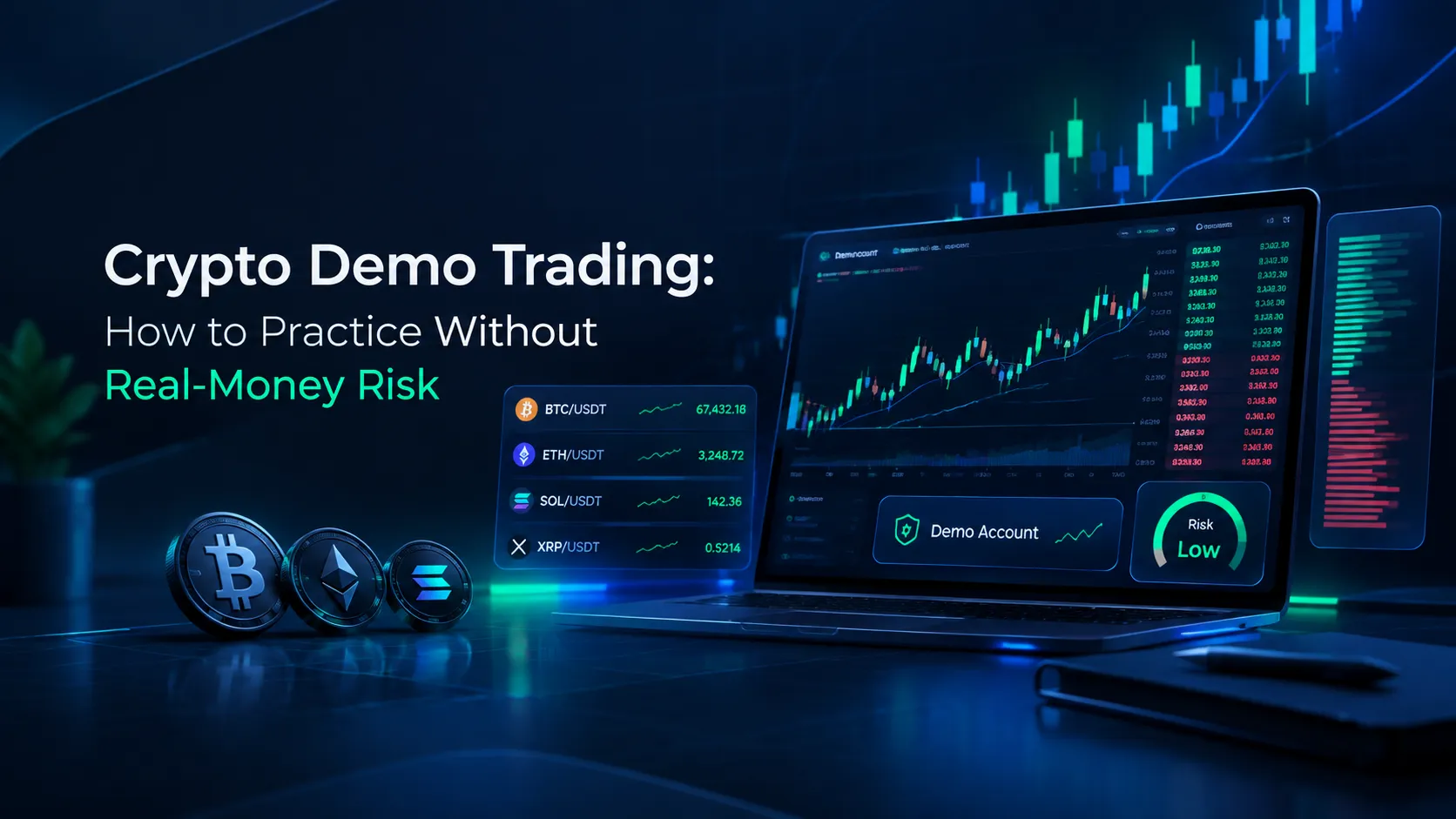
Crypto demo trading refers to a simulated environment where market participants can explore crypto trading mechanics using virtual funds rather than real capital. A demo trading account typically mirrors the interface of a live exchange, allowing a user to place trades, monitor a portfolio, and observe live market conditions without financial exposure.
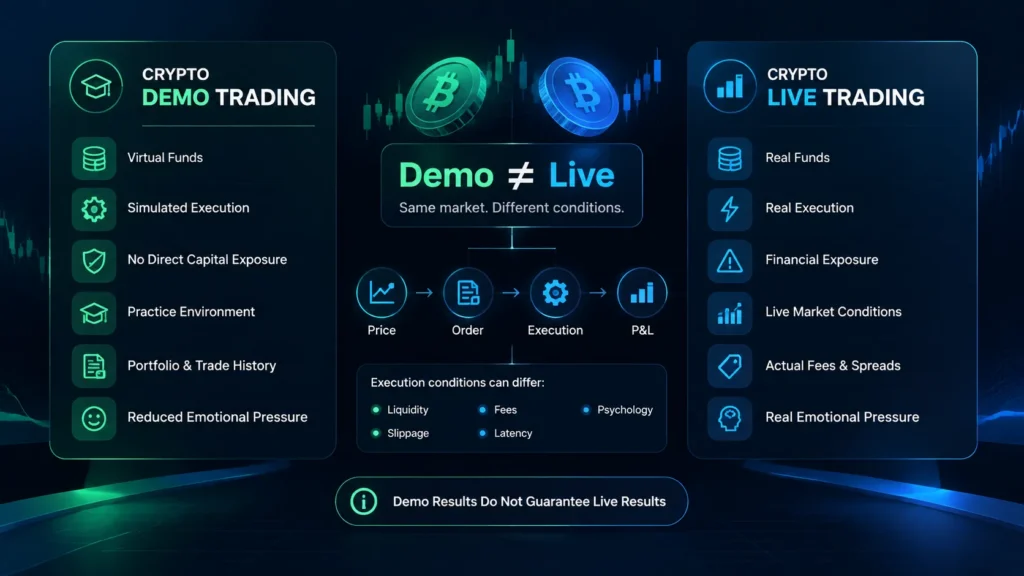
This structure is often used to build familiarity with charts, order types, and platform mechanics before capital is committed. It’s worth noting from the outset that simulated results do not reproduce every condition found in live trading, including fees, slippage, and emotional pressure.
Key Takeaways
- Crypto demo trading uses virtual funds rather than real capital, allowing to practice in a risk-free environment.
- Demo trading platforms can reproduce charts, live market prices, order interfaces, and portfolio tracking.
- A demo account can help build familiarity with trading mechanics without real-money exposure.
- Simulated execution generally cannot fully reproduce liquidity, slippage, fees, latency, or the psychological pressure of live trading.
- Demo performance is typically viewed as educational rather than evidence of future live-market results.
What Is Crypto Demo Trading?
Crypto demo trading, sometimes called paper trading or a crypto trading simulator, describes a method of practicing trading crypto using a simulated balance instead of real money. These terms are often used interchangeably, though some platforms distinguish between a basic paper-trading tool and a fuller demo account with exchange-style features. A simulated balance separates the trading experience from real capital, since gains and losses in demo mode do not affect an actual bank account or wallet. Some platforms connect demo mode to live or near-live market data, while others rely on historical or replay-based data feeds.
Virtual Funds and Simulated Positions
A demo trading account typically allocates a set amount of virtual funds to a new user, which functions as hypothetical capital rather than real cryptocurrency. Simulated positions, unrealised profit and loss, and portfolio value are calculated the same way a live account would calculate them, but no cryptocurrency is actually bought, sold, or held. This structure allows the mechanics of buying and selling to be observed without transferring real capital.
Live Market Data and Historical Data
Some demo environments use real-time market feeds so that price movement in the simulator reflects current market conditions. Others rely on historical data or chart-replay tools, which display past price movement instead of live market behaviour. Each format creates a different practice experience: real-time data can feel closer to live market conditions, while historical data may be used to examine how the market behaved during a specific historical period.
Demo Trading vs Live Crypto Trading
| Feature | Demo Trading | Live Crypto Trading |
| Capital used | Virtual funds | Real capital |
| Execution | Simulated fills | Actual order matching |
| Fees and slippage | Often simplified or excluded | Applied by the exchange |
| Psychological pressure | Generally lower | Present due to real financial risk |
| Consequence of errors | No direct financial loss | May result in real losses |
How Crypto Demo Trading Works
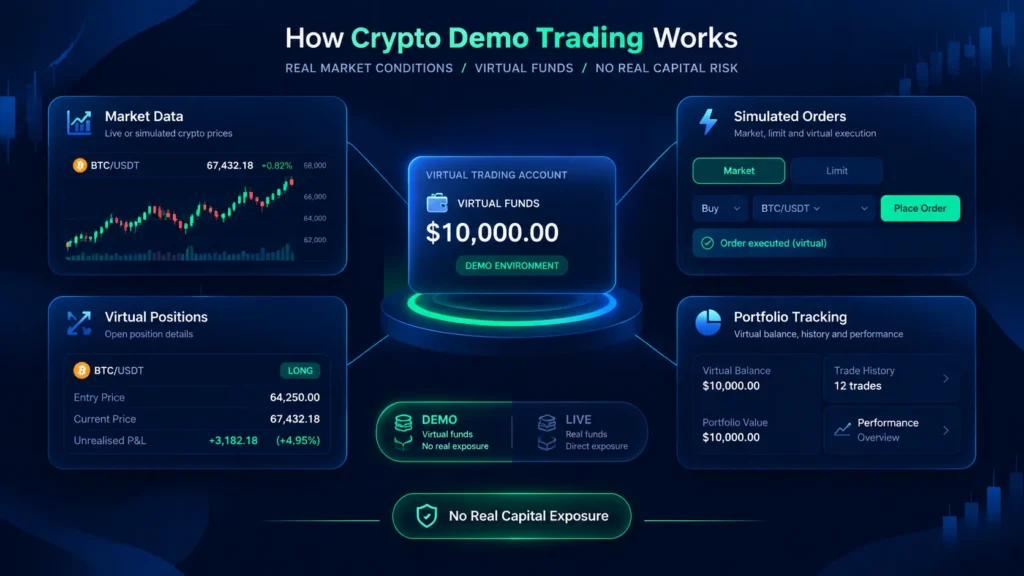
A simulated crypto trading environment generally combines market data, a virtual balance, an order interface, and account history into one platform. Modern tools commonly resemble the layout of a live exchange, with charts positioned alongside order panels and portfolio summaries. This structure allows the general flow of trading crypto to be observed without turning the process into a prescriptive tutorial.
Market Prices and Charts
Charting tools within a demo environment often include candlestick charts, multiple timeframes, and volume indicators, similar to what is available on a live exchange. Price movement is displayed either from a live feed or historical dataset, depending on the platform. These charting features are commonly associated with technical analysis concepts, including support, resistance, and trend structure.
Simulated Orders and Execution
Order types such as market orders and limit orders are typically available within a demo account at a conceptual level. A market order is generally executed at the prevailing simulated price, while a limit order is designed to execute only at a specified price or better. Some simulators attempt to model execution delay or slippage, while others fill orders instantly regardless of live market conditions.
Positions, Balance, and P&L
A demo account interface commonly displays virtual cash balance, open positions, unrealised P&L, realised P&L, and total portfolio value. These figures update as simulated prices move, mirroring the structure of a live trading dashboard. Reviewing this information can be associated with understanding how portfolio value responds to price changes over time.
What Can Be Practised With Crypto Demo Trading?
Simulated environments can help explore several trading-related skills, though none of them are guaranteed to translate directly into live-market outcomes.
- Reading price charts and identifying basic chart patterns
- Placing and adjusting different order types
- Monitoring portfolio value and trade history
- Observing how prices behave across different market conditions
- Becoming familiar with a trading platform’s interface and menu structure
Reading Crypto Charts
Chart reading in a demo environment covers candlestick structure, price movement, volume, and commonly used timeframes. These concepts are considered foundational to technical analysis and are often introduced through demo charts before being applied elsewhere.
Exploring Order Types
A demo environment can illustrate the mechanical difference between a market order and a limit order, including how each is intended to interact with the order book. This exploration is descriptive rather than instructional, since actual execution conditions vary by exchange and by market.
Portfolio Tracking
Reviewing virtual balances, open positions, and trade history is commonly associated with understanding how a portfolio evolves over a trading session. Historical records within a demo account can be examined afterward to study how simulated decisions affected portfolio value.
Market Behaviour Across Conditions
Demo trading can expose a user to rising, falling, sideways, and highly volatile market conditions, depending on which data feed is used. Observing these different conditions is often associated with building a general sense of how volatility can affect price movement and order execution.
Crypto Demo Trading Features to Compare
Several platform characteristics can affect how closely the experience resembles a live exchange. Delta Exchange, Bitsgap, TradingView, eToro, and Bybit are examples of platforms that have offered demo or simulated trading features, each with a different combination of markets and tools.
Charting and Technical Tools
Candlestick charts, indicators, drawing tools, and multiple timeframes are common features across demo platforms. Some paper-trading environments integrate charting tools similar to those used alongside live markets, such as the type of charting interface associated with TradingView.
Order Types and Trading Interface
The availability of market and limit orders, along with the general look of the trading interface, can vary between simulators. Some platforms design their demo mode to closely resemble a conventional crypto exchange, while others use a simplified interface focused on basic order placement.
Portfolio and Trade History
Transaction records, open-position details, and P&L tracking are commonly available within a demo account and can support a review of simulated activity after a session ends.
Spot and Derivatives Simulation
Some demo environments focus solely on spot markets, while others include simulated futures or derivatives trading, including leverage and margin mechanics. Derivatives simulation, such as that associated with Delta Exchange India, introduces additional complexity related to margin requirements and liquidation mechanics compared with spot-only environments.
Mobile and Desktop Access
| Access Type | Common Characteristics |
| Mobile app | Compact charts, streamlined order panel, portable access |
| Desktop / browser | Larger chart area, additional analytical tools, multi-window layouts |
Benefits of Crypto Demo Trading
A demo account has several educational advantages, though these benefits do not eliminate the risks associated with live crypto markets.
- No direct financial exposure from simulated transactions
- Increased familiarity with trading interfaces over repeated use
- Opportunity to review simulated mistakes without real losses
- A practical context for studying volatility, execution, and portfolio mechanics
No Real Capital Exposure
Because virtual funds are used, simulated transactions do not create a direct financial loss. This structure can be associated with exploring order placement and market mechanics without committing real capital.
Familiarity With Trading Interfaces
Repeated exposure to charts, order panels, balances, and position information can make platform mechanics more familiar over time. This familiarity is often described as a foundational step before capital is engaged in how to start crypto trading.
Opportunity to Review Mistakes
Simulated losses can be examined afterward without an accompanying financial consequence, which may allow decision-making patterns to be studied in a lower-pressure setting.
Testing Market Concepts
Demo environments can offer a practical context for studying concepts such as volatility, order execution, and position P&L, supporting a broader understanding of how crypto trading strategies are commonly structured.
Limitations of Crypto Demo Trading
The phrase “without real-money risk” does not mean that a demo account fully reproduces live-market conditions. Differences can arise from execution modelling, liquidity, fees, slippage, latency, leverage assumptions, and trading psychology.
Slippage and Liquidity Differences
A simulated fill may differ from what could occur in a live market, particularly during fast price movements or lower-liquidity periods, since many simulators execute orders instantly at the displayed price.
Fees and Funding Costs
Trading fees, spreads, and derivatives funding mechanisms may be simplified, omitted, or represented differently across simulators, which can make simulated returns appear more favourable than a comparable live scenario.
Emotional and Psychological Differences
Virtual losses generally do not create the same financial consequences as losses involving real capital, so the emotional responses associated with live trading are often reduced or absent in demo mode. This is why studying crypto trading risk management alongside demo practice is often considered a relevant complement rather than a substitute.
Simulated Results Are Not Guarantees
Positive demo performance does not establish future live-market performance, since market conditions and execution environments can differ substantially. Past simulated performance does not guarantee future results, and losses in live trading may exceed initial expectations.
Crypto Demo Trading vs Backtesting vs Chart Replay
These three approaches to simulated practice rely on different types of market information and are generally associated with different educational purposes.
| Method | Data Type | Typical Use |
| Demo trading (live data) | Real-time or near-real-time feed | Practicing platform mechanics under current conditions |
| Historical backtesting | Past price data, applied systematically | Reviewing how a defined methodology performed historically |
| Chart replay | Historical data shown progressively | Studying how price structure develops step by step |
Demo Trading With Live Market Data
Real-time or near-real-time market feeds allow a simulated environment to reflect current price movement, which can be associated with observing live market behaviour without financial exposure.
Historical Backtesting
Backtesting generally involves applying a predefined methodology to historical price data to examine how it would have behaved during past conditions, without any implication about future performance.
Chart Replay
Chart replay tools allow historical price movement to be reviewed progressively, rather than displaying the entire future sequence at once, which can support the study of how price patterns unfolded over time.
Main Differences in Simulation
Data source, execution assumptions, and psychological context vary across these three approaches, and each is generally associated with illustrating a different aspect of trading crypto.
How to Evaluate a Crypto Platform
Several neutral criteria can be used to assess the general characteristics of different demo environments.
- Market coverage – supported cryptocurrencies, trading pairs (such as BTC or ETH), spot markets, and futures markets.
- Data quality and realism – freshness of market data, pricing accuracy, and how execution is modelled.
- Order and risk features – available order types, margin simulation, and liquidation mechanics.
- History and analytics – trade logs, performance records, and reporting tools.
- Availability and access – account requirements, regional availability, and differences between mobile app and desktop functionality.
Common Mistakes in Crypto Demo Trading
Certain behavioural and conceptual pitfalls are commonly associated with simulated environments.
- Treating virtual money like a guaranteed indicator of live-trading ability
- Ignoring fees and slippage when reviewing simulated results
- Focusing only on profit figures rather than execution quality and decision-making
- Overlooking how quickly market volatility can shift between conditions
Treating Virtual Money Like Guaranteed Practice
Demo results can create a misleading impression when the simulator does not reproduce live-market costs or execution conditions, since real trading fees and slippage may not be reflected.
Ignoring Fees and Slippage
Excluding transaction costs from a simulated environment can make results appear different from what might occur in a comparable live scenario.
Focusing Only on Profits
Trade history, execution quality, consistency, and drawdown patterns can provide more information about a trading approach than a single virtual profit figure.
Overlooking Market Volatility
Performance observed in one market regime may not translate to another, which is particularly relevant in crypto markets where volatility can shift rapidly.
Is Crypto Demo Trading Useful for Beginners?
For a beginner exploring financial markets for the first time, a demo account can offer a structured setting in which basic terminology and platform mechanics are introduced gradually.
Learning Trading Terminology
Terms such as market order, limit order, spread, volatility, margin, liquidation, and P&L are commonly encountered within a demo trading interface, which can support a general vocabulary before live trading is considered.
Exploring Platform Mechanics
A demo environment can provide familiarity with charts, order panels, balances, and trade history, supporting a general understanding of how a trading platform is organised.
Recognising Simulation Boundaries
A demo account can reduce financial exposure during practice, but it cannot eliminate the risks and uncertainties associated with real crypto markets. This distinction is generally considered a relevant part of building realistic expectations before live capital is used.
FAQ
What Is Crypto Demo Trading?
Crypto demo trading is a simulated form of cryptocurrency trading that uses virtual funds instead of real capital, allowing platform mechanics and market behaviour to be observed without financial exposure.
Is Crypto Demo Trading Free?
Availability and pricing vary between platforms. Some exchanges and trading apps offer free demo trading accounts, while others restrict certain simulated features to specific account types.
Does Crypto Demo Trading Use Real Market Prices?
Some platforms connect a demo account to live or near-live market data, while others rely on historical or simulated pricing, which can affect how closely the demo experience reflects current market conditions.
Can Crypto Demo Trading Simulate Futures?
Some demo platforms include simulated futures markets with leverage and margin mechanics, while others focus exclusively on spot trading, so available features vary by provider.
Is Crypto Demo Trading Completely Risk-Free?
A demo transaction itself does not carry direct financial risk since no real capital is used. However, this does not remove the broader risks associated with cryptocurrency markets, and simulated conditions cannot fully reproduce live execution or psychological pressure.
Does Demo Trading Prepare Someone for Real Trading?
Demo trading can build familiarity with market mechanics and platform interfaces, but simulated performance does not guarantee equivalent results once real capital and live execution conditions are involved.
What Is the Difference Between Paper Trading and Demo Trading?
The two terms are frequently used interchangeably, although individual platforms may apply them to describe slightly different sets of simulation features.
Can Demo Trading Be Used on Mobile?
Mobile availability depends on the platform. A mobile app may offer a more compact selection of charts, order tools, and analytics compared with a desktop or browser-based demo environment.
Does Demo Trading Include Real Trading Fees?
Fee treatment varies by simulator. Some platforms model trading fees, spreads, or funding costs within the demo experience, while others simplify or exclude these costs entirely.