Margin Trading Crypto Guide: Collateral, Maintenance Margin and Liquidation Risk on Bitcoin Exchanges

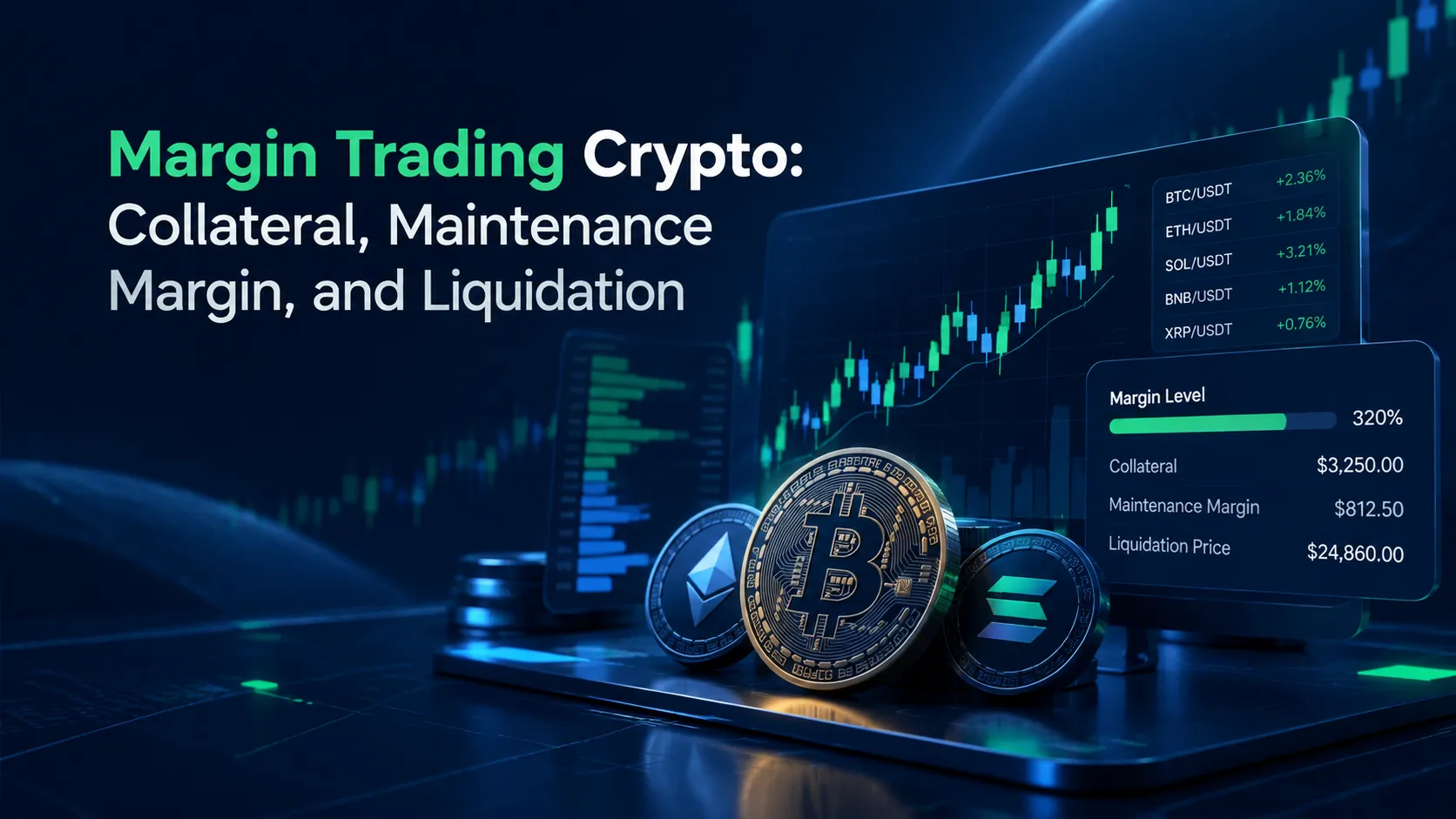
Margin trading crypto means using deposited collateral to open trades larger than the available balance. Collateral, maintenance margin, and liquidation decide whether a leveraged trade survives volatility or is closed automatically by the platform.
This guide covers how borrowed exposure works, how liquidation prices are formed, and how liquidation risk is typically measured. For a wider view of the market, see this overview of crypto trading. This article is educational and is not investment advice.
Key Takeaways
- Margin trading lets traders control larger cryptocurrency exposure by posting collateral instead of funding the full trade value.
- Initial margin is the collateral required to open a trade. Maintenance margin is the minimum equity required to keep it open.
- Liquidation occurs when account equity falls below the maintenance threshold, causing partial or full forced closure.
- Higher leverage shortens the price distance to liquidation and increases sensitivity to volatility.
- Cross margin and isolated margin allocate risk differently across open trades.
- Liquidation risk is commonly reduced through lower leverage, extra collateral, smaller trade size, and stop-loss orders.
What Is Margin Trading in Crypto?
Margin trading in crypto is the practice of borrowing exposure from a cryptocurrency exchange or platform to open a long or short trade larger than the trader’s own capital. The trader still carries the profit-and-loss outcome of the full trade size, while only a portion is posted as security.
In simple terms, this works like a deposit on a rental. The deposit is small compared with the asset’s value, but any damage is measured against the whole asset.
How Margin Trading Differs From Spot Trading
Spot trading means buying a coin such as Bitcoin and holding it directly in a cryptocurrency wallet. Leveraged trading gives borrowed exposure instead, which can amplify both gains and losses.
| Feature | Spot Trading | Margin Trading |
| Ownership | Direct ownership of the asset | Leveraged exposure, often without full ownership |
| Capital needed | Full purchase price | A fraction of the trade value as collateral |
| Maximum loss | Usually the amount invested | Can reach the full collateral and, on some platforms, more |
| Liquidation | None | Forced closure when collateral runs too low |
| Ongoing costs | Trading fees | Fees, interest on borrowed funds, funding payments |
Long and Short Exposure
A long position profits when the price rises, and a short profits when the price falls. Shorting means selling a borrowed asset first, with the intention of buying it back later at a lower price.
Short exposure carries an additional risk because the price of an asset can rise without a fixed ceiling. Losses on a short can therefore grow quickly during a sharp rally.
Where Margin Trading Is Available
Leveraged trading is offered by centralized exchanges such as Binance, OKX, KuCoin, and Bitfinex, by derivatives platforms, and by some decentralized lending or perpetual-futures protocols. Some venues also support peer-to-peer lending, where users fund each other’s loans.
Collateral rules, leverage limits, liquidation engines, and fees vary by platform. Each platform publishes its own documentation, which is the authoritative source for its parameters.
How Collateral Works in Crypto Margin Trading
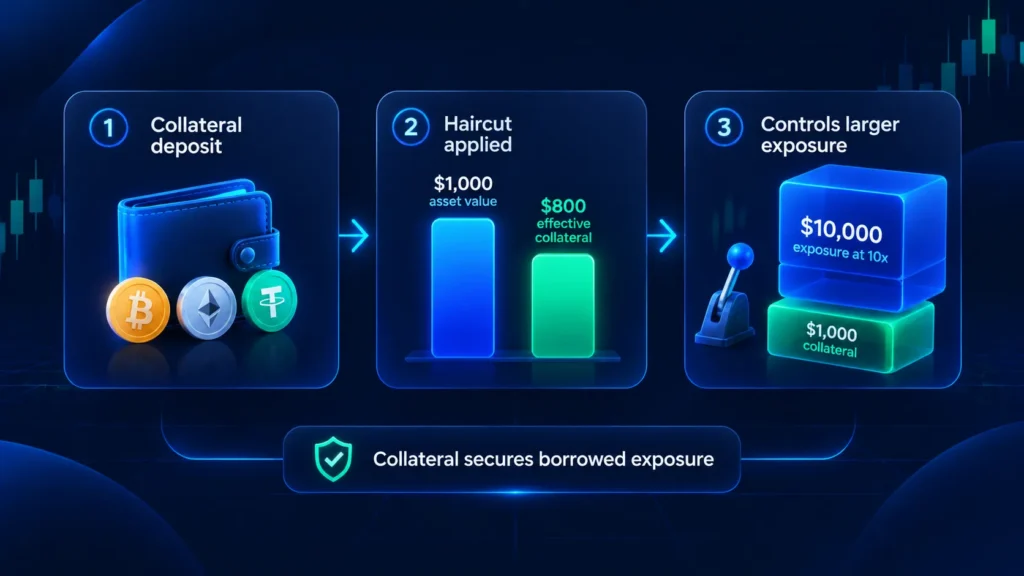
Collateral is the set of assets a trader deposits to secure borrowed exposure and cover potential losses. Platforms may accept stablecoins, BTC, ETH, or other eligible coins, often applying a haircut to reflect volatility and market liquidity.
The platform checks collateral value continuously, because the collateral itself can change in price while a trade is open.
Initial Margin and Position Size
Initial margin is the amount required to open a trade. It depends on the trade size and leverage.
Initial Margin = Position Size / Leverage
For example, a $10,000 trade at 10x leverage generally requires $1,000 in initial margin, before fees and platform-specific requirements. At 2x leverage, the same trade would require $5,000.
Eligible Collateral and Haircuts
A haircut is a reduction applied to the value of a volatile or less liquid asset when the platform counts it as collateral. If a platform applies a 20% haircut, $1,000 of a risky token counts as only $800 of effective collateral.
Stablecoins and major assets such as Bitcoin and Ethereum often receive smaller haircuts. Smaller tokens with thin order books often receive larger ones.
Cross Margin vs. Isolated Margin
Cross margin shares the whole account balance across all open trades, while isolated margin assigns a fixed amount of collateral to a single trade.
| Feature | Cross Margin | Isolated Margin |
| Collateral pool | Entire account balance | Fixed amount per trade |
| Liquidation tendency | Later, because other balances provide support | Sooner, because only allocated collateral is available |
| Maximum exposure | Whole account | Allocated amount |
| Complexity | Higher, since trades affect each other | Lower, since trades are separated |
The cross approach can delay liquidation but may expose the full account. The isolated approach limits the loss to the allocated collateral.
What Is Maintenance Margin?
Maintenance margin is the minimum equity a trader must hold to keep a leveraged trade open. It is usually lower than the initial requirement and is monitored continuously while the trade is live.
When account equity falls to this level, the platform’s risk engine treats the trade as unsafe and begins the liquidation process.
Maintenance Margin Rate
The maintenance rate is a percentage of trade value used to calculate the required minimum. Rates can rise for larger sizes or higher risk tiers, and some platforms include estimated closing fees in the figure.
Maintenance Margin = Maintenance Margin Rate x Position Value
Because the value moves with the market price, the maintenance requirement can change during the trade.
Equity, Unrealized PnL, and Account Balance
Account equity is collateral value plus or minus unrealized profit and loss (PnL). An adverse price move reduces equity, while a favorable move increases it.
The platform compares this equity figure against the maintenance requirement. That comparison determines whether a trade stays open.
Margin Call vs. Liquidation
A margin call is a warning that asks the trader to add funds or reduce exposure. Liquidation is the forced closure of part or all of a trade.
Not every platform issues a warning before liquidation, so alerts alone are not a dependable safety net. Many crypto exchanges liquidate automatically with no prior notice.
How Liquidation Works in Crypto Margin Trading
Liquidation is an automated risk-control process that closes a leveraged trade when equity no longer meets the maintenance requirement. Its purpose is to keep losses within available collateral and to protect the platform from unpaid debt. Many exchanges also maintain an insurance fund to absorb losses when a trade closes below the bankruptcy price.
Liquidation Price Explained
The liquidation price is the approximate market price at which a trade reaches the maintenance threshold. The exact level depends on entry price, leverage, collateral, maintenance rate, fees, and funding costs where applicable.
The liquidation price shown by an exchange is the most reliable figure, because it reflects that platform’s live parameters.
Partial and Full Liquidation
Partial liquidation reduces trade size to bring requirements back within limits. Full liquidation closes the entire trade.
Some platforms attempt partial liquidation or risk-tier reductions before closing everything. Others close the whole trade at once, depending on their rules.
Liquidation Fees and Slippage
Liquidation can involve fees, unfavorable execution prices, and slippage during volatile markets. When order books are thin or prices move quickly, the final realized loss may be larger than expected.
Slippage is the gap between the expected execution price and the actual one. Low market liquidity widens that gap.
How Leverage Affects Liquidation Risk
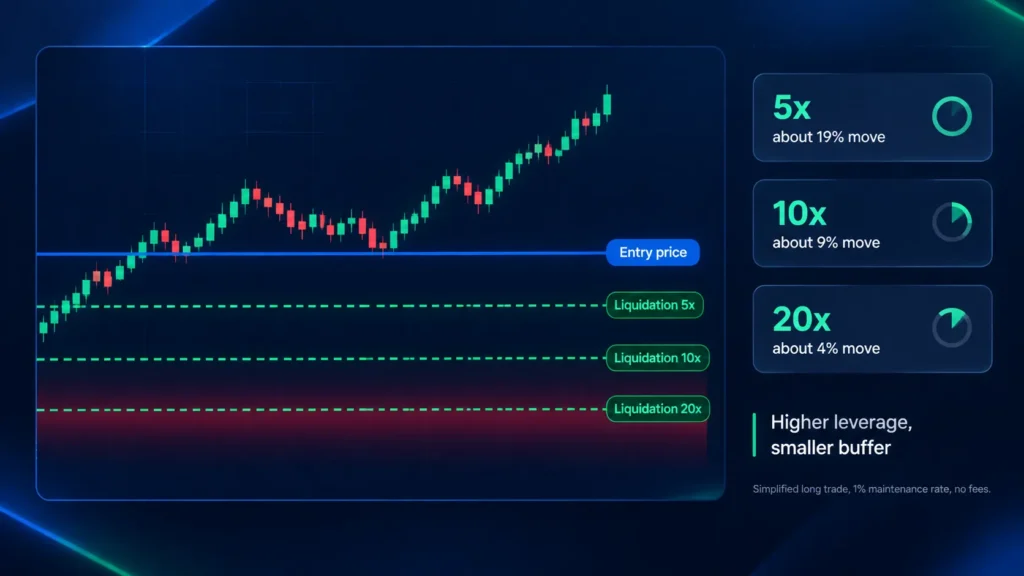
Leverage determines how much price movement is needed to erode collateral. A higher multiple creates a larger trade from the same deposit, and it moves the liquidation price closer to the entry price.
Leverage, Notional Value, and Requirements
Notional value is the total size of a leveraged trade. At 5x, $1,000 of collateral controls $5,000 of exposure, and at 20x, the same $1,000 controls $20,000.
The same adverse percentage move therefore has a much larger effect on equity at higher leverage. A 5% drop on $20,000 of exposure equals a $1,000 loss, which is the entire deposit.
Example: Liquidation Distance at Different Leverage Levels
The table assumes a long trade, a 1% maintenance rate, and no fees or funding costs. The adverse move is approximately 100% / leverage minus the maintenance rate.
| Leverage | Initial Collateral | Approx. Adverse Move to Liquidation |
| 5x | 20% | About 19% |
| 10x | 10% | About 9% |
| 20x | 5% | About 4% |
| 50x | 2% | About 1% |
A 10x trade liquidates after roughly a 9% adverse move, not 10%, because the maintenance requirement consumes part of the buffer. Real figures differ by platform.
Volatility, Funding, and Borrowing Costs
Cryptocurrency volatility, funding payments on perpetual contracts, interest on borrowed assets, and trading fees can all reduce available collateral over time. These costs are part of an honest estimate of liquidation risk.
For a deeper look at perpetual contracts and expiring contracts, see this explanation of crypto futures trading.
How to Calculate Margin and Liquidation Levels
Required collateral and liquidation levels can be estimated in a few steps: initial requirement, maintenance requirement, unrealized PnL, and an approximate liquidation price. Formulas and risk parameters differ across exchanges, so the platform’s own calculator remains the reference.
Understanding leverage trading crypto makes these formulas easier to follow.
Initial Margin Formula
Initial Margin = Position Size / Leverage
Platforms may add fees, adjust for collateral haircuts, or apply tiered requirements. A $5,000 Bitcoin trade at 5x leverage generally needs $1,000.
Maintenance Margin Formula
Maintenance Margin = Maintenance Margin Rate x Position Value
If a $10,000 trade has a 1% rate, the maintenance requirement is $100. If the trade value grows to $12,000, the requirement rises to $120.
Approximate Liquidation Price
Liquidation occurs when equity falls to the maintenance requirement. For a long trade, this places the liquidation price below entry, and for a short, above entry.
Trades that use multiple collateral assets or cross margin are harder to estimate by hand. The live liquidation price displayed by the platform is the better reference.
Risks of Crypto Margin Trading
The main risks of leveraged trading are rapid liquidation, volatility, overleveraging, funding costs, collateral devaluation, and execution risk. It is generally considered suitable only for traders who understand these mechanics and can tolerate losing their allocated collateral.
Regulators describe this danger directly. The European Securities and Markets Authority found that 74-89% of retail CFD accounts lose money, and it set a lower leverage limit of 2:1 on crypto CFDs for retail clients, according to reporting on the decision. CFDs are a different product from exchange-based borrowing, but the leverage mechanics are comparable.
Market Volatility and Gap Risk
Crypto prices can move sharply within seconds, especially during news events, low-liquidity periods, or exchange disruptions. A sudden price gap can trigger liquidation before a trader has time to respond.
Overleveraging and Sizing
High leverage does not by itself raise expected returns. It mainly raises the probability of liquidation, because a small adverse move consumes the collateral buffer.
Trade size relative to total account value is therefore a more meaningful measure of risk than the maximum leverage a platform allows.
Collateral Risk
Collateral held in a volatile asset can lose value at the same moment the trade moves against the trader. Stablecoin collateral reduces that specific problem but introduces counterparty and depeg considerations.
How to Avoid Liquidation
Liquidation risk is commonly managed by using lower leverage, keeping a collateral buffer, reducing trade size, monitoring account health, setting stop-losses, and avoiding highly leveraged exposure through major events. Broader principles are covered in this guide to crypto trading risk management.
Add Collateral Before Account Health Deteriorates
Adding collateral raises equity and moves the liquidation price further from the market. It works best as a planned decision, not as an attempt to rescue an oversized or poorly reasoned trade.
Reduce Size Early
Partially closing a trade reduces notional exposure and the maintenance requirement. This is often more effective than waiting for a margin call that may never arrive.
Stop-Loss Orders That Sell Automatically
A stop-loss order sells a long trade, or buys back a short one, when the price reaches a chosen level. It defines a maximum acceptable loss before liquidation occurs.
Stop-loss orders can still experience slippage or fail to fill during extreme market conditions, so they reduce risk without removing it.
Monitor Funding, Fees, and Account Health
Account health depends on unrealized PnL, available collateral, maintenance usage, funding payments, and open-order exposure. Small recurring costs can become material over longer holding periods.
Pre-Trade Checklist for Leveraged Crypto Trading
A pre-trade checklist covers the items below, in this order:
- Eligible collateral and its haircut
- Initial and maintenance requirements
- The displayed liquidation price
- The maximum loss in dollars
- Current volatility
- A defined exit plan
Check Platform Rules and Risk Tiers
Maintenance rates, leverage caps, liquidation procedures, and eligible assets differ by platform and trade size. The exact contract rules published by the exchange define what applies.
Define Risk Before Entry
A maximum dollar loss and a trade size, set before entry, help prevent emotional decisions during volatility. Defining them in advance turns an abstract risk into a specific figure.
Plan for Extreme Market Conditions
Extreme conditions include price gaps, liquidity shortages, funding spikes, and temporary exchange outages. Excessive leverage around high-impact announcements or thin liquidity increases the chance of unexpected liquidation.
FAQ
What is collateral in crypto margin trading?
Collateral is the deposit a trader provides to open and maintain a leveraged trade. It acts as security for borrowed exposure and can be used to cover losses if the market moves against the trade.
What triggers crypto liquidation?
Liquidation is triggered when account equity falls to or below the required maintenance level. The platform then closes part or all of the trade automatically.
Can liquidation happen even if I have funds in another position?
Yes, although with cross margin, balance from other trades may be used to support a losing one. This can delay liquidation but may also put more of the account at risk.
Does higher leverage always mean liquidation?
No, but higher leverage makes liquidation more likely because the same price movement has a larger effect on equity. It also reduces the buffer between entry price and liquidation price.
How much maintenance margin do crypto platforms require?
Requirements vary by platform, asset, trade size, and risk tier. Major crypto assets may carry lower rates, while smaller or more volatile assets often require more.
Can I avoid liquidation by adding margin?
Adding collateral can increase equity and move the liquidation price further away, but it does not remove market risk. If the trade stays too large or the market keeps moving against it, liquidation can still occur.
Is margin trading suitable for beginners?
Leveraged trading is generally better suited to traders who already understand spot trading, volatility, order types, and risk management. Beginners typically use low or no leverage while learning how collateral and liquidation work.