Leverage Trading Crypto: Exposure, Potential Returns, and Amplified Risk

Leverage trading crypto is a mechanism that lets market participants hold exposure to a position larger than the margin they commit. In crypto trading, rapid price fluctuations can magnify both gains and losses. Leverage, capital exposure, margin, liquidation and market volatility are therefore closely connected. Leveraged positions do not guarantee higher returns and may result in the rapid loss of committed funds.
This article explains crypto leverage trading in neutral, educational terms for beginner traders. It is market commentary, not a tutorial, and it does not constitute investment advice. According to the Financial Conduct Authority, significant price volatility and the difficulty of valuing cryptoassets place retail consumers at high risk of losses from crypto derivatives.
Key Takeaways
- Crypto leverage trading provides exposure larger than the margin committed, supported by collateral, borrowed funds or derivative contracts.
- Leverage ratios, initial margin and position size together determine market exposure: Margin = Position Size / Leverage.
- Leverage amplifies both positive and negative price movements, so losses can build as quickly as gains.
- Maintenance margin and liquidation mechanisms may close a position automatically when account equity falls below required thresholds.
- Trading fees, funding payments, borrowing interest and exchange-specific rules add costs and conditions, while volatility adds risk.
- Potential returns differ from actual profit or loss after fees and funding costs, and examples are illustrative rather than predictive.
What Is Crypto Leverage Trading?
Crypto leverage trading gives market participants exposure to cryptocurrency prices that exceeds the capital they commit. Collateral, usually called margin, supports the larger position. According to ESMA’s product intervention FAQs, leverage means only a portion of a position’s value is put down, while price changes are multiplied for both profits and losses.
How Leverage Works in Crypto Markets
Leverage is a multiplier of market exposure relative to margin. In leverage trading, a trader commits collateral, and a platform provides exposure through borrowed funds or derivative contracts. A 10x leverage position, for example, represents exposure ten times the margin committed, before trading fees and platform requirements are considered.
Leveraged exposure differs from outright ownership of a cryptocurrency. A trader holding a leveraged Bitcoin contract typically holds a claim on price changes rather than the coin itself. Ownership, withdrawal rights and custody therefore depend on the instrument and the exchange, which is why leveraged crypto is often described as a derivative form of exposure.
Leverage Ratios and Position Size
Common leverage ratios include 2x, 5x, 10x and 20x. Position size follows one relationship: Margin = Position Size / Leverage. The table below uses 1,000 units of margin, such as £1,000 in pound sterling terms, to show how different ratios correspond to different position sizes and sensitivities.
| Leverage Ratio | Position Size (1,000 Margin) | Gross Change for a 1% Price Move | Approximate Adverse Move Equal to Full Margin |
| 2x | 2,000 | 20 (2% of margin) | About 50% |
| 5x | 5,000 | 50 (5% of margin) | About 20% |
| 10x | 10,000 | 100 (10% of margin) | About 10% |
| 20x | 20,000 | 200 (20% of margin) | About 5% |
Higher leverage ratios increase sensitivity to price changes and reduce the margin available to absorb losses. At 10x leverage, an adverse move of roughly 10% could consume the full margin on paper, before fees and maintenance requirements. Real platforms may close positions earlier than this simplified estimate suggests.
Margin Trading vs. Spot Trading
Spot trading involves purchasing a crypto asset with available funds, which results in direct ownership. Margin trading uses collateral to create greater exposure through borrowing or derivative contracts. The comparison below summarizes differences in ownership, borrowing costs, collateral requirements and liquidation risk as they are commonly described for beginner traders.
| Feature | Spot Trading | Leveraged Trading (Margin or Derivatives) |
| Ownership | Direct ownership of the coin | Exposure through borrowed assets or contracts; ownership may not transfer |
| Funds required | Full purchase price | A portion of position value as margin |
| Borrowing costs | None | Interest or funding payments may apply |
| Collateral | None beyond purchase funds | Initial and maintenance margin |
| Liquidation risk | None from price moves alone | Automatic closure possible |
| Maximum loss | Amount invested | Collateral, or potentially more depending on platform rules |
How Leverage Amplifies Potential Returns and Losses
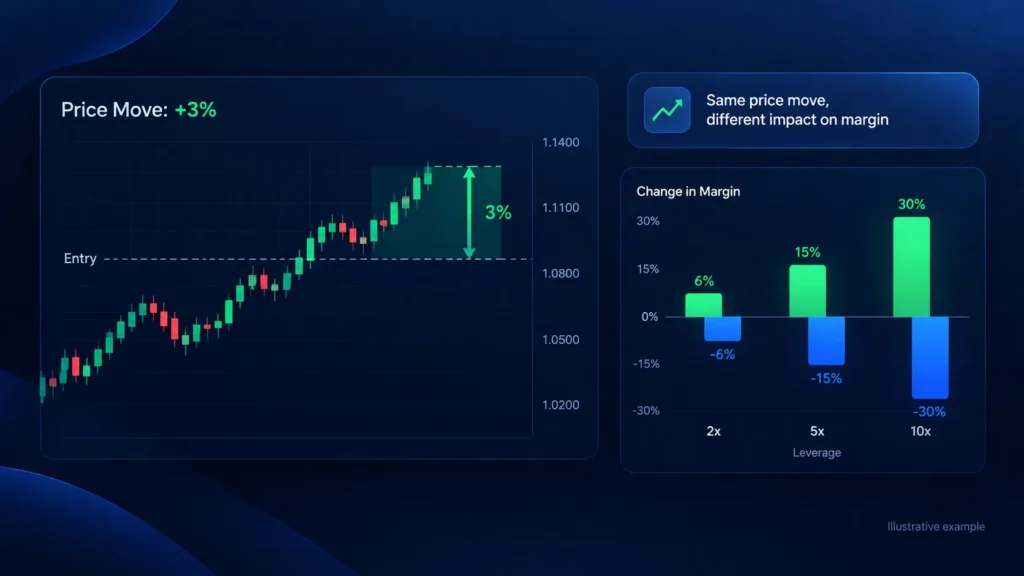
The relationship between price movements, leveraged exposure and return on margin is arithmetic, and it works in both directions. ESMA has noted that leverage can make losses so rapid that some people have ended up owing large sums to providers. The following sections present favorable and unfavorable scenarios in a balanced way.
Relationship Between Leverage and Market Exposure
Leverage changes the notional value of a position without changing the underlying asset’s percentage price movement. If Bitcoin moves 2%, the asset has moved 2% regardless of leverage, but the equity of a 10x position changes by roughly 20% of margin. A small market movement can therefore produce a comparatively large change in account equity.
Potential Returns Under Different Leverage Ratios
Consider an identical hypothetical scenario: 1,000 units of margin and a 3% favorable price move. At 2x leverage, gross profit is about 60 units, or 6% of margin. At 10x leverage, gross profit is about 300 units, or 30% of margin. An adverse 3% move reverses these figures into losses of the same size.
Gross profit or loss differs from return on margin and from net results. Trading fees, borrowing interest and funding payments reduce or add to the final outcome, so net results can diverge noticeably from headline figures. These examples are illustrative rather than predictive, and past performance does not guarantee future results.
How Small Price Movements Amplify Losses
Adverse price movements consume margin faster as the leverage ratio rises. A 5% decline against a 20x position corresponds to a notional loss equal to the entire margin, while the same decline against a 2x position corresponds to a 10% loss of margin. Drawdowns are therefore deeper at higher ratios.
In some market conditions, most or all committed collateral may be lost before a price recovers. Losses may exceed initial expectations, particularly when volatility is high. A position closed by a platform does not participate in later rebounds, and a recovery in price does not restore collateral that has already been liquidated.
Margin Requirements and Liquidation in Crypto Trading
Margin requirements determine whether leveraged positions can remain open as prices fluctuate. Rules differ by exchange and jurisdiction. For regulated retail CFDs in Europe, ESMA’s measures included a margin close-out rule set at 50% of minimum required margin, which illustrates how formal thresholds can trigger closure. The sections below describe the mechanisms conceptually.
Initial Margin and Maintenance Margin
Initial margin is the collateral required to establish a position, while maintenance margin is the minimum equity required to keep it open. Both depend on position size, leverage ratio and exchange schedules. Larger positions often fall into higher tiers, where maintenance requirements may represent a bigger share of equity.
Factors that commonly influence these thresholds include:
- The chosen leverage ratio and total position size
- The volatility and liquidity of the underlying crypto asset
- The exchange’s tiered maintenance margin schedule
- The collateral type and how its value is assessed
Liquidation Price and Forced Position Closure
Liquidation occurs when a platform automatically closes a position because margin has fallen below the required maintenance threshold. The liquidation price is the market price at which that threshold is reached. Fees, maintenance requirements and market conditions all affect where it sits, so simplified estimates do not capture every platform’s rules.
In a simplified calculation, a 10x long position opened at a price of 100 might approach liquidation near 90. Exchanges such as Binance, Kraken, OKX and Bybit may apply different maintenance schedules and fee treatments, so actual liquidation levels can differ from textbook figures. Margin call procedures also vary between providers.
Isolated Margin vs. Cross Margin
Isolated margin allocates collateral to an individual position, so a loss is generally limited to the margin assigned to that position. Cross margin allows eligible account collateral to support multiple positions, which can delay liquidation but exposes a wider portion of account funds. The two modes differ in collateral exposure rather than in price sensitivity.
Under cross margin, a loss in one position can reduce the funds available to support others. Under isolated margin, other collateral typically remains separate. Each approach involves trade-offs, and platform rules determine how collateral, unrealized profit and loss, and liquidation are calculated. Understanding these differences is part of basic margin literacy.
Major Risks of Leveraged Crypto Trading
Leverage is particularly consequential in cryptocurrency markets because of price volatility, liquidity conditions and platform-related risks. The FCA concluded that volatility and valuation difficulty place retail consumers at high risk of losses from crypto derivatives. Wider discussion of crypto trading risk management generally covers these categories.
Crypto Volatility and Sudden Price Swings
Rapid price changes, liquidity fluctuations and unexpected market events can intensify leveraged losses. A short-lived move of a few percentage points may trigger liquidation at high leverage even if the price later returns to its previous level. Volatile crypto market conditions can therefore close a position before any recovery occurs.
Liquidation Cascades and Market Liquidity
Forced closures of long positions create selling pressure, and forced closures of short positions create buying pressure. During volatile periods, this can contribute to additional price movement. Thin order books, slippage and clustered liquidation levels may amplify the effect, although not every liquidation produces a cascade. Historically, sharp crypto sell-offs have often coincided with large liquidation volumes.
Borrowing Costs, Funding Rates and Counterparty Risk
Interest on borrowed assets differs from funding payments. Interest accrues on borrowed cryptocurrency in margin trading, while funding payments are periodic transfers between long and short holders of perpetual futures. Both recurring costs can influence net results, particularly when positions stay open for extended periods, and their size varies with market conditions.
Counterparty risk adds further exposure. Exchange outages, custody failures, insolvency or smart-contract vulnerabilities may restrict access to collateral or prevent a position from being adjusted. These platform-related risks are separate from price risk, and they may apply even when price movements are modest.
Crypto Leverage Trading Instruments and Market Mechanics
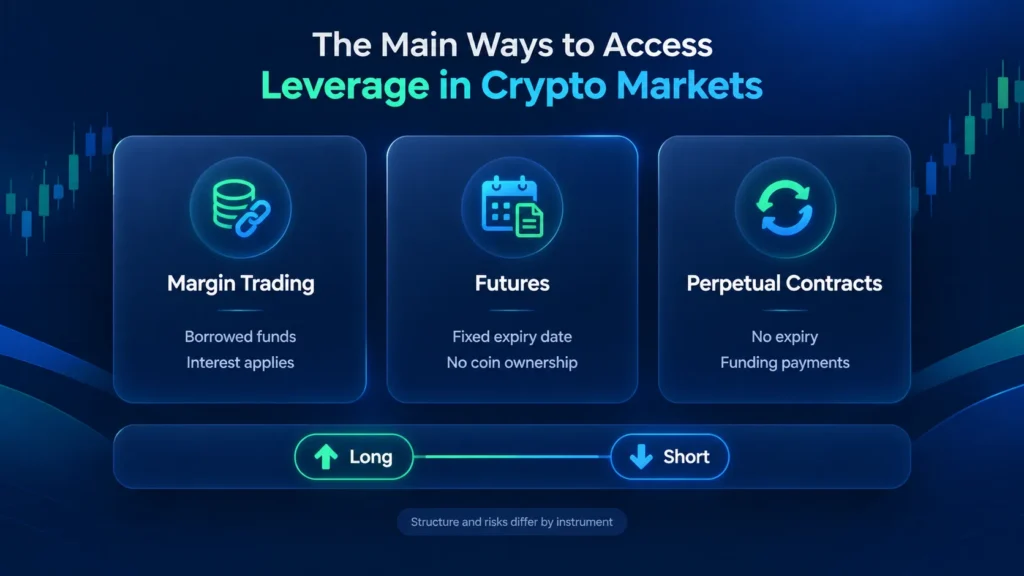
Leverage in cryptocurrency markets is accessed through several instruments, each with a distinct structure, settlement method and risk profile. Availability depends on jurisdiction. In the United Kingdom, for example, the FCA’s rules, in effect since January 2021, prohibit the sale of derivatives such as CFDs, options and futures referencing certain unregulated cryptoassets to retail consumers. Regulatory status can change over time.
Margin Trading and Borrowed Cryptocurrency
Margin trading crypto uses collateral to borrow funds or assets and increase exposure in spot markets. The borrower owes the borrowed amount plus interest, and collateral is valued at market prices that change continuously. Holding an asset and owing borrowed funds are different positions, and falling collateral value can lead to a margin call.
Futures and Perpetual Contracts
Crypto futures trading provides exposure to cryptocurrency prices through contracts, without necessarily requiring ownership of the underlying asset. Dated futures have expiration dates, whereas perpetual contracts have none and use funding payments to help keep contract prices aligned with spot prices. Options trading and other crypto derivatives offer further forms of leverage with different payoff structures.
Long Positions vs. Short Positions
A long position benefits from upward price movements, while a short position benefits from downward movements. Leverage amplifies losses in either direction. Short positions may face additional pressure during sharp price increases, because potential losses are theoretically unlimited as prices rise and forced closures can add buying pressure. Some market participants describe short exposure as a hedge against holdings elsewhere in a portfolio.
Factors That Influence Leverage Trading Outcomes
Outcomes depend on conditions beyond the headline leverage ratio. ESMA’s retail CFD measures illustrate this: regulators agreed a 2:1 limit for CFDs referencing cryptocurrencies, reflecting how volatility differs by underlying asset, with higher limits applied to relatively more stable markets.
Asset Volatility and Liquidity Conditions
Volatility affects the speed at which account equity changes, while liquidity influences the execution prices available when positions open or close. Highly traded assets such as Bitcoin typically have deeper order books than smaller coins. In thinner markets, even a moderate order may move prices, which can increase slippage and liquidation risk.
Trading Fees, Funding Payments and Slippage
Transaction fees, periodic funding payments, borrowing interest and execution differences all affect net performance. Gross returns can differ significantly from final results, particularly when positions remain open for extended periods. The list below summarizes the main cost categories commonly associated with leveraged crypto trading.
- Trading fees charged when an order is opened or closed
- Funding payments exchanged periodically on perpetual contracts
- Borrowing interest on assets lent for margin trading
- Slippage between the expected and executed price of a market order
Exchange Rules and Leverage Limits
Maximum leverage, maintenance margin schedules, collateral eligibility, liquidation procedures and regional product availability differ between platforms. Two exchanges may therefore produce different outcomes for similar positions. Commonly described differences include:
- Maximum leverage ratios, which may be lower for retail clients in regulated jurisdictions
- Maintenance margin schedules and tier thresholds
- Collateral types accepted and their valuation
- Liquidation methods, such as partial or full closure
Frequently Asked Questions About Crypto Leverage Trading
What Is Leverage Trading in Crypto?
Leverage trading in crypto means gaining exposure to a cryptocurrency position that exceeds the margin committed. Collateral supports the position, and leverage multiples such as 5x or 10x determine its size relative to that collateral. Leverage amplifies gains and losses alike, so outcomes may differ sharply from those of unleveraged holdings.
How Does 10x Leverage Work in Crypto?
At 10x leverage, margin supports exposure roughly ten times its size, before fees and platform requirements. A 1% move in the asset price corresponds to approximately a 10% change in gross position value relative to initial margin, with direction determining profit or loss. A 1,000-unit margin therefore supports a 10,000-unit position.
Can Crypto Leverage Trading Increase Potential Returns?
Leverage increases the percentage impact of price movements on committed margin, so favorable movements may produce larger percentage returns. However, higher exposure does not guarantee profit and can magnify losses just as quickly as gains. Fees, funding costs and liquidation may also reduce final results below gross figures.
Can You Lose All Your Money With Crypto Leverage?
Yes, liquidation can consume some or all collateral allocated to a position. Whether losses can exceed initial margin depends on the instrument, platform rules, account structure and applicable negative-balance protections. Some jurisdictions require such protections for retail products, while others do not, so terms differ between providers.
What Happens When a Leveraged Crypto Position Is Liquidated?
When margin falls below the maintenance level, the platform may automatically close the position. Remaining collateral, if any, depends on execution prices, fees and the applicable liquidation mechanism. Some platforms use insurance funds or partial liquidation, while others close the entire position, so outcomes vary by exchange.
What Is the Difference Between Leverage and Margin?
Leverage expresses the relationship between position exposure and collateral, such as 10x, while margin is the collateral committed to support the position. The two are linked by the relationship Margin = Position Size / Leverage. Leverage describes the multiple, whereas margin describes the funds, so each addresses a different aspect of leveraged trading.