Crypto Futures Trading: Contracts, Funding, Expiry, and Liquidation Risk

Crypto futures trading allows market participants to gain exposure to cryptocurrency price movements through derivative contracts rather than direct ownership of digital assets. Cryptocurrency futures link contract value to the price of the underlying asset, such as Bitcoin, while funding payments, expiry dates, leverage, margin, and liquidation rules shape how each contract operates.
This beginner’s guide covers everything you need to know about how crypto futures trading works, from contract mechanics to risk. Readers familiar with spot crypto trading will notice that futures introduce extra variables that can influence costs, market exposure, and potential losses. Past performance does not guarantee future results, and losses may exceed initial expectations.
Key Takeaways
- Crypto futures allow exposure to cryptocurrency price movements through derivative contracts.
- Perpetual futures have no scheduled expiry, while dated futures settle at a specified time.
- Funding payments help align perpetual futures prices with spot-market prices.
- Initial margin and maintenance margin serve different purposes in leveraged positions.
- Liquidation can occur when account equity no longer meets required margin conditions.
- Contract specifications, settlement mechanisms, and exchange rules influence the risks associated with futures.
What Are Crypto Futures Contracts?
A crypto futures contract is a standardized derivative and a financial instrument whose value depends on the price of an underlying crypto asset. The contract creates price exposure rather than ownership of the digital asset. Derivatives markets, which also include options and traditional stock or commodity futures, use such agreements for speculation, hedging, and price discovery.
How Crypto Futures Contracts Work
Futures are contracts to buy or sell an asset at a predetermined price and date, and crypto versions apply the same logic to digital assets. Each contract pairs a long position with a short position. Settlement terms, including price, size, and timing, depend on the specific contract and exchange.
Participants who go long, meaning they take a long position, may gain when the contract price rises, while holders of a short position may gain when the price falls. Changes in the price of the underlying asset create unrealized profit or loss while a position is open, and realized profit or loss once closed.
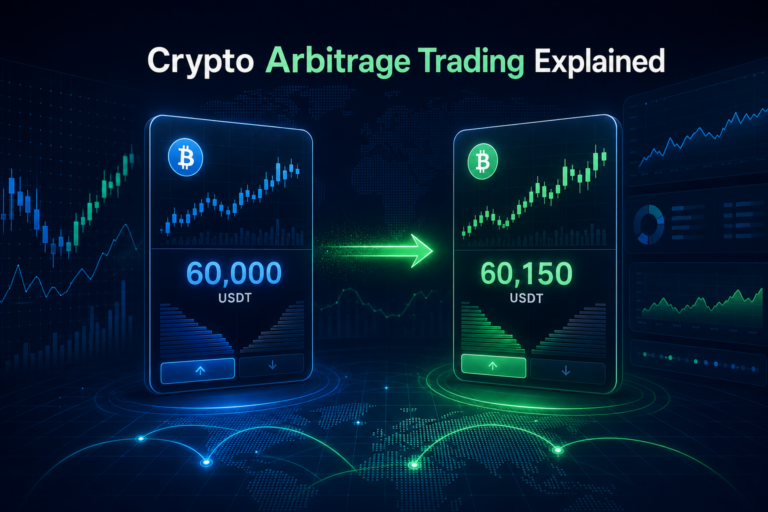
For example, a Bitcoin futures contract covering 1 Bitcoin priced at 60,000 USD changes in value by 1,000 USD when the price moves by 1,000 USD, before fees and funding. Perpetual and dated versions apply the same arithmetic, although holding costs differ between the two contract types, as later sections explain.
Perpetual Futures vs Traditional Futures
Perpetual futures and traditional futures both track an underlying cryptocurrency, yet the two contract types differ in duration and price alignment. Perpetual contracts have no expiration, and funding payments perform the alignment role, whereas dated futures rely on an expiry-based settlement date. The table below summarizes the main structural differences between the two formats.
| Feature | Perpetual Futures | Traditional (Dated) Futures |
| Duration | No scheduled expiry | Fixed expiry date |
| Price alignment | Funding payments between long and short holders | Convergence toward spot price at expiry |
| Settlement | Position closed by the holder or by liquidation | Settled at expiry in cash or by delivery |
| Holding costs | Recurring funding payments | Basis between futures and spot price |
| Rollover | Not required | Replacement with a later contract if exposure continues |
Price convergence refers to the tendency of a futures price to approach the spot price as the settlement date nears. Perpetual futures lack a settlement date, so exchanges apply funding payments to encourage alignment with spot reference prices. Dated contracts rely on the approaching expiry itself, which obliges the contract price to match the settlement index.
Contract Specifications and Settlement Types
Contract specifications define the economic terms of a futures contract. Contract size states how much of the underlying asset one contract represents, while the quote currency states the denomination of price. Collateral currency is the asset posted as margin, and settlement currency is the asset in which profit and loss are credited.
- Linear contracts: quoted and margined in a stablecoin such as USDT, so collateral value stays relatively stable.
- Inverse contracts: margined and settled in the underlying cryptocurrency, so collateral value moves with the market.
- Cash settlement: final value is paid in currency without delivery of the asset.
- Physical settlement: the underlying cryptocurrency is delivered at expiry.
These specifications determine economic exposure and obligations. A contract margined in the underlying cryptocurrency, for instance, can experience collateral value changes alongside position value changes. Crypto exchanges such as Binance and BuyUcoin publish product terms for listed instruments, and terms may differ across platforms, so the documented terms of each contract define the applicable rules.
Funding Rates in Crypto Futures
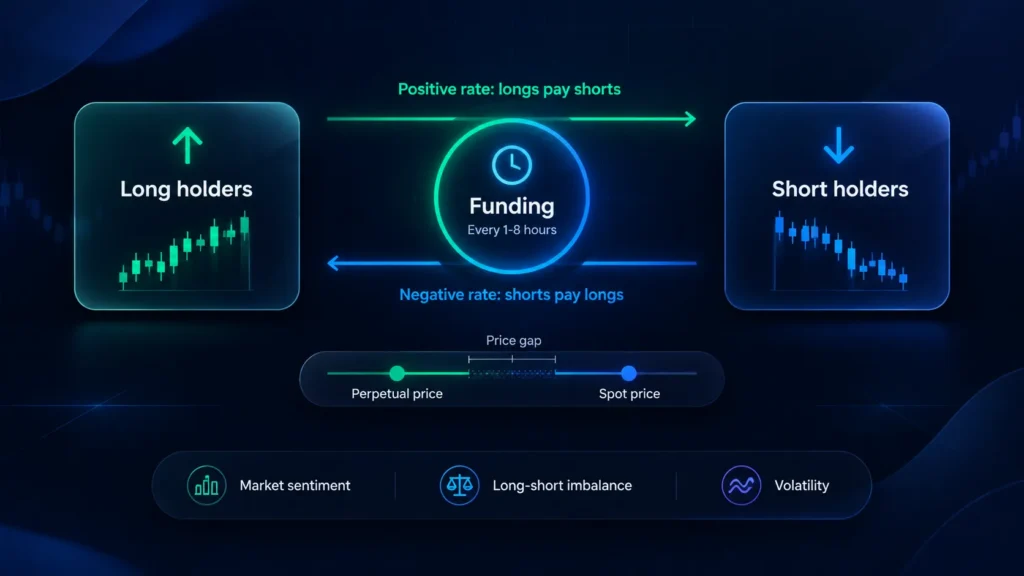
Funding rates are periodic payments exchanged between long and short holders of perpetual futures. The payment mechanism links perpetual contract prices to spot-market reference prices and can change direction as market conditions shift. Because funding recurs at set intervals, funding can influence the cost of maintaining a position, particularly over longer holding periods.
How Funding Rates Work
A positive funding rate typically means long position holders pay short position holders, which often occurs when the perpetual contract trades above the spot reference price. A negative funding rate typically reverses the direction, with short position holders paying long position holders. Payment direction depends on the contract’s specific funding rules.
Funding calculations in cryptocurrency futures commonly combine an interest component with a premium component, where the premium reflects the gap between the perpetual price and the spot index. For example, a funding rate of 0.01 percent on a 10,000 USD position equals a 1 USD payment for that interval. Exact formulas and intervals vary by exchange.
Factors That Influence Funding Rates
Funding rates fluctuate with market conditions, and calculation intervals vary across platforms and contracts, commonly ranging from one to eight hours. Analysts often associate several recurring factors with changes in funding levels. The list below describes the most frequently cited influences on funding for perpetual contracts in simplified terms.
- Market sentiment: strongly bullish positioning may be associated with positive funding.
- Long-short imbalance: uneven demand on one side of the market can widen the gap between perpetual and spot prices.
- Futures premiums or discounts: the difference between perpetual and spot reference prices feeds the premium component.
- Volatility: sharp price swings can change funding levels quickly.
- Exchange methodology: caps, floors, and intervals differ across platforms.
Historically, funding rates have often remained small during quiet periods and have changed more noticeably during sharp rallies or declines, according to some analysts. Funding data therefore serves as one indicator of positioning, though funding alone cannot predict price direction. Technical analysis tools sometimes incorporate funding data alongside volume and open interest.
Funding Costs and Their Effect on Positions
Recurring funding payments can accumulate over time and change the net outcome of a position independently of price movement. At 0.01 percent every eight hours, a 10,000 USD position would pay or receive roughly 3 USD per day, or about 90 USD over 30 days, assuming the rate stays constant, which rarely occurs in practice.
Funding payments differ from trading commissions and other exchange charges. Commissions are fees paid to the exchange when orders are executed, whereas funding payments move between traders holding opposite positions. Other costs may include withdrawal fees and spread costs, so total holding expense depends on the combined fee structure of the platform.
Crypto Futures Expiry and Settlement
Fixed-expiry futures contracts reach maturity on a date defined in the contract specifications, at which point settlement occurs according to a published methodology. Perpetual futures, by contrast, operate continuously without a scheduled maturity. The distinction affects liquidity patterns, price convergence, and the obligations attached to each position as expiry approaches.
Futures Expiration Dates and Contract Cycles
Exchanges list dated futures on weekly, monthly, quarterly, or other schedules, and each contract specification defines the exact expiry time. Quarterly Bitcoin futures, for instance, commonly settle on the last Friday of March, June, September, and December on some platforms. Schedules vary by exchange and product, so published calendars define applicable dates.
Different maturities can represent different market exposures. A contract expiring in one month and a contract expiring in six months may trade at different prices, because each reflects expectations, funding conditions, and demand for exposure over a different time horizon. The price difference between maturities is often described as part of the term structure.
Cash Settlement vs Physical Delivery
Cash settlement pays the final contract value in currency, with no transfer of the underlying cryptocurrency. Physical delivery transfers the actual digital asset between counterparties at expiry. Many crypto futures offered on major derivatives platforms are cash-settled, although contract terms differ and the specific product documentation defines the applicable method.
Settlement price is commonly derived from a reference index that averages prices from several spot exchanges, often over a short window before expiry. Index-based pricing reduces the influence of a single exchange’s price spike on final settlement. Contract-specific rules determine the index components, the averaging window, and the final settlement value.
Expiry Risk and Futures Rollover
Approaching expiry can affect liquidity, as trading activity often migrates toward later-dated contracts, and price differences between maturities can change. Positions that remain open at expiry are settled according to contract rules. In some market conditions, the timing of settlement can therefore influence outcomes for participants holding exposure through that date.
Rollover is the replacement of an expiring contract with a later-dated contract to maintain similar exposure. Rollover may involve additional transaction costs, since both the closing and opening of positions incur fees and spreads. Basis differences between the two contracts can also create a cost or gain unrelated to the underlying cryptocurrency price.
Leverage, Margin, and Liquidation Risk
Leverage and margin are core components of crypto futures markets. Margin is the collateral supporting a position, and leverage describes how many times larger the position is than that collateral. Adverse price movements reduce account equity and may trigger forced liquidation. In 2018, the European Securities and Markets Authority consulted on retail leverage limits and margin close-out rules.
Initial Margin vs Maintenance Margin
Initial margin is the collateral requirement for opening a leveraged position, while maintenance margin is the minimum equity required to keep the position open. Initial margin is typically higher than maintenance margin. The gap between the two creates a buffer before forced closure occurs, in simplified terms, though exact buffers vary by platform.
Margin requirements can vary with position size, exchange rules, and risk tiers, with larger positions often facing higher maintenance requirements. Concepts used in margin trading crypto also apply to futures, where isolated margin limits collateral to a single position and cross margin shares account balance across positions. Margin mode therefore influences exposure.
How Leverage Amplifies Gains and Losses
Leverage allows traders to control a larger notional position with a smaller deposit, which increases both potential gains and potential losses. In leverage trading crypto, the relationship can be written as Margin = Position Size / Leverage. A 10,000 USD position at 10x leverage requires about 1,000 USD in margin, before fees.
Futures also enable leverage-based exposure that can allow traders to speculate on the future price of cryptocurrencies with a smaller deposit. A 10 percent adverse move on the 10,000 USD position equals a 1,000 USD change, roughly the entire margin, so a small percentage move in the underlying market can produce a much larger percentage change in margin.
How Liquidation Works in Crypto Futures
Liquidation is the process through which an exchange forcibly reduces or closes a position when margin requirements are no longer satisfied. Unrealized losses reduce account equity, and when equity approaches the maintenance margin, the platform may begin closing the position, either partially or fully, under its own published liquidation rules.
Available collateral, position size, and platform-specific procedures determine the liquidation price. Some exchanges maintain insurance funds to cover shortfalls when positions close at prices worse than the bankruptcy level, while others use loss-allocation mechanisms. Liquidation fees may also apply, which can reduce any remaining collateral further. Liquidation thresholds therefore differ between products.
Mark Price vs Last Traded Price
Mark price is a reference valuation that many derivatives platforms use to calculate unrealized profit and loss and liquidation thresholds. Mark price is often derived from a spot index combined with a funding-based adjustment. The last traded price, by contrast, is the price of the most recent executed trade on the contract’s order book.
The two prices can differ, particularly during volatile or illiquid conditions, when a single large order can move the last traded price sharply. Using mark price for liquidation checks is generally described as a method to limit liquidations triggered by brief price spikes, although the method does not remove liquidation risk.
Main Risks Associated With Crypto Futures
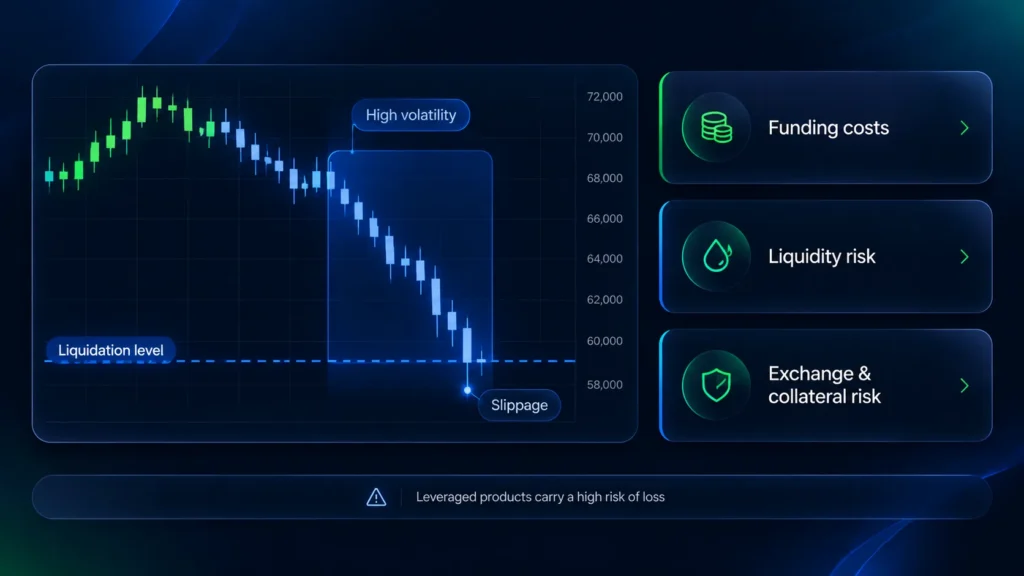
The risks of crypto futures trading combine the volatility of cryptocurrency markets with the structural features of leveraged derivatives. Understanding the benefits and risks of crypto derivatives starts with identifying categories such as market volatility, funding expenses, liquidity constraints, technical disruptions, and platform-specific settlement or liquidation rules. Frameworks for crypto trading risk management typically begin there.
Volatility and Rapid Liquidation
Sharp price movements and sudden liquidity changes can accelerate losses and trigger liquidation. Cryptocurrency prices have historically moved by double-digit percentages within a single day, a pattern that magnifies the effect of leverage. Past performance does not guarantee future results, but historical volatility is frequently cited in discussions of derivative risk.
Slippage is the difference between the expected reference price and the actual execution price, which can widen when order books are thin. Risk management strategies described in educational materials include setting stop-loss orders, which are conditional orders that close positions at a trigger level, although such orders can also experience slippage.
Funding, Basis, and Liquidity Risk
Persistent funding payments can raise holding costs over time, particularly when funding remains one-directional for extended periods. Basis, the difference between futures and spot prices, can widen or narrow, affecting both dated contracts and perpetual contract premiums. Arbitrage activity, in which participants exploit price gaps between markets, is commonly associated with keeping those differences in range.
Market liquidity describes the depth of resting orders available near the current price. Limited market depth can complicate contract execution or settlement, since larger orders may move prices materially. Trading volume and open interest figures are often reviewed as indicators of liquidity, though high volume alone does not guarantee that orders can be executed at expected prices.
Exchange, Collateral, and Systemic Risk
Exchange-related risks extend beyond price movement and vary by platform and jurisdiction. Regulation of crypto derivatives differs widely between countries, and some jurisdictions restrict retail access to leveraged crypto products entirely. The list below outlines frequently discussed categories for derivatives platforms, including operational and financial exposure.
- Exchange outages: technical disruptions may delay order execution during volatile periods.
- Counterparty exposure: collateral held on a platform is exposed to the platform’s solvency and default risk.
- Collateral devaluation: collateral held in cryptocurrency can lose value while a position is open.
- Stablecoin risk: stablecoins used as collateral can lose their peg to the reference currency.
- Insurance funds and loss allocation: coverage of shortfalls is limited and differs by platform.
Regulatory attention to leveraged retail products reflects these concerns. National authorities’ analyses of CFD accounts, summarized by FinanceFeeds, found that 74 to 89 percent of retail accounts typically lose money. Crypto futures differ structurally from CFDs, yet the figures illustrate the loss risk associated with leveraged retail trading in general.
Crypto Futures vs Spot Trading
The benefits of trading futures, such as short exposure and capital efficiency, come with added considerations, and the differences from spot markets explain why futures require attention to leverage, margin, funding, and liquidation. Spot trading generally involves exchanging money for the cryptocurrency itself. Futures involve contractual exposure with obligations that continue until the position is closed, settled, or liquidated.
Ownership, Leverage, and Short Exposure
Spot purchases generally involve owning the underlying assets, such as Bitcoin, whereas futures create contractual exposure without owning the underlying assets. Short exposure is typically available in futures through short positions, while spot markets generally require holding the asset first. Leverage is common in futures, but limited or absent in standard spot transactions.
Costs, Flexibility, and Risk Differences
Spot trading mainly involves transaction fees, while futures can add trading fees, funding payments, borrowing costs where applicable, and expiry requirements. Both markets involve price risk, but liquidation risk exists only in leveraged structures. The comparison below summarizes the main differences, and risk depends on the instrument’s structure and the terms of the transaction.
| Feature | Spot Trading | Crypto Futures |
| Ownership | Direct ownership of the cryptocurrency | Contractual exposure without ownership |
| Leverage | Generally none or limited | Commonly available |
| Short exposure | Generally requires owning or borrowing the asset | Available through short positions |
| Costs | Transaction fees | Trading fees, funding payments, spreads |
| Expiry | None | Dated contracts expire; perpetuals do not |
| Liquidation | Not applicable to unleveraged purchases | Possible when margin requirements are not met |
Frequently Asked Questions About Crypto Futures
Readers who have started with crypto futures trading often ask a similar set of questions. The answers below provide concise definitions for common informational queries, summarizing each concept without repeating full sections. Contract terms, margin rules, and funding formulas vary by exchange, so product documentation from the relevant platform remains the primary reference for specific contract details.
What Are Crypto Futures Contracts?
Crypto futures contracts are derivative agreements whose value is linked to the price of a cryptocurrency such as Bitcoin. In simple terms, the contract provides price exposure rather than ownership of the digital asset. Specific terms, including contract size, settlement method, and margin rules, differ by exchange and by product.
What Is the Difference Between Perpetual Futures and Expiring Futures?
Perpetual futures have no scheduled expiry, while expiring futures settle on a specified date. Perpetual contracts use funding payments to stay aligned with spot prices, whereas dated contracts converge toward spot through settlement at maturity. Dated contracts may require rollover for continued exposure, while perpetual positions remain open until closed or liquidated.
Why Do Crypto Futures Have Funding Rates?
Funding rates exist to keep perpetual futures prices close to the spot-market reference price. Because perpetual contracts lack an expiry date, periodic payments between long and short holders create a financial incentive for the contract price to move toward spot. The mechanism reduces, but does not eliminate, price gaps.
Can Crypto Futures Positions Be Liquidated?
Yes, leveraged crypto futures positions can be liquidated. An exchange may forcibly close a position when account equity or position margin falls below the applicable maintenance requirement. Liquidation prices depend on leverage, collateral, and platform rules, and in fast markets, actual closing prices can differ from expected levels.
What Is the Difference Between Initial Margin and Maintenance Margin?
Initial margin is the collateral required to open a leveraged position, while maintenance margin is the minimum equity needed to keep the position open. Initial margin is usually larger. If equity drops toward the maintenance level, the platform may issue a margin call or begin liquidation, depending on its rules.
Does Every Crypto Futures Contract Have an Expiry Date?
No, not every crypto futures contract has an expiry date. Traditional futures settle on a specified expiry, whereas perpetual contracts have no expiration date and are designed without a scheduled maturity. Perpetual positions can remain open indefinitely, although exchanges may adjust or delist products under their rules.
Can Funding Rates Be Negative?
Yes, funding rates can be negative. A negative funding rate generally means short position holders pay long position holders, which often occurs when the perpetual contract trades below the spot reference price. Payment direction and calculation intervals remain subject to the specific contract’s funding rules.